
14 min 57 sec
Available in: English
Think Like a Rocket Scientist: Simple Strategies You Can Use to Make Giant Leaps in Work and Life
By Ozan Varol
Shows how rocket scientists think, from first principles to brutal testing, so you can come up with original ideas, frame problems correctly and catch costly mistakes before they catch you.
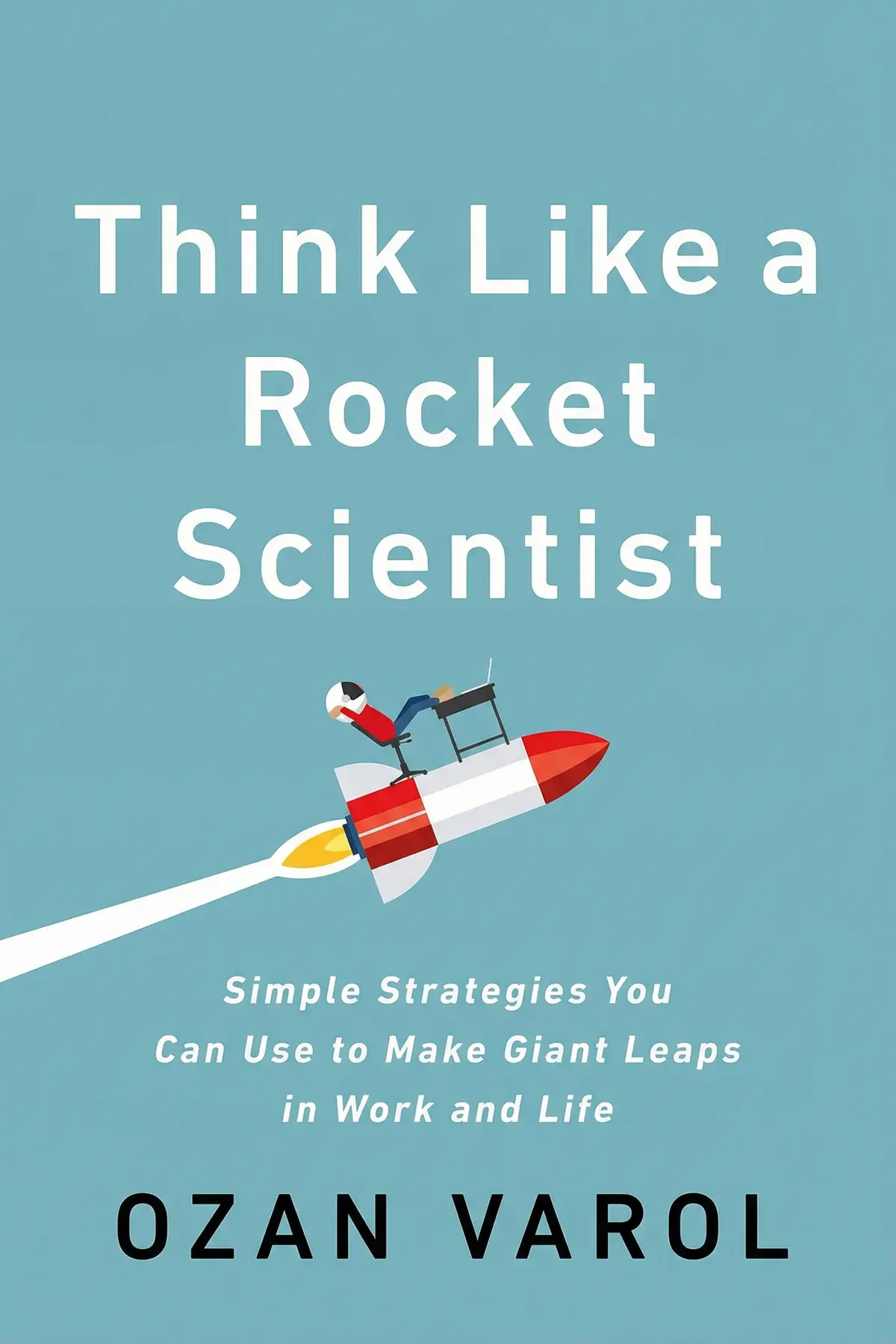
Table of Content
1. Introduction
1 min 03 sec
Most people who stall on a big goal assume they lack the talent or the money. In Think Like a Rocket Scientist, Ozan Varol, who helped run operations for NASA’s 2003 Mars rover mission, argues that what they usually lack is a way of thinking, and that it can be learned. Even engineers at NASA’s Jet Propulsion Laboratory eat peanuts at launches for luck, so nobody starts out at ease with the unknown.
Varol’s method has two halves. First, open up: treat uncertainty as something to explore, strip problems down to what is truly fixed, give your mind empty time and ask a better question. Then turn hard on your own ideas: hunt your blind spots, test until things break and study what went wrong even when things went right. Elon Musk’s rocket math, a Mars lander saved by airbags and a $193 million mix-up over units all become methods for the stuck problem on your own desk.
2. Turn fear of the unknown into curiosity
1 min 34 sec
Some of the most rigorous engineers on Earth rely on a lucky snack at every launch. Their habit shows why uncertainty unsettles everyone, and how a few written lines can shrink a fear that keeps you on familiar ground.
3. Rebuild any stuck problem from first principles
1 min 32 sec
Elon Musk was ready to abandon his space company because rockets cost too much. A short chain of plain questions changed the math, and the same chain works on routines nobody has examined in years.
4. Protect the empty time where ideas grow
1 min 40 sec
Einstein and Tesla did some of their most important work without touching any equipment. Their method needs no lab, but it does need one thing modern offices are very good at destroying.
5. Silence your inner critic while ideas flow
1 min 34 sec
A myth about wax wings still shapes how adults judge their own chances. One space company answered that kind of caution in an unexpected way, by hiring someone whose job was to imagine the impossible.
6. Ask the right question to find a better answer
1 min 35 sec
When a Mars landing system failed, the young Varol rushed to repair it. A colleague asked something different and ended up with a design nobody expected, one that bounced its way onto another planet.
7. Treat your opinions as hypotheses to break
1 min 44 sec
Two months before arrival, the data warned that a Mars spacecraft was in trouble. The team explained the warning away, and the reason they did is a habit every one of us carries into meetings.
8. Rehearse where the real test will happen
1 min 35 sec
Astronaut training is designed to make astronauts fail, on purpose and often. A comedian uses the same logic on small stages. Both expose a common mistake in how people prepare for a big day.
9. Find the mistakes hiding inside your successes
1 min 26 sec
Thousands of failed prototypes produced one famous vacuum cleaner. A string of successful launches produced one of spaceflight’s worst disasters. Varol explains why the second lesson is the one people tend to miss.
10. Conclusion
1 min 14 sec
Varol’s book argues that what looks like rocket-science genius is mostly a temperament anyone can practice. It moves between two moods. One is generous with possibility: curious in the dark room, unimpressed by tradition, comfortable with boredom, willing to picture reaching space without a rocket. The other is hard on its own work: suspicious of comfortable data, eager to find the breaking point, wary of a winning streak. Breakthroughs need both. Openness alone produces ideas that crash, and criticism alone leaves nothing worth testing.
You can start with whatever problem has you stuck right now. Write down the worst case and how likely it really is. Ask what you are truly trying to achieve, the way Mark Adler set the broken legs aside and asked how to land the rover at all. Before you commit, argue against your favorite answer as if a rival had proposed it. And when you hit a wall, Varol’s own advice is simple: put on your shoes and take a long walk, a habit that helped Darwin, Tesla and Heisenberg.
The orbiter that vanished behind Mars sent its warning two months early. Thinking like a rocket scientist means being the one who listens.
About this book
What is this book about?
Many people quietly lower their ambitions because they think breakthroughs belong to geniuses or to people with money to spare. Ozan Varol, who worked on operations for NASA's 2003 Mars rover mission before becoming a law professor, argues that what separates people who make giant leaps from everyone else is mostly how they approach problems. He takes that approach apart using stories from space exploration and beyond. Elon Musk worked out that a rocket's raw materials cost a small fraction of its price. An engineer saved a Mars landing by asking a different question. A $193 million orbiter was lost because nobody questioned strange data, and the Challenger disaster grew out of a habit that had always worked before. Readers learn two sets of tools. The first opens the mind: facing uncertainty, first principles thinking, thought experiments, boredom and divergent thinking. The second keeps it honest: separating strategy from tactics, treating opinions as hypotheses, testing in realistic conditions and examining successes as carefully as failures. Together they give you a way to tackle a stuck problem at work or in life.
Book Information
Who it's for
Professionals wanting original ideas
Professionals who keep landing on the same familiar answers and want a method for original ideas.
Founders and team leads
Founders and team leads who need to test plans hard before money and reputations are on the line.
Hesitant about bold goals
Anyone holding back from a bold goal because the unknown feels too risky.
About the Author
Ozan Varol
Ozan Varol was born in Istanbul and moved to the United States alone at 17 to study at Cornell University, where he joined the team handling operations for the 2003 Mars Exploration Rovers mission. He later became a law professor with tenure at Lewis and Clark Law School, coined the phrase democratic coup and wrote The Democratic Coup d'État. He writes about contrarian thinking and has given keynote talks at Microsoft, Salesforce and the US Department of State.
Ratings & Reviews
Ratings at a glance
What people think
Listeners find this book both gripping and enjoyable, offering excellent perspectives on problem-solving and thought processes. They value its practical application in daily life, as one listener points out how it can be applied to both business and personal growth. The writing is excellent and packed with fascinating anecdotes, and listeners find the work highly inspiring; one review highlights how it encourages setting and achieving big goals.
Top reviews
Tom
Ozan Varol manages to demystify complex aeronautical decision-making processes and translate them into actionable life strategies. I particularly resonated with the "Launch" phase of the book, where he discusses the beauty of divergent thinking and the necessity of befriending uncertainty. Instead of the usual corporate fluff, you get these vivid historical vignettes—like the nuances of the Mars Exploration Rover project—that actually serve a purpose. The concept of "backcasting" was a total revelation for me, shifting my perspective from passive forecasting to active planning. It's rare to find a book that feels both intellectually rigorous and genuinely inspiring for personal growth. If you’re looking to break out of conventional mental ruts, this is your roadmap.
Show moreSupatra
Wow. This book completely reframed how I view failure and the "unknown." Varol argues that uncertainty isn't a foe to be conquered but a friend to be embraced, and that hit home for me. I loved the three-part structure—Launch, Accelerate, Achieve—as it gave a clear narrative arc to the mental shift he’s proposing. The specific advice on "adversarial thought experiments" has already helped me troubleshoot a major bottleneck in my creative process. It's captivating, fun, and quite moving in its call to reclaim our childhood sense of wonder and curiosity. I’ve already recommended it to three colleagues who are struggling with professional burnout.
Show morePla
Ever wonder why some people seem to solve impossible problems while others get stuck in the mud? This book provides the answer by breaking down the specific cognitive tools used by rocket scientists to navigate the cosmos. I was particularly impressed by the discussion on "anomalies" and why we shouldn't just brush off data points that don't fit our preconceived notions. As a data analyst, this part spoke directly to my daily work challenges. The book is well-researched, engagingly written, and full of stories that stick with you long after you close the cover. It’s the kind of book you’ll want to keep on your desk for frequent reference.
Show morePranee
This book is a masterclass in how to think more clearly in an increasingly complex world. Varol takes us behind the scenes of NASA's most famous triumphs and tragedies to show that the biggest obstacles aren't usually technical, but psychological. I loved the breakdown of convergent versus divergent thinking and how we often shut down the most creative parts of our brains too early in the process. The writing is elegant and the pacing is excellent, moving quickly between historical facts and modern applications. It’s a rare nonfiction book that I actually enjoyed reading for the prose as much as the content. Highly recommended for anyone wanting to make giant leaps in their life.
Show moreChee
As a project manager who deals with high-stakes deadlines, I found the "Accelerate" section of this book incredibly grounded and practical. Varol uses his background to explain why we should focus on the process rather than just the outcome, which is a hard pill to swallow in today's results-driven culture. While some of the anecdotes about Steve Jobs or Elon Musk felt a bit recycled from other popular psychology books, the way he ties them back to "first principles" thinking is unique. The writing is punchy and accessible, making it an easy read over a weekend. My only minor gripe is that some of the science metaphors feel a bit stretched to fit the self-help mold. Still, it’s a solid resource for anyone wanting to sharpen their problem-solving skills.
Show moreMingkwan
Finally got around to reading this after seeing it all over LinkedIn, and I have to say the hype is mostly justified. Ozan Varol has a gift for taking the high-level logic used by NASA engineers and applying it to everyday dilemmas like choosing a career path or launching a business. I found the section on "test as you fly" to be particularly useful for my own startup experiments. To be fair, there are a few moments where the prose gets a little too close to "hustle culture" jargon, but the core insights are robust. The author's personal story about his time on the Mars Rover project adds a nice touch of authenticity, even if his tenure there was brief.
Show moreOm
The chapter on "first principles" was worth the price of the book alone. Most of us operate on autopilot, using "the way it’s always been done" as our primary guide, but Varol shows why that's a recipe for stagnation. He uses the development of SpaceX rockets as a compelling example of how questioning every constraint can lead to massive breakthroughs. The tone is encouraging without being overly saccharine, and the short, punchy chapters keep the momentum going. I did feel that the middle section dragged a bit with redundant examples, but the "Achieve" section brought it home with some great tips on handling success and staying humble.
Show moreSarocha
After hearing Ozan on a podcast, I was curious to see if his book lived up to his articulate speaking style, and it definitely does. He manages to bridge the gap between hard science and human psychology in a way that feels natural and useful. I found the accompanying exercise book on his website to be a fantastic bonus that helped me apply the concepts of "backcasting" and "pre-mortems" to my own life. While some chapters are definitely stronger than others, the overall package is a great toolkit for anyone looking to upgrade their brain’s operating system. It’s fun, insightful, and surprisingly humble for someone with such an impressive resume.
Show moreNan
Not what I expected given the title, as this is much more of a "mental models" survey than a deep dive into rocket science. Truth is, if you’ve read a lot of Adam Grant or Malcolm Gladwell, many of these concepts will feel like familiar territory. For instance, the discussion on the Challenger disaster and the O-ring issues is a classic case study that has been covered extensively in other books like David Epstein’s Range. I appreciated the author's writing style, but I found myself skimming through the parts that felt like a collection of generic platitudes. It’s a decent entry point for newcomers to the genre, but seasoned readers might find the content a bit derivative.
Show moreKai
Frankly, I found the "rocket scientist" framing to be a bit of a disingenuous hook for what is essentially a standard self-help book. The author worked a short internship at NASA nearly twenty years ago and uses that fleeting experience to justify a title that suggests deep technical expertise. The content relies far too heavily on anecdotal evidence without addressing survivorship bias, which is ironic for a book about scientific thinking. Many of the strategies are just rehashed versions of things I've read in Chip and Dan Heath's work. The constant use of nonsensical hooks and cliches made it a struggle to get through. If you want a rigorous look at decision-making, you're better off reading Daniel Kahneman or Philip Tetlock.
Show moreQuestions about this book
What is the main idea of Think Like a Rocket Scientist?
Ozan Varol argues that breakthroughs depend on mindset more than on intelligence or money. Rocket scientists treat uncertainty as something to explore, question assumptions down to first principles, make time for imagination and ask the right question. Then they turn critical, treating opinions as hypotheses, testing until things break and studying failures, including the ones hidden inside successes. Anyone can practice both halves.
What is first principles thinking in Think Like a Rocket Scientist?
It means questioning every part of a situation, ignoring how things have always been done, until only facts you cannot dispute are left. Varol’s example is Elon Musk, who could not afford a rocket until he reasoned that a rocket is raw materials and found they cost just 2 percent of a typical rocket’s price. To apply it, ask why you do something and question any reason that belongs only to the past.
How does Ozan Varol suggest overcoming confirmation bias?
Varol suggests holding each opinion as a working hypothesis that can be proven, disproven or dropped. Build several competing hypotheses by asking what is missing, then try to knock them down, as if the opinion belonged to someone else. He points to NASA’s Mars Climate Orbiter, lost in 1999 after navigators explained away odd data that came from a mix of metric and inch-pound units.
Who should read Think Like a Rocket Scientist?
It suits knowledge workers, founders and team leads who want fresh ideas and fewer costly mistakes, and anyone who has lowered their ambitions out of fear of the unknown. The tools are practical: a written worst-case exercise, thought experiments, divergent thinking, separating strategy from tactics, rehearsing in realistic conditions like Jerry Seinfeld in small clubs, and reviewing successes as closely as failures.
Readers also enjoyed

59 Seconds: Change Your Life in Under a Minute
Richard Wiseman






A Guide to the Good Life: The Ancient Art of Stoic Joy
William B. Irvine


A High-Performing Mind: Strengthen Your Mind and Live Your Best Life
Andrew D. Thompson
AUDIO SUMMARY AVAILABLE
Listen to Think Like a Rocket Scientist in 15 minutes
Get the key ideas from Think Like a Rocket Scientist by Ozan Varol, plus 5,000+ more nonfiction titles.
- 5,000+ titles
- Listen as much as you want
- 7-day free trial
- Cancel anytime









