

13 min 26 sec
Available in: English
The Worry Trick: How Your Brain Tricks You Into Expecting the Worst and What You Can Do about It
A clinical psychologist explains why arguing with, avoiding or distracting yourself from anxious thoughts makes them stronger. He then gives simple daily practices that shrink worry back to an occasional, manageable visitor.
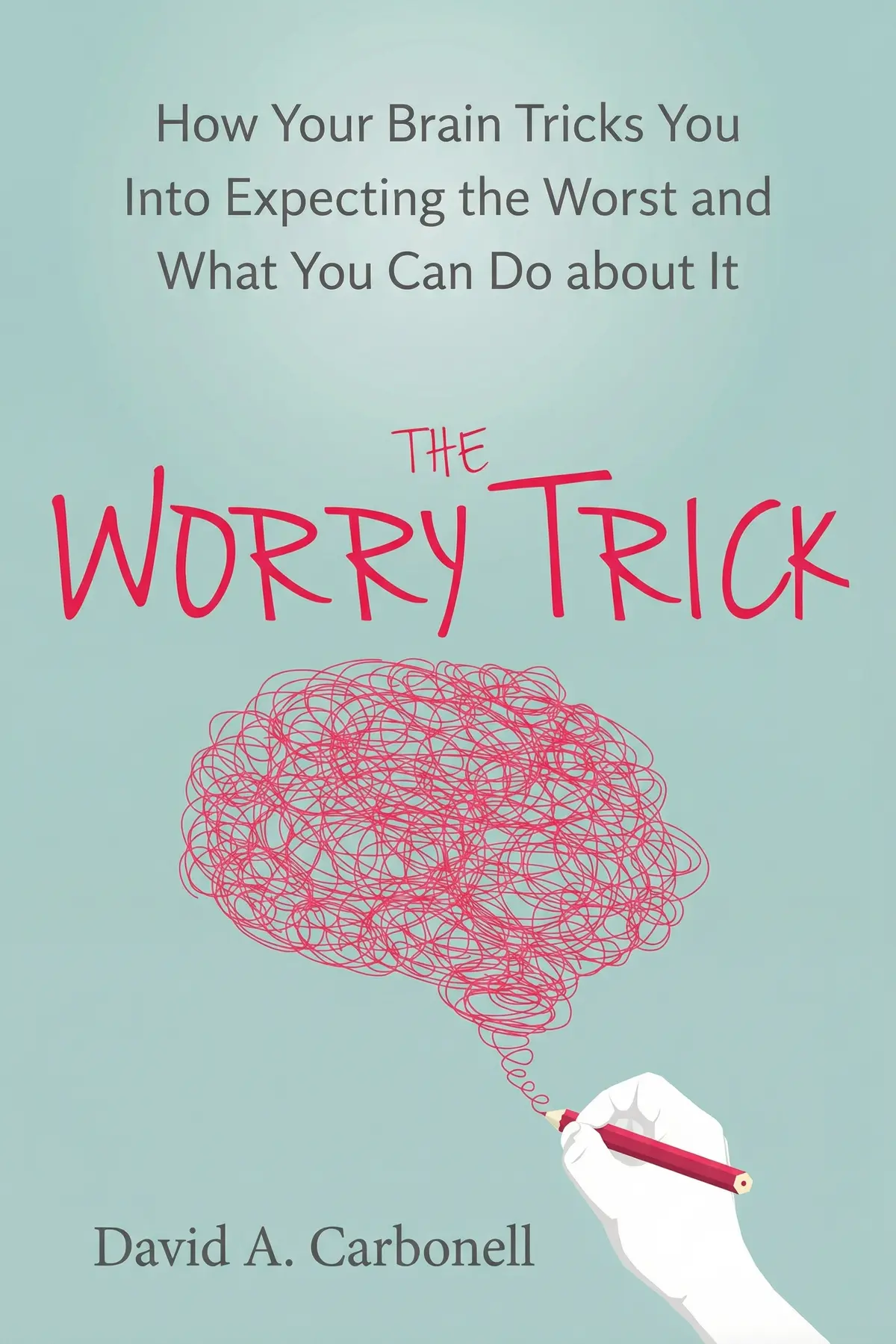
Table of Content
1. Introduction
1 min 02 sec
If worry keeps you awake at night or follows you into family dinners, the trouble may lie less in what you worry about than in how you respond. In The Worry Trick, clinical psychologist David A. Carbonell argues that chronic worry wins by a trick. It presents an ordinary doubt about the future as if it were an immediate danger, and that tempts you to fight it. Every attempt to argue it away, avoid it or distract yourself only feeds it.
Carbonell’s way out is counterintuitive. Instead of trying to make worry disappear, you change your relationship with it, until it shrinks back into an occasional visitor. The steps are small and a little playful: a pack of mints for counting worries, a mirror, an absurd joke at worry’s expense and ten quiet minutes a day. By the end you will know how to spot a worry the moment it arrives, and what to do in place of wrestling with it.
2. See how fighting your worries makes them grow
1 min 49 sec
Reasoning with a fear seems like the sensible response, and so does keeping busy until it fades. Carbonell shows why both moves backfire, and why a forgotten childhood pet proves the point.
3. Do the opposite of what your gut demands
2 min 04 sec
Some people live with worry the way they live with a neighbor they rarely see. Others feel it has moved into the house. Carbonell describes two patterns that keep it there, and both feel completely reasonable.
4. Catch every worry by its two favorite words
1 min 52 sec
Almost every anxious thought opens the same way, and that habit gives it away. A red light and a pack of mints reveal what those opening words really mean, and it is far less threatening than it sounds.
5. Agree with the heckler and it loses its grip
2 min 00 sec
A dinner guest who contradicts everything you say cannot be beaten by arguing or ignoring. Carbonell’s answer for that guest, and for worry, sounds almost too silly to work, until you try it in front of a mirror.
6. Book a daily appointment with your worries
1 min 34 sec
Shutting worries out makes them pound harder on the door. Carbonell borrows a habit from a busy office manager to give them a place to go, and it works best when you can see your own face.
7. Calm the body and watch thoughts pass
1 min 54 sec
Take a deep breath is advice everyone has heard and most people follow badly. Carbonell explains the small change that makes it work, and the ten-minute habit that trains the exact skill worry exploits.
8. Conclusion
1 min 11 sec
Carbonell’s closing image is a matador. The bull charges because a bright cape waves in front of it, though nothing stands behind the cloth. Worry works the same way, flashing a provocative what-if and waiting for you to charge. Every instinctive response, from arguing to avoiding to numbing, is a run at the cape, and each one makes worry stronger.
What the book offers is a change of stance. Worry, Carbonell insists, is part of life, and the task is to keep it a small part, a visitor you can live alongside.
That stance is practical. This week, count your what-if thoughts with a pack of mints and notice how many of them are games of pretend. When a worry heckles you, agree with it, loudly and absurdly, the way you would humor the difficult guest at dinner. Give your worries a fixed daily appointment, spoken aloud in front of a mirror, and add one full breath and a few minutes of quiet attention to each day.
None of this makes worry vanish. It makes worry visible, and a trick you can see is a trick that stops working.
About this book
What is this book about?
Most people who worry too much have already tried the obvious fixes. They reason with the fear, look for reassurance, keep busy or tell themselves to stop. None of it lasts, and the worry often comes back louder. David A. Carbonell, a psychologist who has treated nothing but anxiety for more than thirty years, argues that this is no accident. Worry plays a trick. It makes a doubt about the future feel like a danger happening now, and the instinct to fight that danger is exactly what keeps worry alive. His answer is to stop trying to defeat worry and to change your relationship with it instead. The method is counterintuitive and often playful. You learn to catch worries by their two favorite words, to agree with them in absurd ways and to read a fear aloud in front of a mirror until it loses force. Readers also get three daily habits to build resistance over time: a fixed appointment for worrying, a breathing technique done properly and a short mindfulness practice. The goal is not a mind free of worry. It is a life in which worry no longer runs things.
Book Information
Who it's for
Awake replaying what-ifs
People who lie awake replaying what-if scenarios and have found that telling themselves to stop never works.
Professionals bringing worry home
Professionals whose worry about reports, presentations or job security follows them home.
Wanting a different approach
Anyone who has tried reassurance, distraction or comfort eating and wants a different approach.
About the Author
David A. Carbonell
David A. Carbonell, Ph.D., is a Chicago clinical psychologist who has run a practice devoted entirely to anxiety disorders for more than thirty years, after earning his doctorate at DePaul University in 1985. He has written four books on anxiety, including Panic Attacks Workbook and Outsmart Your Anxious Brain, serves as the coach on the self-help site anxietycoach.com and trains therapists in the United States, Australia, Italy and the UK. He also cofounded The Therapy Players, an improv comedy group of psychotherapists.
Ratings & Reviews
Ratings at a glance

What people think
Listeners find this guide to be a superb resource for understanding persistent anxiety and obtaining actionable methods for managing intrusive thoughts. Additionally, the tone is approachable and clear, making for a compelling experience. The material also delivers profound observations and highlights the underlying scientific research. However, views regarding its value are divided; some believe it is worth the expense, while others feel it is a poor investment of both time and money.
Top reviews
Priya
This book completely shifted my perspective on how to handle the nagging thoughts that keep me up at night. Truth be told, I was initially skeptical because I’ve tried CBT before without much success, but the ACT approach used here feels much more sustainable. Carbonell’s writing is light and surprisingly humorous, which helps take the edge off a very heavy topic. While the first few chapters focus heavily on theory, the second half is packed with practical tips that I started using immediately. It’s all about realizing that your brain is playing a trick on you rather than presenting facts. I highly recommend sticking with it even if the repetition feels a bit much at first.
Show moreYaowares
Carbonell’s take on chronic worry is both brilliant and relatable. He uses humor to ridicule the way our minds create catastrophic scenarios, which actually made me feel more empowered. In my experience, most books on this topic are too clinical, but this felt like talking to a wise friend. The distinction between thoughts and emotions was a major 'lightbulb' moment for me. I stopped trying to argue with my anxiety and started noticing it as a mere mental event. If you are tired of the same old 'just think positive' advice, this counter-intuitive method is exactly what you need.
Show moreDylan
Wow, I finally feel like someone understands the toxic thought processes I’ve been trapped in for years. As a woman of color, my worries are often tied to real social pressures, and I appreciated how this book helped me distinguish between valid concerns and chronic, unproductive worry. The sections on how emotions are simply responses to our thoughts were particularly transformative. It taught me to confront my fears head-on rather than resisting them, which only ever made them stronger. It’s a light, engaging read that manages to deliver profound psychological tools without being overly academic or dry.
Show moreUdom
As someone who has struggled with chronic anxiety for years, finding a guide that actually offers a different path was refreshing. Carbonell explains the research behind why our brains get stuck in these loops in a way that is very easy to digest. I appreciated the specific exercises designed to help you confront your worries rather than running away from them. To be fair, the book does get a bit repetitive, but the author argues that repetition is necessary to retrain an anxious mind. The 'opposite of instinct' concept was particularly eye-opening for me. It’s a solid resource that provides real value for the price.
Show moreSophia
The concept of the 'worry trick' is a game-changer for anyone who feels hijacked by their own mind. I’ve read plenty of books on this topic, but this one stands out because of its focus on counter-intuitive responses. Instead of teaching you how to calm down, it teaches you how to be okay with being anxious. Look, it’s not an easy pill to swallow at first, and some of the chapters feel a bit long-winded. But if you can get past the repetitive nature of the writing, the insights are incredibly deep. It’s a practical, well-researched guide for handling chronic worry.
Show moreNatnicha
Picked this up during a period of extreme stress and found it to be a very helpful companion. The author’s humorous approach really helps to demystify the power that anxiety holds over us. I particularly liked the exercises that focus on 'leisure time' worry and how to stop treating every thought like an emergency. While I agree with other reviewers that it takes a long time to get to the 'meat' of the advice, the payoff in the second half is worth the wait. It’s a great value for anyone needing encouragement and a new way to look at their brain.
Show moreChai
Ever wonder why some self-help books feel like they could have been a long blog post instead of 200 pages? That was my main issue here. The central idea is solid—stop fighting your thoughts and just accept them—but the author repeats this same point through endless metaphors that didn't always land for me. Frankly, it felt like a stream of consciousness at times. I did find a few helpful gems in the later chapters, but you have to dig through a lot of fluff to find them. It's okay for beginners, but if you've already read about ACT therapy, this might feel too basic for your needs.
Show moreVimolwan
After hearing a lot of hype about 'The Worry Trick,' I went in with very high expectations. While the core message about accepting worry is vital, the delivery felt a bit slow and drawn out. Truth is, I almost gave up during the first half because it felt like the author was just talking in circles about how CBT fails. However, once I reached the second half, I found the examples of past clients to be very relatable and helpful. It isn't a life-changing masterpiece, but it provides a decent foundation for anyone looking to understand the mechanics of their own anxiety.
Show moreClara
Look, the information here is definitely useful, but I can't help feeling that it lacks a bit of depth for more experienced readers. Much of what Carbonell suggests feels like common sense dressed up in new terminology. Personally, I struggled with the tone; it felt a bit too 'simple' for a topic as complex as chronic anxiety. That being said, for someone who is just starting their mental health journey, this is probably a great entry point. The research is solid, and the writing style is easy to follow, but it just didn't 'wow' me like I hoped it would.
Show moreOrawan
Frankly, I found this book incredibly frustrating and ended up DNFing it about halfway through. I was looking for actionable strategies to manage my obsessive thoughts, but I just got stuck in a loop of meandering metaphors and anecdotes. The author keeps telling you to 'do the opposite' of your instincts without giving clear, step-by-step instructions on what that looks like in real life. Not gonna lie, I felt like my time was being wasted by the constant repetition. It’s definitely not for everyone, especially if you prefer a more structured, direct approach to therapy and personal improvement.
Show moreQuestions about this book
What is the worry trick according to David Carbonell?
Carbonell describes it as a sequence. A normal doubt about the future gets experienced as an immediate danger, so you naturally try to stop it by arguing, seeking reassurance, avoiding or distracting yourself. Because no one can prove a future disaster won’t happen, those efforts fail, and the failure makes the danger feel more real. The harder you fight, the more the worry grows.
Why doesn't distraction stop worrying?
Carbonell shows it with a simple request: try not to picture the pet you had first as a child. Even when that animal hasn’t crossed your mind in decades, it springs up immediately. Trying to push a thought away keeps it in focus. Distraction also signals to your brain that the worry is something dangerous to escape, which feeds the same cycle as arguing with it.
How do you humor a worry?
Carbonell suggests agreeing with it in an exaggerated way, adding a yes, and to the fear. If you worry about failing a presentation, answer that yes, and your coworkers will laugh you out of the building. A stronger exercise is to write a worry in about 25 words and read it aloud 25 times in front of a mirror, noticing how much weaker it feels by the end.
What daily habits does The Worry Trick recommend?
Carbonell recommends three. First, a scheduled worry appointment where you let yourself worry out loud, ideally facing a mirror, without trying to fix anything. Second, a breathing exercise that starts by fully emptying the lungs, prompted by everyday sounds like car horns or phone alerts. Third, ten minutes a day of mindfulness meditation, gently returning attention to the breath or a steady sound.
Who should read The Worry Trick?
It suits people whose worry is constant rather than occasional, those who find that reasoning, reassurance, distraction or comfort eating only make it worse. Carbonell, who has treated anxiety disorders exclusively for over thirty years, writes for readers ready to try counterintuitive steps such as counting what-if thoughts with mints and humoring fears instead of fighting them.
Readers also enjoyed




Alcoholics Anonymous
Alcoholics Anonymous World Services

A Liberated Mind: How to Pivot Toward What Matters
Steven C. Hayes




AUDIO SUMMARY AVAILABLE
Listen to The Worry Trick in 15 minutes
Get the key ideas from The Worry Trick by David A. Carbonell, plus 5,000+ more nonfiction titles.
- 5,000+ titles
- Listen as much as you want
- 7-day free trial
- Cancel anytime









