

A Liberated Mind: How to Pivot Toward What Matters
Steven C. Hayes
 English
 ไทย
Eric Hoffer shows that every mass movement, left or right, religious or political, runs on the same parts, and explains how ordinary people become fanatical followers and which movements build rather than destroy.
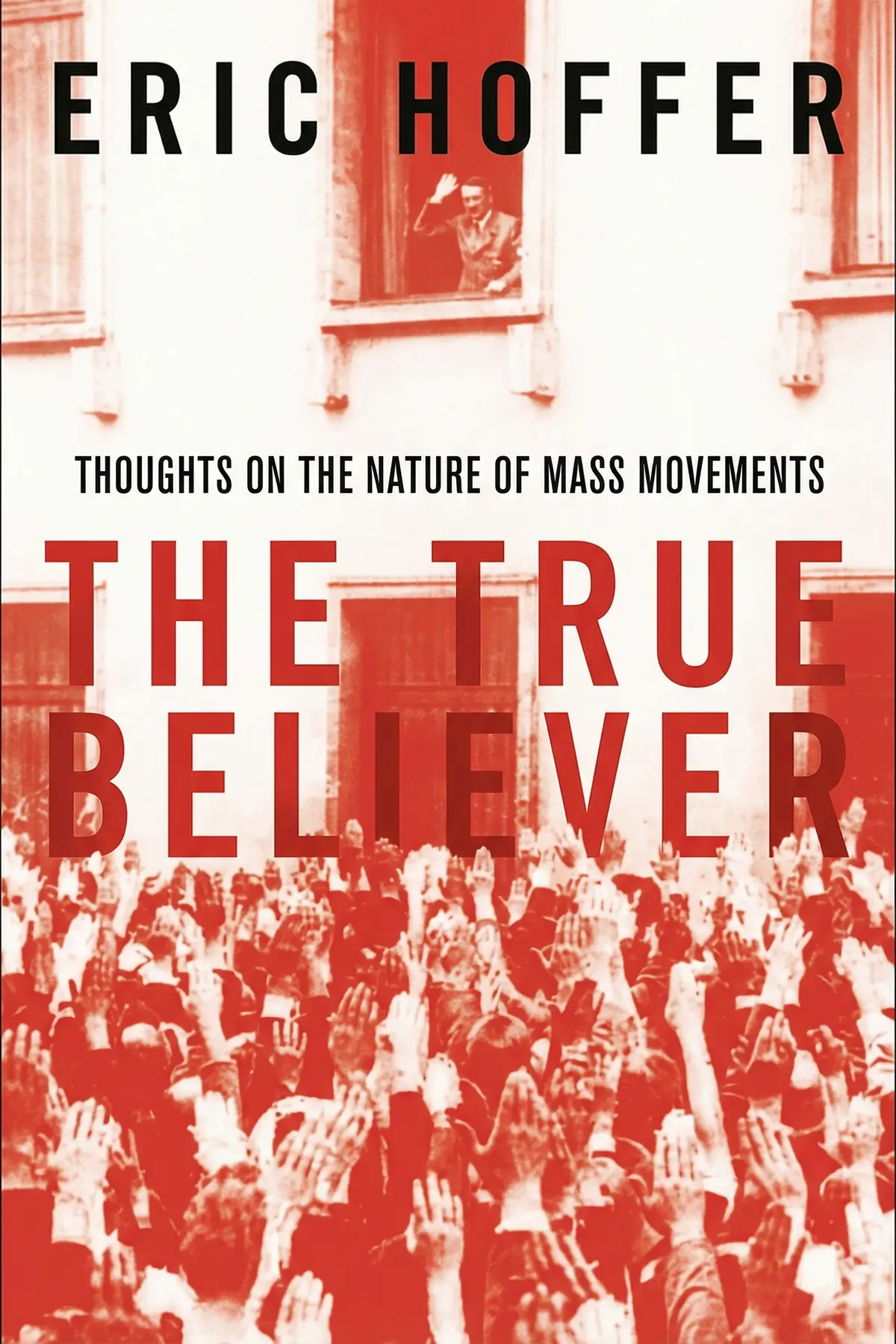
59 sec
Crowds marching for a cause can look baffling from the outside and strangely tempting from the inside. In The True Believer, Eric Hoffer, a longshoreman who wrote between shifts on the docks, argues that every mass movement, left or right, religious or political, is assembled from the same parts. The first surprise is where it starts: people who have lost hope will follow someone who offers them a future far more readily than someone who offers them money.
From there Hoffer lays out the rest of the machine. A movement melts the self into a group, names an enemy, finds words for its grievance and a leader to act on them. Once you can name those parts, a rally, a party or a roaring crowd becomes much easier to read, and so does the uncomfortable fact that almost anyone could become a true believer. Hoffer also leaves you with a test for telling which movements build and which ones destroy.
2 min 11 sec
Money seems like the obvious thing to offer people who are struggling. Hoffer saw something else win their loyalty, and he found the most dangerous recruits among people who had recently lost what they owned.
2 min 02 sec
Group loyalty kept prisoners alive in the worst places of the last century. The same force, pushed further, convinced people of things that were plainly false for years after the facts had changed.
2 min 11 sec
Some observers in 1932 studied the Nazi movement and came away envious of one ingredient. Hoffer explains why that ingredient works, which kind is most reliable, and what has to happen before it turns into a movement.
1 min 47 sec
Philosophers rarely storm palaces, yet Hoffer finds them at the start of nearly every great upheaval. He shows how a scholar’s grievance can wait for decades until someone else turns it into an empire.
1 min 49 sec
Two movements can share every ingredient and still end in opposite places. Hoffer borrows an image from the vegetable garden to explain why, then offers one simple measure for predicting which way things will turn.
1 min 01 sec
Hoffer’s warning is aimed at the reader as much as at history. The Nazis, the Bolsheviks and the Puritans were made of ordinary people: people short on hope or newly stripped of what they had, given a group to disappear into, an enemy to hate, a doctrine to repeat and a leader to follow. Right or left, sacred or political, the parts stay the same, and under the right conditions any of us could be drawn in.
The defense is to notice those parts as they arrive. When a message moves you, ask whether it is selling hope or solving a problem. When a group asks you to drop your doubts, keep at least one. When a crowd needs an enemy, look at who picked it. And when a cause never seems to finish, remember that the American and French revolutions did their work quickly and then ended.
Tomatoes and nightshade grow in the same family. The skill Hoffer offers is telling them apart before you take a bite.
Communism, Nazism and Stalinism each claimed to know the road to a better future, and millions marched behind them. Eric Hoffer, a self-taught longshoreman writing in 1951, asks what such movements have in common and why some change the world for the better while others end in chaos. His answer is that the doctrines differ but the machinery does not. Movements recruit people who have lost hope or lost what they once had. They dissolve the individual into a uniformed whole, unite it against a powerful enemy, and depend on two kinds of people: men of words who give the grievance a language, and fanatical leaders who turn that language into action. Hoffer draws his cases from the French and Puritan revolutions, the Bolsheviks, Fascist Italy and Nazi Germany. The reader gets a way to recognize these parts as they appear, in politics or in any group that asks for total loyalty, and a simple test for judging outcomes: movements with clear goals that finish quickly tend to leave something good behind.
Readers unsettled by political rallies and polarized crowds who want to understand what draws people in.
Students of history and politics looking for one frame that fits Communism, Fascism and earlier revolutions.
Leaders and team builders who want to see where group loyalty turns into blind belief.
Eric Hoffer was born in the Bronx, New York City, had no formal schooling and was nearly blind until about fifteen. Once his sight returned he read hungrily in English and German. He worked as a migrant laborer and gold miner in California, then as a San Francisco longshoreman, writing alongside his dock work until he retired at 65. The True Believer, published in 1951, was his first book. He received the Presidential Medal of Freedom in 1983, the year he died.
Listeners find this work deeply perceptive and meticulously documented, noting that its clear prose makes for a smooth reading experience. Furthermore, the volume grants a more thorough grasp of the mechanics behind mass movements and continues to be very applicable, specifically concerning the 2016 election. They also value its impartial look at human nature and its reputation as a definitive classic within the field of social psychology.
It’s rare to find a book written in 1951 that feels like it was ripped from today’s headlines. Hoffer manages to dissect the anatomy of the fanatic without getting bogged down in the specific politics of his era. He focuses on the psychological profile of the 'true believer,' arguing that the actual doctrine of a movement is almost secondary to the sense of belonging it provides. To be fair, his assertion that people join movements to escape an 'unwanted self' is a harsh pill to swallow, but it explains so much of the current polarization. The writing is incredibly dense yet punchy, lacking the academic jargon you’d expect from a social psychology landmark. It's a sobering look at how frustration and a lack of creative outlet can drive anyone toward extremism.
Show moreEric Hoffer was a longshoreman with no formal education beyond high school, yet he produced one of the most incisive works of political psychology I’ve ever encountered. This book completely changed how I view modern political rallies and social media 'tribes.' Hoffer’s central thesis—that mass movements attract those who feel their lives are a failure—is devastatingly simple. He explains that for the frustrated individual, a holy cause offers a 'fact-proof screen' against a reality they can't bear. My only complaint is that the book is so cynical it might leave you feeling a bit hopeless about human nature. Still, his observations on the necessity of a 'devil' or common enemy are chillingly accurate. It’s a landmark study that everyone should read before the next election cycle.
Show moreWow, this was a punch to the gut. I’ve been trying to understand the 2016 election and the rise of populist movements for years, and this 70-year-old book gave me more answers than a decade of cable news. Hoffer identifies 'boredom' as a primary driver for mass movements, which sounds trivial until you see how he connects it to a desperate search for meaning. The way he describes the 'True Believer' as someone seeking a 'rebirth' to shed an unwanted self is just brilliant. It’s a short book, but I found myself re-reading paragraphs multiple times just to let the weight of the insight sink in. It’s balanced, deeply researched in its own way, and terrifyingly relevant. Every citizen needs this on their shelf.
Show moreThe chapter on 'the bored' alone is worth the price of admission. Hoffer identifies that those who live lives of 'unrelieved boredom' are often the most fertile ground for radicalization, even more so than the oppressed. This was a total 'mind-blown' moment for me. He explains that when people have no creative outlet or individual purpose, they crave the 'high-definition drama' of a mass movement. The book is incredibly well-researched, drawing parallels between the rise of Islam, the Reformation, and the French Revolution. I loved his take on how a 'fact-proof screen' allows believers to ignore glaring contradictions. It’s a slim volume but incredibly dense with wisdom. If you want to understand the 'why' behind the headlines, start here.
Show moreAs someone who spends too much time worrying about the state of the world, this book provided a much-needed framework for understanding the chaos. Hoffer’s perspective as a 'layman' intellectual gives the book a grit and honesty that academic texts usually lack. He understands that humans aren't always rational actors; instead, we are driven by a need for hope, even if that hope is built on a 'specious' past. His points about how a movement must foster 'unity and cohesion' through symbols and spectacles feel like they were written about today's political climate. It’s a straightforward read that offers a balanced yet chilling view of our capacity for fanaticism. Not gonna lie, it's a bit of a downer, but knowledge is power.
Show moreWhy do otherwise rational people suddenly start championing absurd ideas? Hoffer answers this by focusing on the 'interchangeability' of mass movements, suggesting a person can jump from one extreme to another because the underlying need for unity is the same. I appreciated the distinction he makes between the 'man of words' who starts the movement and the 'fanatic' who takes it into the streets. While some of his generalizations about 'the poor' felt a bit dated and perhaps overly broad, the core logic holds up remarkably well. The prose is lean and mean, avoiding the fluff found in modern non-fiction. It’s an essential read for anyone trying to make sense of the 1930s or the 2020s. Just don't expect a light, uplifting afternoon read.
Show morePicked this up after seeing it referenced in a dozen different articles about modern political polarization. Frankly, I was surprised by how accessible the writing style is; it’s straightforward and completely lacks the 'ivory tower' vibe. Hoffer’s breakdown of how a movement requires an 'indispensable devil' to maintain cohesion is perhaps his most relevant point for our current social media landscape. We see this daily—the constant need for an enemy to keep the ranks unified. I did find the middle section a bit repetitive, as he hammers home the same points about self-sacrifice and the 'unwanted self' over and over. However, as a study of the 'active phase' of a movement, it’s practically peerless. A solid four stars for the sheer volume of 'aha!' moments.
Show moreTruth is, I found the prose surprisingly accessible for a book that tackles such heavy psychological themes. Hoffer doesn't waste time with flowery language; he gets straight to the point about why people surrender their individuality to a group. I found his discussion on 'men of action' versus 'men of words' particularly insightful when looking at how movements transition from ideas to reality. My minor gripe is that he occasionally treats all mass movements as inherently dangerous or pathological, which ignores those that have brought about positive social change. Nonetheless, his observations on the 'unbounded brazenness' of leaders are spot-on. It’s a fascinating, if somewhat dark, exploration of the human psyche.
Show moreI have mixed feelings about this one, even though I recognize its importance. On one hand, Hoffer’s insights into the psychological needs of the 'frustrated' are undeniably sharp and provide a unique lens for viewing history. On the other hand, the book feels like a collection of aphorisms rather than a rigorous scientific study. He makes bold, sweeping declarations about human behavior without providing much empirical evidence beyond historical anecdotes. Look, I get that he was a self-taught intellectual, and that’s impressive, but some of his conclusions feel a bit too convenient and pessimistic. It’s a great conversation starter, but I wouldn’t treat it as the absolute gospel on social psychology. Worth a read, but keep your critical thinking cap on.
Show moreMaybe I’m missing something, but this felt like a series of pessimistic rants rather than a cohesive analysis. The author seems to have a very low opinion of humanity, essentially arguing that anyone who cares deeply about a cause is just a 'frustrated failure' trying to hide from themselves. It feels incredibly reductive to claim that the actual goals of a movement don't matter and that people are just looking for a 'fact-proof screen.' What about movements for genuine civil rights or justice? Hoffer lumps everything together—Nazism, Christianity, Communism—as if they all stem from the same pathology. To be honest, it felt like he was just trying to be provocative. It’s too cynical for me and lacks the nuance required for such a complex topic.
Show moreHoffer argues that all mass movements, whether political or religious, left or right, share the same ingredients. They attract people who have lost hope or lost what they had, dissolve individuals into a group, unite them against a powerful enemy, and rely on men of words to frame a doctrine and fanatical leaders to act on it. Under the right conditions, he suggests, almost anyone can become a true believer.
In Hoffer’s view, the deepest despair of unemployed people comes from losing hope, not income. That is why they follow someone who offers a better future before someone who offers cash. Even a small amount of hope restores a sense that their actions matter. He points to Germany after the First World War, where hopelessness gave the Nazi movement room to grow.
Hoffer argues that a shared enemy binds a movement together, and the more powerful the enemy seems, the stronger the unity. The Nazis built their rise on a fabricated threat from the Jews. Foreigners make the most reliable enemy, which is why French revolutionaries painted aristocrats as descendants of German tribes and English Puritans called the Royalists Normans.
Hoffer says movements share a nature but differ in results, much as tomatoes and nightshade share a plant family. His main test is duration. Movements with clear goals that finish quickly, like the American and French revolutions, left lasting gains. Nazism and Communism stayed mass movements after taking power, which stalled creativity and development and led toward their downfall.
Use Hoffer’s parts as a checklist. When a message grips you, ask what hope or loss it plays on. When a group asks you to think and dress alike, notice what judgment you are giving up. When people are urged to hate a group, ask who chose that target. And ask whether a cause has a reachable goal and plans to stop once it gets there.
Steven C. Hayes

Barack Obama


Masaji Ishikawa

Deborah Gruenfeld

John Rawls



Anthony Pratkanis

AUDIO SUMMARY AVAILABLE
Get the key ideas from The True Believer by Eric Hoffer, plus 5,000+ more nonfiction titles.









