

14 min 40 sec
Available in: English
The Third Plate: Field Notes on the Future of Food
By Dan Barber
Chef Dan Barber explains how our taste for prime cuts and single crops wears out soil, rivers and oceans. He shows what a diverse, better-tasting way of farming and cooking looks like.
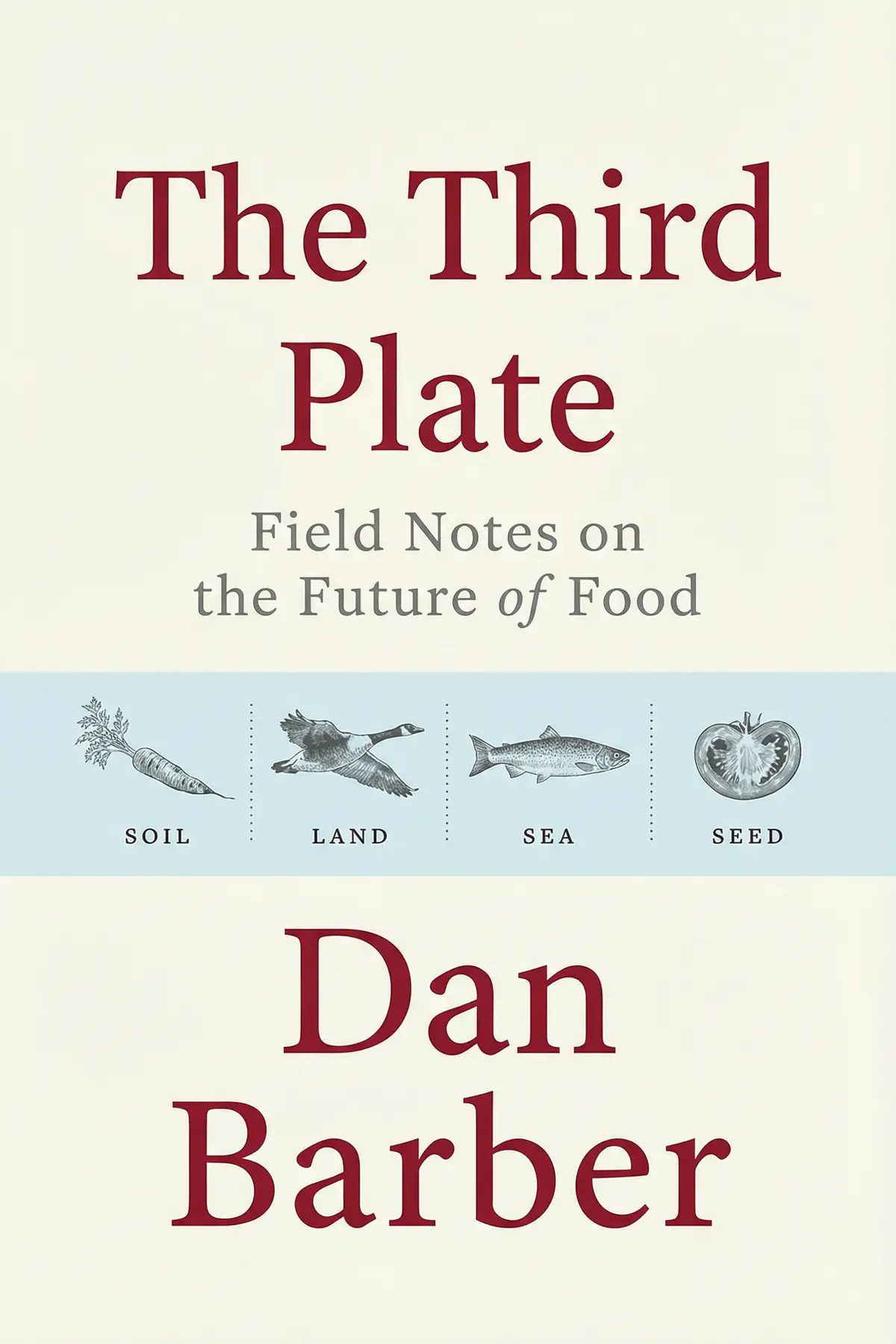
Table of Content
1. Introduction
1 min 03 sec
Most of us know a meal of fries and soda does little for our health. In The Third Plate, chef Dan Barber goes further: the way we like to eat, with a big cut of meat in the middle and vegetables at the edge, is wearing out the soil, rivers and seas that feed us. Barber runs the kitchens at Blue Hill in Manhattan and at Blue Hill at Stone Barns, and he also brings good news. Food grown inside a diverse, healthy system is better for the planet, and it tastes better too.
His argument fits in one line. A lasting cuisine cooks with everything a whole farm or sea produces, instead of forcing the land to supply the few foods we crave. On the way you will see how a milling machine helped cause the Dust Bowl, why one carrot is full of sugar while another has none, and what a risotto built to heal a field looks like. After that, a menu or a shopping list reads very differently.
2. See the hidden bill behind a restaurant plate
1 min 52 sec
The classic fine-dining plate looks generous and harmless. Behind it sits a chain of demands on grain, water and land that grows with every new diner, and a surprising view of who could change it.
3. Learn how one-crop farming turned soil to dust
2 min 08 sec
A clever new milling machine, a world war and a promise of free land turned the American prairie into one enormous wheat field. Within a generation, the soil itself began to blow away.
4. Taste the soil in a sweeter carrot
1 min 56 sec
Two carrots can look identical in the shop and be completely different inside. One test on Barber’s farm found a gap so wide it changes how you might think about organic labels, flavor and even waistlines.
5. Get more from every animal you eat
2 min 05 sec
Chicken became cheap and everywhere in a few decades, yet we now eat less of each bird than our grandparents did. A stretch of Spanish oak country shows what the opposite approach can produce.
6. Choose fish that the ocean can replace
2 min 12 sec
Turning to the sea seems like an escape from tired farmland, and fish farms seem like an escape from empty oceans. Barber finds trouble in both, and one surprising Spanish farm that works.
7. Cook a risotto that gives back to the soil
2 min 14 sec
One short Japanese wheat helped feed millions and tripled harvests in a hungry country. It also planted the seed of a problem, and Barber’s response arrives as two dishes you could order for dinner.
8. Conclusion
1 min 10 sec
Barber’s case comes down to a loop. What we order shapes what farmers grow, and what they grow shapes what reaches our plates. For a century that loop has pushed toward sameness: one wheat, one cut of chicken, one prized tuna, prairies that blew away and a dead zone where a great river meets the sea. The dehesa, Veta la Palma and a carrot with 16.9 percent sugar show the loop can turn the other way, and the food at the end of it tastes better as well.
You do not need a farm to take part. Give vegetables and grains more of the plate, and give meat a smaller and more complete role: a whole bird, a stock from its bones. Choose small fish over the big predators. Cook with rye, barley and buckwheat, the grains that rest and repair a field. And when something tastes remarkable, ask where and how it grew, because good flavor is often a sign of good soil.
The third plate asks only that we eat the way a healthy piece of land would feed us if we let it.
About this book
What is this book about?
A restaurant dinner built around a thick fillet with a few vegetables on the side looks harmless. Chef Dan Barber argues it stands for a food system that is using up the soil, the rivers and the sea. He traces the damage back to roller-milled wheat, the Dust Bowl, the fast-growing broiler chicken, sonar-equipped fishing fleets and the hybrid seeds that now cover huge areas with a single crop. Barber's answer is what he calls the third plate. It is a cuisine that draws on many kinds of grain, vegetables, fish and meat, in proportions the land can sustain. He finds working models in Spain: the dehesa, where acorn-fed pigs produce famous ham, and Veta la Palma, a fish farm that copies a natural estuary. On his own farm, a carrot grown in healthy soil tested at 16.9 percent sugar. Readers come away understanding why flavor and sustainability tend to rise together. They also get practical ways to eat with that in mind, from buying a whole bird to cooking a risotto made from soil-building grains.
Book Information
Who it's for
Hoping to cook greener
Home cooks who want meals that taste better and do less harm to soil and sea.
Worried about industrial farming
Readers worried about industrial farming who want a hopeful, practical alternative to giving up meat.
Chefs and food businesses
Chefs, food entrepreneurs and restaurant teams rethinking menus and sourcing.
About the Author
Dan Barber
Dan Barber is the chef at Blue Hill in Manhattan and runs the kitchen at Blue Hill at Stone Barns, a restaurant inside the nonprofit Stone Barns Center for Food and Agriculture in New York. He is a leading voice of the farm-to-table movement and has written on food and agricultural policy for the New York Times. He has won several James Beard awards, including Outstanding Chef in 2009, the year Time magazine named him one of the world's most influential people.
Ratings & Reviews
Ratings at a glance
What people think
Listeners find this work highly absorbing, with one remarking that it reads like a piece of fiction, and they value the deeply researched exploration of culinary heritage and cultures. The book provides an original viewpoint on the food business, and one listener credits it with teaching them about sustainable eating habits. Listeners express admiration for the prose, the narratives featuring distinctive individuals, and the dedication to environmental impact, with one review praising its thorough investigation into the full circle of sustainability.
Top reviews
Roongsak
Dan Barber has managed to turn a complex treatise on agricultural systems into a narrative that flows like a top-tier novel. I was genuinely surprised by how much I enjoyed the historical deep-dives into specific crops, especially the sections on the evolution of wheat and corn. It’s not just a cookbook or a dry lecture; it’s a journey through the landscapes that produce our flavors. To be fair, his perspective is definitely that of a high-end chef, but the way he profiles characters like Eduardo Sousa in Spain is mesmerizing. The stories about the dehesa and the naturally produced foie gras were particularly eye-opening for me. Truth is, I haven't looked at a grocery store shelf the same way since finishing this. It makes you realize that sustainability isn't just a buzzword. It's an entire ecosystem that requires our attention and respect. Highly recommended for anyone who actually cares about where their dinner comes from.
Show moreKan
As a gardener who has always cared about soil health, I found the 'Seeds' section of this book absolutely transformative. Barber bridges the gap between the kitchen and the field in a way few other writers can. His prose is elegant and his research is clearly exhaustive. I was especially moved by the stories of those trying to revive Carolina Gold rice and the complicated history attached to it. It’s a page-turner that forces you to confront the inadequacy of our modern industrial food complex. Frankly, the book is a masterpiece of environmental storytelling. He doesn't just tell us what to eat; he explains why the very biology of the planet demands a different approach. While he does focus on high-end dining, the underlying principles of crop rotation and soil vitality are universal. This is essential reading for anyone interested in the future of our planet’s resources.
Show moreSomsri
The chapter on the dehesa in Spain and the naturally produced foie gras changed how I think about animal husbandry forever. Dan Barber has a gift for finding these 'outlier' farmers who are doing things the right way and giving them a voice. This isn't just about food; it's about harmony with nature. I was gripped by the descriptions of Veta La Palma and the flamingos—it felt more like a nature documentary than a book about cooking. To be fair, Barber is a chef at an ultra-exclusive restaurant, and that bias shows, but his curiosity is genuine. He admits his own failures and his own learning curve, which makes the 'field notes' aspect feel authentic. It’s a comprehensive look at the full circle of sustainability, from the microbes in the dirt to the fish in the sea. I finished it feeling optimistic, which is rare for environmental books these days.
Show moreKwame
Rarely does a book bridge the gap between high-end culinary arts and the gritty reality of soil microbiology so seamlessly. Barber has written a definitive guide to why our current 'farm-to-table' obsession is actually failing the land. I found his exploration of wheat breeding particularly fascinating; it's amazing how much we've sacrificed in terms of flavor and nutrition for the sake of industrial yield. The book is structured beautifully into Soil, Land, Sea, and Seeds. This allows him to cover a massive amount of ground without it feeling disjointed. I appreciated his humility when describing his interactions with experts like Miguel Medialdea. He’s a chef who is willing to listen and learn. In my experience, this is one of the most important books on ecology written in the last decade. It’s smart, funny, and deeply necessary for our collective future.
Show moreKanokwan
Picked this up expecting a dry lecture on agriculture and ended up staying up until 2 AM reading about the history of grain. Barber is a master storyteller. He populates his 'field notes' with such unique people—from Spanish fish farmers to obsessive seed breeders—that it feels like you're traveling right alongside him. The way he describes the flavors of truly sustainable food makes you want to go out and find a local grain mill immediately. Gotta say, the section on the 'Third Plate' menu at the end was the perfect way to wrap up his theories. It’s an engaging, novel-like experience that actually teaches you something profound about the world. It’s easily the most comprehensive look at sustainability I’ve ever come across. If you love food and care about the planet, you need to read this book. It’s absolutely brilliant.
Show moreMan
Is it possible to feel deeply inspired and mildly annoyed at the same time? Barber’s writing is exquisite, and his logic regarding the 'Third Plate'—a system where we eat the whole farm, not just the choice cuts—is incredibly sound. He correctly identifies that the current farm-to-table trend is often just a superficial fix. However, I can’t ignore the fact that his solutions often feel tailored for the one percent. Not everyone can afford to dine at Blue Hill or source the specific heritage grains he champions. Personally, I found the technical details about soil health and Veta La Palma fascinating. He writes with a passion that is contagious, even if his ego occasionally peaks through the prose. It’s a dense read but worth the effort for the 'Sea' section alone. Just be prepared for a bit of a 'trickle-down' culinary philosophy that doesn't always account for the average family’s budget.
Show moreAkosua
After hearing several people compare this to Michael Pollan's work, I finally dove in and found something much more personal and 'field-note' heavy. Barber isn't just a journalist; he's a practitioner, and that gives his observations on 'bycatch' and cover crops a unique weight. I loved the way he broke down the three stages of American eating. The idea that we are still stuck in a 'Second Plate' mentality—where we just put organic garnish next to a massive steak—really resonated with me. My only gripe is that the book can be a bit rambling in the middle sections. Some of the Spanish travelogues felt a bit long, though the descriptions of the food made me incredibly hungry. It’s a thought-provoking look at how we might actually save our food system if we’re willing to change our palates. Definitely worth a spot on your shelf.
Show moreSarawut
Barber’s argument about the 'Second Plate'—where we just swap industrial beef for organic beef without changing the actual proportions of our meal—is a real eye-opener. He’s right that we’ve been 'cherry-picking' our ingredients rather than supporting the whole farm system. The book is incredibly well-researched, and I enjoyed the focus on lesser-known seafood and 'trash' fish that should be on our menus. Look, the guy is a bit of an elitist, and he clearly spends a lot of time in a world of white tablecloths. But if you can look past the fancy restaurant setting, the core message about crop diversity and soil health is vital. The writing style is engaging and the pages fly by. It's a solid 4 stars for me, only held back by the occasional sense that this 'future of food' is currently only available to the wealthy.
Show morePensuda
While the writing is undeniably beautiful, I struggled to get past the inherent elitism of Barber's 'food revolution.' The book is filled with fascinating anecdotes about Spanish fish farms and ancient grains, but it feels like a memoir written for people who don't have to worry about the price of eggs. He spends a decade traveling the world to learn about sustainability, yet he seems almost blind to the human labor and social inequalities that prop up the restaurant industry. Where are the stories of the field workers or the line cooks? Not gonna lie, the 'trickle-down' culinary theory he proposes—where elite chefs dictate culture—felt a bit out of touch with how most of us actually eat. It’s a brilliant intellectual exercise, and I learned a lot about the 'Third Plate' concept, but it lacks the grounded, human ethics I was hoping for. Great for foodies, perhaps less so for activists.
Show moreKwan
Does the world really need another book about how millionaire chefs are going to save the planet? Don't get me wrong, Barber is a talented writer and his research into soil health is genuinely impressive. I actually enjoyed the technical parts about nitrogen fixing and the history of various wheats. But there is a glaring hole in his narrative: the people. He talks about 'sustainability' for 400 pages but barely mentions the social ethics or the plight of the workers who actually pick the tomatoes and slaughter the livestock. It feels like a very privileged take on a global crisis. The 'Third Plate' sounds delicious, but it also sounds like something only a tiny fraction of the population will ever get to taste. Frankly, it’s a bit frustrating to read someone wax poetic about geese while ignoring the human cost of the food industry. Interesting, but very one-sided.
Show moreQuestions about this book
What is the main idea of The Third Plate by Dan Barber?
Barber argues that Western eating habits, built around prime cuts of meat and a few single crops, are draining soil, polluting rivers and emptying oceans. He proposes a third plate: a cuisine that uses many kinds of grain, vegetables, fish and meat in proportions the land can sustain. Food raised in diverse, healthy systems, he shows, also tastes better and carries more nutrients.
Does The Third Plate say everyone should become vegetarian?
No. Barber says farms and natural ecosystems depend on plants and animals living together, so removing animals misunderstands how those systems work. He wants meat to play a smaller, more complete role instead: using more of each animal, as in his blood-to-bone pig dish, and raising animals in systems like the Spanish dehesa, where acorn-fed pigs, sheep and geese all live off the same land.
What does Dan Barber say about soil and flavor?
Soil is food for plants, and plants grown in depleted soil become stressed, weaker and less nutritious. Barber cites research showing food has lost up to 40 percent of its nutrients over 50 to 70 years. On his Stone Barns farm, carrots grown in healthy soil tested at 16.9 percent sugar, while industrially farmed organic carrots tested at zero.
How can I apply The Third Plate in my own kitchen?
Put vegetables and grains at the center of more meals, and treat meat as a smaller part of the plate. Buy whole chickens and make stock from the bones. Choose smaller fish that sit lower in the food chain rather than tuna or cod. Cook with soil-building grains such as barley, rye and buckwheat, as in Barber’s rotation risotto, and buy from growers who care for their soil.
What caused the Dust Bowl according to The Third Plate?
Barber links it to wheat monoculture. Roller mills made long-lasting flour possible, World War I created export demand and the Enlarged Homestead Act of 1909 gave settlers free western land. The prairie became one vast wheat field, mostly hard wheat with shallow roots that coped badly with drought. In the 1930s the dry soil blew away in huge dust clouds.
Readers also enjoyed






AUDIO SUMMARY AVAILABLE
Listen to The Third Plate in 15 minutes
Get the key ideas from The Third Plate by Dan Barber, plus 5,000+ more nonfiction titles.
- 5,000+ titles
- Listen as much as you want
- 7-day free trial
- Cancel anytime









