

14 min 45 sec
Available in: English
The Strength Switch: How The New Science of Strength-Based Parenting Can Help Your Child and Your Teen to Flourish
By Lea Waters
Shows parents how to notice and build on a child's natural strengths. It covers spotting real talents, giving specific praise, correcting behavior without shame and staying calm when tempers flare.
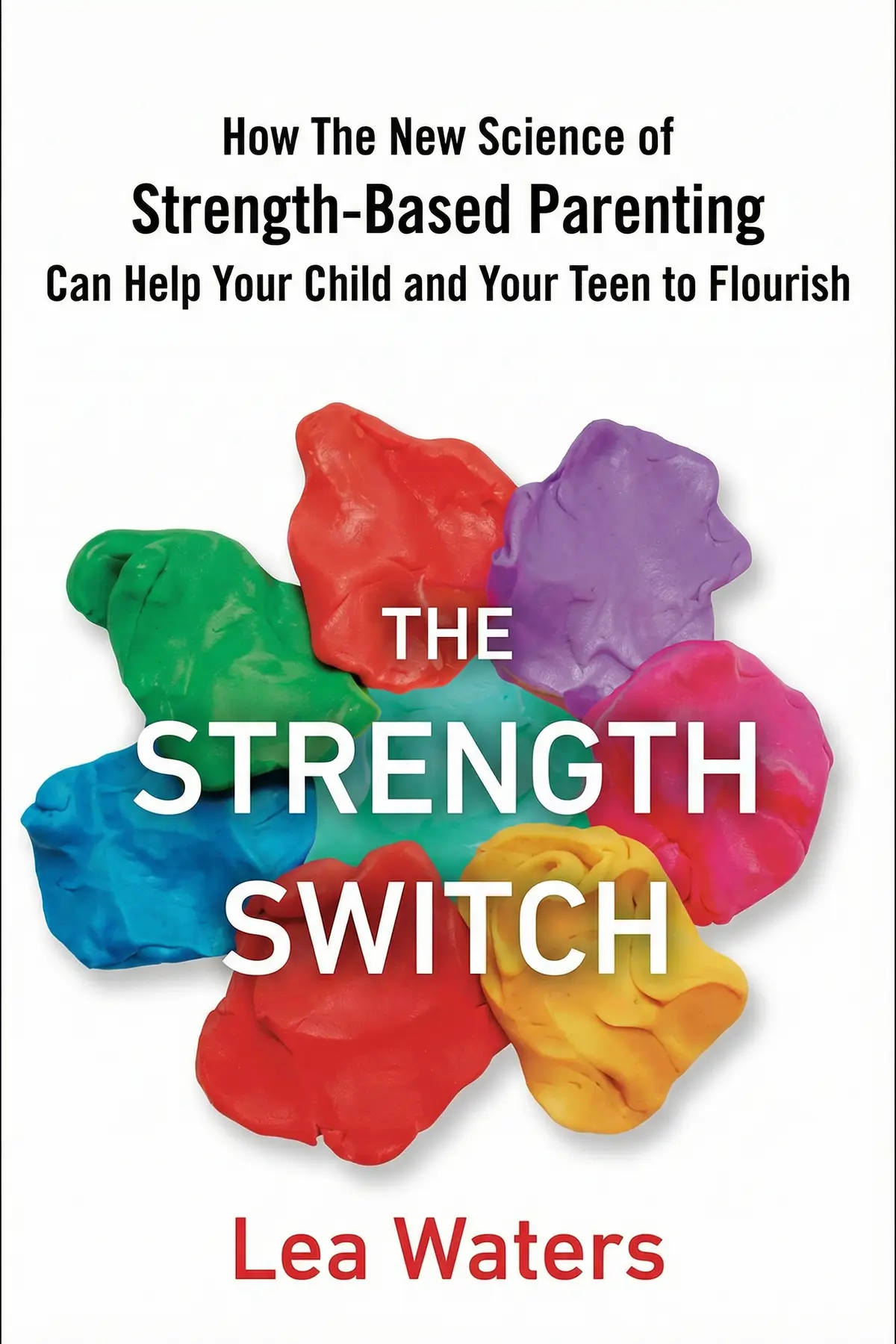
Table of Content
1. Introduction
1 min 05 sec
Many parents spend their days catching mistakes: the forgotten homework, the bike left by the door, the fight over the couch. In The Strength Switch, Lea Waters argues that this habit is natural and that it works against the very children it is meant to help. Waters founded the Centre for Wellbeing Science at the University of Melbourne. Her alternative is a deliberate flip of attention she calls the strength switch: before reacting, look first at what your child already does well.
That single move, she shows, can shape everything else a parent does. Waters draws on research about genes, brain development, attention, praise and self-control. Her case is that children flourish when the adults around them notice their strengths, feed them and use them even while correcting bad behavior. Along the way come a three-step mindfulness routine for heated moments, a way to tell a real talent from a passing whim, and a kind of praise that does far more than a quick well done.
2. See your child's strengths before their mistakes
1 min 26 sec
A forgotten bike by the front door pushed one parenting researcher into snapping at her son. What she changed the next day, before she even opened the door, set her on a calmer path that eventually solved the problem.
3. Build a setting where natural talents multiply
1 min 40 sec
Twin studies suggest genes shape about half of some childhood strengths. The other half is where parents come in, and it works through a kind of compounding that can turn a small gift into a large one.
4. Let young kids sample, then help teens focus
1 min 38 sec
A child who drops the trumpet for computer games after a week can drive any parent mad. Brain research suggests that restlessness has a purpose, and that the right response changes completely once adolescence arrives.
5. Spot a real strength by what holds attention
1 min 35 sec
Most three-year-olds hold focus for a few minutes at a time. When one builds silently for hours instead, the gap between normal attention and unusual absorption tells a parent something worth acting on.
6. Praise that names the strength behind the win
1 min 40 sec
Parents tend to believe they are warm and encouraging. Their children often report something very different, and the gap has measurable effects. Even the familiar well done may be doing less than parents assume.
7. Use guilt, not shame, to correct behavior
1 min 33 sec
Every child needs correcting, and the two feelings parents reach for most look alike from the outside. One builds empathy and responsibility. The other cuts much deeper, and telling them apart changes how a reprimand lands.
8. Find your calm when the kids are fighting
1 min 34 sec
Children fighting over a holiday couch can push a calm parent toward shouting. A short routine that starts with noticing your own chest and breathing offers another way through the moment.
9. Train self-control, and let it rest
1 min 28 sec
An experiment that tempted people with a comedy sketch while they tracked a moving square found that self-control can grow. It also explains why even well-trained children unravel at the end of a long, tiring day.
10. Conclusion
1 min 06 sec
The Strength Switch asks parents to change what they look for. Faults will always catch the eye first, like the chip on a vase. Waters shows that children do better when the adults around them keep turning their attention back to what is working, and then build on it. That shapes the activities a child gets to try, the praise they hear, the way they are corrected and the calm a parent brings into the room.
Her most practical suggestion is to change the stories your family tells. Stop retelling the day your son was too scared to dive into the pool. Share instead the story of when he crafted a gift for a friend or family member, with no one asking him to. Then name what it showed, perhaps kindness, forethought or organization. You can turn it around, too, by choosing a strength and asking your child when they used it most clearly.
Then, when the next bike lands by the door or the homework stays behind, start with a strength you have already seen before you say a word about the slip. Nick’s bike moved to the deck because his mother had first noticed everything he was getting right.
About this book
What is this book about?
Most parents know the feeling. The one mistake a child keeps making fills the whole view, and the good things go unnoticed. Lea Waters argues that this focus on faults is natural, and that it holds children back. Her answer is the strength switch, a deliberate shift of attention toward what a child already does well. She draws on twin studies, brain research, attention studies and work on praise and self-control. With them she shows how strengths form through genes and environment, why young children should sample widely while teenagers narrow down, and how unusual focus can reveal a real talent. The book then turns to everyday communication. Waters explains why generic praise falls short and what strength-based praise sounds like. She shows why guilt can correct behavior while shame harms, and how a three-step mindfulness routine helps a parent stay steady in the middle of a fight. Readers get a practical way to notice, name and grow their children's strengths, along with the patience to keep doing it on hard days.
Book Information
Who it's for
Parents wanting calmer routines
Parents who catch themselves correcting more than praising and want a calmer, more encouraging routine.
Parents weighing kids' interests
Mothers and fathers of children and teens wondering which interests to support and when to narrow them down.
Coaches and teachers
Teachers and coaches who want specific praise and fair discipline that build on young people's strengths.
About the Author
Lea Waters
Lea Waters founded the Centre for Wellbeing Science at the University of Melbourne, originally called the Centre for Positive Psychology. Her research spans positive psychology, resilience, school psychology and parenting. She was President of the International Positive Psychology Association from 2017 to 2019 and was made a Member of the Order of Australia in 2020. She also founded Visible Wellbeing, an initiative that takes wellbeing science into schools. The Strength Switch has been translated into languages including Chinese, Japanese, Korean, French and Spanish.
Ratings & Reviews
Ratings at a glance

What people think
Listeners find this parenting book both productive and eye-opening, with one listener emphasizing the scientific foundation of positive psychology. Furthermore, the text assists in refining caregiving skills and delivers an instant effect by utilizing pragmatic strategies and concrete exercises. Additionally, listeners value how it fosters a more delightful parenting experience for both the guardian and the child.
Top reviews
Prae
The chapter on mindfulness alone changed the way I handle my toddler’s afternoon meltdowns. I never realized how much my own 'negative bias' was clouding my perception of her personality. By using the Strength Switch, I’ve started noticing her natural curiosity before I notice the mess she made on the floor. Frankly, parenting has become significantly more enjoyable for both of us since I stopped focusing solely on her weaknesses. The science behind positive psychology is explained clearly without being too academic or dry for a tired parent. I especially appreciated the VIA survey tool for identifying character strengths in older children. It feels like I finally have a roadmap for encouraging her to thrive rather than just survive the school year. This is a gem of a book and a must-read for anyone feeling overwhelmed by modern parenting pressures.
Show moreChon
Wow, it turns out that looking for what's right with my son actually makes him want to fix what's wrong on his own! Lea Waters provides a host of great strategies that go beyond the typical 'be positive' fluff found in most blogs. I loved the section on 'savoring' and how it differs from traditional mindfulness practices. The book is grounded in solid work on strengths and makes the science come alive through relatable examples. I’ve already seen a shift in how my kids interact with each other after we started sharing 'strength stories' at dinner. It is a very practical guide with realistic exercises that don't feel like a chore to implement. Choosing to focus on their potential rather than their deficits has made our home a much calmer place. If you want to raise resilient kids who know their own value, buy this book immediately.
Show morePensuda
This book provides a solid, evidence-based framework that moves beyond just being nice to your children. I’ve read a lot of parenting books, but this one actually gave me tools I could use the same day I read them. The 'Strength Switch' approach has helped me reframe my son’s ADHD as a collection of high-energy strengths that just need the right outlet. Personally, I found the section on 'free-form attention' and the importance of goofing off to be incredibly validating in our over-scheduled world. We’ve started prioritizing downtime and daydreaming, and I’ve noticed a significant drop in his anxiety levels. The science of character is fascinating and Waters explains it in a way that feels both urgent and hopeful. It’s a refreshing change from the deficit-based models that usually dominate the education system. Our family is much better off for having found this resource.
Show moreSing
Finally got around to finishing Lea Waters’ take on positive psychology in the home. The 3 Ps—Priming, Present Moment, and Postmortem—are absolute game-changers for how I handle my son’s outbursts. Instead of just reacting to the noise, I am learning to look for the 'unrealized strength' hidden beneath the frustration. To be fair, the book can feel a bit repetitive if you are already familiar with the work of Carol Dweck or Martin Seligman. However, the way Waters bridges the gap between academic theory and Tuesday morning tantrums is impressive. I found the section on 'scaffolding' particularly helpful for building my daughter's confidence in math. Even though it doesn't solve every single behavioral issue, it offers a much more constructive approach than my old habits. We are moving away from the 'what needs fixing' mindset toward a more energized way of living.
Show moreBo
As a parent who feels constantly buried under a mountain of to-do lists, this was the breath of fresh air I needed. The distinction between 'performance' and 'energy' really clicked for me during my morning commute. Just because my son is good at something doesn't mean it is a true strength if it leaves him feeling drained. The book helps develop parenting skills that have an immediate impact on the atmosphere of the home. I’ve started using 'process praise' instead of generic 'good job' comments, and the difference in his persistence is visible. My only minor complaint is that some of the exercises feel a bit unrealistic for a busy household with three kids. Still, the underlying philosophy of focusing on what is right rather than what is wrong is powerful. It has helped me dial down my own perfectionism and enjoy the chaos a little more.
Show moreOscar
Is it possible to discipline a child without causing the kind of shame that leads to depression? Waters argues that it is, and her breakdown of 'other-oriented induction' versus 'power-assertive responses' is eye-opening. I realized that my own habit of 'love withdrawal' was doing more harm than good to my daughter's self-esteem. The book offers a constructive, growth-oriented perspective that gives kids a clear idea of how to use their strengths to improve. I especially liked the five questions for diagnosing a strength breakdown, particularly the idea of an 'overused' strength. It helped me see that my son’s stubbornness is actually just his 'persistence' strength being applied in the wrong way. The writing style is accessible, though the 'switch' metaphor is a bit overplayed throughout the chapters. Overall, it’s a very enlightening read for any parent struggling with discipline.
Show moreRoydao
Ever wonder why we're so quick to spot a bad grade but so slow to notice a kid's natural kindness? The central argument here is that where our attention goes, our energy flows, and we've been flowing toward the negative for too long. Not gonna lie, I was skeptical about the 'mindset management' stuff at first, but the results speak for themselves. My kids are more willing to take risks because they know their core strengths aren't tied to a single failure. The book is comprehensive, though you might need to refer back to the charts often to keep all the terms straight. It makes parenting feel less like a series of fires to put out and more like a garden to tend. While I agree with some critics that it's a bit repetitive, the core message is too important to ignore. I’m recommending this to everyone in my playgroup.
Show moreCarlos
Look, I appreciate the deep research behind this book, but the author uses the phrase 'flick the switch' so many times it started to drive me crazy. Is it flick or flip? Regardless of the terminology, the core message about focusing on a child's talents is solid if a bit unoriginal. I have read a lot of books on parenting and didn't find anything particularly new or challenging in these pages. It serves as a great summary of current approaches, but it lacks the depth needed to solve real, gritty problems. For instance, if a kid is failing math, analyzing their 'feelings' isn't nearly as helpful as actually sitting down and doing the work. The stories about her daughter Emily felt a bit too perfect and polished for my liking. It’s a good primer for beginners, but seasoned readers of psychology might find themselves skimming the repetitive stories.
Show moreArm
After hearing so much buzz about Waters' work, I was surprised to find that much of the content felt like a summary of stuff I'd already seen elsewhere. The information on Baumrind’s parenting styles and fixed versus growth mindsets is basically standard knowledge at this point. Truth be told, the book is quite repetitive and could have been about fifty pages shorter without losing any impact. I did enjoy the discussion on the 'shadow side' of strengths, such as how curiosity can turn into intrusive questioning. That nuance was helpful, but I found myself getting bored with the constant anecdotes that all seemed to end in a perfect resolution. It’s a decent book for someone brand new to positive psychology, but it doesn't offer much for the well-read parent. It’s definitely worth a skim, but maybe not a deep study.
Show moreAim
Not what I expected from a parenting guide that claims to be a total game-changer for families. To be honest, positive psychology often feels like a bit of an 'opium' that masks real issues with a coating of happy thoughts. If you cannot face your child's weaknesses head-on, you will never make actual progress in the long run. The author seems to lack the ability to dig into the root causes of bad behavior, opting instead to paint 'rosy pictures' of the appearance of happiness. I also have serious concerns about labeling children with specific 'strengths' or 'talents' at such an early age. Labeling, even when it is positive, can create a self-limiting mindset that prevents a child from trying new things. While the intention is good, the execution feels shallow and ignores the complexity of real-world struggles. It just didn't sit right with me.
Show moreQuestions about this book
What is the main idea of The Strength Switch?
Lea Waters argues that parents naturally zoom in on a child’s faults, and that this narrow focus holds children back. The strength switch is a deliberate shift of attention toward what a child does well. She shows how it can shape the activities parents support, the praise they give and the way they correct behavior. Her case draws on research into genes, brain development, attention and self-control.
What is strength-based praise?
It is praise that recognizes what a child achieved and also names the strengths behind it. Waters finds a generic well done too thin. When a child brings home a painting, she suggests acknowledging the effort and the creativity shown, for example in a particular mix of colors or tones. Research she cites links a lack of clear positive communication with depression and weaker learning skills.
What is the difference between guilt and shame in disciplining children?
Shame targets the child’s identity with labels such as rude or stupid, and Waters says it should be avoided entirely. Guilt targets a specific action and invites regret for it, which keeps responsibilities in view and builds empathy. Combined with the strength switch, a parent can remind a child who teased others of times she was kind, express disappointment and plan how to do better.
How can I use the strength switch at home?
Before reacting to a mistake, think first of one strength you have seen in your child, as Waters did before raising the forgotten bike with her son. Share strength stories, such as the time your child made a present for someone unprompted, and name the strength it showed. Watch for long stretches of focus, praise specifically and protect rest at the end of long days.
Readers also enjoyed








AUDIO SUMMARY AVAILABLE
Listen to The Strength Switch in 15 minutes
Get the key ideas from The Strength Switch by Lea Waters, plus 5,000+ more nonfiction titles.
- 5,000+ titles
- Listen as much as you want
- 7-day free trial
- Cancel anytime









