
15 min 20 sec
Available in: English
The Squiggly Career: The No.1 Sunday Times Business Bestseller - Ditch the Ladder, Discover Opportunity, Design Your Career
Shows how to steer a career that zigzags between roles and industries: build on your strengths and values, train your confidence, grow a network based on help, and test several futures before you move.
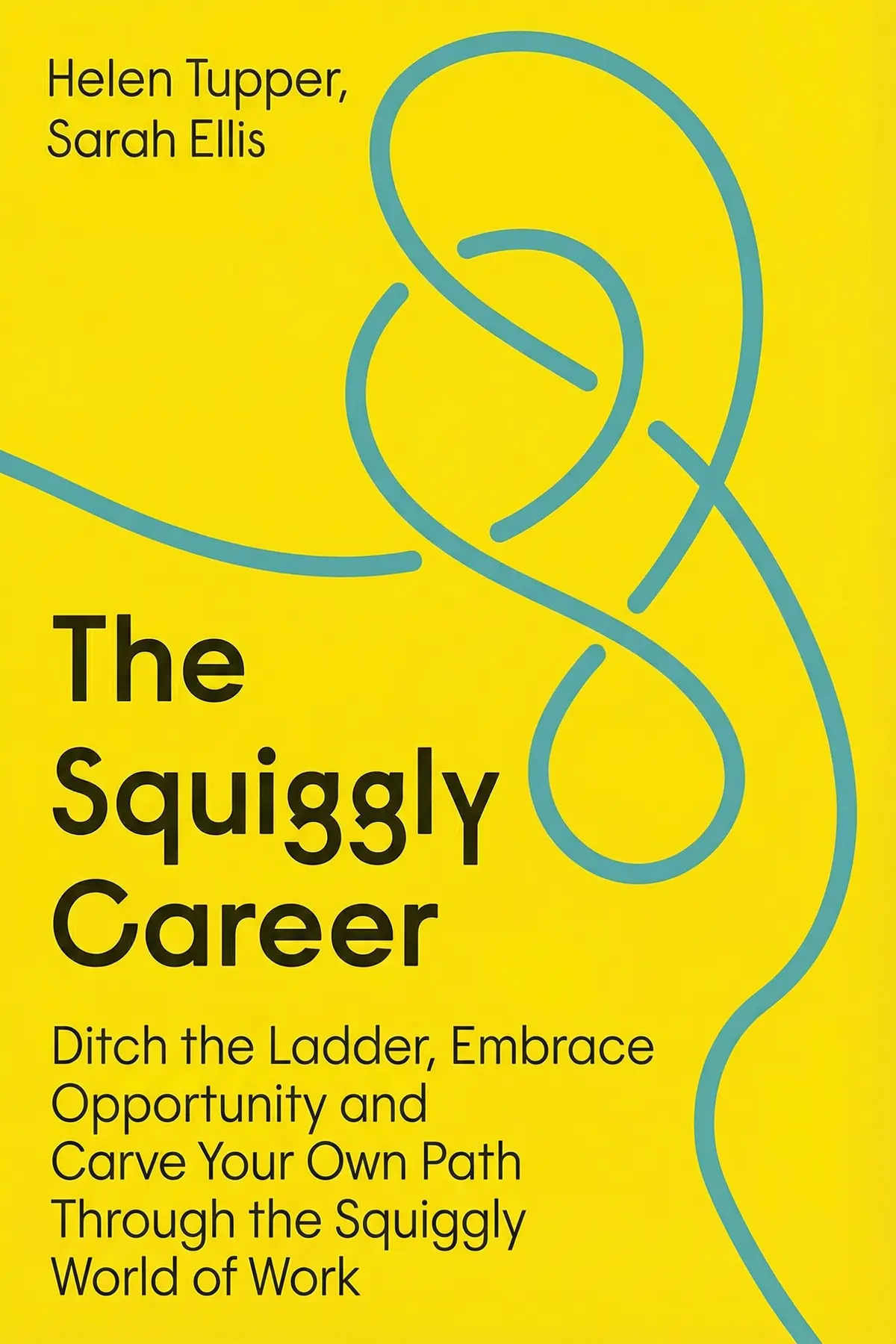
Table of Content
1. Introduction
55 sec
Most of us will spend around 90,000 hours at work, and few of those hours will now be spent climbing one company’s ladder toward a gold watch and a pension. In The Squiggly Career, Helen Tupper and Sarah Ellis, cofounders of the careers company Amazing If, argue that this is good news for anyone willing to steer. Careers now zigzag between roles and industries.
A path like that needs a different kind of map. It is drawn from your strengths, your values and your confidence, a network built on helping each other, and several possible futures explored at once, so that every move is chosen, not drifted into.
Along the way come a test for whether to stay in a job, a feedback formula for your next meeting, and the salary level beyond which more money stops adding to well-being.
2. Turn frequent job changes into a selling point
1 min 37 sec
Moving between jobs once looked like a warning sign to employers. A study of automation and another of flexible hours suggest the old career rules are breaking, with a catch the authors refuse to hide.
3. Spend most of your time on super strengths
1 min 38 sec
Trying to be good at everything feels like the safe bet in an uncertain career. A Gallup finding and a simple reversal exercise suggest a different split of your effort, and a reason to stop hiding what you do best.
4. Find the few values steering your choices
1 min 39 sec
A generous salary, a company car and free lunches can still leave a job feeling empty. The authors trace that emptiness to beliefs formed long before your first job, in three distinct stages of growing up.
5. Train confidence like any other skill
1 min 44 sec
Stage fright and self-doubt can feel like permanent features of your personality. The authors treat them as named opponents you can study, test and beat, with a pastry as part of the plan.
6. Build a network around what you want to learn
1 min 41 sec
Late-night scrolling through old contacts during a job search reveals how neglected most networks are. Research on friendship limits and company diversity points to a smaller, more useful way to connect.
7. Sketch four futures instead of one plan
1 min 36 sec
Planning a single career route assumes the destination will still exist when you arrive. The authors offer four kinds of future to write side by side, and one question that should judge all of them.
8. Stay ready with curiosity, feedback and grit
1 min 40 sec
Every new job asks for skills the last one never needed. The authors single out three abilities that travel with you, including a two-part feedback sentence that makes criticism easier to give and to hear.
9. Decide whether to stay or go on evidence
1 min 45 sec
The urge to leave a job returns again and again in a winding career. Studies on salary, training and failed startups suggest the questions to ask before you hand in your notice.
10. Conclusion
1 min 05 sec
Tupper and Ellis swap the question of how to climb for a different one: which way to move next, and why. A career without a ladder still has structure, they argue, but you build it yourself, from what you do best, what you value, the people who back you and a few futures worth testing. A zigzag stops looking like drift once each turn is chosen.
The book ends with a simple practice. For a week or two, write down one success every day, or score each day in steps forward and steps back. Then read the list. More steps forward is good news; more steps back is material to learn from. Pair it with a count of how often you used a super strength, and one specific question sent to someone doing work you might want. When the next stay-or-go moment comes, weigh it against your learning, your values and that $75,000 line before the paycheck decides for you.
Ninety thousand hours is too long to spend on a ladder someone else built.
About this book
What is this book about?
Few people still spend their working lives at one company, waiting for promotions and retiring with a pension. Careers now move between roles, projects and industries, and automation keeps changing which jobs exist. That gives people more freedom than earlier generations had. It also means nobody hands you a map. Helen Tupper and Sarah Ellis, cofounders of the careers company Amazing If, argue that this kind of career can be designed. Their approach starts with self-knowledge: the super strengths others see in you, the three to five values you formed in childhood and adolescence, and the fears they call confidence gremlins. From there they show how to build a network around what you want to learn, how to sketch four kinds of possible future instead of one rigid plan, and which skills keep you ready to change. Readers get practical tools: an 80/20 split between strengths and weaknesses, a support solar system, the what went well, even better if feedback format, and evidence-based questions for deciding whether to stay in a job or leave. The result is a way to make each turn in a winding career a deliberate choice.
Book Information
Who it's for
Career changers
Professionals who have changed jobs or industries and want their path to feel chosen.
Early in their careers
Early-career workers unsure which direction to take when no promotion ladder exists.
Stuck in a role
People stuck in a role and weighing whether to stay, retrain or move on.
About the Author
Helen Tupper
Helen Tupper and Sarah Ellis cofounded Amazing If, a company that aims to improve careers for everyone, and they host the weekly Squiggly Careers podcast. Tupper held leadership roles at Microsoft, Virgin, BP and E.On, including Commercial Marketing Director at Microsoft UK, and is a qualified coach with an MBA from Henley. Ellis worked in marketing and corporate responsibility for Boots, Barclays and Sainsbury's, earned an MBA with distinction from Warwick Business School and is a qualified Mental Health First Aider.
Ratings & Reviews
Ratings at a glance
What people think
Listeners value the book’s uplifting take on non-traditional career progression, although views are mixed regarding the level of detail provided about future professional paths. They find the organized frameworks for discovering "super strengths" and personal values to be extremely beneficial for self-evaluation. Additionally, listeners point out that the integration of external tools like apps and podcasts enhances the experience, with one listener highlighting that the activities are particularly advantageous when getting ready for interviews or pivoting to a new position. They also feel the "confidence gremlins" concept provides a grounded and useful method for tackling insecurities on the job.
Top reviews
Jin
The concept of the 'career ladder' has always felt suffocating to me, so this was a breath of fresh air. Tupper and Ellis argue that the traditional path is dead, and in its place is a vibrant, non-linear journey that they call the 'squiggly career.' I found the exercises on identifying 'super strengths' to be incredibly illuminating because they force you to look at natural talents rather than just a list of job duties. Truth is, we spend about 90,000 hours of our lives working, so why settle for a linear path that doesn't fit? The authors provide a brilliant framework for navigating this messiness. My favorite part was the personal manifesto section, which helped me define my career DNA beyond just a job title. This book is an essential toolkit for anyone feeling stuck in the old way of thinking. It is practical, encouraging, and deeply relevant for today’s fast-moving job market.
Show moreSiraporn
Finally got around to finishing this after listening to their podcast for months, and it did not disappoint. The way Tupper and Ellis break down 'super strengths' versus 'learnt strengths' is a game-changer for how you present yourself on a CV. I used their SRI (Situation, Result, Impact) feedback framework during a recent performance review and the results were immediate. The book is packed with external resources, referencing everything from HBR articles to TED talks, which makes it feel like a curated masterclass. I especially loved the section on 'meaningful mentors' versus 'mentors of the moment.' It took the pressure off finding one single person to guide my entire life. The truth is, our careers are messy, and this book gives you the permission to embrace that chaos. It's an empowering read that shifts the power back to the employee. I’ll be buying copies for my entire team this Christmas.
Show morePetch
Wow, I wish I had read this five years ago when I was feeling guilty about my 'job-hopping' history. This book validates the idea that trying different routes actually builds a more robust and adaptable skill set. The '90,000 hours' statistic really put things into perspective for me—life is too short to be in a role that doesn't align with your values. I spent a whole weekend working through the 'values' discovery steps, and it was a revelation. It turns out that my frustration wasn't about the work itself, but about the lack of autonomy in my previous organization. The authors provide a compass, not a map, and that is exactly what a modern career requires. It’s an interactive experience, not just a passive read. If you actually do the exercises, you will get so much more out of it. It’s the most practical career book I’ve read in years.
Show moreLillian
The 'what went well & even better if' framework is something I’ve already started using with my team, and the culture shift is palpable. This isn't just a book for individuals navigating their own paths; it’s a great resource for managers who want to support their employees' growth. We are working across five generations now, and the 'squiggly' approach is the only one that makes sense for everyone from Gen Z to Baby Boomers. The authors have a gift for taking complex career theories and turning them into actionable steps. Whether it's building 'career karma' through networking or taming your confidence gremlins, the advice is always grounded in real-world application. I particularly appreciated the 'random person rule' for building curiosity. It’s such a simple way to expand your horizons. This book is a must-read for anyone who wants to stay relevant in an era of automation and constant change.
Show moreManop
Picked this up during a particularly messy transition between roles and it really helped calm my nerves. The authors do a great job of explaining why job-hopping isn't the red flag it used to be. In fact, they celebrate the adaptability that comes with a non-linear path. I spent a lot of time on the 'support solar system' exercise. It made me realize that my professional network was way too insular and needed more diversity to truly thrive. To be fair, the writing style can be a bit repetitive at times, and some of the alliteration feels forced. But the core message about taking ownership of your own development is vital. I’ve already recommended the 'what went well & even better if' feedback loop to my manager. It’s a practical, no-nonsense guide that focuses on action over theory. Definitely worth having on your shelf for interview prep or annual reviews.
Show moreMadison
As someone who has struggled with workplace anxiety, the section on 'confidence gremlins' was a total game-changer for me. Identifying the specific thoughts that hold me back allowed me to challenge them with logic rather than just feeling overwhelmed. The 3 Ds of networking—discerning, deliberate, and diverse—offered a much more manageable way to think about building relationships. I used to hate the idea of networking, but viewing it as an exchange of help makes it feel much more authentic. The writing is accessible and the tone is incredibly supportive throughout. I do wish there were more case studies from industries outside of marketing and tech, as some of the advice felt a bit specific to those worlds. Still, the core principles of self-reflection and proactive growth are universal. It helped me prepare for a recent pivot into the charity sector with much more confidence.
Show moreTakeshi
After hearing Adam Grant recommend this, I had high expectations, and for the most part, they were met. The focus on being a 'learn-it-all' rather than a 'know-it-all' is a philosophy I’ve tried to adopt, and this book provides the roadmap to do it. The distinction between 'what' and 'how' strengths was particularly useful for my latest interview prep. It allowed me to talk about my project management skills in a way that highlighted my stakeholder management and risk-spotting abilities. My only gripe is that some of the 'future skills' sections felt like they were added as an afterthought. I would have loved to see more on 'grit' and how to build it over time. Nevertheless, the 'personal manifesto' idea is something I’ll be using to keep myself focused this year. It’s a very modern take on professional development that feels grounded in reality.
Show moreNathan
Ever wonder if career advice has actually kept up with the 21st century? This book certainly tries, and while the early chapters on 'confidence gremlins' are fantastic, the later sections felt a bit thin. Personally, I found the activities for mapping out values to be the most useful part of the entire experience. It helped me realize why I was feeling so frustrated in my current role—it just didn't align with my core drivers. However, I was disappointed by the 'Future Possibilities' chapter. It promised a lot of depth but felt more like a list of prompts I could have found on a blog. Look, it's a solid read if you are early in your career or looking for a pivot. But if you’ve already read a lot of Adam Grant or Arianna Huffington, some of this might feel like familiar territory. It’s a good starting point, but perhaps not the deep dive I expected.
Show moreKai
Frankly, it’s a bit of a mixed bag for those of us further along in our careers. While the 'career ladder is gone' premise is spot on, the exercises felt geared toward people just starting out. I did enjoy the section on 'Future Possibilities,' though I agree with other reviewers that it could have used more meat. The authors suggest exploring four types of possibilities—obvious, ambitious, dream, and pivot—which is a helpful mental model. However, the execution of these ideas felt a bit rushed compared to the lengthy chapters on values. To be fair, the focus on 'curiosity, feedback, and grit' as future-proof skills is a great takeaway. It’s a quick read, and the layout is very user-friendly with plenty of space for notes. If you want a structured way to reflect on your path, it’s worth a look. Just don't expect it to provide all the answers to your mid-life career crisis.
Show moreAnna
Maybe I’m just not the target audience, but this felt like a collection of LinkedIn posts stretched into a book. While I appreciate the attempt to modernize career advice, the constant 'squiggly' terminology became grating after the third chapter. Frankly, the 'confidence gremlins' idea is cute, but it lacks the psychological depth I was hoping for in a professional development text. I found myself skimming the networking section because it felt like common sense repackaged with catchy alliteration. If you've never read a career book, this might be a goldmine, but for anyone else, it’s a bit repetitive. Not gonna lie, the tone was a bit too 'corporate cheerleader' for my taste. It kind of made me want to self-yeet rather than embrace my supposed super strengths. I was looking for grit and data, but I found mostly fluff and colored charts.
Show moreQuestions about this book
What is The Squiggly Career about?
Helen Tupper and Sarah Ellis argue that linear career ladders are fading and that careers now zigzag between roles and industries. That gives people more freedom but no map. Their answer is to build one from self-knowledge and relationships: develop your super strengths, live your values, train your confidence, grow a network based on mutual help, explore several possible futures and judge each job move on clear questions.
What are super strengths in The Squiggly Career?
Super strengths are the qualities colleagues and family associate with you when you are not in the room, things you do really well. The authors want them used often and visibly. They recommend spending about 80 percent of your time developing strengths and 20 percent on the weaknesses that hurt performance, citing a Gallup finding that people using their strengths are six times as engaged.
What are the four career possibilities in The Squiggly Career?
The authors suggest writing out four futures. The obvious option is the logical next step, where you would end up if you kept doing what you do now. The pivot uses your skills in a fresh way. The ambitious possibility is something you have set aside because of a hurdle, such as missing experience. The dream is what you would do with nothing holding you back. Each is then tested against why you work.
How does The Squiggly Career help you decide whether to leave a job?
If you are happy and still learning a lot, the authors advise thinking twice before leaving. For a new role, ask whether it uses your super strengths and values or mainly offers more money, since Kahneman and Deaton found salary stops affecting well-being past about $75,000. If your employer offers no training, look for grants, self-directed study or side projects before deciding.
Who should read The Squiggly Career?
It suits people whose careers do not follow a straight line: job changers, early-career workers without a clear ladder, and anyone feeling stuck in a role. Its tools are practical, from the confidence gremlin and the support solar system to the what went well, even better if feedback format and a weekly log of steps forward and back.
Readers also enjoyed


60 Seconds & You’re Hired!
Robin Ryan



Be A Free Range Human: Escape the 9 to 5, Create a Life You Love,
Marianne Cantwell
Be the Unicorn: 12 Data-Driven Habits That Separate the Best Leaders from the
William Vanderbloemen
AUDIO SUMMARY AVAILABLE
Listen to The Squiggly Career in 15 minutes
Get the key ideas from The Squiggly Career by Helen Tupper, plus 5,000+ more nonfiction titles.
- 5,000+ titles
- Listen as much as you want
- 7-day free trial
- Cancel anytime









