


14 min 49 sec
Available in: English
The Social Brain: The Psychology of Successful Groups
Shows why human groups start to fray past about 150 people, and how small teams, workplace friendships, shared rhythm and trust in the honest majority make organizations healthier and more productive.
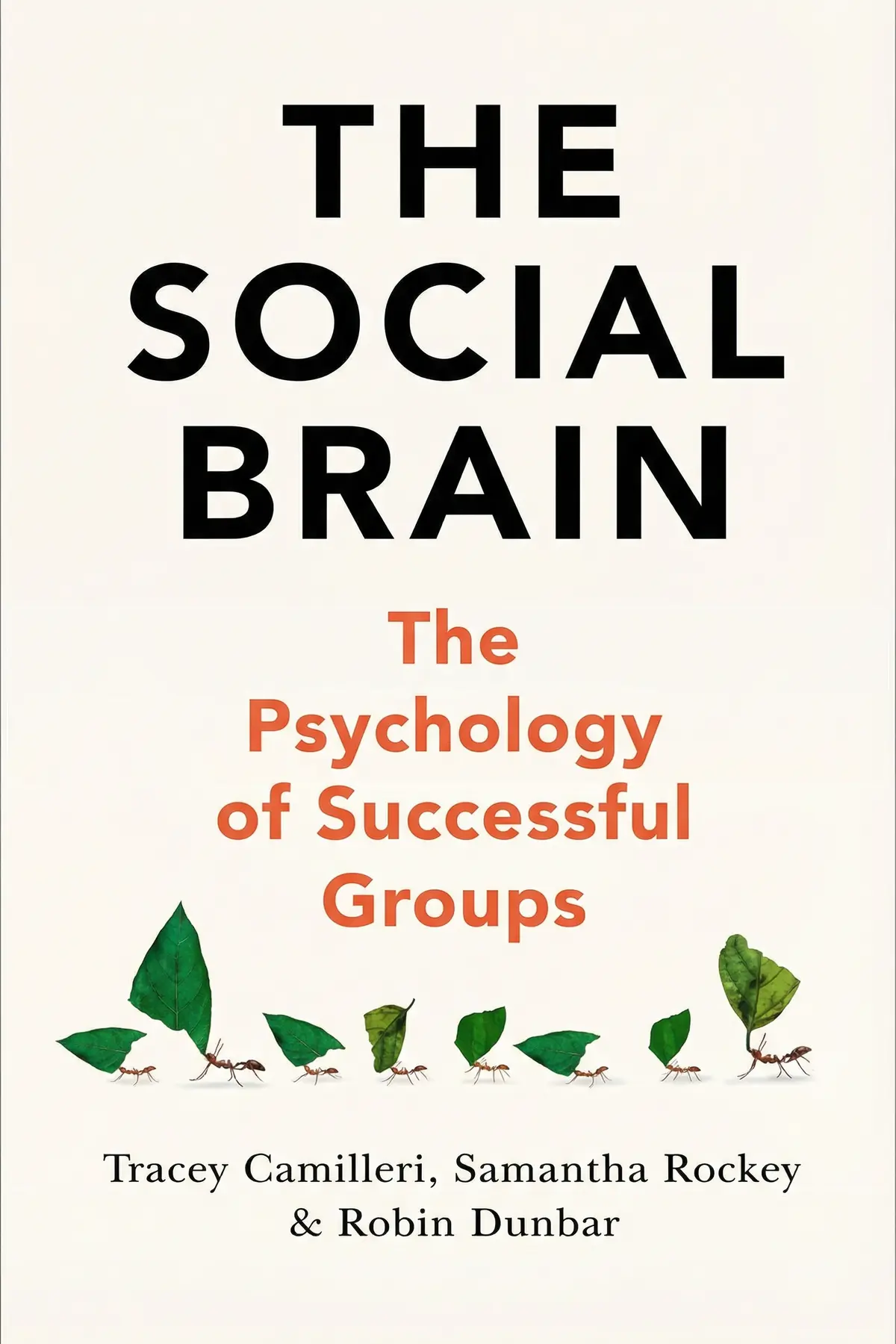
Table of Content
1. Introduction
1 min 04 sec
If you lead a team that keeps growing, you may have noticed that the warmth and speed of the early days start to fade around a certain size. In The Social Brain, Oxford’s Tracey Camilleri and Samantha Rockey, writing with evolutionary psychologist Robin Dunbar, put a number on that moment: about 150, the most meaningful relationships a human brain seems able to hold. Past that line, cooperation in human groups tends to fray.
The authors argue that this limit is no accident. Our brains were built for a small world of close bonds, and organizations work best when they are designed around that wiring. That means small units, real friendships, a shared rhythm and rules written for the honest majority.
The evidence runs from rowing crews studied by Oxford researchers to Hutterite settlements, a Dutch nursing company and a coffee station watched by a picture of eyes. Each idea ends in a change you can make to how your own team meets, mixes and decides.
2. Know the limits of your social world
1 min 58 sec
The same number turns up in medieval village records, army units and social media networks. It points to a ceiling inside every human head, and to a pattern in how we sort the people we know.
3. Keep teams small enough to trust each other
1 min 49 sec
A close-knit community that has kept the same habit for over a century splits itself in two at a very specific size. Its reasons match what software teams and elite soldiers have found about group size.
4. A best friend at work boosts your engagement
2 min 20 sec
Night-shift railway workers in the cold turned out to be in better mental shape than warehouse staff indoors. The reason links heart attack survival, employee engagement and something as ordinary as a lunch break.
5. Build teams with just enough in common
2 min 09 sec
People who share almost everything become close friends, yet they rarely produce the boldest ideas. An insurance company tested where the right balance lies, and the answer sits somewhere surprising.
6. Move in rhythm to build trust faster
1 min 57 sec
Rowers putting in exactly the same effort got very different chemical rewards depending on one condition. Theaters and armies have used the same effect for years, and offices can borrow it too.
7. Design your rules for the honest majority
2 min 17 sec
Diamond dealers trade fortunes on a handshake, while many companies cannot trust staff with an expense form. A nursing company in the Netherlands shows which response to broken trust actually works.
8. Conclusion
1 min 15 sec
The Social Brain makes an unusual case for management: the most useful facts about your organization may be biological. A brain that can hold about 150 relationships, and only five truly close ones, will not change because an org chart grows. What can change is the shape of the group around it. The Hutterites split at 167. Gore gives every employee a sponsor. Buurtzorg lets ten nurses run their own care. Each one bends the structure to fit the people and never waits for the people to stretch.
For your own team, the book points to a few moves. Keep working units small, close to the inner ring of five, and link them in a network as you grow. Make regular room for people to be together, ideally doing something in rhythm, whether that is a shared lunch or a weekly walk. When someone breaks trust, deal with that person and leave the rules for everyone else alone.
Picture the three railway workers again, cold and tired at three in the morning, and still in better mental shape than the warehouse worker who rarely speaks to anyone. On the book’s evidence, the cold was never the problem. Being alone was.
About this book
What is this book about?
Teams grow, meetings multiply and the closeness of the early days fades. Most organizations treat this as a management problem. The authors of The Social Brain treat it as a biological one. Drawing on Robin Dunbar's research into human social networks, they argue that our brains can sustain about 150 meaningful relationships, arranged in rings from five intimate bonds outward, and that groups behave differently once they pass those limits. From that starting point the book looks at what makes groups work: why teams of three to five outperform larger ones, why a best friend at work predicts engagement, how shared traits such as humor and music shape who bonds, why moving in rhythm releases trust-building chemicals, and why a few freeriders can sour a whole system. The cases range from Hutterite settlements and Gore's sponsors to rowing crews, a coffee station watched by printed eyes and the Dutch nursing company Buurtzorg. Readers get a set of practical design choices for any team or community: how big to make it, how to mix it, how to bring it together and how to respond when trust breaks.
Book Information
Who it's for
Leads of growing teams
Team leads whose groups have grown past the point where everyone knows everyone.
Founders weighing company structure
Founders deciding how to structure a company as it scales beyond a few dozen people.
HR and learning teams
HR and learning professionals trying to raise engagement, collaboration and trust without adding more controls.
About the Author
Tracey Camilleri
Robin Dunbar is an emeritus professor of evolutionary psychology at the University of Oxford. He began his career studying how wild monkeys and antelope in Africa relate to one another, and his research has covered the behavioral ecology of hoofed animals and primates, including humans, and the mental processes behind animal choices. He is best known for the social brain hypothesis, or Dunbar's number. Tracey Camilleri and Samantha Rockey are Associate Fellows at Oxford Saïd Business School, part of the University of Oxford.
Ratings & Reviews
Ratings at a glance
What people think
Listeners find *The Social Brain* to be an illuminating and rigorously documented investigation into the invisible structures that drive human interaction and group behavior. They value the thorough examination of "Dunbar’s number" and the realization that biological boundaries impact every organizational level, from intimate teams to major companies. While the material is described as high-quality and discerning, perceptions differ regarding the book's scholarly tone and extensive use of graphs. They also point to the functional benefits of the scientific data, with one listener highlighting that the sections on synchronized behavior and building trust are remarkably engaging.
Top reviews
Elise
As someone who manages a growing startup, I found the breakdown of Dunbar’s number to be a complete revelation. We often try to scale our teams without considering the biological limits of the human brain, and this book explains exactly why that backfires. The authors dive into how our frontal lobes and limbic systems can only handle about 150 meaningful connections before the social fabric starts to fray. I particularly enjoyed the section on the 'kinship premium,' which explains why we treat close colleagues almost like family. It’s a dense read, but the insights into how small teams of five are the most productive units were worth the effort. Frankly, it changed how I plan to structure our next hiring phase.
Show moreMilk
Wow. I didn't realize how much my physical environment and the size of my immediate team were affecting my mental health until I read the comparison between railway workers and warehouse staff. The authors make a compelling case for the necessity of human interaction and shared breaks. It’s not just about 'being social'; it’s about a biological need for connection that drives performance and resilience. The concept that only 1% of people are responsible for 25% of the lies in a network was a huge 'aha' moment for me. This book provides a scientific lens for things we often only feel intuitively. It's hella insightful and definitely worth the slow read.
Show morePracha
Finally got around to reading this, and the section on the Seven Pillars of Friendship was incredibly timely. It explains how shared musical tastes, worldviews, and even humor act as the glue for successful teams. The authors argue that while diversity is essential for innovation, a certain level of common ground is needed to prevent total misunderstanding. I’ve started looking at my own professional network differently, identifying where those pillars are missing. The book is dense and requires focus, but the payoff is a much deeper understanding of the hidden patterns that shape our communities. It’s easily one of the most researched books on group dynamics I’ve ever encountered.
Show moreMaja
This book is absolutely eye-opening for anyone who works in a large organization. It’s not just another management book; it’s a deep dive into the evolutionary anthropology of why we fail when we get too big. The idea of 'splitting' communities once they exceed their natural size, much like the Hutterites do, is such a simple but radical solution for corporate bloat. I loved the data showing that smaller teams of 3-5 people actually have 72% higher productivity. It makes you realize that most of our modern working habits are fighting against our biology. If you can handle the academic tone, the insights are gold.
Show moreLeila
The chapter on synchronized activity was the highlight of this book for me. Seeing the data on how rowing in sync can actually double your endorphin release compared to working out alone was fascinating. It makes so much sense why shared rhythms—whether in a choir or a high-stakes military unit—create such unshakable trust. Look, the writing style is quite serious and analytical, which might turn off readers looking for a breezy self-help book. But if you want a well-researched overview of how groups actually function beneath the surface, this is it. It balances neuroscience with real-world examples like the Hutterites and the Buurtzorg healthcare model. A very high-quality resource for leaders.
Show moreFort
Picked this up to better understand group cohesion, and the authors deliver a very high-quality analysis of how we are biologically capped. The book explains that humans are neurologically equipped for layers of connection—from our inner circle of five to the broader 150. I found the discussion on trust particularly relevant, especially the warning against using excessive monitoring to solve social problems. Instead of fixing issues, rigid controls just breed resentment. My only gripe is that it leans a bit too heavily into the corporate perspective at times. Still, the variety of examples, from medieval villages to modern software teams, keeps the core arguments grounded and applicable.
Show moreOmar
In my experience, books that mix neuroscience with leadership can be hit or miss, but this one definitely hits. The authors do a great job of explaining how trust is a fragile resource that can be poisoned by just a few bad actors. I was particularly struck by the Buurtzorg model of self-managing teams; it’s a refreshing alternative to the top-down surveillance we see in so many companies today. While the book is quite dense and relies heavily on data points, the real-world case studies like the Amsterdam diamond district keep it from being too dry. It’s a thoughtful exploration of what it means to be a social creature in a digital age.
Show moreOrathai
Ever wonder why your office feels so disconnected despite all the team-building retreats? This book tries to explain it through evolutionary anthropology, though it occasionally gets bogged down in its own academic density. To be fair, the research is top-notch and the 'Seven Pillars of Friendship' provided a great framework for understanding why I click with certain coworkers but not others. However, I’ve come across many of these concepts before in other social psychology texts. If you aren't familiar with Dunbar’s 150-person limit, this will be eye-opening. For me, it was a solid refresher that felt a bit like a textbook. I found myself skimming the more corporate-heavy recommendations toward the end.
Show moreSiraporn
Frankly, if you've studied social psychology before, most of the content regarding the 150-person limit will feel like a refresher course. The book is essentially an expanded study on Dunbar’s number and its implications for modern business. While it is well-written and the research is undeniably solid, I didn't learn anything particularly new or applicable that I hadn't already read in a dozen LinkedIn articles. That being said, for those who are new to these concepts, it’s a good source for the factors that contribute to group performance. It’s just a bit repetitive if you’re already familiar with the 'kinship premium' or the benefits of small, agile teams.
Show moreAurora
Not what I expected from the title. I was looking for something more intuitive about human connection, but this felt like a math-heavy manual filled with too many graphs and rigid rules. I personally struggle with books that try to reduce human relationships to specific numbers and charts. It feels a bit reductive to say our social potential is capped at exactly 150 people just because of our brain size. While the authors are clearly experts, the tone was exceptionally academic and dry. I found myself taking several naps while trying to push through the middle chapters. If you enjoy data-driven corporate strategy, you’ll love it, but it wasn’t for me.
Show moreQuestions about this book
What is the main idea of The Social Brain?
The authors argue that the human brain can maintain only about 150 meaningful relationships, arranged in rings from five intimate bonds outward. Because of that wiring, organizations work best when they keep units small, make room for real friendships, bring people into shared rhythms and design their rules around the trustworthy majority. They support this with cases ranging from Hutterite communities and Gore to rowing crews and the Dutch nursing company Buurtzorg.
What is Dunbar's number?
Dunbar’s number is the roughly 150 meaningful relationships a person can keep at one time. Robin Dunbar found it by comparing group sizes in hunter-gatherer societies, old villages, armies and companies, and social media studies point the same way. Inside the 150 are layers: about five intimate contacts, fifteen in a sympathy group, and fifty in a wider circle. Brain regions such as the frontal lobes and limbic system set the limit.
What is the ideal team size according to The Social Brain?
The book points to small teams of about five or fewer. A study of software teams found groups of three to five were 72 percent more productive than groups of nine or more, and special forces keep teams to four or five. For larger organizations, the authors suggest a network of small units, much as Hutterite settlements split at around 167 members to stay a workable size.
What are the Seven Pillars of Friendship?
Seven traits forecast how tightly two people connect: the way they speak, their place of origin, their work history, pastimes, outlook on life, humor style and taste in songs. Sharing six or more usually means a close, lasting bond. For innovation, though, a global insurance company found that teams sharing three or four pillars, and differing on the rest, outperformed both very similar and very diverse teams.
How can a leader apply The Social Brain at work?
Keep teams small and connect them, rather than letting one group swell. Create shared time, such as overlapping breaks or daily communal lunches, which in one warehouse raised cross-team collaboration by 27 percent. Use rhythmic group activities to build trust. When trust breaks, avoid blanket controls: the Harvard Business Review figures the book cites link high-trust companies to less stress and higher productivity.
Readers also enjoyed



A Year with Peter Drucker: 52 Weeks of Coaching for Leadership Effectiveness
Joseph A. Maciariello




Acting with Power: Why We Are More Powerful Than We Believe
Deborah Gruenfeld

59 Seconds: Change Your Life in Under a Minute
Richard Wiseman

All In: How Great Leaders Build Unstoppable Teams
Mike Michalowicz
AUDIO SUMMARY AVAILABLE
Listen to The Social Brain in 15 minutes
Get the key ideas from The Social Brain by Tracey Camilleri, plus 5,000+ more nonfiction titles.
- 5,000+ titles
- Listen as much as you want
- 7-day free trial
- Cancel anytime









