

13 min 20 sec
Available in: English
The Sleep Prescription: Seven Days to Unlocking Your Best Rest
By Aric Prather
A seven-day plan from an insomnia specialist that shows how daytime choices about waking, caffeine, stress, worry, screens and the bed itself decide how well you sleep, and how to retrain each one.
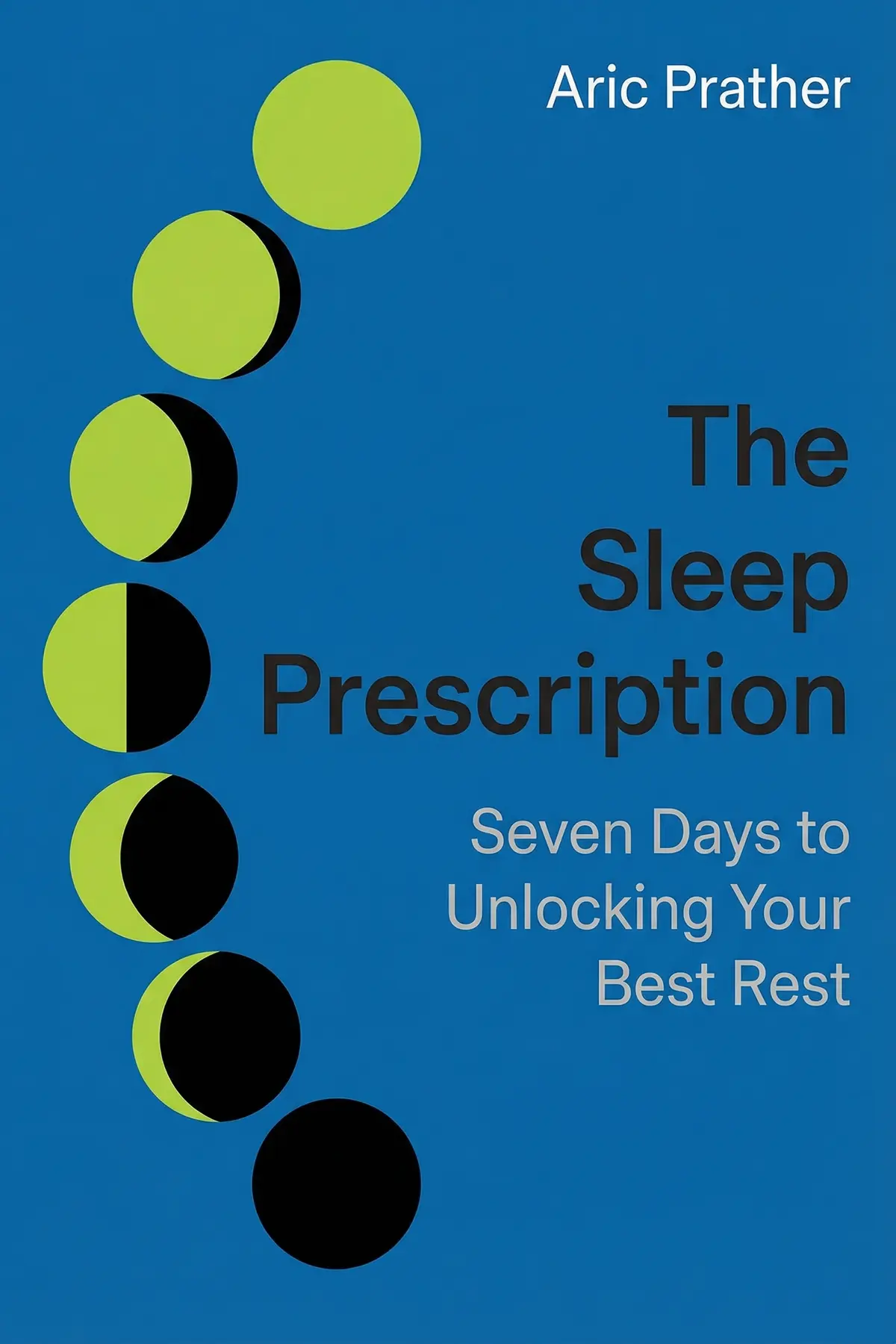
Table of Content
1. Introduction
59 sec
If you lie awake at night and drag yourself through the day, the fix may start hours before bedtime. In The Sleep Prescription, Aric Prather, a psychiatry professor and clinical psychologist who treats insomnia, argues that a good night begins with the choices you make from the moment you get up. Sleep has grown hard partly because modern life is not built for rest. The rest of the blame falls on us: small decisions about coffee, screens, worry and the bed itself shape what happens after dark.
Prather spreads his plan over seven days, one practice per day. The throughline is simple. Your body keeps a clock and builds a pressure to sleep, and your mind learns what the bed means, so steady daytime habits can retrain all three. By the end of the week you have a fixed wake-up time, a way to park your worries, an evening routine that slows the brain and a plan for the nights when sleep still refuses to come.
2. Fix one wake-up time and reset your clock
1 min 37 sec
A lion rests up to twenty hours and a giraffe gets by on fewer than five. Human needs are far more modest, yet one simple morning decision does more for our nights than almost anything we try at bedtime.
3. Beat the 3 p.m. slump and still sleep tonight
1 min 42 sec
The heavy-eyed feeling in mid-afternoon seems like proof you slept badly. Prather reads it differently, and his view on coffee will relieve anyone who dreaded giving up their favorite cup to sleep better.
4. One good night makes stress easier to carry
1 min 42 sec
A brutal day at work predicts your night far less than most people expect. The real danger runs in the opposite direction, and Prather argues it hands you two separate chances to break the cycle.
5. Give your worries a fifteen-minute appointment
1 min 36 sec
The thoughts you dodge all day tend to be waiting for you on the pillow. Prather’s fix sounds backward at first: make room for more worry, at a time of your own choosing.
6. A two-hour wind-down that switches your brain off
1 min 40 sec
Drifting off feels gradual, yet the brain treats it more like a switch. Blue light gets most of the blame for jamming it, though Prather points to a bigger problem sitting on your phone.
7. Teach your bed to mean sleep again
1 min 30 sec
Plenty of people feel drowsy on the couch and wide awake the instant they lie down. The cause is a lesson their bodies learned without meaning to, and learned lessons can be replaced.
8. Staying up later helps you fall asleep faster
1 min 32 sec
The boldest practice in this book asks people who already struggle to sleep to go to bed later than they do now. It sounds like a recipe for exhaustion, and in a sense that is the plan.
9. Conclusion
1 min 02 sec
Sleep, in Prather’s telling, is less something you do at night than something you prepare all day. The world will not make it easy, and our own small decisions often make it harder. But the systems behind sleep respond to training: a clock that learns from regular mornings, a mind that can be given a set time to worry, a bed that can be taught to mean rest, and a pressure that grows if you let it.
That gives a single week of small experiments real stakes. Set your alarm for the same time every morning and treat it as the anchor that never moves. When the bed starts to feel like a place for lying awake, leave it and return only when drowsy, even if that means a later night for a while. And when the afternoon dip arrives, try a walk before the coffee machine, keeping your last cup well away from bedtime.
None of it asks for a new mattress or a perfect day. Prather’s promise is narrower and more useful: the person who gets up tomorrow already holds most of the controls for tonight.
About this book
What is this book about?
Sleep is as basic a need as food or water, yet for many people it has turned into hard work. Aric Prather, a psychologist who specializes in treating insomnia, blames two things. One is a world that pushes rest to the bottom of the list. The other is us: the small choices we make all day without seeing what they cost us at night. His argument is that a good night starts the moment you get up. The body runs a master clock that learns from routine, builds a pressure to sleep through every waking hour and links places with states of mind. Stress, worry, caffeine and screens all push on those systems, and each can be pushed back. The book is laid out as a seven-day plan, one practice per day. Readers fix a wake-up time, take short breaks, swap the afternoon coffee for a walk, schedule fifteen minutes of deliberate worry and build a two-hour wind-down. They also retrain the bed as a place for sleep and, when nights stay restless, use a very late bedtime to rebuild their drive to sleep.
Book Information
Who it's for
Light sleepers
Light sleepers who feel tired on the couch and wide awake the moment they lie down.
Desk workers emailing late
Desk workers who lean on afternoon coffee and answer emails until their eyes close.
Replaying worries at bedtime
Anyone whose worries replay at bedtime and who wants a short, structured plan to try for one week.
About the Author
Aric Prather
Aric Prather, PhD, is a professor of psychiatry and behavioral sciences at the University of California, San Francisco. He is also a licensed clinical psychologist whose specialty is cognitive behavioral therapy for insomnia, and he sees patients with sleep problems in his clinic. The Sleep Prescription is the second book in a series of three, alongside The Love Prescription and The Stress Prescription.
Ratings & Reviews
Ratings at a glance
What people think
Listeners find this guide highly practical and simple to follow, featuring a realistic tone that ensures accessibility. The book assists listeners in achieving better rest, as one listener points out it is based on a program of sleep restriction. They value how digestible the material is and regard it as one of the best books on CBTi.
Top reviews
Ubolwan
Wow. This isn't your typical 'drink chamomile tea' sleep guide that you see all over the internet. Dr. Prather takes a very pragmatic, evidence-based approach to insomnia that feels like a condensed version of CBT-i. What I loved most was the concept of the 'homeostatic sleep drive' and the balloon metaphor. It really helped me understand why my naps were actually ruining my nights. The seven-day structure makes the daunting task of fixing your life feel manageable. It’s written with a sense of empathy that most medical books lack. I’m finally sticking to a consistent wake-up time, and while the first few days were rough, the 'sleep pressure' is finally working in my favor. If you’ve been struggling to find a science-backed method that doesn't feel like a chore, this is it. It’s short, punchy, and actually works if you follow the steps.
Show moreSukit
Finally got around to reading this and it’s a game-changer for those of us struggling with revenge bedtime procrastination. Prather’s advice isn't about being a monk; he actually says you can keep your screens if they help you wind down! That kind of realistic approach is so refreshing in the health space. The book focuses on the 'arousal systems' in the brain and how to transition from a hectic day into a restful state. I particularly enjoyed the section on sticking your head in the freezer to snap out of an afternoon slump. It sounds crazy, but it works! The seven-day format provides a clear roadmap that takes the guesswork out of the process. I’ve recommended this to three friends already because it’s the first sleep book I’ve finished that didn’t make me feel guilty about my habits.
Show moreAiden
As someone who has struggled with chronic insomnia for a decade, I appreciated that Prather doesn't demand total perfection. He’s a sleep scientist who actually understands that we live in the real world where people drink coffee and watch Netflix. The book explains the 'sleep drivers' in a way that finally clicked for me. I stopped focusing so much on the hours of sleep I was getting and started focusing on the quality and the consistency of my internal clock. This shift in perspective reduced my sleep anxiety almost immediately. The prose is lean and mean, with no fluff or filler to waste your time. It feels like a comforting hug from a doctor who actually gets it. I’ve tried the heavy hitters like 'Why We Sleep,' but this one is actually actionable. It’s easily the best CBT-i resource for the layperson on the market.
Show moreFatima
Prather manages to condense complex sleep science into a digestible week-long program that anyone can follow. Not gonna lie, I was worried this would be another boring textbook, but it's quite the opposite. The metaphors, like the balloon for sleep pressure, stay with you and help you make better choices throughout the day. I learned that simple carbs like white bread can actually cause more wake-ups at night, which was a total 'aha' moment for me. By switching to more complex carbs and stabilizing my wake time, I've seen a massive improvement in my 'sleep efficiency.' The charts and data points provided are excellent for tracking progress. It’s a very grounding read that reminds you that you were built to sleep. If you feel like your brain just won't shut down, this book provides the manual you've been missing.
Show moreJoseph
Ever wonder why you can't just 'shut down' your brain like a computer? Dr. Prather explains that we aren't machines, and our bodies need a 'wind-down' period that most of us completely ignore. This book changed how I view my entire day, not just my bedtime. I’ve started taking short, screen-free breaks like he suggests, and it has made a world of difference in my evening stress levels. The advice is grounded in science but delivered with a very human touch. I love that he acknowledges that things like meditation can actually make some people more anxious. It’s not a one-size-fits-all approach, which I found deeply refreshing. By the time I hit Day 7, I felt like I had a totally different relationship with my bedroom. It's no longer a place of struggle, but a place of rest. Truly a must-read for the modern, stressed-out adult.
Show morePan
After hearing about Prather's work on a podcast, I decided to give this 7-day plan a go. Personally, I found the chapter on 'Worry Early' to be the most transformative part of the whole book. For years, I’ve been taking my stress to bed with me, but setting aside specific 'worry time' during the day actually helped quiet my mind at 11 PM. The writing style is very accessible and avoids the heavy jargon that usually bogs down science books. My only gripe is that the physical sleep journal at the back is a bit small for my handwriting, so I ended up using a separate notebook. To be fair, most of the advice is common sense if you’ve studied sleep hygiene before. However, the way it’s packaged into a week-long challenge makes it much easier to implement than just reading a list of tips on a website.
Show moreRin
Picked this up because my internal clock felt completely broken after months of late-night working. The book is incredibly easy to read and I managed to finish it in just two sittings. Prather has a very conversational voice that makes complex medical concepts feel like a chat with a friend. I was skeptical about the 'stay up late' advice on Day 7, but it really helped reset my sleep drive. My only minor complaint is that the anecdotes about clinic patients started to feel a bit repetitive after a while. However, the summaries at the end of each chapter are golden for quick reference. It’s a very pragmatic guide that focuses on what you do during the day, not just the thirty minutes before bed. My sleep isn't perfect yet, but the ripple effect on my daily energy levels is already noticeable.
Show moreGun
The chapter on 'Ease off the Gas' offered some decent insights, but I found the rest of the book a bit basic for my needs. Look, if you’re a traditional insomniac who can’t fall asleep, this will be your bible. But for those of us who wake up at 3:00 AM and can’t get back to sleep? The author basically admits there isn't a magic fix for that once the sleep pressure has drained away. That was a bit of a letdown. I did appreciate the science regarding how our master clock is shaped by our DNA, but much of the 'prescription' felt like things I’ve heard a million times before. Stop the caffeine early, don't drink booze, and keep the room cool. It’s a quick read and very well-organized, but don't expect earth-shattering revelations if you’ve already been down the sleep-research rabbit hole.
Show moreGung
In my experience, this book is a solid introduction to sleep hygiene, but it might leave seasoned insomniacs wanting more. The writing is great and the 7-day plan is a smart way to organize the material. That said, a lot of the 'prescriptions'—like avoiding naps and cutting caffeine—are things you can find in any basic health article. I did find the section on high rumination and how it affects our perception of stressful events to be quite insightful. It explains why neutral events can feel threatening when we are sleep-deprived. But did I need a whole book for this? Probably not. The author’s voice is soothing, and I actually fell asleep while reading it a few times, which I guess is a compliment! It’s a good gift for someone who doesn't know where to start, but experts can skip it.
Show moreChiw
Frankly, if you work the night shift or have a non-traditional schedule, save your money. This book is almost entirely geared toward the 9-to-5 crowd who can maintain a perfectly consistent wake-up time. As a nurse, my 'circadian rhythm' is constantly being assaulted by my shift rotations, and the author offers very little in the way of adaptations for people in my position. The tone is a bit too 'pull yourself up by your bootstraps' regarding the morning wake-up call. I also felt like the 7-day structure was a bit forced just to sell the 'prescription' gimmick. Most of this info could have been a PDF or a long-form blog post. While the science about neural pathways being like forest paths was an interesting metaphor, the practical application just wasn't there for my lifestyle. Disappointing.
Show moreQuestions about this book
What is the main idea of The Sleep Prescription?
Aric Prather argues that a good night begins with the choices you make after waking. The body runs a master clock shaped by routine, builds sleep pressure the longer you stay awake and learns to link the bed with either rest or alertness. His seven-day plan works on each of these, from a fixed wake-up time and short daytime breaks to a two-hour wind-down, a bed reserved for sleep and a temporary very late bedtime.
What is the most important rule for better sleep according to Aric Prather?
Prather calls a fixed wake-up time the number one strategy. Choosing one time and keeping it every day gives the circadian rhythm a steady signal, because the body learns to anticipate regular events such as waking, meals and bedtime. His second rule is to stay out of bed until you are actually ready to sleep, so the bed becomes a cue for rest instead of wakefulness.
Do I have to give up coffee to sleep better?
Prather says no. The issue is when you drink it, since caffeine can take around ten hours to clear the body, so a late afternoon cup can still be active in the evening. He also suggests that the 3 p.m. craving is often the body asking for movement, fresh air and a new setting, so a short walk outside can lift energy without costing you sleep that night.
What is sleep restriction in The Sleep Prescription?
Sleep restriction means going to bed very late for about a week to build up sleep pressure, which Prather compares to a balloon filling through the day. It reduces time in bed rather than sleep itself. Once you fall asleep faster and sleep better through the night, you move bedtime earlier bit by bit, and when the gains level off you have likely found your ideal schedule.
Who should read The Sleep Prescription?
It suits people who struggle to fall or stay asleep and want a short, practical plan instead of theory. Busy professionals who rely on afternoon coffee, people whose worries surface at bedtime and anyone who feels alert the moment they lie down will find a specific practice for their problem, written by a clinical psychologist who specializes in treating insomnia.
Featured in
Readers also enjoyed




AUDIO SUMMARY AVAILABLE
Listen to The Sleep Prescription in 15 minutes
Get the key ideas from The Sleep Prescription by Aric Prather, plus 5,000+ more nonfiction titles.
- 5,000+ titles
- Listen as much as you want
- 7-day free trial
- Cancel anytime









