
13 min 27 sec
Available in: English
The Search: Finding Meaningful Work in a Post-Career World
By Bruce Feiler
Shows why careers no longer run in straight lines and how to read job upheavals, multiple roles and buried dreams as material for defining meaningful work on your own terms.
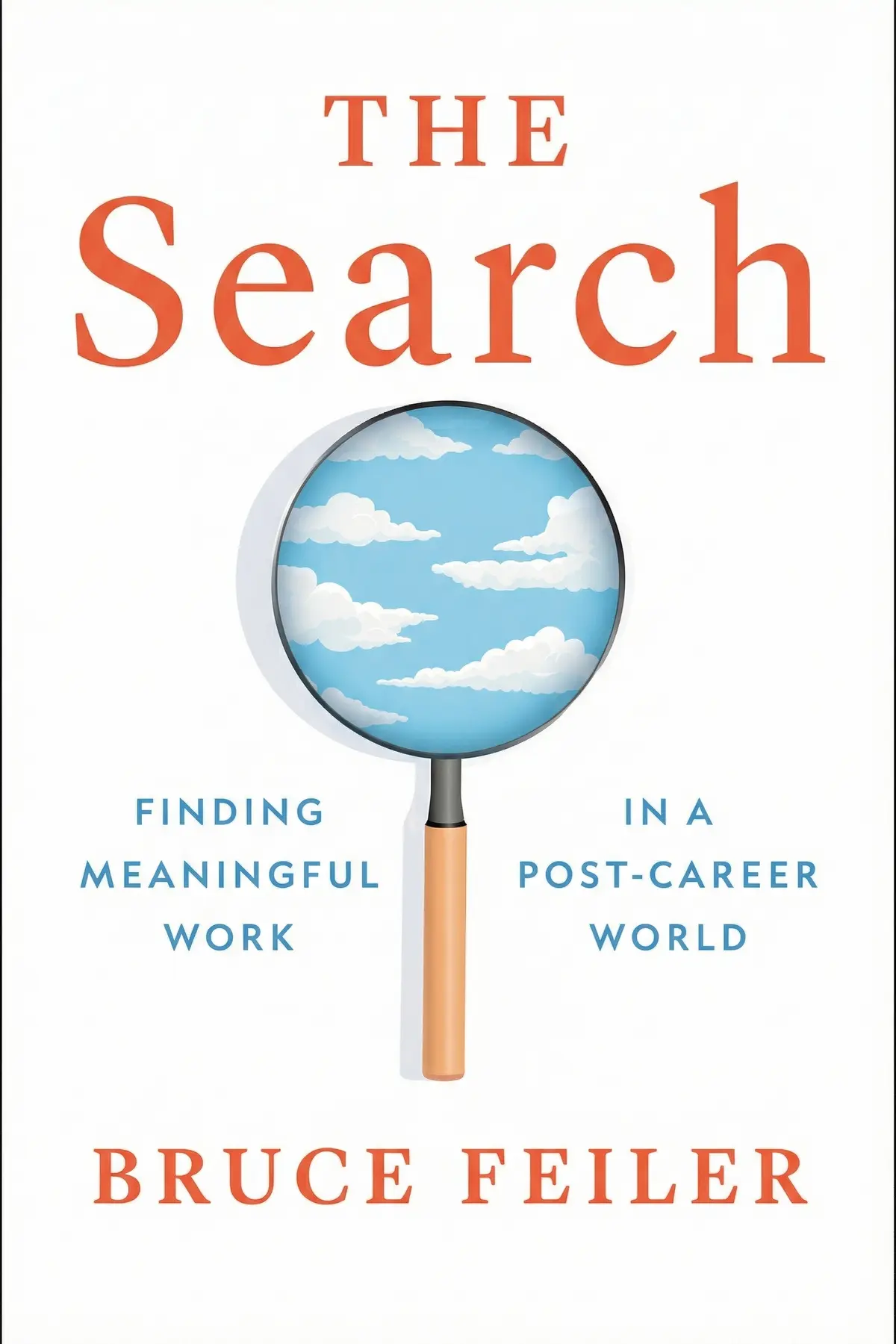
Table of Content
1. Introduction
58 sec
If your work no longer fits the life you want, you are far from alone. In The Search, author Bruce Feiler reports that about a million people in the United States are now leaving their jobs every week. Roughly a third of workers quit each year, and another third reshape their roles around new interests or family time. Feiler reads that wave hopefully. The old picture of a career as a steady climb has collapsed, he argues, and that frees each of us to decide what meaningful work looks like.
His case starts by clearing away three comfortable beliefs: that you have a career, a path and a job. He replaces them with one demanding truth, which is that nobody else can point you in the right direction. What follows is a way to read the disruptions in your working life as openings and to see all the work you already do. It ends with a short written draft of where you want to go next.
2. Stop measuring your work against a straight line
1 min 47 sec
Many people feel their working history looks like a mess. The neat standard they compare it to turns out to have a surprisingly short past, and a man who never kept a job for long helped invent it.
3. Turn your next work upheaval into a fresh start
1 min 32 sec
Disruptions at work feel like rare bad luck, something to recover from quickly and forget. Feiler’s numbers say they arrive on a schedule, and the instinct to rush past them may waste the best chance you get.
4. Follow the chance encounters that redirect you
1 min 35 sec
Follow your passion is the most repeated career advice there is. Feiler’s interviews suggest it fits very few real lives, and they point to something smaller and stranger that actually changes where people end up.
5. See all five jobs you already hold
1 min 58 sec
Ask someone what they do and they will name one thing. Feiler’s research counts far more, including one kind of job almost everyone carries and almost nobody talks about.
6. Define success yourself with a meaning audit
2 min 04 sec
With more freedom than any generation before, it is tempting to wait for someone to tell you what to do next. Feiler’s single truth about work closes that door, then hands you a three-stage way forward.
7. Draft your next chapter with six questions
2 min 20 sec
A blank page is the hardest thing to write on, especially when the page is your working life. Feiler borrows the oldest questions in storytelling and turns each into a single sentence you can finish tonight.
8. Conclusion
1 min 13 sec
The Search turns a frightening trend into an invitation. A million people a week are walking out of jobs, and quakes hit every few years. So the straight line that Frank Parsons helped popularize was never a promise anyone could keep. What remains is a story you write and keep revising.
Feiler closes with four rules for success. Dig for it by searching your memories for dreams you buried. Treat it as shared: no one succeeds alone, so let go of pure self-reliance and find your people. Locate it in what your work means to you, whatever others call success. And see it as a story with no fixed ending, a draft that belongs to you.
The practical start is modest. The next time your work is shaken, treat the moment as a chance to re-story before you rush to fill the gap. Write down your five jobs, ghost job included, and see where your hours and your meaning really go. Then spend an evening on the six sentences before you open your résumé.
A career once meant a line on a page. In Feiler’s hands it becomes a narrative you keep writing, one chapter at a time.
About this book
What is this book about?
Work used to come with a map: pick a career, climb the ladder, keep the résumé tidy. Bruce Feiler argues that this map has stopped describing real lives. Huge numbers of people are quitting or reshaping their jobs. Most no longer do what they dreamed of as children, and the typical worker holds several jobs at once, paid and unpaid. Feiler takes apart three comfortable beliefs about work: that you have a career, a path and a job. In their place he offers new tools. Workquakes are the frequent disruptions that redirect a working life. Butterflies are the chance encounters that steer it. Work360 is a wider view of the five kinds of job everyone carries, from side hustles to the private struggles he calls ghost jobs. At the book's practical core sit a meaning audit and a set of six story prompts: who, what, when, where, why and how. Readers come out with a written draft of their next chapter and a definition of success that belongs to them.
Book Information
Who it's for
Professionals facing job change
Professionals who just quit, lost a job or are quietly thinking about leaving one.
Juggling work, projects, family
People juggling a main job, side projects and family care who want to see how it all fits.
Wanting meaningful next steps
Anyone whose childhood dream never became a career and who wants a meaningful next step.
About the Author
Bruce Feiler
Bruce Feiler is the author of 15 books. Born in Savannah, Georgia, he now lives in Brooklyn. His book Life Is in the Transitions drew on hundreds of life stories gathered across America to study how people handle change with purpose. The Council of Dads, written after a rare cancer diagnosis, inspired an NBC drama. He has also presented the PBS series Walking the Bible and Sacred Journeys with Bruce Feiler.
Ratings & Reviews
Ratings at a glance
What people think
Listeners find this book to be a potent tool for therapists and value its application to modern career growth. The narrative approach receives high marks, with one listener noting that the text guides them through a truly remarkable journey. Additionally, listeners praise its accessible nature, characterizing it as a refreshing read.
Top reviews
Chanon
This is exactly the kind of compass I needed during my current transition. Bruce Feiler takes you on a transformative odyssey through the human experience of labor, moving far beyond the stale advice found in most HR manuals. The 'meaning audit' he proposes felt revolutionary to me because it forces you to look at your past and present with brutal clarity. While the book is undeniably heavy on anecdotes, those stories serve as essential mirrors for our own struggles. I particularly loved the concept of 'ghost jobs'—those internal battles with self-doubt that suck up so much of our energy. To be fair, some of the people interviewed seem like extreme outliers in terms of their success levels. However, the core message about ditching the linear career path is incredibly liberating. It’s a refreshing read that prioritizes the 'why' over the 'how,' making it a perfect gift for anyone feeling stuck in a 20th-century mindset.
Show moreTom
The 'Work360' framework completely changed how I value my time outside of my primary 9-to-5 job. For years, I felt guilty about my 'side hustles' and 'hope jobs,' thinking I was just unfocused. Feiler’s research proves that most of us are juggling multiple roles, and that this variety is actually a source of strength. The book is incredibly readable and feels like a conversation with a very wise friend who has done their homework. While some reviewers find the anecdotes overwhelming, I found them to be the heart of the book. Hearing how a government leader or a teacher navigated their own 'workquakes' gave me the courage to initiate my own. The 'meaning audit' is a brilliant exercise that I’ve already recommended to several friends. It’s rare to find a professional development book that feels this human and empathetic. Truly a remarkable journey through the modern world of work.
Show moreWaree
Finally got around to reading this during a period of professional transition, and the timing could not have been better. Bruce Feiler has a gift for making complex data feel like a personal conversation. The concept of 'follow your butterfly'—those unexpected encounters that change everything—was a lightbulb moment for me. I’ve always been a bit of a linear thinker, so being told that my 'workquake' was a normal part of life was incredibly healing. To be fair, the book is quite long and some of the stories felt a bit repetitive by the end. However, the 'meaning audit' at the end is worth the price of admission alone. It’s a powerful resource for anyone trying to navigate the messy reality of 21st-century work. This isn't just a book about jobs; it's a book about how to live a life that actually feels like your own. Highly recommended.
Show morePing
Ever wonder why the traditional corporate ladder feels like such a broken prop lately? Feiler’s deep dive into 'workquakes' explains why our professional lives feel so much more volatile than our parents' did. He argues convincingly that the average person now experiences a massive career disruption every few years. The writing is engaging and moves at a clip, though I found myself skimming some of the longer profiles to get back to his actual framework. The six questions—who, what, when, where, why, and how—are surprisingly effective tools for self-reflection. I've already started using the 'ABC' framework to evaluate my own agency and belonging at my current firm. My only real gripe is that the book occasionally feels a bit too optimistic about the gig economy. It glazes over the fact that for many, having multiple jobs isn't a choice but a survival tactic. Still, for anyone looking to re-story their life, this is a solid four-star guide.
Show moreFort
Picked this up after a recommendation from a mentor, and I can see why it’s being hailed as an essential toolkit for clinical professionals. For therapists and career coaches, the way Feiler categorizes work into 'Work360' provides a fantastic vocabulary for helping clients. I especially appreciated the distinction between 'hope jobs' and 'care jobs.' It validates the unpaid labor we do for our families and our passions. The book is a quick listen or read, despite being packed with data from hundreds of interviews. My main criticism is that the author sometimes struggles to connect the dots between his stories and his conclusions. Some of the self-help flavored sentences felt a bit forced, as if he was trying too hard to make every interview fit into a neat box. Despite that, the 'meaning audit' is a powerful resource that I’ll definitely be using with my own students in the future.
Show moreKatya
For anyone feeling the itch to leave their job without a backup plan, this book provides the psychological permission you might be looking for. Feiler’s research into the 'quit rate' and the rise of the 'meaning audit' is timely and relevant. I particularly liked the 'ABC'—Agency, Belonging, and Cause—as a way to diagnose what’s missing in a career. The writing is polished and the storytelling is top-notch, though the book does meander quite a bit in the middle chapters. I found the reflection questions in the 'Who, What, When, Where, Why, How' section to be the most practical part of the whole experience. It forces you to stop being a passive observer of your life and start being the narrator. It’s not a perfect book—it definitely skews a bit too optimistic about the 'American Dream'—but it’s a refreshing alternative to traditional career advice.
Show moreCarlos
As someone currently navigating a massive career shift, I had high hopes for this one after hearing the author on a podcast. The truth is, the book is a bit of a mixed bag. On one hand, the central thesis—that the linear career is a lie—is absolutely spot on and very validating. On the other hand, the data feels heavily skewed toward high-achievers like CEOs and media stars. It's hard to find your own story in a book where every 'workquake' ends with someone becoming a non-profit founder or a famous artist. This survivorship bias makes the advice feel a little unearned for the average worker just trying to pay rent. The reflection questions are the real value here, especially the prompts about childhood role models and recurring patterns of pain. It’s a readable book with some gems, but you have to dig through a lot of anecdotal white noise to find them.
Show moreWan
Honestly, the central thesis about the 'linear career' being a lie is powerful, even if the delivery is a bit bloated. Feiler identifies 'workquakes' as the new normal, which is a concept that resonates deeply in this post-pandemic landscape. However, I couldn't help but notice how much the book avoids the darker side of the gig economy. He frames having three or four jobs as a path to 'self-actualization,' ignoring the reality that for many, driving for Lyft after a shift is a necessity, not a choice. The lack of a systemic critique makes some of the advice feel a bit hollow and individualistic. That said, the section on 'ghost jobs' was incredibly insightful. It helped me realize how much of my professional 'stuckness' was actually an internal battle with my own upbringing. It’s a decent read for personal reflection, but it won't solve the structural problems of 21st-century labor.
Show moreVera
I’ve read my fair share of career guides, but Feiler’s approach felt more like a collection of elite profiles than a grounded manual. The book is structured around an endless anecdote merry-go-round that eventually starts to feel repetitive and unmoored from reality. He talks about 'following your butterfly,' which sounds lovely in a graduation speech but offers little for someone facing real financial precarity. To be fair, he’s an engaging storyteller, but the 'meaning audit' just felt like common sense dressed up in fancy new terminology. Most of the insights boil down to 'know your values,' which isn't exactly a revelation in 2024. If you enjoy reading about how successful people reinvented themselves, you might like this. If you want practical, actionable steps for a career change that don't involve having a massive safety net, look elsewhere. It lacks a serious critique of how modern work exploits people, choosing instead to focus on a cringey version of the American Dream.
Show moreCarter
Not what I expected given the hype on LinkedIn. The book starts with a promising premise but quickly devolves into a series of surface-level scans of very successful people. I found it difficult to follow the logic at times because the sheer volume of anecdotes undermines the actual advice. Feiler provides a 'plethora of anecdotal evidence' that often feels like it's just reinforcing the behaviors of people who are already highly driven outliers. If you aren't a CEO or a tech founder, the data might feel statistically unreliable due to the obvious survivorship bias. I was hoping for more depth on how to handle the financial and social risks of a career change. Instead, I got a lot of 'self-help flavored' platitudes. It’s a readable enough book, but the insights are mostly things you've likely already heard on a motivational podcast. I’d suggest listening to his interviews online instead of buying the book.
Show moreQuestions about this book
What is The Search by Bruce Feiler about?
Feiler argues that the linear career has given way to frequent upheavals, multiple roles and a search for meaning. He debunks three beliefs: that you have a career, a path and a single job. He then offers a meaning audit and six story questions to help readers define success for themselves and write the next chapter of their working lives.
What is a workquake?
A workquake is Feiler’s term for a disruption or rethinking that redirects your work in a meaningful way. Triggers can be starting a new job, returning to school, getting laid off, having a child or living through a pandemic. He reports that people face one about every two years and ten months, and that women face them 22 percent more often than men.
What are the five jobs in Work360?
Feiler’s Work360 describes five kinds of job. The main job is your central work, though only 39 percent of Americans clearly have one. Side jobs add money or options. Hope jobs are spare-time projects you hope will grow. Care jobs involve looking after others. Ghost jobs are inner struggles such as discrimination, self-doubt or money worries, which 93 percent of his participants reported.
How do I apply the ideas in The Search?
Start with a meaning audit. Review your past dreams and the messages you absorbed about work, then check your present priorities using Agency, Belonging and Cause. Next, answer who, what, when, where, why and how, finishing one sentence for each. Write the six sentences on one page as a draft of your next chapter before you update your résumé or apply anywhere.
Readers also enjoyed


60 Seconds & You’re Hired!
Robin Ryan




Be A Free Range Human: Escape the 9 to 5, Create a Life You Love,
Marianne Cantwell
Be the Unicorn: 12 Data-Driven Habits That Separate the Best Leaders from the
William Vanderbloemen
AUDIO SUMMARY AVAILABLE
Listen to The Search in 15 minutes
Get the key ideas from The Search by Bruce Feiler, plus 5,000+ more nonfiction titles.
- 5,000+ titles
- Listen as much as you want
- 7-day free trial
- Cancel anytime









