
Incognito: The Secret Lives of the Brain
David Eagleman
 English
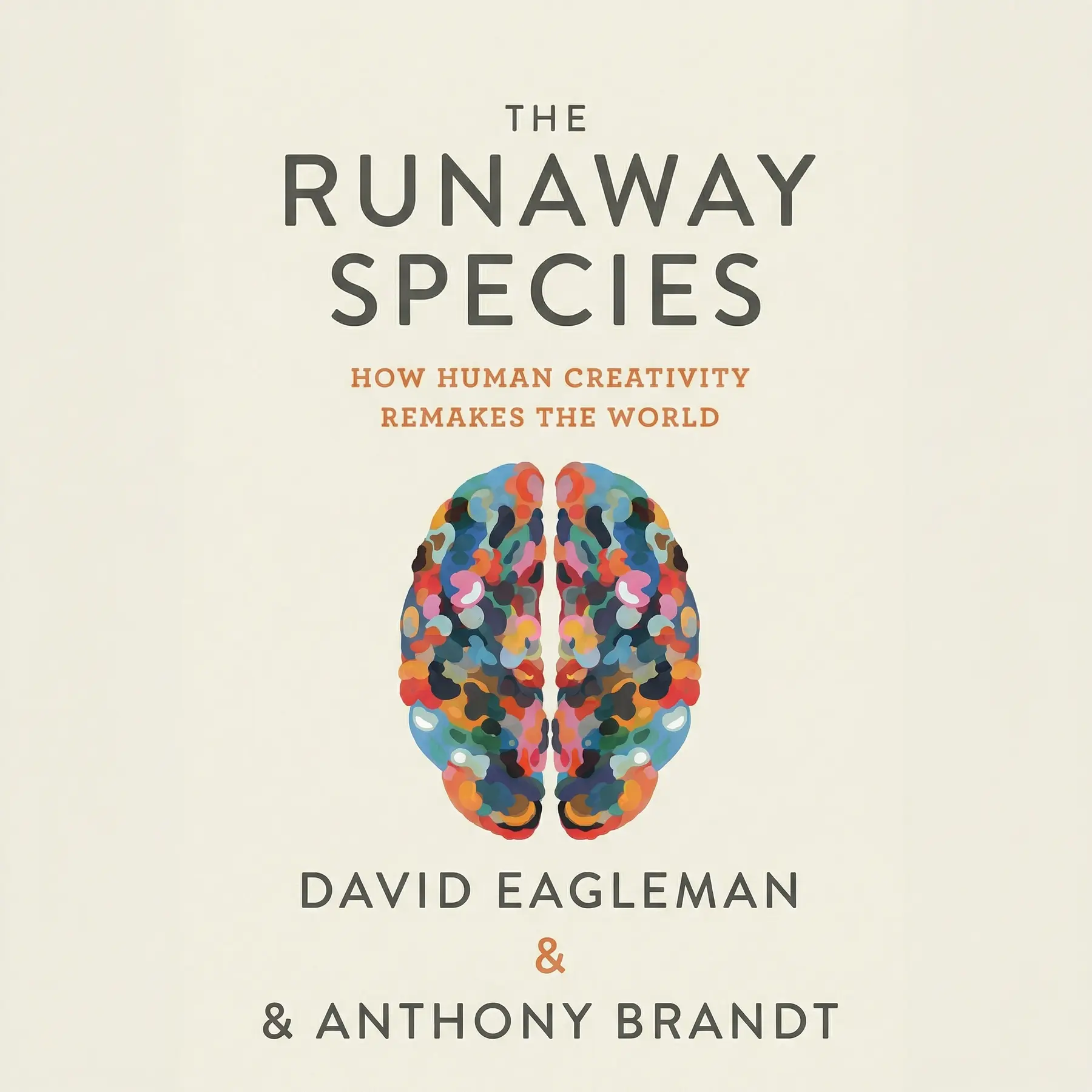
Shows that creativity is a learnable skill: reshaping what already exists by bending, breaking and blending it. It also explains why producing many imperfect ideas, and rewarding experiments, leads to better inventions, art and teams.

1 min 04 sec
If you think of yourself as someone who isn’t creative, The Runaway Species has a surprising reply: nobody invents from nothing, and the people we call geniuses mostly rework what came before. Composer Anthony Brandt and neuroscientist David Eagleman make that argument, following creativity across areas as distant from each other as genetics, art history, cinema and medicine. Their argument is that every new idea, from a smartphone to a painting, comes from reshaping something familiar in a few basic ways.
They name three: bending an existing model, breaking it into pieces, and blending it with something unlike it. Add the habit of producing many imperfect options, and creativity starts to look less like a gift and more like a practice anyone can learn.
Along the way you will meet a goat that gives spider silk in her milk, a piano made of concrete and computer servers cooled in the depths of the ocean. Each one shows a move you can try on your own work, your team or your classroom.
1 min 57 sec
The device that changed consumer technology in 2007 looked like it had no history at all. A forgotten gadget from 1994 and a dead poet’s bookshelves tell a different story about where breakthroughs really begin.
1 min 59 sec
The first artificial heart kept a patient alive, yet it carried a flaw built into its very design. Two doctors fixed it by questioning something everyone else had taken for granted about how hearts work.
2 min 04 sec
Early films showed every step a character took, in real time, with almost no cuts. What changed cinema forever is a habit you already use dozens of times a day without noticing.
1 min 54 sec
Spider silk is stronger than steel, but farming spiders turns out to be a nightmare. One genetics professor found a way around the problem that sounds like science fiction, and the result looks like a perfectly ordinary goat.
2 min 00 sec
A scientist stood before a congressional committee in 1921 and talked about peanuts for 47 minutes. Meanwhile, one of history’s great inventors built a piano nobody wanted. Both were doing the same thing right.
1 min 56 sec
On the first day of class, nearly every student copies the teacher’s drawing. By the end of the semester, almost nobody does. What happens in between holds a lesson for any manager trying to get fresh ideas.
1 min 15 sec
The Runaway Species takes creativity down from the mountain. The iPhone had the Simon behind it, Coleridge had his shelves, and a goat named Freckles exists because someone thought about a spider and a farm animal at the same time. In every case the new thing grew out of something familiar that a person was willing to reshape. That makes creativity something you can practice on purpose, in a lab, a theater or an ordinary office.
Practice starts with the material in front of you. Take one product, process or lesson and work on it with each move in turn: change one of its rules, split it into parts, and join it to something from a distant field. Produce more versions than you think you need, the way Carver kept naming peanut products for 47 minutes, and let the concrete pianos go without shame. If you run a team, make room for experiments aimed at problems that have not yet arrived, and reward good ideas, even if only with real acknowledgment.
Think back to Lindsay Esola’s classroom. On the first day, almost everyone copied the apple. By the last, almost no one did. The apple had not changed. The students had learned what to do with the past.
Most people treat creativity as a rare gift. Great inventions and works of art seem to arrive from nowhere, so the rest of us wait for inspiration that never comes. Composer Anthony Brandt and neuroscientist David Eagleman argue that this picture is wrong. Every new idea owes a debt to older ones, and the act of creating comes down to a few basic moves that anyone can practice. Drawing on genetics and art history, medicine and cinema, the authors name three of those moves. Bending reshapes an existing model, as when doctors redesigned the artificial heart. Breaking splits something into pieces, as filmmakers did with time on screen. Blending joins unrelated elements, as a geneticist did when he created a goat whose milk contains spider silk. On top of these, they argue for producing many fallible options instead of chasing one perfect answer. The book closes with what schools and workplaces can do: look toward problems that have not yet arrived, make room for experiments that may fail, and reward people who offer ideas. Readers get a clear way to approach a blank page, and to help a team or a class approach theirs.
Professionals who feel they are not creative and want a method instead of waiting for inspiration.
Managers and founders who want their teams to propose and test more ideas.
Teachers and trainers looking for ways to help students reshape what they learn.
Anthony Brandt is an American composer and writer who teaches composition and theory at the Shepherd School of Music at Rice University and is artistic director of Musiqa, which he co-founded. David Eagleman is a neuroscientist and Guggenheim Fellow who teaches at Stanford University, founded several neurotech startups and presented the Emmy-nominated series The Brain with David Eagleman. His other books include Incognito and Livewired. Together they bring an artist's and a scientist's view of how new ideas are made.
David Eagleman

David Eagleman
David Eagleman
Listeners find the book absorbing and accessible, offering great perspectives on creativity along with a wonderful mix of scientific study and artistic arrangement. They value its informative nature, with one listener noting how it helps us understand who we are and another mentioning dozens of fascinating stories of perseverance. Views on the caliber of the research are varied among listeners.
Finally finished this deep dive into the human psyche and I’m genuinely impressed. Brandt and Eagleman provide a compelling look at the "three Bs"—bending, breaking, and blending—to explain how we innovate. It’s not just about art; it’s about how scientific breakthroughs like Apollo 13 share the same DNA as a Picasso painting. The writing is incredibly accessible, moving quickly between neuroscience and historical anecdotes without losing the reader in jargon. While some might find the optimism a bit much, I found the message about our inherent drive to refashion the world quite motivating. The book itself is beautiful, filled with color images that illustrate the concepts perfectly. This is a must-read for anyone who feels stuck in a creative rut.
Show moreWow, what a refreshing take on how we interact with the world around us. This book isn't just about "being an artist"; it's about the fundamental way the human brain functions to create new versions of reality. The concept of "proliferating options" really stuck with me—the idea that you have to let most of your ideas die to find the one that actually works. The authors do a fantastic job of showing how even "failed" ideas aren't waste, but seeds for future success. With its vibrant images and clear prose, it’s one of the most engaging nonfiction books I’ve picked up this year. It genuinely inspired me to take more risks in my own professional work and rethink my approach to problem-solving.
Show morePicked this up because I’m a writer, and I was looking for some inspiration to kickstart my creative process. The authors’ observations on how we "bend" reality—like how a novelist might take their own life and refashion it into fiction—were incredibly insightful. I loved the idea that art isn't divorced from our experience, but is actually our experience in its most distilled form. The advice to not commit to the first solution you find is something every creator needs to hear regularly. While the tone can be a bit self-congratulatory regarding human achievement, the enthusiasm is infectious. It’s a beautiful book that celebrates the messy, iterative, and wonderful process of bringing something new into existence through constant trial and error.
Show moreAs a teacher, I found the sections on reforming education to be the most vital part of the text. The authors argue that we need to foster risk tolerance in students rather than just rewarding the "correct" answer every time. By encouraging kids to go "different distances from the hive," we can actually prepare them for a world that requires constant adaptation. I loved the examples of how the brain seeks a balance between the familiar and the surprising. It’s a beautifully designed book with an attractive layout that makes it easy to digest in short bursts. My only gripe is that the research feels a bit thin in spots, relying more on stories than hard data to prove its points.
Show moreThe collaboration between a neuroscientist and a composer results in a uniquely rhythmic look at human innovation. It’s rare to see a book that treats a patent for a blouse by Einstein with the same level of intellectual curiosity as the development of the Gregorian calendar. I particularly enjoyed the discussion on "repetition suppression" and why we eventually get bored with the status quo. This innate hunger for novelty is what drives the "runaway" nature of our species. While the sheer volume of examples can be a mind-numbing whirl at times, the overarching framework remains sturdy. It’s a great pick for anyone looking to understand the bridge between the arts and the sciences and how they feed into each other.
Show moreTo be fair, this is more of a sociological survey than a hard science book, but that doesn't make it any less interesting. I was fascinated by the section on how we seek the "sweet spot" between the familiar and the completely new. Think about how Tesla car doors open upwards—it's a blend of a standard car and something futuristic that we've seen in sci-fi. Brandt and Eagleman argue that we are constantly remixing our experiences to push the boundaries of what is possible. Personally, I found the layout and the font choices to be a huge plus; it’s a book that practices what it preaches regarding design. It’s a solid 4-star read that offers plenty of food for thought for any curious mind.
Show moreEver wonder why humans are the only species that constantly tries to "upgrade" everything around them? This book attempts to answer that by looking at the specific ways our brains process and remix existing information. I appreciated the visual nature of the book; the diagrams and photos really help to clarify the "break and blend" concepts. However, to be fair, a lot of the advice feels a bit like preaching to the choir. Most people interested in creativity already know that we should "think outside the box" or "tolerate failure." It's a fun read and very engaging, but it might not offer many "aha!" moments if you've already read a lot of popular psychology on the same subject.
Show moreLook, I love David Eagleman’s work, but this one felt a little bit like "Creativity for Dummies" at times. The "bend, break, blend" model is a helpful way to categorize ideas, but I wanted more of the gritty neuroscience behind why our brains do this. Instead, we get a lot of anecdotes about things like Esperanto and the Apollo 13 mission. These are entertaining stories, for sure, but they don't always feel like they're building toward a meaningful scientific conclusion. It’s a quick, breezy read that will definitely make you feel good about being human. Just don’t expect a deep dive into the mechanics of neurons or complex cognitive mapping that explains the 'why' instead of the 'how'.
Show moreThe chapter on the various ways we "break" existing ideas to create new ones was the highlight for me, though the book as a whole has some issues. There are moments where the authors throw so many factoids at you—from the Wright brothers' wing surfaces to Edison's phonograph—that your head starts to spin. I found myself wishing they would spend twenty pages on one deep case study rather than two pages on ten different ones. It starts to feel a bit repetitive after a while, as if the authors are trying to prove the same point over and over with different names. Still, it’s an easy read and the central thesis about the "three Bs" is quite memorable and useful for brainstorming.
Show moreNot what I expected after hearing so much praise for Eagleman's previous work. While the premise is fascinating, the execution feels like a never-ending list of "did you know" facts that eventually lose their impact. In one short section, we are bombarded with Hemingway, Audi vehicles, and the Wright brothers, leaving no room for actual depth or analysis. Frankly, it felt more like a coffee table book than a serious exploration of the creative brain. The advice to "proliferate options" is solid but hardly groundbreaking, and the tone often drifts into self-congratulatory territory. If you want a collection of trivia about inventions, this is fine, but don't expect a rigorous scientific treatise with new neurobiological insights.
Show moreAnthony Brandt and David Eagleman argue that creativity is not a mysterious bolt from the blue. Every new idea builds on older ones, and people create by reshaping what already exists in three basic ways: bending a model, breaking it into parts and blending it with something unrelated. The iPhone, for example, followed the forgotten IBM Simon smartphone of 1994.
Bending changes an existing model, as when doctors Billy Cohn and Bud Frazier redesigned the artificial heart to use a continuous flow of blood. Breaking splits something into fragments, as filmmakers did by cutting and compressing time on screen. Blending joins unrelated elements, as geneticist Randy Lewis did by putting spider silk DNA into a goat named Freckles.
They point to nature, which produces endless variations and lets the world decide which survive. George Washington Carver showed a congressional committee in 1921 more than a hundred uses for peanuts, and not all of them worked. Thomas Edison built a concrete piano that failed. Both treated weak ideas as a normal cost of finding strong ones.
The authors suggest working on problems the organization expects to face in the future, as Microsoft does by testing ocean cooling for its servers, and accepting that some experiments will fail. Teachers can push students to reshape past styles, as Lindsay Esola does with her apple drawings. Leaders can reward valuable ideas with bonuses or acknowledgment.



Steven C. Hayes


Deborah Gruenfeld


Anthony Pratkanis


AUDIO SUMMARY AVAILABLE
Get the key ideas from The Runaway Species by Anthony Brandt, plus 5,000+ more nonfiction titles.









