

16 min 22 sec
Available in: English
The Robots Are Coming!: The Future of Jobs in the Age of Automation
A tour of the jobs that automation will erase, the ones it will reshape and the ones it will create. It covers factories, transport, retail, law, banking, medicine, newsrooms, classrooms and entertainment.
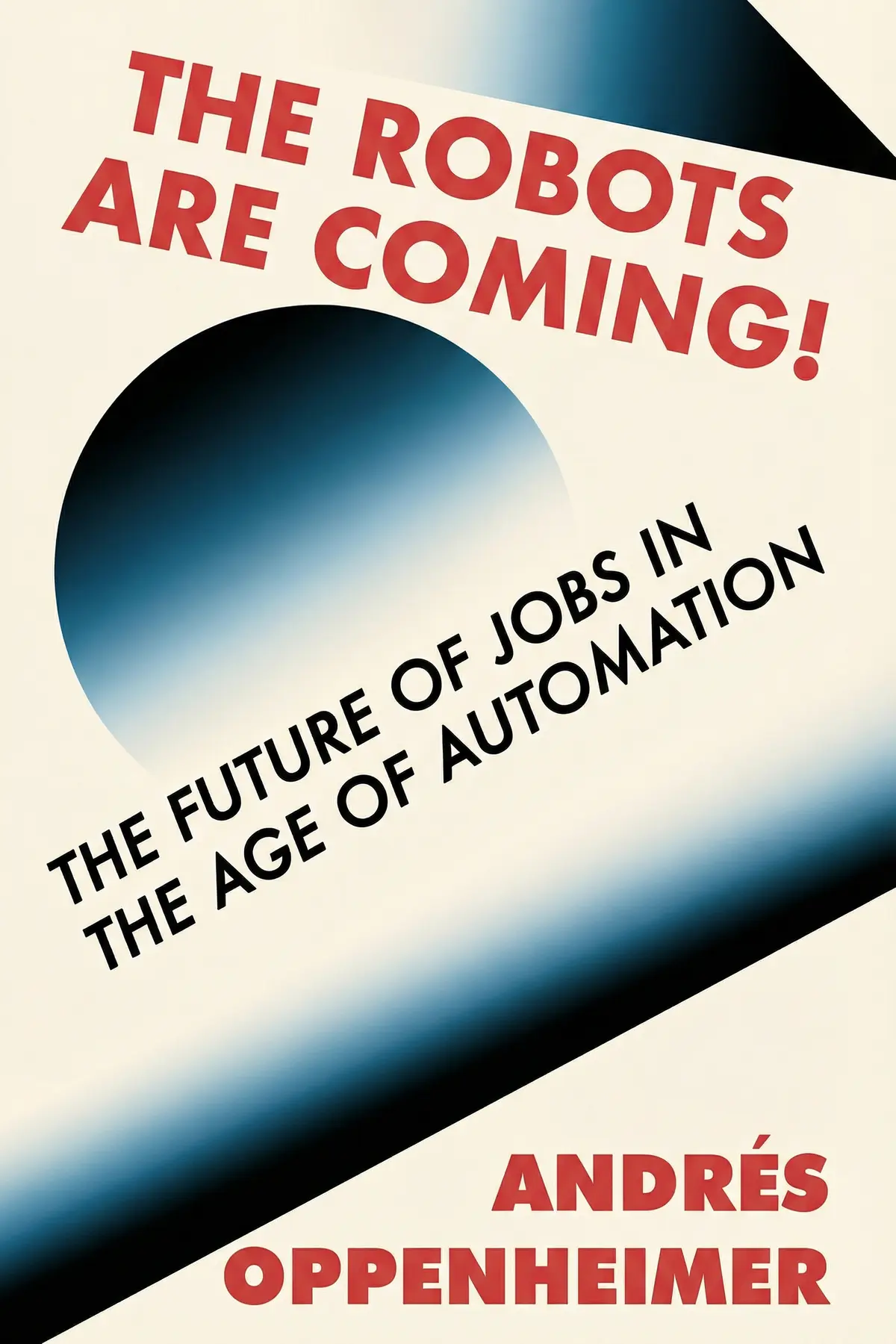
Table of Content
1. Introduction
1 min 08 sec
If you have ever wondered whether a machine will take your job, the honest answer begins with a number. Back in 2013, Carl Benedikt Frey, an economist at Oxford, teamed up with Michael A. Osborne estimated that up to 47 percent of current US jobs could disappear by 2033. In The Robots Are Coming!, journalist Andrés Oppenheimer, who shared a Pulitzer Prize in 1987, follows that warning through the working world, from Chinese factories to law firms, hospitals, newsrooms and classrooms.
His argument rests on one test. The more routine a job is, the sooner a robot or an algorithm will do it, whatever the job pays. Yet the same machines also strip routine out of the work that survives, leaving people the parts that need explanation, repair, judgment and imagination. Apply that test industry by industry and you can sort your own work into what is likely to vanish, what is likely to change and what is likely to grow, then decide where your next year of effort should go.
2. Read the economics behind the factory robot wave
2 min 05 sec
Robots were supposed to empty factories back in the 1960s, and for decades they did not. A cellphone factory in the Chinese city of Dongguan suggests the long wait is ending, and the reasons apply far beyond manufacturing.
3. Prepare for the end of the human driver
1 min 56 sec
Millions of people earn a living behind a wheel, and some of the richest companies in the world are spending heavily to remove them. One small number from test drives shows how close that moment may be.
4. See how automation is reshaping shops and restaurants
2 min 00 sec
Store closures are usually blamed on online shopping alone. Inside the shops that survive, and in fast-food kitchens, something else is happening, and customers themselves are helping it along.
5. Test your own job for routine tasks
2 min 06 sec
A law degree or a banking career feels like protection against machines. Oppenheimer’s rule of thumb cuts straight through job titles, and the numbers from law firms and investment banks are hard to ignore.
6. Doctors who explain what machines find
1 min 52 sec
Automated systems may soon handle most of what a doctor does today. Strangely, that does not mean most doctors disappear, and the role they keep shows where human work survives in every field.
7. Hand the dull work to software and go deeper
2 min 05 sec
A newspaper let software write hundreds of election stories, and a robot teacher froze on live television. Both point to the same future for reporters and teachers, and to a training plan for everyone else.
8. Free time that turns into creative work
1 min 51 sec
If machines take over much of the work, people are left with a great many empty hours. Oppenheimer sees an industry already bigger than carmaking waiting to fill them, and a reason for hope.
9. Conclusion
1 min 19 sec
Oppenheimer’s tour ends where it began, with a sorting problem. Some jobs will disappear, many more will change shape, and some new ones will appear. What decides a job’s fate is how much of it repeats, and that test ignores status. A Dongguan assembly line, a standard lease and a story about a local election all fail it in the same way.
What remains once routine is gone is the human half of each job: the doctor explaining a genetic risk, the mechanic fixing a driverless car, the reporter tracing a lead through 11.5 million documents, the teacher building persistence and empathy, the musician filling someone’s evening.
That suggests where to start. Go through a normal week and separate the template work from the judgment work, then move your effort toward the judgment. Look for the support roles that grow around every new system in your field, the people who maintain it and explain it. Treat curiosity, cooperation and empathy as career skills worth training, since they are what the machines leave behind.
In Oppenheimer’s account, the robots are coming for the parts of a job that never needed a person. The rest belongs to whoever is ready to take it.
About this book
What is this book about?
In 2013, an Oxford economist and a machine-learning researcher estimated that up to 47 percent of current US jobs could disappear by 2033. Andrés Oppenheimer, a journalist who has reported from across Latin America, sets out to learn what that warning means in practice. He looks at factories and highways, and at shops, law firms, banks, hospitals, newsrooms and classrooms. His guiding rule is simple. The more routine a job is, the sooner a robot or an algorithm will do it, and that holds for well-paid professionals as much as for cashiers. He shows Chinese factories cutting almost their whole workforce, a robot lawyer built on IBM's Watson, a bank that employs more programmers than Facebook and a newspaper whose software wrote stories on hundreds of local elections. The book is not only a list of losses. Oppenheimer also follows the work that grows once routine is gone: doctors who explain what machines diagnose, technicians who keep robots running, teachers who build curiosity and empathy, and an entertainment industry serving people with more free time. Readers get a practical way to sort their own work into what is likely to vanish, change or grow.
Book Information
Who it's for
Professionals wondering about automation
Professionals in law, banking, retail or transport who wonder how exposed their role is.
Students and career switchers
Career switchers and students choosing skills that machines are unlikely to replace.
Preparing others for automation
Managers and teachers preparing people for work alongside automated systems.
About the Author
Andrés Oppenheimer
Andrés Oppenheimer was born in Buenos Aires and moved to the United States in 1976 on a World Press Institute scholarship. He earned a journalism master's degree at Columbia University in 1978. At The Miami Herald he has been a columnist, Latin America editor and bureau chief in Mexico, Colombia and Central America, and he hosts Oppenheimer Presenta on CNN en Español. He shared a 1987 Pulitzer Prize as part of the Herald team that exposed the Iran-Contra scandal.
Ratings & Reviews
Ratings at a glance
What people think
Listeners perceive this book as a highly detailed and expertly researched investigation into automation’s role in reshaping various sectors, from medicine to the arts. Though attitudes toward the author’s positive socio-political predictions are mixed, listeners respect the extensive journalistic interviews he conducted with hundreds of global authorities. They also emphasize the practical benefits of the chapters on future job prospects; one listener specifically observes that the reasoning behind the list of expanding industries is notably logical and clear. Finally, they credit the author's readable narrative for blending emerging tech trends with a realistic evaluation of tomorrow's labor market.
Top reviews
Cherry
Andrés Oppenheimer has a knack for turning dense economic data into a genuine page-turner. This isn’t just another dry academic text about the future; it’s a living, breathing reportage that spans multiple continents and dozens of industries. I was particularly struck by how he dissects the transformation of the service sector and healthcare. While some might find his techno-optimism a bit much, the sheer volume of interviews with global experts makes the arguments hard to ignore. To be fair, some of the specific app examples feel slightly dated now, but the underlying logic remains incredibly sound. It’s a comprehensive guide for anyone trying to navigate the messy transition toward an automated economy. The writing is accessible, sharp, and keeps you engaged even when the topic gets a bit scary.
Show moreSai
After hearing about the Frey and Osborne study from 2013, I needed more context on how these job losses would actually play out in the real world. Oppenheimer delivers that context in spades. He manages to balance the 'apocalypse' headlines with a very grounded reality of how technology can augment human labor rather than just replacing it. The chapter on the service sector was eye-opening. Not gonna lie, the idea of a robot making my hotel reservation or cooking my burger is no longer science fiction. This book is masterfully researched and presents a comprehensive exploration of diverse industries. It’s the kind of book you end up highlighting on every other page because the insights are so densely packed.
Show moreNim
Wow, the level of research here is staggering. Oppenheimer doesn't just speculate; he goes to the source, interviewing the people actually building the algorithms that are changing our lives. The section focusing on future career paths is particularly solid. He doesn't just give you a list; he explains the logic behind why certain industries will blossom while others wither away. In my experience, most books on this topic are either too technical or too vague. This one hits the sweet spot. It’s a sobering look at the job market's future, but it’s written with such an accessible style that anyone can grasp the implications. I’ve already recommended it to three colleagues.
Show moreVilaiporn
Gotta say, the section regarding Latin America’s lack of preparation was a sobering reality check. While China is buying up robots to stay competitive, many other regions are sleeping through the revolution. Oppenheimer is fair, letting both the optimists and the cynics have their say, which makes the book feel balanced. The interviews with people like Kasparov add a layer of depth that you don't get from standard economic reports. I loved the practical value of the final chapters. It’s rare to find a book that educates and entertains simultaneously. If you are going to be in the workforce for the next twenty years, you need to read this and prepare your 'surfboard' for the technological wave.
Show moreSuthee
Ever wonder if your job will still exist in fifteen years? This book answers that question with brutal honesty and journalistic rigor. Oppenheimer covers everything from the Internet of Things to the rise of the contract worker. He makes a compelling case for why certain soft skills will become the new currency of the global economy. The logic behind his list of blossoming industries is incredibly insightful and helped me rethink my own career trajectory. It’s a comprehensive, masterfully researched work that feels even more relevant today than when it was first published. Do yourself a favor and pick this up before the robots actually do come for your desk.
Show moreSiriphen
As someone working in the tech sector, I found this deep dive into automation both terrifying and necessary. Oppenheimer doesn't just talk about robots in factories. He goes after the white-collar jobs too. From journalism to law and banking, no one is safe from the algorithm. Look, the book moves fast, which I appreciate, though it occasionally feels like it glosses over the systemic inequality issues. I really valued the section on how automation will actually expand our free time, leading to a boom in the entertainment and arts industries. It’s a sober look at the market, yet it leaves you with enough practical advice to feel like you have a fighting chance. Definitely worth a read for the career advice alone.
Show morePat
Picked this up on a whim at the airport and couldn't put it down until I reached my destination. The author’s journalistic background shines through in every chapter because he asks the exact questions a normal person would ask these Silicon Valley gurus. Personally, I found the chapter on the future of education to be the most insightful part of the whole journey. We aren't just looking at robots replacing teachers; we are looking at a total shift in how humans learn. My only gripe is that it feels very U.S.-centric at times, even when discussing global trends. Despite that, the prose is lean and the information is presented with a clarity that is rare in 'future of work' books.
Show moreGame
The chapter on education was a total eye-opener for me as a parent. Oppenheimer argues that we should be teaching our kids curiosity and empathy rather than rote memorization, which makes perfect sense in an age of instant information. To be honest, I was skeptical about how a journalist would handle such technical topics, but his interviews with over 200 experts provide a level of credibility that’s hard to find elsewhere. The book is well-organized and moves right along. It avoids the trap of being too 'doomsday' while still acknowledging that the transition will be cruel for many. It’s a must-read for anyone who wants to stay economically viable in the next decade.
Show moreMaksim
Not what I expected from a book about robots, as it focuses more on algorithms and AI than literal metal machines. While the information is rescatable and there are some truly interesting interviews, the pace can be quite slow and repetitive in the middle sections. In some chapters, I felt like I was reading the same 'adapt or die' message over and over again. To be fair, the data on the 47% job loss prediction is handled well. But the author’s tone can be a bit condescending toward those who might struggle with the transition. It’s an okay overview if you’re new to the topic, but seasoned tech followers might find it a bit basic.
Show moreChan
Truth be told, the author’s perspective feels a bit trapped in a corporate bubble that ignores the harsh realities of the working class. While the research into AI and robotics is clearly extensive, Oppenheimer’s solutions often lean too heavily on personal resilience rather than systemic change. I found the suggestion that displaced factory workers could simply become 'spiritual guides' or 'wellness coaches' to be a bit out of touch with reality. Frankly, it reads like a manifesto for the meritocracy-obsessed elite who believe mindfulness can solve structural unemployment. If you want a deep dive into the technical side of automation, there’s good info here. However, be prepared to wade through a lot of neoliberal optimism that doesn't quite sit right in today’s economy.
Show moreQuestions about this book
What is The Robots Are Coming! by Andrés Oppenheimer about?
The book looks at how automation will reshape work across factories, transport, retail, law, banking, medicine, journalism, teaching and entertainment. Oppenheimer starts from a 2013 Oxford study estimating that up to 47 percent of US jobs could disappear by 2033. He then shows which jobs are likely to vanish, which will survive and which will be transformed, with examples from China, the United States and Britain.
Which jobs are most at risk from automation according to Oppenheimer?
His rule of thumb is that the more routine a job is, the more exposed it is. That covers factory work, truck and taxi driving, retail and fast food, but also formulaic legal work and much of banking. He cites forecasts that a third of US trucks could be automated by 2025 and that up to half of bank branches in rich countries could close within a decade.
Which jobs will survive automation?
Oppenheimer expects people to remain needed where machines need support or people need explanation. Doctors will counsel patients on diagnoses made by automated systems, technicians and mechanics will repair robots and self-driving cars, and reporters will do investigations and interviews. Teachers will focus on soft skills such as curiosity and empathy. He also expects entertainment and culture, which already employ 29.5 million people worldwide, to grow as people gain free time.
How can I apply the ideas in The Robots Are Coming!?
List the tasks in your week and mark the ones that follow a template, since those are the likeliest to be automated. Move your effort toward judgment, explanation and repair, the support roles that grow around new systems. Build soft skills such as persistence, cooperation, flexibility and empathy, which Oppenheimer sees as what teaching and work will increasingly value.
Readers also enjoyed









AUDIO SUMMARY AVAILABLE
Listen to The Robots Are Coming! in 15 minutes
Get the key ideas from The Robots Are Coming! by Andrés Oppenheimer, plus 5,000+ more nonfiction titles.
- 5,000+ titles
- Listen as much as you want
- 7-day free trial
- Cancel anytime









