
12 min 36 sec
Available in: English
The Proximity Principle: The Proven Strategy That Will Lead to a Career You Love
By Ken Coleman
Ken Coleman shows how to move toward work you love by getting close to the people who do it and the places where it happens, usually starting from your own city and contacts.
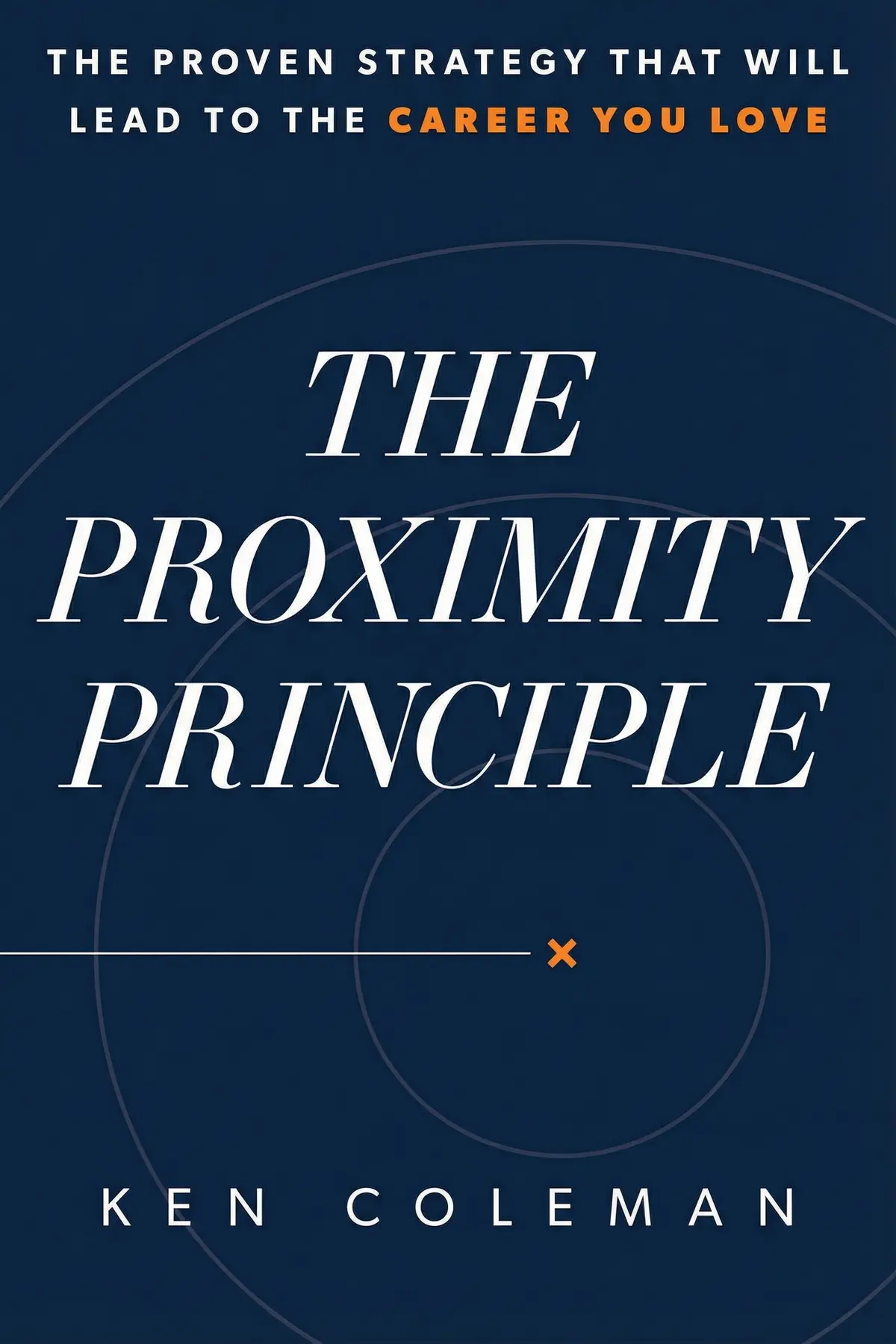
Table of Content
1. Introduction
59 sec
If your job drains you, you have plenty of company. A 2017 Gallup study found that 70 percent of workers around the world are dissatisfied, and the average person spends more than 90,000 hours at work over a lifetime, close to a decade of days and nights. In The Proximity Principle, radio host Ken Coleman argues that escaping that trap is mostly a question of position. To do the work you love, place yourself around the people who already do it and in the places where it happens.
Coleman sums this up as an equation: right people plus right places equals opportunities. He spent years in a job he disliked before using it to break into broadcasting. His playbook covers the two beliefs that keep people from asking for help, how to approach insiders so they want to say yes, how to learn from seasoned professionals, and why your first step may be a few blocks from home.
2. Put yourself near the work you want
1 min 43 sec
One morning on a back porch, a man stuck in the wrong job realized something uncomfortable about who would change his life. His first step afterward was smaller, and stranger, than anyone would expect.
3. Ask for help without feeling weak
1 min 44 sec
Two quiet beliefs stop most people before they take a single step toward the work they want. One of the most ambitious founders of his era explained, years later, why neither should stop you.
4. Win over insiders by asking for a chance
1 min 44 sec
A busy publisher deletes most requests without a second thought, yet one kind of message makes her stop and make time. An unhappy accountant found an even stronger way in, at a price.
5. Borrow from many pros to build your own style
1 min 46 sec
A Hollywood star echoes an older actor’s timing, and a basketball legend built his game from other players’ moves. Copying, done the right way, turns out to be how originality starts.
6. Start your new career from your own zip code
1 min 49 sec
A would-be filmmaker believed his dream meant selling his house and moving his family across the country. One simple question from a radio host changed his plans within two months.
7. Find more job leads through acquaintances than friends
1 min 46 sec
Hundreds of polished applications can vanish without a reply, while one introduction lands an interview. A sociologist’s study from the 1970s shows which part of your network is most likely to provide it.
8. Conclusion
1 min 05 sec
What Coleman offers is a change in where you stand. The career you want is rarely far away in miles; it is far away in contact. Brad’s studio was a few blocks from his house, and Coleman’s first booth was a broom cupboard reached through an old friend. Every part of his method shortens that distance: dropping the pride that stops you asking, offering your work in return for a chance, studying people with ten years on the mountain, and searching your own area before you sell your house.
He also asks you to think a few steps ahead. His friend Sean wanted to become an English scholar and knew he could not walk straight into a professorship. So he looked for universities with professors close to retirement and with rising student numbers, places where a door was likely to open. When you weigh a job offer, look at who sits above you, because that role is the one you will eventually aim for.
This week, tell the people closest to you what work you actually want, sort your acquaintances into buckets and invite one of them for coffee. Nobody on the other end of the line can say yes until you call.
About this book
What is this book about?
Most people give more than 90,000 hours of their lives to work, yet Gallup research from 2017 found that 70 percent of the world's workers are unhappy with their jobs. Ken Coleman was part of that unhappy majority for years, stuck in a dead-end job while he dreamed of broadcasting, until he found a way out that he calls the proximity principle. The idea is simple: to do the work you love, put yourself around the people already doing it and in the places where it happens. Coleman turns that into a practical method. He shows how pride and fear of failure stop people from asking, how to approach busy insiders so they want to help, how to learn from experienced professionals, and why the first opportunity is often close to home. Readers get stories that make each step concrete: an accountant who worked a year unpaid at a brewery and now owns one, a father who found more than 100 production studios in his own city, and research showing that acquaintances open more job doors than close friends.
Book Information
Who it's for
Wanting their dream field
Professionals stuck in a job they dislike who want a realistic route into the field they dream about.
Changing careers
Career switchers who assume a new path means moving cities or starting over.
Early in their careers
Early-career people who hesitate to ask for help or reach out to strangers.
About the Author
Ken Coleman
Ken Coleman hosts The Ken Coleman Show, a call-in program for people who feel stuck in their jobs or want more from their careers. He also co-hosts The Ramsey Show and has worked at Ramsey Solutions since 2014. A two-time national bestselling author, he published The Proximity Principle, his second book, in May 2019, drawing on his own struggles, missed chances and successes on the way to a broadcasting career.
Ratings & Reviews
Ratings at a glance

What people think
Listeners describe the book as an accessible and uncomplicated read, praising its clear language and practical guidance. They also value the inspiring nature of the work, describing it as an engaging experience, with one listener highlighting its relevance to spiritual growth. On the other hand, opinions on its cost-effectiveness are divided; while some believe it is an excellent investment, others feel it was not worth the expense.
Top reviews
Satit
Ever wonder why you're stuck in a dead-end job despite having the skills? The Proximity Principle answers that by showing you that talent isn't enough; you have to be in the room where it happens. I found the book incredibly liberating because it removes the mystery of "getting lucky" in your career. Ken writes with a genuine, caring voice that makes you feel like he’s right there coaching you through your fears. Not gonna lie, the sections on overcoming pride and fear hit me on a spiritual level I wasn't expecting. It’s a very straightforward, easy-to-read guide that provides a concrete starting block for anyone pursuing an abstract dream. If you are willing to put in the work and stop making excuses, this book will be the catalyst for your next big move.
Show moreKrisada
The chapter on the "Producers" changed how I view my current network entirely! I’ve been waiting for a "lucky break" for years, but this book taught me that I have to position myself to be found. Ken’s writing is punchy, motivational, and filled with "you can do it" energy that I desperately needed. Personally, I don't mind the simple language; I think it makes the concepts stick better than some academic textbook would. The way he addresses the limiting beliefs of fear and pride was a major wake-up call for me. It’s a fantastic resource for anyone who feels stuck and needs a concrete plan to move forward. This isn't just a book about jobs; it's about being intentional with your life.
Show morePrapaiwan
After hearing Ken Coleman on the Ramsey Show for months, I finally decided to grab a copy of The Proximity Principle. In my experience, the core message is something most of us instinctively know, but Ken breaks it down into actionable categories that actually make sense. The breakdown of the five people you need—professors, professionals, mentors, peers, and producers—gives a clear roadmap for networking without it feeling "sleazy." While the writing style is very simple and perhaps a bit repetitive for a seasoned professional, the motivational boost is undeniable. I found myself rethinking who I spend my time with and where I physically position myself for opportunities. It’s a quick read, maybe a bit overpriced for a hardcover, but the clarity it provides for your career path is worth the afternoon it takes to finish it.
Show moreHunter
Finally got around to finishing this, and I have to say, the simplicity is actually its biggest strength. In a world of over-complicated career manifestos, Ken Coleman offers a refreshingly direct path: get around the right people in the right places. The "Producers" section was especially enlightening for me, as it helped me identify who in my network actually has the power to give me an opportunity. To be fair, I enjoyed the structured lists at the end of each chapter because they turn the "lofty" ideas into actual tasks. It might feel like common sense to some, but having it organized this way makes it much easier to execute. It’s an exciting read that leaves you feeling like your dream job is actually within reach if you just follow the steps.
Show moreIsaiah
As someone who is middle-aged and looking for a career pivot, I found some real gems here despite the somewhat juvenile writing style. Look, it’s not a literary masterpiece, but the Proximity Principle is a functional tool. I liked how it broke down the difference between a mentor and a professional—it’s a distinction I hadn't really considered before. The book is definitely repetitive, and the celebrity examples are a bit tired, but the core strategy of "intentional positioning" is something I can apply immediately. It’s an easy read for a weekend and serves as a great reminder that your network is your net worth. It’s worth the buy if you actually intend to use the checklists provided.
Show moreRodrigo
Not what I expected in terms of complexity, but exactly what I needed for motivation to finally start my job hunt. The Proximity Principle is straightforward and doesn't hide behind confusing corporate jargon. I especially liked the focus on the "Peers" category; it made me realize I need people around me who are pushing me to be better, not just people to hang out with. In my opinion, some parts feel a bit like a sales pitch for the Ramsey brand, but the underlying message is powerful. If you're someone who likes lists and clear action steps, you’ll get a lot of value out of this. It’s a short, punchy book that focuses on doing rather than just dreaming.
Show moreSaengdao
Picked this up because I’ve been struggling to make connections in my industry, and while the lists are helpful, the book repeats itself way too often. The "right people and right places" framework is solid, but did we really need a whole chapter for each one when the message is largely the same? Truth is, the stories about Hollywood stars and famous CEOs aren't really credible models for the average person working a 9-to-5. I did appreciate the practical steps for getting into the right "places," though. It’s a decent guide for a young person just starting college, but it feels a bit "lofty" and overly produced for a seasoned professional. The resume templates mentioned in his newsletter sign-up probably hold more value than the text itself.
Show moreMingkwan
Gotta say, the advice here is solid, but the delivery is incredibly plastic and feels almost too "cutesie" to hold real weight. Every chapter follows the exact same three-pronged approach which makes the reading experience feel a bit like a coloring book for adults. I appreciate the clarity, but the constant buzzwords and saccharine tone typical of Ramsey personalities can be a bit much after a while. The truth is, the book is written for a very specific demographic—likely 18 to 22-year-olds who need a push to be intentional. It’s a very quick read, and I did take away some good one-liners, but I can't help feeling like this could have been a 20-page PDF instead of a full hardcover book.
Show moreCooper
Truth be told, I like Ken's energy on the radio, but the book repeats the same few points for nearly two hundred pages. It's well-organized, sure, but it feels very "dumbed-down" and could have easily been a single podcast episode. I found the stories to be a bit too focused on "luck" masquerading as "proximity," like the story about the guy whose brother knew a CEO. Is that really a strategy for the rest of us? Still, I can't deny that the book is motivational and the "lead magnets" for the newsletter are actually quite helpful for job seekers. It’s a 3-star read for me—good advice, but it lacks the depth I was hoping for from someone with Ken's experience.
Show moreSara
This book felt more like a long-form blog post than a fully fleshed-out career guide. Frankly, most of the "principles" here are just common sense packaged in Ramsey Solutions' signature high-gloss marketing. Learn from your mistakes? Work for free? Make connections? Like, duh? Ken constantly asserts that his strategy is "proven to work," but then backs it up with anecdotes about celebrities or someone’s lucky brother-in-law. It feels very dated, especially considering it came out in 2019 and doesn’t address the modern remote-work landscape at all beyond basic social media tips. If you’re a 19-year-old who has never had a job, this might be revolutionary, but for anyone else, it's a lot of name-dropping and buzzwords. Save your $25 and just listen to his podcast for twenty minutes; you’ll get the same information without the filler.
Show moreQuestions about this book
What is the proximity principle by Ken Coleman?
Coleman’s principle says that to do work you love, you must be around people already doing it and in places where it happens. He states it as an equation: right people plus right places equals opportunities. He used it himself, calling an old friend at a Georgia company that was starting to make podcasts and offering help in return for studio time in a converted broom cupboard.
Do I need to move cities to change careers, according to The Proximity Principle?
Usually not. Coleman calls this the law of the zip code: what you need to begin is often close by. A caller named Brad thought working in film meant moving his family to Los Angeles. After some research he found more than 100 production studios in Charlotte, North Carolina, and eight weeks later he was hired at one a few blocks from home.
How should you ask someone for help with your career?
Coleman says to ask for a chance rather than a favor. Busy insiders, like his publisher friend Joy, ignore people who only want something for free but make time for those who show real passion and want to learn. Offering something back helps even more: Patrick worked unpaid at a brewery for over a year to learn the trade and now owns one.
Why are acquaintances better than friends for finding a job?
Coleman cites Mark Granovetter, a Stanford sociologist, whose 1973 article found that most job openings come through loose acquaintances rather than family and close friends, partly because that outer circle is far larger. Coleman says connecting with it raises your chances of being hired by 58 percent. He suggests sorting acquaintances into buckets such as coworkers and schoolmates, then inviting promising ones for coffee.
Featured in

Readers also enjoyed

60 Seconds & You’re Hired!
Robin Ryan




Be A Free Range Human: Escape the 9 to 5, Create a Life You Love,
Marianne Cantwell
Be the Unicorn: 12 Data-Driven Habits That Separate the Best Leaders from the
William Vanderbloemen
AUDIO SUMMARY AVAILABLE
Listen to The Proximity Principle in 15 minutes
Get the key ideas from The Proximity Principle by Ken Coleman, plus 5,000+ more nonfiction titles.
- 5,000+ titles
- Listen as much as you want
- 7-day free trial
- Cancel anytime









