

14 min 45 sec
Available in: English
The Power of Ownership: Redeem Your Health, Live Life by Design, and Break the Relentless Pursuit of Normal
A plan for escaping the cycle of overwork and exhaustion: track heart rate variability, then set your meals, training, sleep, recovery and surroundings by what your body reports.
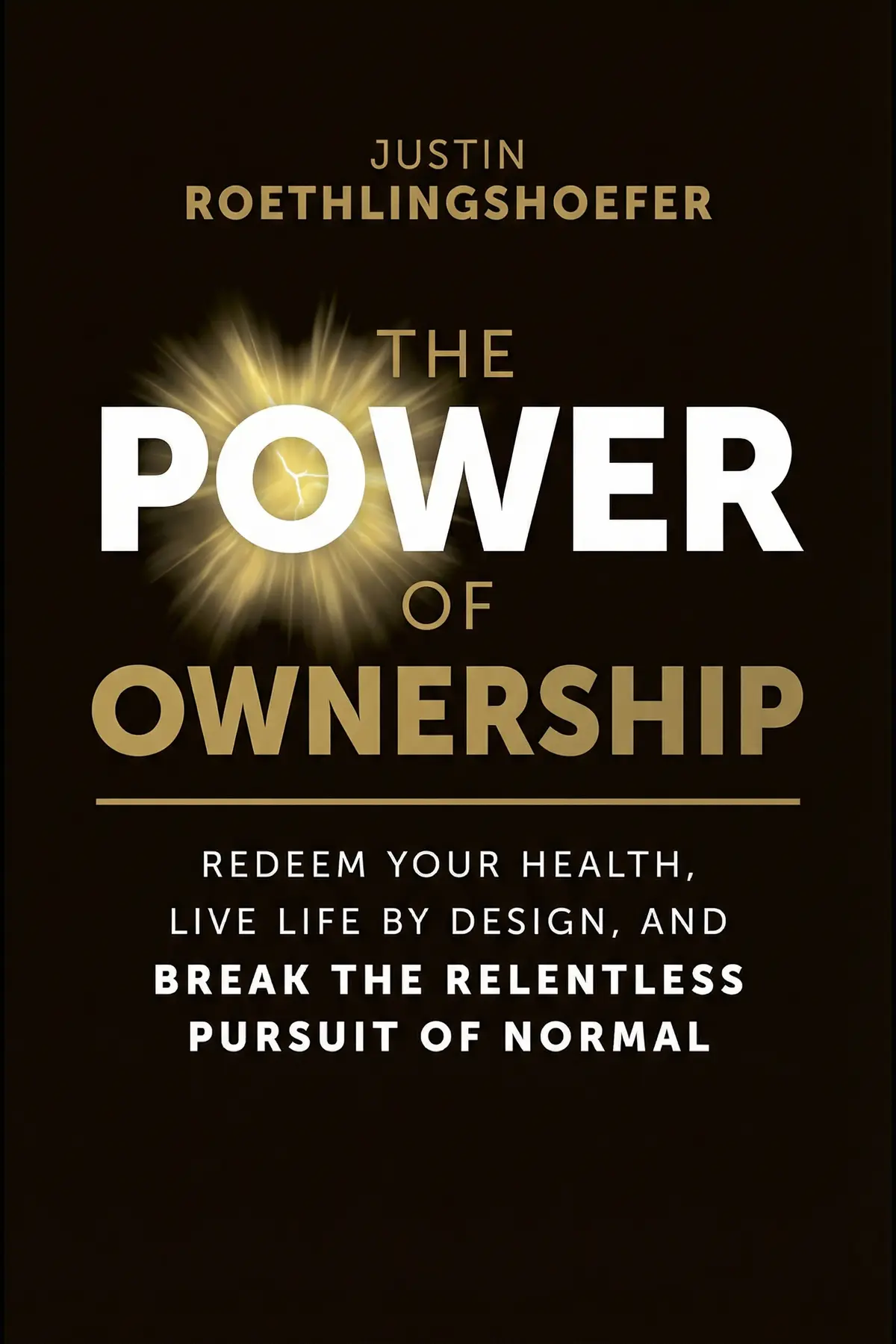
Table of Content
1. Introduction
59 sec
Plenty of capable people run their days on fatigue and scattered focus, and they treat that state as normal. In The Power of Ownership, performance coach Justin Roethlingshoefer argues that normal is exactly the problem, and that your body already reports how it is coping through one measurable signal, heart rate variability. He spent more than 20 years working with professional hockey teams, Olympians and champions, and he builds his whole method around that number.
His case is straightforward. Read your body’s signal, then design how you eat, train, sleep and recover around it, and you move from reacting to stress to owning your health. The plan rests on four pillars he calls fuel, build, repair and renew, and each comes with specific timings: when to eat breakfast, when to stop drinking water, how cool to keep the bedroom. What follows is a daily schedule you can test against your own data, starting tonight.
2. Step out of the overreach and burnout loop
1 min 46 sec
Most busy adults cycle between two exhausting states and call it ordinary life. Two elite athletes show a different way to treat the body, and it starts with noticing which of four zones you are really in.
3. Use one number to steer your health
1 min 48 sec
Advice about sleep, diet and exercise is everywhere, and much of it contradicts itself. The body offers its own running verdict on what is working, but only if you learn to read it.
4. Eat and drink on a schedule your body likes
1 min 51 sec
Most food debates fight over what belongs on the plate. This plan cares just as much about the clock and the order of each bite, and it treats your water bottle as seriously as your meals.
5. Train thirty minutes and feed your mindset daily
1 min 47 sec
Sporadic workouts leave many people tired without making them stronger. The second pillar asks for a daily commitment of body and mind, and the mental half turns out to be the more demanding one.
6. Sleep and recover on your body's clock
2 min 02 sec
Two hormones take turns running your day and your night, and most modern evenings work against them. A simple countdown rule and a few cheap habits aim to put them back in balance.
7. Surroundings and people that restore your energy
1 min 44 sec
An executive working across time zones kept gaining weight and losing sleep. What changed her situation within a month had less to do with discipline than with the shape of her days.
8. Build habits that match what you value
1 min 42 sec
Four pillars and dozens of timings can start to feel like a second job. The final step deals with that problem by deciding what deserves your energy before adding a single new routine.
9. Conclusion
1 min 06 sec
The book’s real proposal is a change in who sets the pace. In the normal pattern, demands decide the schedule and the body sends its bill later, as fatigue, aches and broken sleep. Roethlingshoefer wants the body’s own signal, read through HRV, to set the pace instead, with every meal time, workout and bedtime chosen against it. Elite athletes already go to great lengths for their performance. His argument is that anyone whose work depends on energy and focus has the same reason to.
The book supports a few concrete moves. Start tracking HRV and learn your own range before comparing yourself with anyone. Pick the pillar your numbers point to and change one habit there, such as eating vegetables first at dinner or keeping the 3-2-1-0 rule at night. Then look honestly at your surroundings and the people around you, the way Ava reshaped her travel and felt the difference within a month.
Ownership, in the end, is not a dramatic overhaul. It is the habit of asking your body before you ask more of it.
About this book
What is this book about?
Many people accept constant tiredness, scattered focus and overloaded weeks as the price of a busy life. Justin Roethlingshoefer calls that pattern normal, and he argues that normal is the problem. Most people, in his view, swing between taking on too much and burning out, without ever reaching a state where they control their own energy. His way out rests on one measurable signal: heart rate variability, or HRV, which he treats as the body's report on how it is coping with stress. HRV then guides four pillars of daily life. Fuel covers food and water. Build covers training and mindset. Repair covers sleep and the immune system. Renew covers self-care and the places and people around you. The book is specific. It gives meal timings, a morning hydration routine, a daily training target, a bedtime rule, a bedroom temperature and a short guide to sauna, cold and sunlight. It closes with a method for ranking priorities and growing habits from a plan into instinct, so readers can build a schedule shaped around their own data and values.
Book Information
Who it's for
Tired and scattered professionals
Professionals who feel tired and scattered most days and suspect that this has quietly become their normal.
Busy founders and travelers
Founders and frequent travelers whose sleep, weight and focus suffer under a packed schedule.
Wearable owners
Wearable owners who collect health data but are unsure how to turn it into daily habits.
About the Author
Justin Roethlingshoefer
Justin Roethlingshoefer holds a master's degree in exercise physiology and did postgraduate research in heart rate variability and functional medicine. He has served as a Performance Director in the NHL and in college sports, and he founded a private camp for professional hockey players. Across more than 20 years he has worked with Olympians, Stanley Cup and Super Bowl champions, entrepreneurs and Fortune 500 companies. He now speaks, runs workshops and writes about health and leadership, building personal plans from data and testing.
Ratings & Reviews
Ratings at a glance

What people think
Listeners find this book delivers a masterful perspective on health mentality and habits, filled with useful guidance and concrete action items. They value how easy it is to digest, with one listener highlighting its ability to wake people up to reality. The caliber of the writing is well-regarded, with listeners characterizing the work as a helpful roadmap.
Top reviews
Sun
This book completely shifted my perspective on what it means to be truly healthy in a high-stress environment. Justin Roethlingshoefer doesn't just recycle the same old diet advice; instead, he dives into the science of Heart Rate Variability (HRV) and how our bodies actually process stress. I found the holistic approach to be a breath of fresh air compared to the quick-fix weight loss trends dominating social media right now. The narrative is engaging, making complex physiological concepts feel accessible to anyone, regardless of their medical background. It is a masterful guide for those who are tired of feeling drained and are ready to reclaim their vitality through intentionality. Truly, the way he breaks down the necessity of a strong foundation changed how I view my morning routine entirely.
Show moreDream
The chapter on personalized diagnostics and DNA testing was a total game-changer for my personal fitness routine. Justin’s methodology is incredibly sophisticated yet he explains it with a clarity that makes you feel like you can actually master your own biology. I’ve tried every fad diet under the sun, but understanding my gut health and nutrient absorption through his lens has finally moved the needle. It is rare to find an author who practices what he preaches with such authenticity and scientific backing. The book serves as both a motivational kick in the pants and a precise blueprint for long-term health. Not gonna lie, I was skeptical at first, but the results I'm seeing from just shifting my focus to HRV are undeniable. This is essential reading for the modern age.
Show moreKanokwan
Finally got around to reading this and I am kicking myself for waiting so long to dive in. The Power of Ownership is more than just a fitness book; it is a manifesto for anyone who wants to perform at their highest level. Justin’s diagnostic-driven approach is the future of wellness, and he lays it out in a way that feels achievable for the average person. I was particularly impressed by the case studies which show the dramatic transformations possible in just a year. The emphasis on muscle gain and metabolic enhancement through personalization is spot on. If you are tired of the 'one size fits all' approach of big-box gyms, this book is your new best friend. It’s insightful, evidence-based, and incredibly motivating. I'll be recommending this to everyone in my circle.
Show moreNew
Picked this up during a particularly bad bout of burnout, and the timing could not have been more perfect for me. The roadmap Justin provides is incredibly clear, focusing on tangible action steps rather than just abstract theories about wellness. While some of the diagnostic talk regarding DNA testing felt a bit advanced for my current budget, the core principles of the four pillars—Fuel, Build, Repair, and Renew—are easy to start today. I appreciate that he emphasizes that there is no one-size-fits-all solution for our unique bodies. It’s a wake-up call to stop being a passive participant in your own life and start taking real ownership. My only gripe is that I wanted even more recipes, but the lifestyle advice more than makes up for that.
Show moreWanphen
Wow, I wasn't expecting a health book to be this engaging or this easy to implement into a chaotic professional schedule. The way the author explains the intersection of spiritual and physical health is something you don't see often enough in fitness literature. It’s not just about hitting the gym; it’s about how you repair your mind and renew your spirit after a long day of meetings. I specifically liked the focus on 'Repair' because I’ve been guilty of overtraining for years without seeing results. The anecdotal evidence and case studies included really helped illustrate how these personalized adjustments look in the real world. This isn't just a book you read once; it’s a manual you keep on your desk for constant reference. Highly recommended for the busy overachiever.
Show moreMikael
Ever wonder why you are doing all the 'right' things but still feel like absolute garbage every morning? This book tackles that exact frustration by challenging the status quo of 'normal' health and demanding something better from us. Justin provides a masterful approach to the mindset required to actually sustain a healthy lifestyle long-term. I loved the distinction between just surviving and actually having the vitality to lead your family and business. The writing style is punchy and direct, which I personally prefer over long-winded medical texts. There is a lot of practical advice here that doesn't cost a dime to implement, which I found very refreshing. It’s a great resource for anyone feeling stuck in a cycle of fatigue and looking for a way out.
Show moreSophia
Look, we all know we should eat better and sleep more, but Justin provides the actual 'how' that most gurus skip over. His four pillars framework provides a logical structure to a topic that usually feels overwhelming and scattered. I found the section on 'Renew' to be the most impactful, as it addresses the mental and emotional components of health that are so often neglected. The book is well-written and flows naturally from one concept to the next without getting bogged down in jargon. Frankly, it’s one of the more readable self-help books I’ve picked up in years. While I think some of the supplement advice could be more specific, the overall message of taking control is powerful. It really does wake you up to the reality of your current choices.
Show moreWissanu
After hearing Justin speak on a podcast, I wanted to dive deeper into his philosophy of taking full control of one's journey. The book does a fantastic job of explaining why we are currently facing a crisis of chronic disease and how ownership is the only cure. His breakdown of the 'Build' pillar helped me realize I was focusing on the wrong types of exercise for my specific body type. The text is peppered with scientific backing that gives the advice a lot of weight. It’s an enlightening read that doesn't just tell you to do better, but shows you exactly where to start. I gave it four stars only because I felt the intro was a little long, but once it gets into the meat of the pillars, it’s gold. Every page offers a new insight.
Show moreFrida
In my experience, most health books are either too dry or too focused on superficial aesthetics, but this one finds the perfect middle ground. The blend of spiritual, physical, and physiological application creates a truly comprehensive guide for the modern person. Justin’s tone is supportive yet firm, pushing you to stop making excuses for your lack of energy. I really enjoyed the specific details on how to measure health metrics beyond just the number on the scale. Understanding my body's response to stress has helped me manage my workload so much better. The writing is easy to digest, and the chapters are short enough to read during a commute. It’s a very good investment for anyone looking to establish healthy patterns and finally get out of their own way.
Show moreSarocha
As someone who follows health trends closely, I found the core message of self-responsibility valuable but felt some sections were a bit repetitive. To be fair, the emphasis on bio-individual diagnostics is a great point that many other authors ignore. However, I was hoping for a bit more deep-dive data into the scientific studies mentioned throughout the chapters. The tone is very motivational and the writing is fluid, which makes for a quick read, but it sometimes skims the surface of the 'why' to focus on the 'what.' It’s a solid resource for beginners or those stuck in a rut. If you are already an elite athlete, you might find some of the advice a bit foundational, though the reminders on sleep and recovery are always necessary.
Show moreQuestions about this book
What is the main idea of The Power of Ownership?
Justin Roethlingshoefer argues that most people swing between overreaching and burnout and accept that as normal. He proposes a different path: use heart rate variability as a personal gauge of how your body is coping, then design daily habits across four pillars, fuel, build, repair and renew, so that energy and focus become something you control rather than something you hope for.
What is heart rate variability and why does the book focus on it?
In the book, HRV reflects the timing between heartbeats and serves as the body’s report on how it handles daily stress. A high reading suggests resilience, a low one signals you are pushing too hard. Because it can be measured with wearables like the Apple Watch or Fitbit, the author treats it as a compass for choosing which pillar to work on first, judged against your own baseline.
What is the 3-2-1-0 sleep rule?
It is the author’s bedtime countdown: no food in the three hours before bed, no drinks in the last two hours, and screens off for the final hour. He pairs it with consistent bed and wake times, less caffeine and alcohol near bedtime, and a dark, quiet bedroom kept around 64 degrees Fahrenheit, which is about 18 Celsius.
How can I start applying The Power of Ownership?
Begin by tracking HRV to learn your usual range. Then choose the weakest pillar and change one habit, such as eating vegetables before protein, fat and carbohydrates, drinking most of your water before 3 in the afternoon, or training for 30 focused minutes a day. The author describes habits growing from a plan into a routine, then a rhythm, and finally an instinct.
Readers also enjoyed




AUDIO SUMMARY AVAILABLE
Listen to The Power of Ownership in 15 minutes
Get the key ideas from The Power of Ownership by Justin Roethlingshoefer, plus 5,000+ more nonfiction titles.
- 5,000+ titles
- Listen as much as you want
- 7-day free trial
- Cancel anytime









