

A Splendid Exchange: How Trade Shaped the World
William J. Bernstein
 English
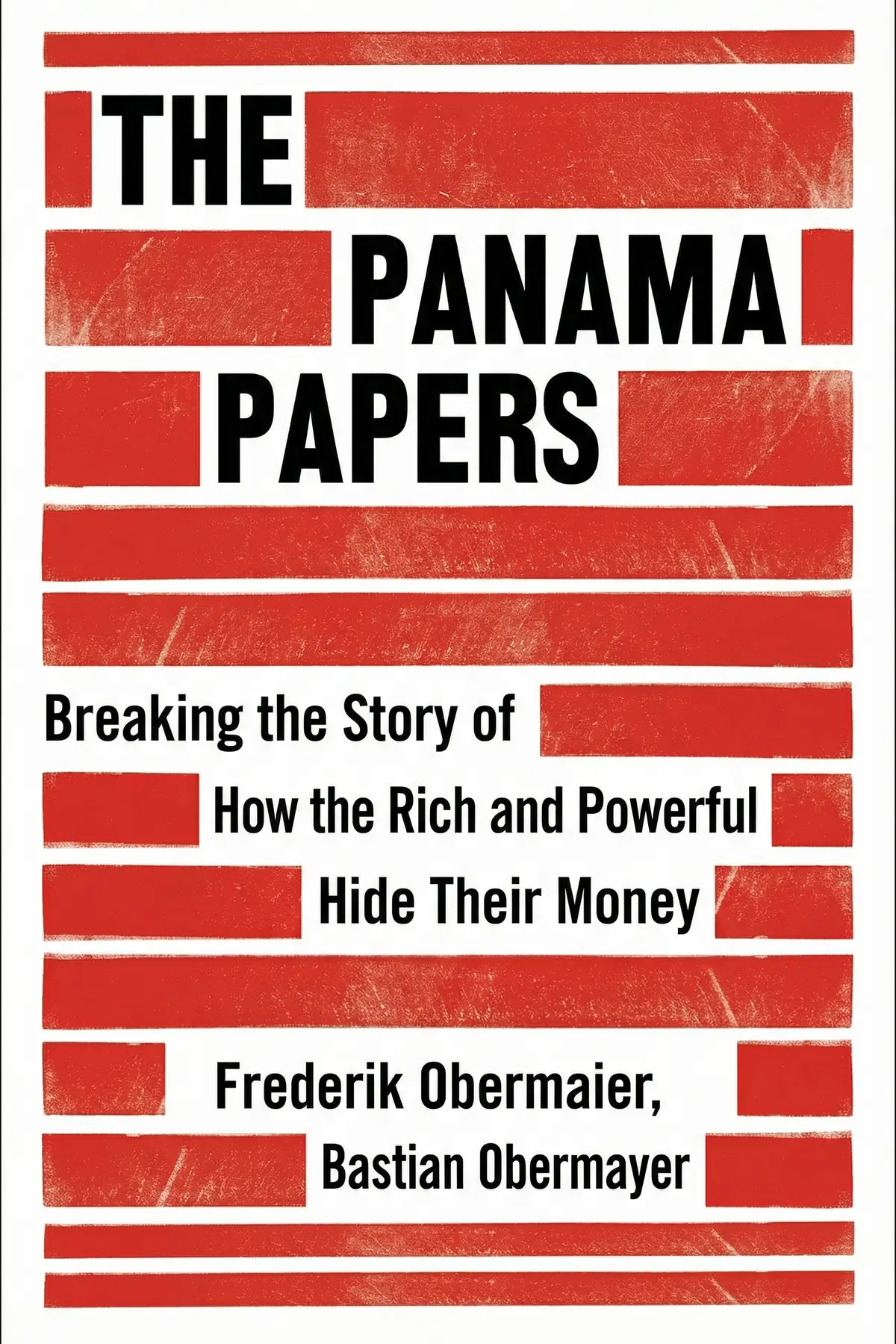
Two reporters explain how shell companies, stand-in owners and secrecy laws hide the money of dictators, oligarchs and billionaires, and how one leak to Munich exposed that system to the world.
1 min 05 sec
Most of us assume the rich hide their money in ways too technical to follow. In The Panama Papers, German investigative journalists Bastian Obermayer and Frederik Obermaier show that the machinery is surprisingly simple: a company with a bland name, a stranger who signs for it and a piece of paper that says who owns it. Both reporters worked at the Munich newspaper Süddeutsche Zeitung when they received the largest leak journalism had ever seen. It came from inside a Panamanian law firm called Mossack Fonseca.
Their argument is stark. Offshore secrecy looks legal on paper, yet it has grown into a parallel financial system that lets dictators, oligarchs and billionaires play by rules nobody else gets to use. Follow their reporting and the headlines about tax havens stop sounding abstract. You will see how a shell company hides its owner and how a cellist became a channel for billions. You will also see why the authors treat the whole arrangement as a threat to equal treatment under the law.
2 min 02 sec
A stranger offered a reporter some data one quiet evening, and the files kept growing until no newsroom on Earth could read them alone. What the journalists did next mattered as much as the leak itself.
2 min 03 sec
A billionaire once lost his yacht and his property without anyone stealing anything. His mistake shows how offshore ownership really works, and why the person on the paperwork is rarely the person in charge.
1 min 46 sec
A law passed almost a century ago still shapes where the world’s hidden money goes. The authors trace how a poor former province turned privacy into a national industry, and why its government has little reason to change.
2 min 10 sec
International sanctions were supposed to cut off Syria’s ruling family. Internal emails show a law firm’s compliance team raising the alarm, and a partner deciding that a famous bank’s comfort was reason enough to carry on.
2 min 07 sec
A loan worth two hundred million dollars changed hands for one dollar, and a ski resort received money it never paid back. Behind the paperwork stood a musician who said he had no fortune at all.
2 min 01 sec
For most people, tax is as certain as anything gets. For a few hundred thousand of the very richest, it has become closer to a choice, and the authors argue that democracy pays the price.
1 min 22 sec
The Panama Papers begins with a stranger’s message and ends with a firm’s collapse. Authorities raided Mossack Fonseca and arrested its founders in 2017, and the firm closed in 2018. For Obermayer and Obermaier, that outcome proves journalism can still hold power to account. They are just as clear that the wider offshore system survived and still enables tax evasion and inequality on a vast scale.
The book leaves you with a way of seeing. The hiding places of the powerful are built from ordinary parts: a signature from someone with no control, a shareholder standing in for someone else, a certificate anyone can carry. A small country’s secrecy law, a bank’s casual approval and a firm’s appetite for fees did the rest. The client could be a careless billionaire, a cousin of Assad or a cellist close to Putin.
So when the next scandal breaks, look for the people who sign without owning and the loans that never come back. Ask who would lose if ownership became public. Remember too that the leak covering 214,000 companies became a story only because 400 reporters agreed to read it together. A wall of paper hides money until enough people decide to look behind it.
An anonymous source contacted a journalist in Munich and began sending files from inside Mossack Fonseca, a little-known law firm in Panama. It turned into the largest leak journalism had ever handled: 11.5 million documents covering 214,000 offshore companies. Bastian Obermayer and Frederik Obermaier tell how they brought in 400 reporters across 80 countries to work through it in secret. The book explains the machinery of hiding wealth. Nominee directors sign without having any control, nominee shareholders hold shares for someone else, and bearer shares give ownership to whoever holds the paper. The authors trace how Panama's 1927 secrecy law made the country a haven. They follow the money that kept Syria's Assad regime trading under sanctions, and the roughly two billion dollars that moved through companies tied to Putin's friend, a cellist named Sergei Roldugin. Readers come to understand tax havens as a system, along with the authors' argument that it gives the ultra-wealthy a separate set of rules and threatens the equal treatment democracies depend on.
Professionals in finance, law or compliance who want to see how offshore structures are really used.
Readers puzzled by tax haven headlines who want the mechanics explained through real cases.
Anyone interested in investigative journalism and how a huge leak becomes a story.
Bastian Obermayer, born in 1977, works for the Munich newspaper Süddeutsche Zeitung and was the journalist an anonymous source chose to receive the Panama Papers. He studied politics, history and American studies in Munich, trained at the Deutsche Journalistenschule and later helped found Forbidden Stories. Frederik Obermaier, born in 1984 in Eggenfelden, Germany, is an investigative journalist at the same paper and co-founded the newsroom paper trail media. In 2016 the two initiated and coordinated the Panama Papers revelations, and they later worked together on the Paradise Papers.
Listeners find the work expertly written and extensively researched, with one individual remarking that it is a must-read for practitioners and students of financial crime. Furthermore, they like the narrative's tempo, especially how it demystifies the world of offshore companies, and view it as revelatory; one review highlights how it reveals the world's corruption. However, the storytelling gets a mixed response, as some find the tales captivating while others feel the stories jump around quite a bit.
Wow. This isn't just a book; it's a terrifying roadmap of how the world's wealthiest individuals bypass the systems the rest of us rely on. The Obermaier/Obermayer duo manages to take an abstract concept like "shell companies" and give it a face—or rather, many faces, ranging from world leaders to criminal kingpins. It reads with the frantic energy of a spy novel, even though it's all based on rigorous, depressing fact. I was particularly struck by the sheer volume of 2.6 terabytes of data they had to parse. Truth is, the corruption detailed here feels so systemic that it’s almost overwhelming. While the authors clearly have a point of view, their commitment to transparency and the way they organized the International Consortium for Investigative Journalists (ICIJ) is nothing short of heroic. If you want to understand why the gap between the rich and poor keeps widening, you need to read this immediately.
Show moreFinally got around to finishing this massive account of global corruption, and it’s truly eye-opening. It exposes a world where the 1% operate in a shadow economy that is almost entirely invisible to the public. I loved the chapters detailing the collaboration between journalists across 80 countries—it shows what the media can still achieve when they work together. The risk these reporters took to bring down firms like Mossack Fonseca is inspiring. Personally, I found the "John Doe" mystery to be the most compelling thread. Who is he, and why did he choose these specific journalists? It’s a deep dive into the ethics of whistleblowing and the rot at the heart of our financial systems. Highly recommended for students of political science or anyone who wants to see how the world really works.
Show morePicked this up after seeing the documentary, and the depth of research here is staggering. It provides a much more granular look at the shell companies and the specific legal loopholes used by the elite. The authors break down complex financial concepts with ease, making it accessible even if you aren't an economist. I was fascinated by the section on how the data was actually transferred and secured. In my experience, the facts are shocking enough on their own without the extra dramatic flair, but the pacing here actually works. It reveals the world's corruption in a way that is impossible to ignore. It’s a long read, but essential for understanding the modern world and how the wealthy evade their responsibilities. An absolute must-read for anyone curious about international finance.
Show moreThis book is essentially a manual for understanding how the global elite play by a completely different set of rules. It’s infuriating, exhausting, and absolutely necessary reading. I was particularly gripped by the stories of the journalists in countries with less press freedom who risked everything to participate in this project. The authors do a fantastic job of balancing the technical details of offshore banking with the human cost of this corruption. It reveals a level of systemic rot that is hard to ignore once you've seen it laid out so clearly. Every chapter feels like another blow to one's faith in the global financial system. To be fair, it’s depressing, but the truth usually is. Brilliant work by the team at Süddeutsche Zeitung.
Show moreAfter hearing about Mossack Fonseca for years, it was fascinating to see the play-by-play of the leak. This book captures the paranoia and excitement of the early days of the investigation perfectly. It’s a masterclass in investigative technique. The authors don't just tell you that people are hiding money; they show you the exact paper trails they used to do it. It’s eye-opening to see how little these firms cared about who their clients were, as long as the fees were paid. This isn't just a book about tax evasion; it's a book about the breakdown of global ethics. The pacing is excellent, especially in the first half. Essential reading for anyone who cares about justice and transparency in the 21st century.
Show moreAs someone who follows financial news, I thought I knew the gist of this scandal, but the details in this book are wild. The way Mossack Fonseca operated with such blatant disregard for due diligence is shocking. The authors do a great job explaining the mechanics of offshore accounts without making it feel like a dry textbook. My only gripe is that the storytelling jumps around quite a bit, making it hard to keep track of every specific politician or shell company mentioned. To be fair, when you’re dealing with such a massive data leak, a bit of messiness is expected. It’s a dense read, yet the pacing keeps you engaged throughout. It is a vital resource for practitioners and students interested in financial crime or investigative journalism. The sheer scale of the greed uncovered is eye-opening.
Show moreHow do you turn 2.6 terabytes of data into a readable story? The Obermayers do a decent job, though the sheer volume of information sometimes bogs down the narrative. It’s incredible to see how many heads of state were implicated in these leaks. The book highlights the existential threat these tax havens pose to developing nations by draining their resources. My main criticism is that the book focuses heavily on European and Russian players, while American involvement feels curiously underrepresented. Is that a flaw in the data or the reporting? Either way, it’s a fascinating scoop. The pacing is generally good, and the tension of the initial leak is palpable. It is a deeply researched piece of work that everyone should at least skim to understand global inequality.
Show moreThe scale of the investigation is undeniably impressive, but the narrative flow left me wanting more. I appreciated the behind-the-scenes look at how the Süddeutsche Zeitung journalists handled the mysterious "John Doe," but the writing itself felt a bit repetitive at times. They keep circling back to the same themes of tax evasion and elite hypocrisy without adding much new depth after the first few chapters. Frankly, it felt more like a series of long-form articles stitched together than a cohesive book. The translation also felt a bit clunky in places, using odd phrasing that pulled me out of the moment. Still, the core message about global corruption is vital. It’s an important historical record, just not a particularly elegant one. I expected a bit more punch from such a historic scoop.
Show moreLook, the content is vital, yet the structure is frustratingly disjointed. One minute we're in Iceland watching a prime minister fall, and the next we're deep in the weeds of African mineral rights. It’s all connected, of course, but the transitions are jarring. I found myself having to flip back several pages to remember which specific intermediary or law firm was being discussed. The truth is, the book could have used a much stronger editor to trim the fat and focus the narrative. It’s still worth a read for the sheer audacity of the Mossack Fonseca operation, but be prepared for some dry stretches. It feels like a very long, very detailed newspaper report rather than a cohesive book.
Show moreI really wanted to be swept away by this 'journalistic thriller,' but the translation felt stiff and the chapters were too repetitive. I understand that the authors are journalists, not novelists, but the "listy" nature of the prose made it a slog to get through. It felt like I was reading a never-ending spreadsheet of rich people behaving badly. Plus, the authors' sanctimonious tone occasionally grated on me. Not gonna lie, I struggled to finish it. While the leak itself was a monumental event in history, this particular book fails to capture the drama in a way that feels fresh. It’s a lot of names and dates with very little narrative connective tissue to hold it all together. For such a massive scoop, the writing should have been much better.
Show moreThe book tells how an anonymous source leaked 11.5 million documents from Mossack Fonseca, a Panamanian law firm, to Bastian Obermayer at Süddeutsche Zeitung. With Frederik Obermaier and 400 journalists in 80 countries, he examined 214,000 offshore companies. The files showed how heads of state, dictators’ families, criminals and billionaires used shell companies to hide wealth, dodge taxes and get around sanctions.
The authors describe three layers Mossack Fonseca offered. Nominee directors sign documents and appear as the company’s face but have no real control. Nominee shareholders hold shares on behalf of someone else. Bearer shares are paper certificates that make whoever holds them the owner, leaving no register at all. One German billionaire lost track of his assets for a time by misplacing such a certificate.
According to the authors, the key was Law 32, passed in 1927, which guaranteed secrecy over estates, money transfers and company ownership. Combined with tax exemptions, it made Panama attractive for hidden money. The government has embraced the industry because offshore providers pay corporate taxes and create jobs, while relaxed laws keep money flowing in.
Iceland’s prime minister resigned, and protesters filled the streets of Buenos Aires. Authorities raided Mossack Fonseca and arrested its founders in 2017, and the firm closed in 2018. The authors take this as evidence of journalism’s continuing ability to hold power accountable, yet they emphasize that the broader offshore system still enables tax evasion and inequality.
It suits readers who want to understand how hidden wealth works through real cases rather than theory. That includes the Assad regime getting around sanctions and about two billion dollars moving through companies tied to Putin’s friend Sergei Roldugin. It is useful for people in finance, law and compliance, and for anyone who wants to follow debates about tax havens and inequality.
William J. Bernstein

John Rawls






Miles Taylor

Yanis Varoufakis

AUDIO SUMMARY AVAILABLE
Get the key ideas from The Panama Papers by Frederik Obermaier, plus 5,000+ more nonfiction titles.









