
13 min 59 sec
Available in: English
The Net and the Butterfly: The Art and Practice of Breakthrough Thinking
Shows how new ideas form in the brain and how to invite them on purpose. Its tools include switching between focus and mind-wandering, borrowing from other fields, building a varied crew and managing fear and uncertainty.
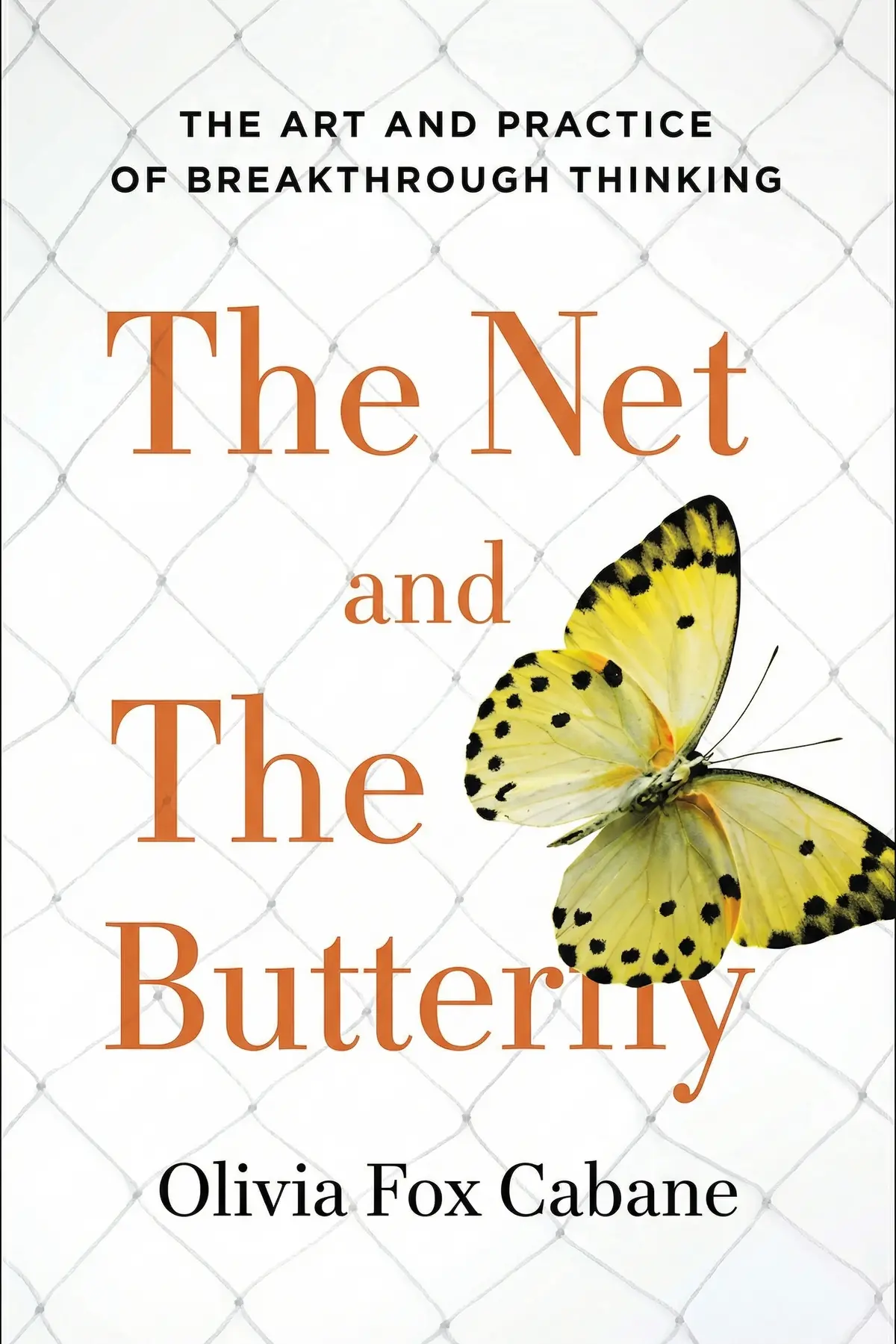
Table of Content
1. Introduction
1 min 02 sec
If your best ideas seem to arrive only by luck, in the shower or on a walk, The Net and the Butterfly suggests luck plays a smaller part than you think. Olivia Fox Cabane and her co-author draw on neuroscience and on the habits of famous inventors to show that the brain produces insight through two networks taking turns: one that focuses on a problem and one that drifts. Breakthroughs tend to come when the focused one lets go.
That means the conditions for new ideas can be set up. The case built here is that you can catch them on purpose, by aiming your mind at a problem, letting it wander, feeding it unfamiliar material, gathering the right people around you and calming the fear and uncertainty that make most people stop too early.
Along the way come a ballpoint pen, a guitar riff recorded half asleep, a comedy gag made of coconuts and a footballer who missed most of his World Cup goal shots. What follows is a set of habits for the next problem that refuses to give way.
2. Spot the four shapes a breakthrough can take
1 min 47 sec
A newspaper editor tired of ink blots solved a problem others had already failed at, using parts that already existed. His success points to four very different ways an answer can arrive, and each one asks for different patience.
3. Aim hard, then step away so ideas can land
1 min 55 sec
A rock guitarist found a career-changing riff on a tape he had no memory of recording. The brain science behind that night explains why forcing an answer often blocks it, and what to do instead.
4. Borrow from other fields to build something new
1 min 38 sec
The assembly line and the tattoo machine both began as parts of something else. Their stories suggest that the ideas you need may already exist, sitting in places you have never thought to look.
5. Fresh experiences rewire your brain for better ideas
1 min 33 sec
Your brain physically changes every time you try something unfamiliar. A device in your pocket, built to grab your attention, may be spending the very drive that this change depends on.
6. Build a small crew that sharpens your ideas
1 min 38 sec
Tolkien and Lewis traded drafts, and Einstein had his Olympia Academy, a group of peers he could test ideas on. The right group around an idea needs more than kind listeners, and the missing roles are easy to overlook.
7. Stop fear of failure from killing your ideas
1 min 37 sec
Two of the greatest athletes in history missed far more often than most fans would guess. Their records, and a ten-day writing exercise, show how to keep fear from blocking your next attempt.
8. Steady yourself while the answer stays out of reach
1 min 40 sec
Not knowing whether you are close to a solution registers in the brain much like pain. Three simple tools, none of them about thinking harder, help people stay with a problem long enough to crack it.
9. Conclusion
1 min 09 sec
The image in the title fits the argument. A butterfly cannot be forced, but it can be caught by someone who knows where to stand and holds the net still. Fox Cabane’s case is that breakthroughs behave the same way. They come from an ordinary brain that switches between pointing at a problem and letting it go, that has fresh material to combine, and that stays calm enough to keep waiting. Biró’s pen and Ford’s assembly line came from people who joined known parts in a new way. Keith Richard’s riff came from a mind that had been aimed at a goal and then left alone.
That puts much of creativity within your reach. Name the problem clearly, then take a walk without your phone and let the default network do its work. Write what you notice in a notebook, and go looking for inputs from fields far from your own. When fear or uncertainty pushes you to stop, remember Maradona’s misses, pin up your own record of resourceful moments, and give a few minutes to someone else’s problem or to your breathing.
The idea you need may already be on its way. Your part is to be ready when it lands.
About this book
What is this book about?
Most people treat their best ideas as luck: a thought in the shower, a solution on a walk, a riff remembered after sleep. Olivia Fox Cabane and her co-author argue that these moments follow a pattern. Neuroscience, combined with the habits of well-known inventors and artists, shows that insight comes from two brain systems taking turns. One system focuses on a problem. The other wanders and links things in unexpected ways. From that starting point, the book builds a practical method. It explains the four shapes a breakthrough can take, why walking and calm tasks invite ideas, and how tight limits push thinking off the obvious route. It shows how Henry Ford and Samuel O'Reilly built new things from existing parts, and why a phone full of alerts wastes the drive that fuels discovery. The second half turns to people and feelings. Readers learn how to assemble a small crew with the right mix of roles, how to judge ideas with Edward de Bono's Six Thinking Hats, how to loosen the grip of fear of failure, and how three SuperTools (purpose, altruism and meditation) help them keep going while the answer stays out of reach.
Book Information
Who it's for
Professionals stuck on problems
Professionals stuck on a problem who keep waiting for inspiration that never comes.
Founders and team leaders
Founders and team leads who want a practical way to generate and test new ideas with others.
Creatives giving up early
Creative people whose fear of failure or of not knowing makes them quit projects too early.
About the Author
Olivia Fox Cabane
Olivia Fox Cabane, born in Paris, is an author, public speaker and cofounder of the KindEarthTech Foundation. She previously served as Director of Innovative Leadership for StartX, the student accelerator at Stanford University. Her earlier book, The Charisma Myth, treats charisma as a learnable skill made of basic parts. She co-wrote The Net and the Butterfly on the neuroscience of innovation, and her books have been translated into 32 languages.
Ratings & Reviews
Ratings at a glance
What people think
Listeners find this guide to innovative thinking both insightful and approachable, noting the inclusion of practical daily exercises. Its readability is highly regarded, with one listener mentioning that the stories make for a compelling read. The book receives praise for its boost to brain power—one listener specifically notes its positive influence on personal relationships—as well as its focus on creativity, with another listener spotlighting the exercises for overcoming creative challenges. They value the encyclopedic depth of the content, with one review highlighting historical examples, and consider it essential reading for innovation. However, the "woo factor" draws mixed reactions from listeners.
Top reviews
Tom
Personally, I found this book to be a tactical manual for anyone who feels like their best ideas are constantly slipping through their fingers. Cabane and Pollack manage to bridge the gap between heavy neuroscience and everyday application with surprising grace. I was particularly impressed by how they break down the 'butterfly' of genius into something you can actually invite into your life through specific environmental shifts. It isn't just a collection of theories; the pages are packed with exercises that help you move from a rigid mindset to one that embraces the wandering mind. In my experience, I’ve already started implementing the 'loving kindness' meditation they suggest, even though it felt a bit 'woo' at first. The results in my professional relationships have been tangible. If you’re looking to master the art of breakthrough thinking, this is a must-read for your collection.
Show moreHazel
Finally got around to reading this and I’m genuinely surprised by how much it actually changed my daily routine. Most books on creativity just tell you to 'think outside the box,' but this one gives you the actual tools to expand the box itself. The exercises for tackling creative challenges are approachable and, more importantly, they don't take hours to complete. I especially loved the sections on how to view failure as a necessary data point rather than a dead end. The writing style is clear and easy to understand, making complex neuroscience accessible for someone who doesn't have a PhD. It’s like an encyclopedia for innovation that you can actually enjoy reading while traveling or in your downtime. This is definitely a book you will keep going back to for inspiration.
Show morePatcharaporn
Wow, this book is far more than a typical business read; it is a comprehensive manual for mastering your personal mindset. I was blown away by the depth of information regarding how our physical environment affects our ability to have breakthroughs. The authors explain complex neuroscience with such clarity that anyone can understand it without feeling overwhelmed. I particularly liked the section on the activating effects of altruism and how quiet tranquility can lead to a 'voice of genius' that sounds remarkably like intuition. It is an inspiring guide that I will keep going back to whenever I feel stuck on a project or need a fresh perspective. For anyone wishing to learn about invention, this is an absolute goldmine. I’ve already recommended it to colleagues looking for innovation.
Show moreEvelyn
After hearing so much about the author’s previous work on charisma, I was eager to see how she tackled the concept of innovation. The fusion of the 'net'—your disciplined, executive brain—and the 'butterfly' of your wandering, creative mind is a brilliant metaphor. While some sections felt a little like common sense repackaged, the historical examples of famous inventors were genuinely captivating and provided a solid anchor for the more abstract concepts. I did find the pacing slowed down significantly during the middle chapters when the science got a bit dense. However, the practical daily exercises kept me engaged enough to push through until the end. It’s a solid guide for leaders who want to foster a culture of creativity within their teams without losing focus on commercial goals and practical outcomes.
Show moreJoe
As someone who has always been fascinated by how the unconscious mind works, I found this book to be a very informative resource. It offers a unique collection of frames for understanding how we can increase the number of creative ideas we 'catch' in our daily lives. The balance between the science of the brain and the art of innovation is handled quite well, though I can see why some might find the 'loving-kindness' sections a bit jarring. Personally, I think the motivating compendium of approaches is exactly what a modern leader needs to spark change. The book reminds us that genius isn't just a lightning bolt; it’s a process we can cultivate through deliberate practice and a better environment. It’s a great fusion of art and science that offers real value.
Show moreOlivia
Look, if you can get past the occasional 'woo-woo' factor, there is an incredible amount of value in these pages. The authors have done a fantastic job of gathering research from neuroscience, psychology, and sociology to create a comprehensive manual for breakthrough thinking. It’s written in a way that makes you feel like you’re having a conversation with an expert rather than reading a dry academic paper. I found the tips on reducing fear of failure particularly helpful for my current project. Some of the meditation techniques might not be for everyone, but they are presented alongside very practical methods for organizing team meetings and brainstorming. It’s a varied collection that offers something for everyone, provided you keep an open mind about the more unconventional suggestions.
Show moreLayla
Truth is, I wasn't sure if I needed another book on creativity, but the historical examples and case studies in this one won me over. It functions almost like an encyclopedia of innovative thinking, providing a wide range of techniques that are easy to try and implement immediately. I appreciate how approachable the exercises are; they don't require any special equipment or massive time commitments. The focus on both professional and personal life makes the advice feel more holistic than your standard business book. It’s a great guide for anyone looking to spread creativity to their teams at work. Just be prepared for a bit of a head game when it comes to the mindfulness sections. Overall, a very solid and valuable read for any innovative thinker.
Show moreNannapat
The chapter on the default mode network was what originally piqued my interest, but I struggled to stay engaged as the book progressed into the technical weeds. Insights into how the unconscious yields up ideas were fascinating at first. Unfortunately, the overall tone shifted way too much for my liking. It felt like it was trying to be too many things at once: a science textbook, a business manual, and a spiritual guide. To be fair, there is some real substance here regarding how to corral brainstorming sessions effectively. I just wish it had stayed more focused on the psychology rather than drifting into mindfulness exercises that I’ve seen in a dozen other self-help books recently. It is useful, but it requires some patience to get through.
Show moreNadia
Picked this up because I wanted to learn how to generate more novel solutions to problems at work. The first half was excellent and really opened my eyes to how the brain switches between different modes of thinking. However, my interest began to fade once the book got into the more technical details of brain waves and specific neurotransmitters. It’s definitely a book you might need to re-read a couple of times to fully grasp everything, which can be a bit frustrating if you're looking for quick wins. Gotta say, I found myself getting caught up in other self-help titles before I could even finish the last few chapters. While it’s a good book, it didn't grab me quite as much as I hoped it would initially.
Show moreIngrid
Not what I expected given all the glowing praise I had seen on social media. Frankly, it felt like useless psychobabble hidden behind fancy brain science terminology that didn't lead anywhere concrete. There are far too many platitudes about 'mindfulness' and 'zen-like tranquility' for my taste. I was hoping for a rigorous deep dive into the mechanics of innovation, but instead, I got a collection of active thinking techniques that felt a bit too 'new age' for me. To be fair, the writing is decent, but the substance just isn't there for a professional setting. Even the in-flight magazine probably would have offered more concrete advice on business strategy. It simply didn't click for me at all, and I found myself getting bored halfway through the second chapter.
Show moreQuestions about this book
What is The Net and the Butterfly about?
The book explains how breakthrough ideas form in the brain and how to invite them on purpose. Olivia Fox Cabane and her co-author combine neuroscience with stories of inventors such as László Biró, Henry Ford and Elias Howe. Their method covers switching between focus and mind-wandering, borrowing ideas from other fields, building a varied crew of advisors, and managing the fear and uncertainty that stop people before an idea arrives.
What are the executive network and the default network?
They are two brain systems the book describes. The executive network is the focused part that plans, organizes and carries out tasks. The default network is the wandering part behind sudden ideas, like those that appear in the shower. The executive network sets the direction, then steps back so the default network can make unexpected links, which is why insights often come during sleep, walks or daydreams.
What are the four types of breakthrough in the book?
The authors name eureka, metaphorical, intuitive and paradigm breakthroughs. Eureka moments arrive suddenly, as when James Watt solved a steam engine problem on a walk. Metaphorical ones come as dreams or analogies, like Elias Howe’s dream of spears with holes in their tips. Intuitive ones build slowly, as with Edison’s phonograph. Paradigm breakthroughs, like Einstein’s relativity, change how everyone sees the world.
What are the three SuperTools in The Net and the Butterfly?
The SuperTools are purpose, altruism and meditation. A higher purpose builds resilience, and the book suggests imagining what people might say at your 100th birthday to clarify it. Altruism, such as helping a colleague, moves attention off your fears and lowers stress. Meditation, even brief mindful breathing during waits, strengthens focus and calms emotions, leaving room for new insight.
How can I apply the ideas in The Net and the Butterfly?
Define a problem clearly, then step away to walk, garden or do a puzzle so your mind can wander. Keep a breakthrough notebook and seek out new food, routes, films and people from other fields, with your phone put away. Test ideas with a crew using Six Thinking Hats, and fight fear by listing five resourceful moments a day for ten days.
Readers also enjoyed





AUDIO SUMMARY AVAILABLE
Listen to The Net and the Butterfly in 15 minutes
Get the key ideas from The Net and the Butterfly by Olivia Fox Cabane, plus 5,000+ more nonfiction titles.
- 5,000+ titles
- Listen as much as you want
- 7-day free trial
- Cancel anytime









