

14 min 44 sec
Available in: English
The Muqaddimah: An Introduction to History
By Ibn Khaldūn
A fourteenth-century scholar's theory of why groups rise and fall. Cooperation builds strength, solidarity wins power and luxury slowly wears it away, while climate, diet, trade and faith shape each people along the way.
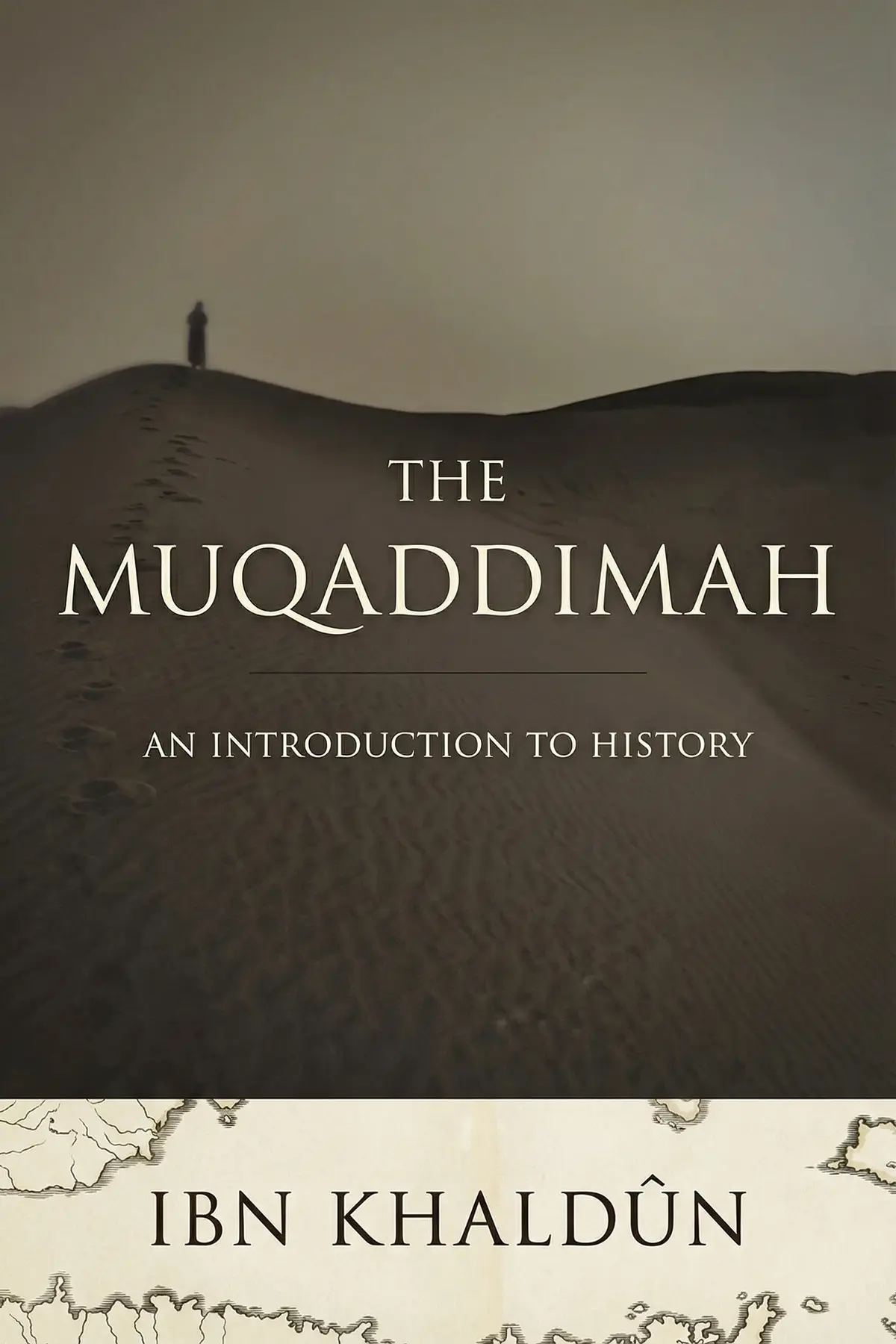
Table of Content
1. Introduction
57 sec
Most groups that win do not lose to a stronger rival. They lose to the comfort their own success brings. That is the warning at the center of The Muqaddimah, the Introduction to History by Ibn Khaldūn, a scholar born in Tunis in 1332 who said he wrote it in six months.
In his account, people survive by cooperating, the group bound by the strongest group feeling prevails, royal authority generally stays in one house for at most four generations, from builder to destroyer, and the pursuit of luxury in settled life makes people lazy and wears that authority down. Around that cycle he arranges climate, diet, trade and faith. Some of his views sound dated or even shocking today, and they are reported as his. His core pattern still fits teams, companies and families, and once you can see it, you can notice decline while there is still time to act.
2. Turn weakness into strength by working together
1 min 39 sec
A human facing a lion has no chance at all. A medieval scholar built his entire theory of civilization on that unflattering fact, and on the uncomfortable thing people need once they band together.
3. Build the bond that decides who wins
1 min 40 sec
Better weapons and bigger numbers do not settle every contest. Ibn Khaldūn points to something softer that does, and to a strange habit losing groups fall into that seals their fate.
4. Spot the moment success starts to decay
1 min 48 sec
Monuments, a full treasury and a peaceful reign sound like the peak of a dynasty. In Ibn Khaldūn’s timeline they are warning signs, and he gave ruling families a surprisingly short clock.
5. Lead firmly without crushing your people
1 min 45 sec
Ibn Khaldūn believed people need a strong ruler to hold back their worst instincts. He was just as sure that rulers who lean too hard on that power end up losing it.
6. See how comfort and plenty shape character
1 min 54 sec
Ibn Khaldūn thought weather could make a city cheerful or gloomy, and that rich food could dull the mind. His explanations belong to his century, but his suspicion of abundance does not.
7. Judge which kinds of profit are worth earning
1 min 52 sec
Centuries before modern economics, a North African scholar was explaining capital, the value of pooled labor and why risky trade routes pay more. He also had firm views on which ways of getting rich do not count.
8. Plan backward from the finished goal
1 min 58 sec
A medieval scholar used the building of a simple shelter to explain what separates human minds from animal ones. His example doubles as a planning method you can use on any project.
9. Conclusion
1 min 11 sec
Ibn Khaldūn’s history is finally a story about what success does to the people who achieve it. Weak creatures grow strong by joining together, and the group with the closest bond takes power. Then come the stone buildings, the full treasury and the softer habits, until a conqueror’s heirs are spending what he won. He wrapped that cycle in theories of climate, diet, money and prophecy, and some of them belong firmly to his century. The cycle itself lasted well enough that Ottoman historians, Mustafa Naima among them, later used it to study how their own empire grew and declined.
You can use it on a smaller scale. When something you lead begins to win, guard the bond among its people with more care than its profits, and ask honestly whether you are still building or have started to coast. When a problem feels too big, bring other people in instead of carrying it alone. And when a rival looks perfect, remember Ibn Khaldūn’s warning against copying a winner’s surface while your own ties go slack.
A lion can afford to fight alone. People never could, and the groups that forget it are the ones that fade.
About this book
What is this book about?
Why do the groups that win so often lose a few generations later? Ibn Khaldūn, a fourteenth-century scholar from Tunis, built a whole theory of history around that question. He starts from human weakness. A person cannot fight a lion alone, so people think, cooperate and make tools, and they need a strong authority to keep their own aggression in check. From there he traces how power is won and lost. The group with the strongest solidarity, which he calls group feeling, comes out on top. Defeated groups copy their conquerors and slide into apathy. Winners settle down, build and grow comfortable, and within about four generations a ruling family moves from builder to destroyer. Around this cycle he sets his views on climate and character, diet, profit and the crafts, human thought and knowledge, and prophecy. Some of his opinions sound dated or even shocking today, and they are presented as his. His core pattern still applies to companies, teams and families. Readers get a clear model of how success breeds the habits that end it, and some ways to notice that slide while there is still time to act.
Book Information
Who it's for
Leaders wary of complacency
Founders and team leads whose group is starting to win and who want to avoid the slide into complacency.
Wanting medieval Islamic perspectives
Readers who want world history from a medieval Islamic scholar's point of view.
Students tracing social science
Students curious about the early roots of sociology, economics and the study of history.
About the Author
Ibn Khaldūn
Ibn Khaldūn was born in Tunis in 1332 into a family of scholars whose ancestors had held political and religious office in Andalusia and Tunisia. His father was his first teacher, and he memorized the Qur'an as a child. He said he wrote The Muqaddimah in six months. He also met Tamerlane, founder of the Timurid Empire. Ottoman historians, including Mustafa Naima, later used his theories to study their empire's growth and decline. Many scholars count him among the forerunners of historiography, sociology and economics.
Ratings & Reviews
Ratings at a glance
What people think
Listeners discover that this work offers remarkable perspectives, especially regarding geopolitics and political economy, with one listener highlighting its deep philosophical take on politics. Furthermore, the text earns praise for being quite accessible, as one listener suggests it is essential reading for leaders and academics. They also value its historical significance, with one listener calling it an ideal entry point for studying sociology and history. Opinions on the translation are somewhat divided, though several listeners consider it to be of high quality.
Top reviews
Narumon
Few texts from the 14th century feel as startlingly modern as this one. Ibn Khaldun masterfully dissects the rise and fall of civilizations, predating Western sociologists by centuries with his concept of 'Asabiyyah' or group solidarity. Frankly, his observations on how urban luxury eventually leads to the decay of the state are as relevant to today's political climate as they were to the Berber dynasties of his era. While the sections on geography can feel a bit dated and dry, the core thesis remains incredibly sharp. It is an intellectual journey that forces you to reconsider the inevitable cycles of history. The way he identifies the shift from rural grit to urban complacency is a haunting reminder of our own societal trajectories.
Show moreLek
Finally got around to this classic after seeing it mentioned in so many history podcasts. I was worried it would be an impenetrable slog, but the abridged version is actually quite readable if you take it slow. The central idea of 'Group Feeling' really puts a lot of historical conflicts into perspective, especially when you look at how tribes transition into sedentary city-dwellers. Not gonna lie, the religious tangents get a bit heavy in certain chapters, making it hard to maintain momentum. However, the sheer scope of what he covers—from military strategy to the arts—is staggering. It's a foundational text that offers a unique lens on the Islamic world.
Show moreTang
This should be required reading for any political science major. Khaldun’s analysis of how states decay from within once they lose their fighting spirit is incredibly prescient. He highlights the paradox of civilization: the more refined and 'civilized' we become, the more we lose the social glue that allowed us to build the state in the first place. Personally, I found the parallels between his 14th-century world and modern geopolitical shifts to be the most rewarding part of the experience. It isn't just a history book; it's a manual on the lifecycle of power. Even though it's an older text, the prose feels vibrant and the arguments are remarkably easy to follow.
Show moreIsabella
Picked this up on a whim and ended up fascinated by how the translator managed to keep the 14th-century prose so accessible. The depth of Ibn Khaldun’s knowledge is staggering; he seems just as comfortable discussing Greek philosophy as he does the intricacies of desert survival. I particularly enjoyed the chapter on how education and the sciences flourish in stable urban environments, even if those same environments eventually become decadent. It’s a bit of a contradiction, but he handles the nuance perfectly. The physical quality of this edition is also great, making it a nice 'bedside book' for short nightly readings. It’s definitely mind-expanding to see the world through the eyes of a genius from another era.
Show moreOoi
To be fair, I expected a dusty history book, but instead I found a vibrant roadmap of human psychology and power. Khaldun captures the essence of what it means to be a 'political animal,' emphasizing our natural need for social organization and the inevitable conflicts that follow. The distinction he draws between the self-reliant rural populations and the state-dependent urbanites is a fascinating critique of governance. While some of the more esoteric sections on Islamic theology were a bit over my head, the general socio-political theories are universal. It’s a masterclass in historiography that every serious student of history needs to have on their shelf. He proves that while civilizations may fall, the patterns of human behavior remain consistent.
Show moreSiraporn
As someone who studied economics in college, I was floored by the early insights into taxation and labor value found here. He essentially describes the Laffer curve and the dangers of excessive tax rates centuries before modern supply-side theorists were even born. Khaldun correctly identifies labor as the true source of wealth. This shows a sophisticated understanding of production far ahead of its time. To be fair, some of the scientific observations regarding climate and human 'humors' are quite amusing in their inaccuracy, but they don't detract from the economic brilliance. This is a hidden gem for fiscal history buffs. It offers a glimpse into how money truly moved through ancient developing societies.
Show moreChaiwat
The Muqaddimah is a sprawling, ambitious attempt to categorize the entirety of human social behavior within a naturalistic framework. Ibn Khaldun operates like a 14th-century social scientist, analyzing how environmental factors shape the character of different cultures. While his 'scientific' methodology is obviously primitive by today's standards, his realism regarding political power is bone-chillingly accurate. He understands that dynasties are living organisms with finite lifespans of growth, stagnation, and eventual collapse. Truth is, the middle sections on various crafts and sciences can drag on for quite a while, which might test your patience. Despite those slower moments, the payoff is a profound understanding of the structural forces that govern our world's civilizations.
Show moreChanpen
What struck me most was the author's brutal realism regarding the way luxury eventually erodes the foundation of a nation. Ibn Khaldun doesn't sugarcoat the transition from the rugged, sacrificial life of rural tribes to the soft, hedonistic existence of city dwellers. He argues that this comfort is exactly what invites outsiders to come in and topple the existing order. In my experience, reading this gives you a much better grasp of the 'Law of the Jungle' that persists in international affairs to this day. There are some parts about the specific histories of Arab and Berber tribes that were a bit hard to follow without more context. Still, the overarching philosophy is so strong that it carries you through the dense passages.
Show moreJune
Ever wonder why empires consistently follow the same trajectory of growth and collapse regardless of their ideology? This book provides the blueprint for that cycle, explaining how the 'Group Feeling' of a new movement eventually dissipates into bureaucratic stagnation. Ibn Khaldun’s observations on the economic effects of high taxation are particularly haunting, as he shows how governments often destroy their own revenue base in a desperate bid to stay afloat. The writing style is formal, but there’s a certain charm to the way he classifies everything from agriculture to magic. Gotta say, the sheer volume of information can be overwhelming if you try to rush through it. It’s best read in small chunks, allowing the weight of his historical observations to really sink in.
Show moreArt
Look, I understand the historical importance of this work, but the pacing is absolutely glacial for a modern reader. I struggled through the first half because the translator, while seemingly faithful, kept in so many repetitive religious invocations that they broke the flow of the argument. Some of the 'scientific' explanations for why people behave differently based on their proximity to the equator are honestly just bizarre and difficult to take seriously today. I appreciate the insights into the Bedouin lifestyle, but the book feels like it could have been trimmed down by another hundred pages without losing its core message. It’s an important document for scholars, but for a casual reader, it’s a difficult mountain to climb.
Show moreQuestions about this book
What is the main idea of The Muqaddimah?
Ibn Khaldūn argues that civilizations rise because physically weak humans think, cooperate and bond into groups, and that the group with the strongest solidarity, which he calls group feeling, takes power. Success then brings settled life and luxury, which make people lazy and wear down that solidarity. In his view a ruling family rarely keeps power beyond four generations, moving from builder to destroyer.
What is group feeling according to Ibn Khaldūn?
Group feeling is the solidarity people feel toward their own group, something close to modern nationalism. It is strongest among close relatives, but someone adopted into a tribe can feel it just as fully. The group with more of it wins conflicts. Defeated groups tend to copy their conquerors’ dress and customs, mistaking a tighter bond for superiority, and then slip into apathy and decline.
What are the stages of a dynasty in The Muqaddimah?
Ibn Khaldūn describes five stages. Success, when a ruler defeats the opposition. Control, when he claims full royal authority. Leisure, when wealth and monuments arrive. A contented peace, when the ruler simply follows tradition. Squander, when he wastes resources, trusts bad advisers and turns his followers against him. He cites the Umayyad split, when Abd ar-Rahman I fled to Spain after the Abbasids took power.
How can I apply The Muqaddimah today?
Use the dynasty cycle as a check on any team, company or family that has started to succeed: ask whether you are still building or have begun to coast on comfort. Protect the bonds between people, since solidarity decides who wins in his account. Plan projects his way, picturing the finished roof and reasoning back to the foundation. And when a problem is too big, seek help rather than facing it alone.
Readers also enjoyed


Alexander Hamilton
Ron Chernow


Alexander the Great
Philip Freeman

A History of Iran: Empire of the Mind
Michael Axworthy

A History of the World in 6 Glasses
Tom Standage

A Long Way Gone: Memoirs of a Boy Soldier
Ishmael Beah
AUDIO SUMMARY AVAILABLE
Listen to The Muqaddimah in 15 minutes
Get the key ideas from The Muqaddimah by Ibn Khaldūn, plus 5,000+ more nonfiction titles.
- 5,000+ titles
- Listen as much as you want
- 7-day free trial
- Cancel anytime









