

11 min 20 sec
Available in: English
 ไทย
EnglishไทยThe Motorcycle Diaries: Notes on a Latin American Journey
Follows a young medical student and his friend across South America in 1952. It shows how crashes, strangers' kindness and close encounters with poverty slowly turned an adventure into a lifelong commitment to the oppressed.
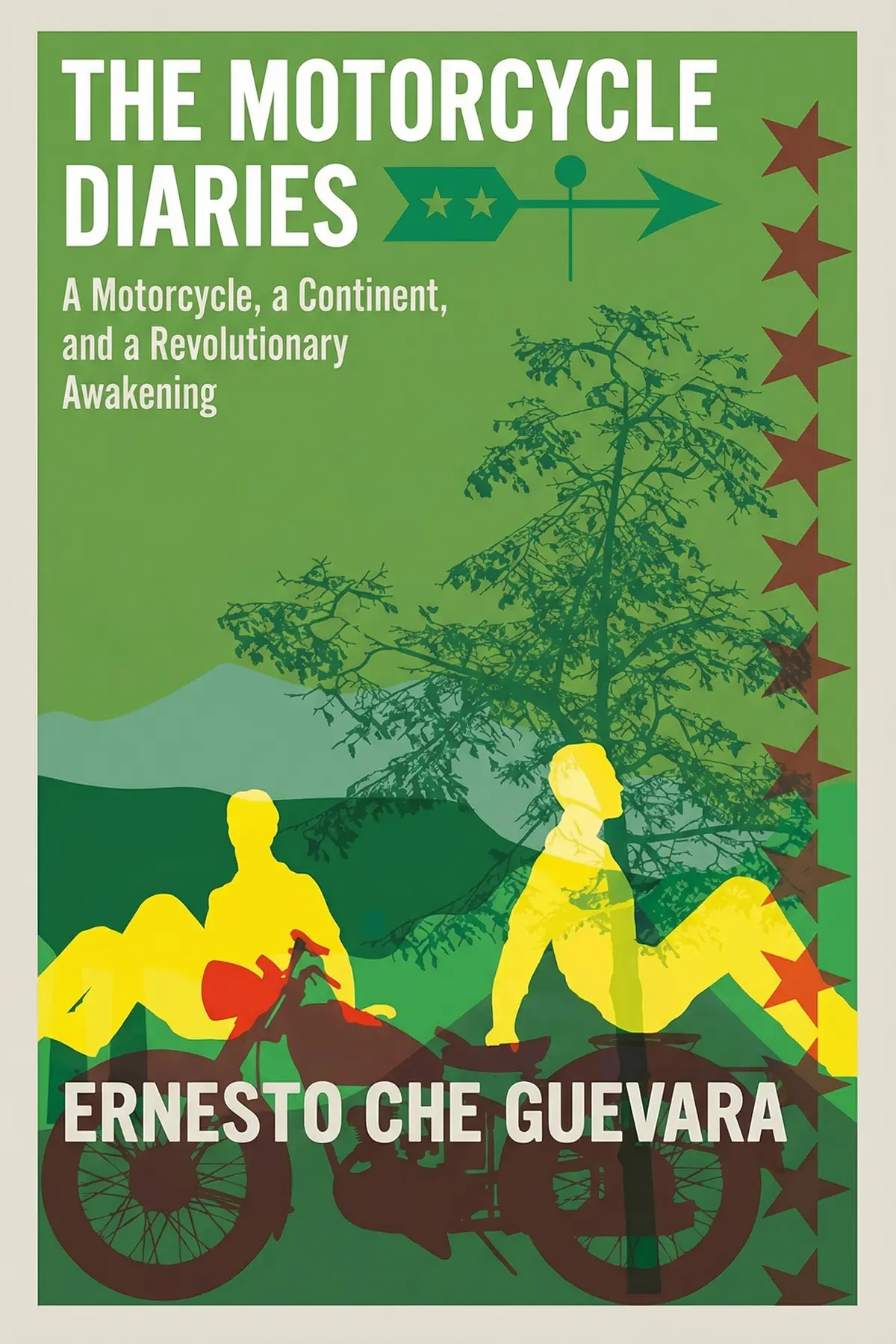
Table of Content
1. Introduction
1 min 00 sec
Many people travel and come home with photographs, while a few come home with a new idea of what their life is for. In The Motorcycle Diaries, Ernesto Che Guevara records a 1952 ride across South America with his friend Alberto Granado, and one of its hardest lessons came in a poor Chilean village, where a sick old woman showed a young medical student how little his training could do against poverty.
That meeting holds the throughline. Again and again, the road put two carefree young men face to face with people whose hardship they could not fix, and the crashes, jokes and borrowed beds along the way kept them open enough to be changed.
From a runaway motorcycle and a burning house to a dusty mining town and a leper colony, the trip shows how what a person sees up close can redirect a whole life. It also gives anyone hoping that a new place or job will reshape them a way to tell whether it is happening.
2. A broken motorcycle can make a better trip
1 min 47 sec
A snapped handbrake, a herd of cows and a ruined tray of peaches should have spoiled the adventure. Instead, losing control of the trip is what pushed two young men into other people’s lives.
3. Join the work of strangers and they become friends
1 min 45 sec
Two untrained visitors ended up inside a burning building on a stranger’s street. What happened that night explains why some newcomers are welcomed in days while others stay outsiders for years.
4. What a failed house call reveals about poverty
1 min 53 sec
A medical student with years of training sat beside a sick old woman and could do almost nothing. The reason had little to do with medicine, and it changed the direction of his life.
5. See the people behind the scenery
1 min 50 sec
A mining town, a leper colony in a beautiful river basin and a welcoming village each looked one way from the road. Up close, every place told the travelers a different story.
6. Turn what you witness into lasting commitment
1 min 53 sec
From the ruins of Machu Picchu to the streets of Caracas, the same pattern kept appearing. By the time the two friends prepared to part, one of them knew what he wanted to do with his life.
7. Conclusion
1 min 12 sec
The Motorcycle Diaries is remembered as the origin story of a famous rebel leader, yet most of it is something smaller and more familiar: two friends on a bad motorcycle, crashing, laughing, getting sick in strangers’ homes and saying yes to whatever came next. That ordinariness is what makes the change believable. The same openness that sent Alberto into a burning house for a cat brought Ernesto to an old woman’s bedside, and it left him unable to forget what he found there.
Convictions, the diary suggests, grow from faces: a miner’s tired expression, a patient’s dignity, an illness beyond the reach of advice. If you travel, for work or for yourself, spend time inside other people’s daily lives instead of passing through them. Keep a notebook and watch for the day your entries move from what you saw to what it meant. And when your skills meet a problem they cannot solve, ask what larger conditions keep it in place.
Ernesto left home to see a continent. He came back having seen its people, and that turned out to be the harder thing to forget.
About this book
What is this book about?
In 1952, Ernesto Guevara, a medical student from Argentina, set off with his friend Alberto Granado on an unreliable motorcycle called La Poderosa II. They wanted adventure. The Andes, the Amazon and a long run of breakdowns, accidents and comic mishaps gave them plenty of it. The road also gave them something they had not planned for. In a poor Chilean village, a sick old woman showed Ernesto the limits of his medical training. Exhausted miners in Bolivia, leprosy patients in the Amazon Basin, Indigenous villagers and the shantytowns of Lima showed him how unevenly hardship was shared across the continent. Page by page, his diary moves from landscapes and jokes toward questions of justice. The Motorcycle Diaries is the record of that change. It is the story of how a curious young traveler became the man the world would later know as Che Guevara. It is also a picture of how real experiences shape conviction, useful to anyone who hopes a trip, a move or a new job will change what they care about.
Book Information
Who it's for
Wondering what travel changes
Students and young professionals wondering whether a big trip or a year abroad will really change them.
In the helping professions
Doctors, nurses, teachers and aid workers who know the frustration of help that cannot reach the real cause.
Curious about young Che
Readers curious about how Che Guevara's politics took shape long before Cuba.
About the Author
Ernesto Che Guevara
Ernesto Che Guevara was born in Rosario, Argentina, in 1928. As a medical student he traveled across South America, and the poverty, hunger and disease he saw shaped his politics. He later met Fidel and Raúl Castro in Mexico City, joined their movement and helped overthrow the Cuban dictator Fulgencio Batista. In the new government he served as minister of industries and president of the National Bank. He left Cuba in 1965 to pursue revolution in Congo-Kinshasa and Bolivia, where he was executed in 1967. His books include Guerrilla Warfare.
Ratings & Reviews
Ratings at a glance
What people think
Listeners find this to be a superb experience featuring graceful prose and deep perspective on Ernesto Guevara's life and ideology. The narrative brings South American nations and their citizens to life vividly, and listeners value the historical setting of Guevara's travels. They characterize Guevara as a man of great passion, though some find the translation difficult to track. The political themes receive a variety of reactions from listeners.
Top reviews
Rosa
The prose in this travelogue is surprisingly elegant for a young medical student. It's fascinating to watch Ernesto's casual observations of the landscape slowly morph into a deep, agonizing awareness of social inequality. You can see the seeds of the revolutionary being sown when he encounters the indigenous people and the poverty-stricken workers. Truth is, I expected something much more dry or dogmatic, but what I got was a very human story about a boy becoming a man. The way he describes the various South American countries feels incredibly vivid and lived-in. While some might find the structure a bit loose, it feels authentic to the diary format. It’s a beautifully written journey of the soul that transcends simple politics and gives us the man behind the beret.
Show moreSayan
Wow, the descriptions of the leper colony in the later chapters were incredibly moving and surprisingly tender. This book really captures the 'Our America' spirit that Guevara became so famous for championing later in his life. The transition from a bored medical student to a compassionate observer of human suffering is handled with remarkable grace. I particularly loved the vibrant descriptions of the landscapes, from the freezing mountains to the humid jungles. It feels like you are sitting on the back of that breaking-down motorcycle right alongside him. Gotta say, his passion for the people he encounters is infectious and truly shines through every single page. It’s a hauntingly beautiful account of a young man discovering his purpose in a very broken world. Highly recommended.
Show moreChee
The way this book captures the spirit of South America is truly vivid and breathless. It’s a classic coming-of-age story set against a backdrop of breathtaking landscapes and systemic injustice. Ernesto's voice is surprisingly relatable; he isn't a saint yet, just a guy trying to figure things out while his bike falls apart. The humor in his interactions with Alberto Granado provides a nice balance to the heavier themes of exploitation and sickness. You can feel the heat of the sun and the dust of the road in his writing. For me, the lasting appeal is the sense of adventure and the genuine compassion he shows for the marginalized. It’s a must-read for anyone who believes that travel should be more than just simple sightseeing.
Show moreAraya
Finally got around to reading the source material for that famous face on every college dorm T-shirt. It’s funny because Guevara actually comes across as a bit of a reckless jokester in the early chapters. His motorcycle, La Poderosa II, seems to spend more time sliding across the dirt than actually driving. To be fair, the humor and the light-hearted tone of the first half make the later shifts into serious social commentary hit much harder. You feel his outrage when he encounters the exploitation of miners and the sick. It isn't a perfect book—some entries feel like hasty scribbles—but it humanizes an icon. Seeing his medical background influence his empathy for the leper colony was particularly striking. A solid, insightful read for history buffs.
Show moreIsabelle
After hearing about his revolutionary exploits for years, seeing Ernesto as a middle-class kid was jarring. He starts the journey with such a carefree attitude, focused mostly on girls and booze and the next adventure. But as they move through Chile and Peru, the tone shifts into something much more somber and urgent. The description of the leper colony near the end is the emotional heart of the book for me. You see his medical training colliding with his sense of justice in a way that feels very authentic. My only gripe is that the ending felt a bit abrupt, though the included speeches help fill the gaps of his later ideology. It’s a great glimpse into how travel can fundamentally change a person’s worldview forever.
Show moreJames
Ever wonder how a doctor becomes a guerrilla leader? This book provides the most human answer possible: through direct, unshielded contact with the suffering of others. The moment he treats the old woman with asthma is a clear turning point where his internal world shifts. Personally, I found the prose to be quite elegant and full of a youthful hope that is both inspiring and tragic. He captures the diverse cultures of the South American continent with a level of detail that feels very respectful and curious. While some parts of the diary are clearly more polished than others, the raw honesty of his transformation is what makes it work. It’s a powerful reminder that our surroundings shape us as much as we shape them.
Show moreDarius
Is it possible to separate the myth of Che from the actual writing on these pages? I struggled with this because the legend is so pervasive that you look for clues of the revolutionary in every sentence. Some of the observations are truly poetic, yet other parts feel like the ramblings of a privileged kid on a gap year. In my experience, the book works best when he forgets he's trying to be an explorer and just describes the people he meets. The section on the dying woman with asthma was undeniably heartbreaking and showed his burgeoning social conscience. However, the political content can feel a bit forced in retrospect, as if later editing tried to make his evolution seem more linear. It's a decent travelogue, but significantly overhyped by his eventual fame.
Show moreZoey
Look, this isn't a political manifesto, so don't go in expecting deep Marxist theory or revolutionary strategies. This is primarily a story about two friends, a leaky motorcycle, and the vast, beautiful expanse of South America. The writing style is somewhat uneven; it jumps from beautiful, sweeping prose to very dry, clinical observations without much warning. Some of the anecdotes are genuinely funny, especially their various schemes to get free lodging and meals from unsuspecting locals. That said, the historical significance carries the book more than the narrative arc does. If this were written by any other medical student, it probably wouldn't be a bestseller. It’s a worthwhile read for the context, but don't expect it to change your life or your politics.
Show moreLogan
As someone who loves a good road trip story, the constant motorcycle crashes kept me entertained for the first few chapters. However, once the bike finally gives out, the narrative slows down considerably and becomes much more introspective. The truth is, I found some of the historical and geographical details a bit tedious to wade through. Guevara is clearly a talented observer, but his youthful arrogance can sometimes be a bit much to handle as a reader. I appreciated the insight into the poverty of the region, yet the pacing felt disjointed and lacked a strong central thread. It's a fascinating historical artifact for sure, but as a standalone travel memoir, it didn't quite live up to the massive reputation it has held for decades.
Show moreWatcharee
Frankly, I found the translation a bit clunky and the pacing was all over the place throughout the entire book. While I understand this is a historical document, the writing often feels like a series of disjointed vignettes that don't always lead anywhere meaningful. The constant talk about motorcycle maintenance and begging for food got a bit repetitive after a while. I was expecting more profound philosophical insights into the Latin American condition, but a lot of it felt like typical middle-class tourism. Not gonna lie, the controversial comments about race in the earlier sections were also quite off-putting, regardless of the historical context. It’s definitely more interesting because of who wrote it than because of the actual literary quality of the text itself. It's a bit of a slog.
Show moreQuestions about this book
What is The Motorcycle Diaries about?
It is Ernesto Che Guevara’s account of a 1952 trip across South America with his friend Alberto Granado, first on an old motorcycle called La Poderosa II and later by hitching rides. Along the way, from Chile and Bolivia to Peru, Colombia and Venezuela, the carefree medical student met poverty, illness and exploitation up close, and the trip set him on the path toward his later life as a rebel leader.
What changed Che Guevara on his motorcycle trip?
A series of close encounters with hardship. In a poor Chilean village, an old woman with asthma and a heart condition showed him how little medical advice could do against poverty. Exhausted miners in Bolivia, leprosy patients in the Amazon Basin and the shantytowns of Lima deepened that feeling, and conversations with workers, students and dissidents turned it into a conviction that society needed radical change.
Is The Motorcycle Diaries only serious, or is it also funny?
It has plenty of humor. The motorcycle’s handbrake snaps on a slope full of cows, Ernesto is sick out of a window onto a host family’s drying peaches, and the two friends end up calling themselves bums without wheels. These light moments matter to the story, because the friendships and mishaps keep pushing the travelers into the lives of the people they meet.
What can readers learn from The Motorcycle Diaries today?
The book shows how people really change: through repeated, personal contact with other lives rather than through passing through places. Readers can apply that by spending time inside the daily routines of people they meet, keeping a journal to notice when their thinking shifts, and asking what larger conditions sit behind a problem their own skills cannot fix, as Ernesto did beside the old woman’s bed.
Readers also enjoyed

Ali: A Life
Jonathan Eig

Abortion: Our Bodies, Their Lies, and the Truths We Use to
Jessica Valenti

A Life Decoded: My Genome: My Life
J. Craig Venter


Adults in The Room: My Battle With Europe’s Deep Establishment
Yanis Varoufakis

A Long Way Gone: Memoirs of a Boy Soldier
Ishmael Beah

All Creatures Great and Small
James Herriot

AUDIO SUMMARY AVAILABLE
Listen to The Motorcycle Diaries in 15 minutes
Get the key ideas from The Motorcycle Diaries by Ernesto Che Guevara, plus 5,000+ more nonfiction titles.
- 5,000+ titles
- Listen as much as you want
- 7-day free trial
- Cancel anytime









