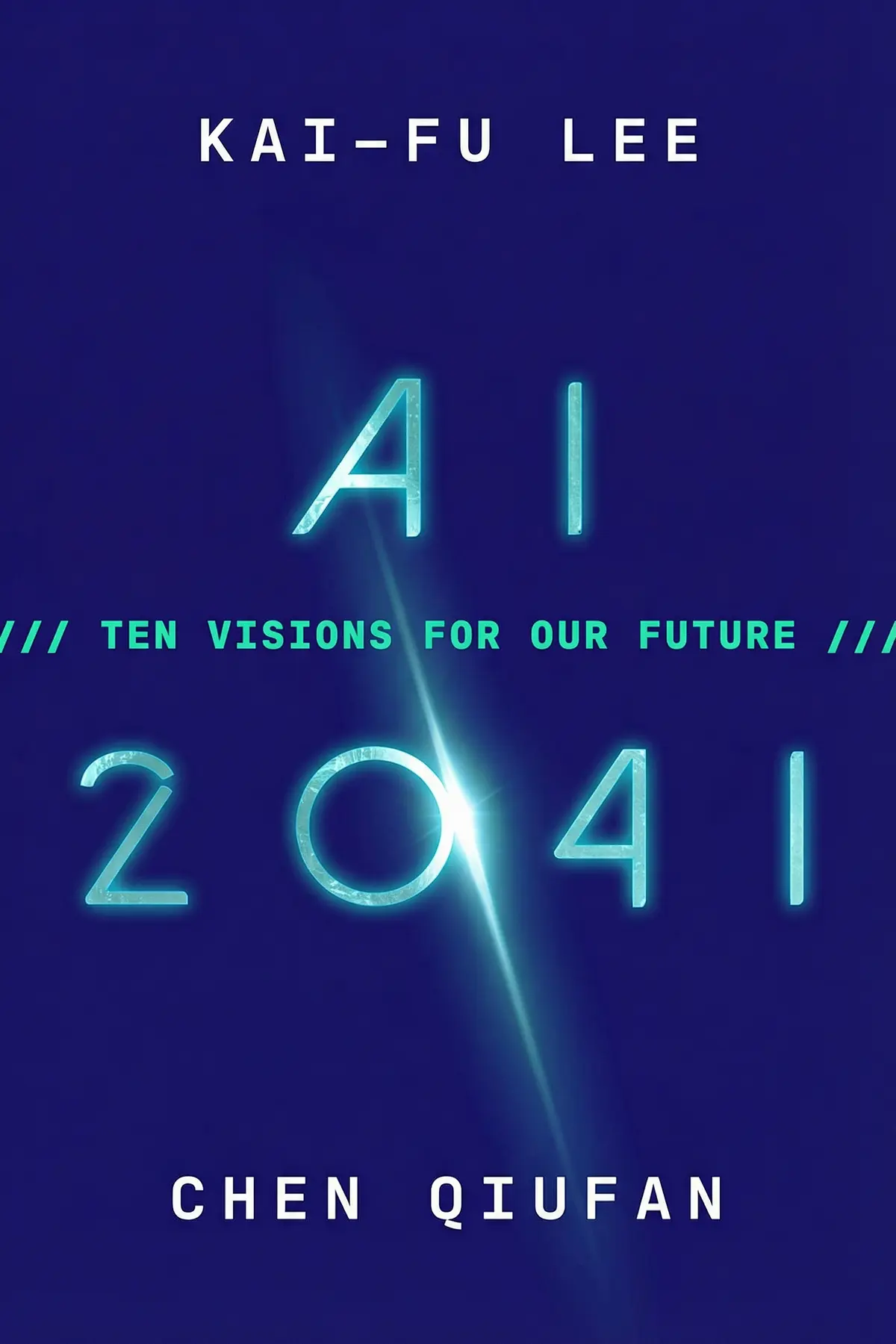
AI 2041: Ten Visions for Our Future
Kai-Fu Lee
 English
A clear tour of how machines learn from data, why they sometimes see patterns that are not there, and what a single universal learning algorithm would mean for science, business and your personal data.
1 min 00 sec
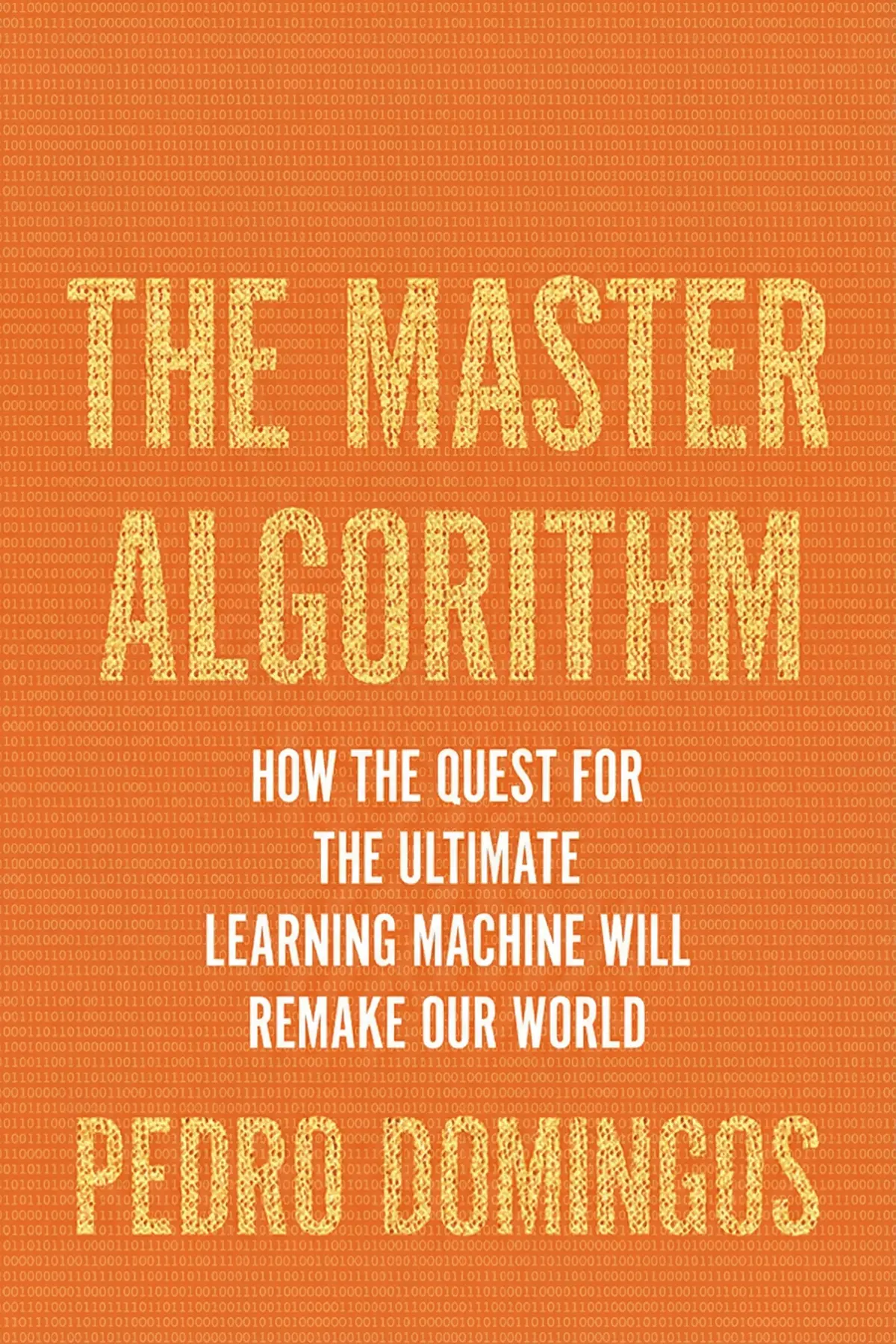
Algorithms are at work all around us, often without our noticing, so many of us know little about technology that shapes the ads, recommendations and purchases we see. In The Master Algorithm, computer scientist Pedro Domingos explains the core trick in a line: a learning algorithm is one that produces other algorithms, built from examples instead of written by hand. Give it enough inputs paired with the right outputs, and it works out the steps that connect them.
Domingos argues that the field’s rival schools each hold part of the answer. The real craft, in his view, is restraining their power with the right limits. Combine those schools into one master learner, and science, business and daily life would change more than through any single event before. Follow his argument and you can explain how spam filters and voice assistants decide, catch a fake pattern before you trust it, and choose more carefully what your own data teaches the machines.
1 min 37 sec
Some of the tasks people find easiest are the ones nobody can explain step by step. Domingos shows how machines handle them anyway, and why a spam filter and a chess engine can share one engine.
1 min 45 sec
A best-selling book claimed to find hidden prophecies in the Bible. Critics found the same kind of prophecies in a novel about a whale. The trick behind both is a trap every data project can fall into.
1 min 34 sec
A piece of software forecast the rulings of the highest court in the United States better than a panel of human experts. Its method looks a lot like a children’s guessing game.
1 min 52 sec
Say call the police to a voice assistant and it has to wonder whether you said something absurd instead. How it settles the question shows a way of reasoning anyone can borrow.
1 min 43 sec
A huge neural network watched ten million random videos with no instructions at all. What it learned to recognize says a lot about how machines find order in noise, and about the internet.
1 min 42 sec
Planning a delivery route, packing parts onto a microchip and playing Tetris turn out to be the same puzzle in disguise. Domingos thinks learning could follow the same path, toward problems no machine can touch yet.
1 min 48 sec
Advertisers put a yearly price on the record you leave online, and it is far higher than you might guess. Domingos also imagines that record turned into a digital you that runs errands on your behalf.
1 min 13 sec
Domingos’s book draws one picture: learning machines are general problem solvers that need few assumptions and a great deal of data, and the craft lies in giving them just enough freedom. Symbolists, Bayesians and the builders of neural networks each found part of that balance. Merge them into a single learner, he argues, and humanity would advance more than through any single event in its history.
You do not have to wait for that day to act on the argument. Every click, Domingos points out, works on two levels. It gets you what you asked for, and it teaches a computer a little more about you. Over time the second level matters more, because that knowledge will help you finish tasks and also nudge you toward buying. When you want a session that leaves no mark on your profile, browse in incognito mode. Give children their own accounts so your history does not shape the videos and ads they see. And when anyone shows you a dazzling pattern, from a sales chart to a hidden code in an old text, ask how it holds up on data it has never seen.
The machines are learning from you either way. What you can still decide is how much of the lesson you write.
Learning algorithms filter our email, read our handwriting and pick the products we see, yet few people can say how they work. Pedro Domingos, a machine learning researcher, sets out to explain the field to a general reader and to argue for its biggest ambition: one master algorithm that could learn anything from data. His starting point is simple. A learning algorithm is an algorithm that writes other algorithms, built from examples rather than coded by hand. From there he shows why too much learning power produces false patterns, and how holdout data and deliberate limits keep machines honest. He then introduces the field's rival schools, from the rule-building symbolists and their decision trees to the probability-minded Bayesians and the neural networks that taught themselves to spot cats on YouTube. Readers come away able to explain the main families of machine learning in plain words and to judge a striking pattern before trusting it. They also see why their own data trail has a price, and what a digital model of themselves might one day do on their behalf.
Professionals who use recommendation engines, voice assistants and analytics daily and want to know how they actually learn.
Founders and managers deciding how to use data, and wary of false patterns.
Curious readers weighing how much of their own data trail to share.
Pedro Domingos is a computer scientist born in Lisbon, Portugal, who earned his doctorate in information and computer science at the University of California, Irvine, and is now professor emeritus at the University of Washington. His research in machine learning includes work on Markov logic networks for reasoning under uncertainty. He has received the SIGKDD Innovation Award and the IJCAI John McCarthy Award, and his articles have appeared in the Wall Street Journal, Scientific American and Wired.

Listeners find that this work offers a superb look at machine learning concepts, with one listener pointing out how thoroughly it covers the field. Furthermore, the content is approachable for educated general readers and provides valuable perspectives, as one listener specifically notes the exploration of psychological and philosophical implications. On the other hand, opinions on the prose and readability are varied; while some enjoy the narrative, others feel it presents a challenge for those without a technical background, and while some laud the writing style, others describe it as verbose. Finally, listeners are divided regarding its difficulty level, as some value the balanced depth of information while others perceive it as being too dense for a layperson.
As someone who works in data, I think this is one of the most ambitious and comprehensive overviews of machine learning ever written for the public. Domingos isn't just explaining code; he’s exploring the philosophical and psychological implications of a world where machines can induce knowledge from raw information. His breakdown of the five tribes is a masterpiece of simplification that doesn't sacrifice the core integrity of the science. The book touches on everything from curing cancer to the privacy trade-offs we make every day, making the stakes feel incredibly high and personal. While some critics find his tone a bit too optimistic, I found his passion for the 'Master Algorithm' to be quite contagious and thought-provoking. It is rare to find a book that handles the math of Markov chains and the ethics of big data with equal grace. This is essential reading.
Show moreThis book provides a truly mind-expanding look at how machine learning is not just a tool, but a fundamental shift in how we discover knowledge. Domingos argues that the 'Master Algorithm' is the ultimate invention, because once we have it, it can invent everything else for us. It’s a bold premise, and he defends it by showing how different schools of thought are slowly converging toward a unified model. I loved the historical context he provided for each of the 'tribes,' making the development of AI feel like a grand human epic. The discussion on the P=NP problem was particularly sharp, highlighting the thin line between what is computable and what remains a mystery. While it's true the book lacks deep mathematical proofs, that's exactly what makes it such a great read for a non-expert. It’s about the big ideas, the philosophical shifts, and the radical future that awaits us.
Show moreFinally got around to reading this foundational text on machine learning, and I found it surprisingly enlightening. Domingos breaks down the field into five distinct 'tribes'—symbolists, connectionists, evolutionaries, Bayesians, and analogizers—which helps categorize the chaos of modern AI. While the prose occasionally leans toward the overly dramatic, the conceptual mapping is invaluable for a literate general audience trying to make sense of the algorithmic world. I particularly appreciated the discussion on how these different philosophies might eventually merge into a single, unified 'master algorithm' that learns everything from data. Some sections are definitely a bit wordy, but the payoff for understanding the underlying logic of big data is worth the effort. It's a solid bridge between technical papers and pop-science fluff.
Show moreEver wonder how Netflix actually knows what you want to watch or how a computer can suddenly learn to play chess better than a grandmaster? This book offers a deep dive into those questions, exploring the quest for a universal learner that can solve any problem given enough data. Domingos does a great job of explaining complex ideas like inverse deduction and genetic algorithms without relying on heavy equations. I found the chapter on the 'evolutionary' tribe particularly interesting, as it connects biological principles to software development in a way that feels very intuitive. To be fair, the book gets a bit dense in the middle, and the author’s 'Lord of the Rings' style metaphors can be a bit much. However, the insights into the future of privacy and the 'personal model' of our digital lives are genuinely chilling and necessary. It’s an excellent, if slightly long-winded, look at the technology.
Show morePedro Domingos manages to take a very dry, technical subject and turn it into a compelling narrative about the search for the 'Theory of Everything' in computer science. I particularly enjoyed the section on the 'Connectionists' and how neural networks are modeled after the human brain, which helped me visualize these abstract systems. The book is very accessible for a literate general audience, though it does require a fair bit of concentration during the more theoretical chapters. My only real gripe is that the author’s writing style can be a bit cheesy at times, especially when he tries to be poetic about algorithms. Still, the way he relates Bayesian inference to everyday life is one of the best explanations I have seen in a popular science book. It provides a great bird's-eye view of a field that usually feels impenetrable to outsiders. If you can get past the occasional wordiness, there is a lot of wisdom here.
Show moreAfter hearing several experts recommend this, I dove in hoping to finally understand the 'black box' of AI, and I wasn't disappointed. The book is at its best when it deals with the practicalities of big data, like the trade-off between losing privacy and gaining a more personalized world. Domingos offers a very sober and relevant discussion on how we can control our digital twins rather than letting corporations own our data. However, the readability is hit or miss; some chapters flow beautifully, while others feel like a slog through dense, repetitive lists of potential AI applications. I found the 'Tower of Support Vectors' section particularly bizarre and unnecessary for a book that is supposed to be grounded in science. Despite the cheesy prose and the occasional 'fawning' over technology, the book's comprehensive scope makes it a valuable resource. It’s a 4-star read that would have been a 5-star one with a stricter editor.
Show moreIt is a struggle to rate this book because the content is fascinating, but the delivery is so incredibly inconsistent. On one hand, you get a brilliant primer on Bayesian statistics and how they apply to real-world scenarios like self-driving cars. On the other hand, the author frequently drifts into weirdly specific Silicon Valley anecdotes that feel disconnected from the average person's life. He talks about how algorithms will soon predict stock market 'black swans,' yet he offers very little empirical evidence to back up these grand, sweeping claims. For a scientist who champions data over intuition, his conclusions about the future of AI feel ironically rooted in pure, unadulterated intuition. It’s a good overview for a total novice, but if you have any background in math, the lack of technical detail will drive you crazy. Stick with it for the broad strokes.
Show moreTruth is, the author is clearly a brilliant mind in the field, but he isn't exactly a natural storyteller. The book jumps from topic to topic with a frantic energy that left me feeling more confused than enlightened in several chapters. He has a habit of mentioning complex terms like 'kernels' or 'S curves' without giving them the thorough explanation they deserve for a general reader. While I appreciated the overview of the different machine learning communities, the way he separates them into rigid 'tribes' felt a bit superficial and forced. It ignores the fact that many of the top scientists in the field work across multiple disciplines and don't fit into his neat little boxes. The final chapter, which delves into a 'Selfish Gene' style rant about human nature, felt like it belonged in a different book entirely. It's a decent primer, but it's hampered by an author who tries too hard to be a novelist.
Show moreThe writing in this book is, frankly, some of the most frustrating I have ever encountered in a non-fiction work. I wanted to learn about the mechanics of AI, but instead, I was forced to wade through pages of bizarre, trippy allegories like the 'Tower of Support Vectors.' This kind of 'educational' fiction doesn't explain the concepts; it just obscures them behind a layer of cringeworthy, novelist-wannabe prose that feels totally out of place. Domingos is clearly a brilliant scientist, but he fails to recognize that a general reader needs clear definitions, not long-winded metaphors about magical towers and guards. He name-drops concepts without sufficient grounding, assuming the reader will just follow his 'messianic' fervor for the future of learning machines. If you actually want to understand how a neural network or a Bayesian classifier functions, you are better off looking at a textbook.
Show moreNot what I expected at all, and I was deeply disappointed by the smug, condescending tone the author adopts toward anyone who disagrees with his vision. Domingos dismisses giants like Minsky and Chomsky with a wave of his hand, acting as if his specific brand of machine learning is the only path forward. The book is filled with inane verbiage and endless lists of applications that feel like a marketing brochure rather than a serious scientific inquiry. He spends so much time fawning over the potential of algorithms that he forgets to actually explain how they work to a layperson. The writing is incredibly tiresome, filled with 'in-jokes' and references that are never explained, leaving the reader feeling like an outsider to an elite geek club. It’s an acid trip of a book that mixes complex concepts together without any discernible structure or educational value. Save your time and money; there are much better introductions to AI.
Show morePedro Domingos argues that machine learning algorithms are general problem solvers: given examples of inputs and desired outputs, they produce a new algorithm that links them. The field is split into schools such as symbolists and Bayesians, each with its own methods and assumptions. Combining them into one master algorithm, he argues, would advance humanity more than any single event in its history.
Overfitting is when a learner is so flexible it finds patterns that are not really there. Domingos uses The Bible Code as an example: its hidden predictions turned up just as easily in Moby Dick and Supreme Court rulings. The fixes are limiting model complexity and testing results on a holdout set of data the algorithm never learned from.
Symbolists are rationalists who learn rules through logic, using inverse deduction and decision trees. Bayesians are empiricists who keep many hypotheses open and update their belief in each as evidence arrives. The source also covers unsupervised learners such as clustering algorithms, and neural networks, which process many inputs at once like a brain and once taught themselves to recognize faces and cats in YouTube videos.
Be aware of your data trail, since every digital interaction also teaches a computer about you, which can serve you or push you to buy. Use incognito mode when you do not want a session to shape your profile, and give children separate accounts. At work, test striking patterns on data they were not built from, and hold several explanations open until evidence picks one.
It suits non-specialists who want a plain-language map of how machines learn, from spam filters and handwriting readers to voice assistants and recommendation engines. Business readers get Domingos’s case that data is a strategic asset, worth around $1,200 a year per person to online advertisers. Anyone curious about future AI will find his vision of a personal digital model that handles errands and job applications.
AUDIO SUMMARY AVAILABLE
Get the key ideas from The Master Algorithm by Pedro Domingos, plus 5,000+ more nonfiction titles.