

14 min 17 sec
Available in: English
 ไทย
EnglishไทยThe Last Lecture
By Randy Pausch
Facing terminal cancer, Randy Pausch shows how to reach childhood dreams through unexpected doors, take life's rough edges calmly, push others to grow with honest feedback and leave the people you love something lasting.
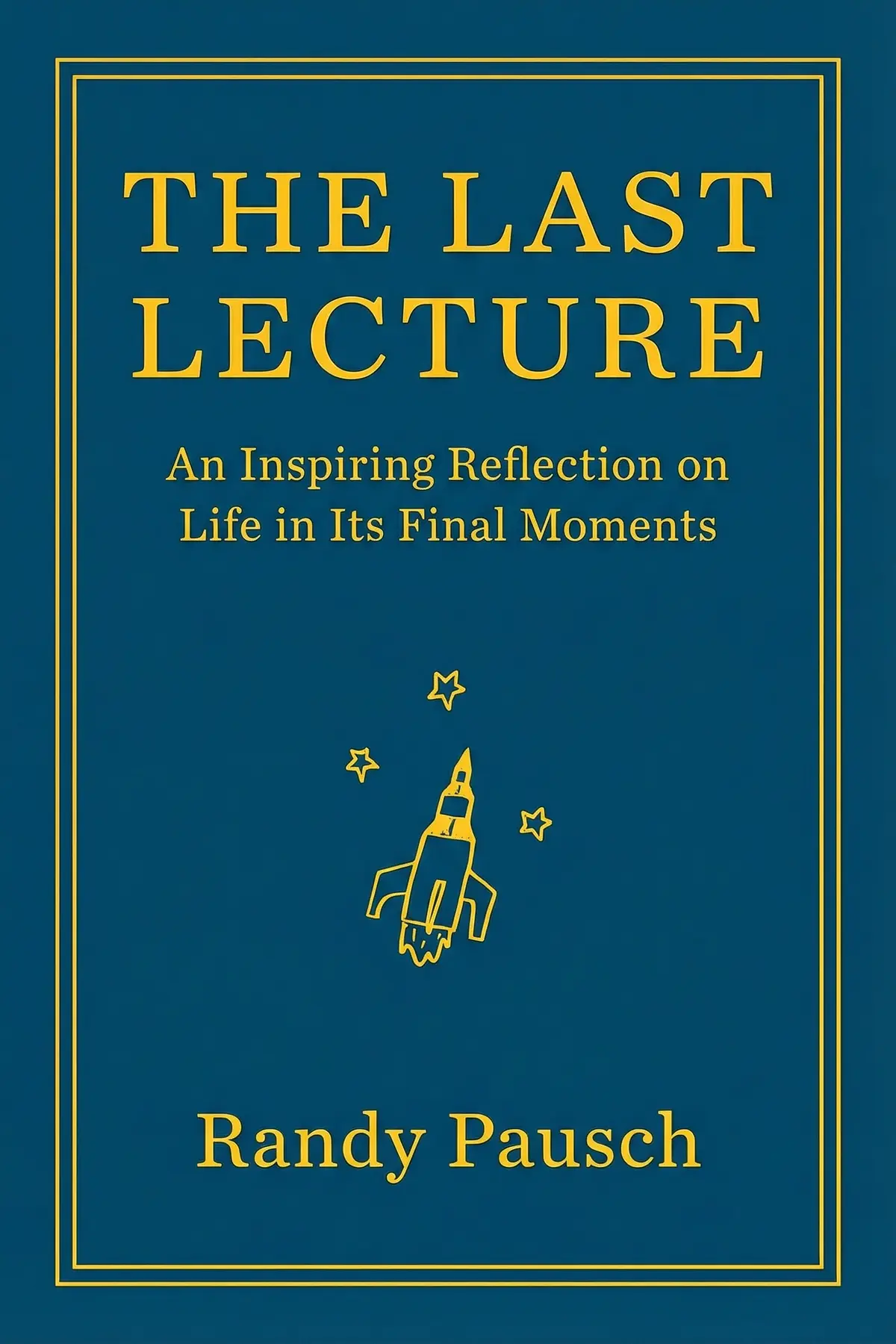
Table of Content
1. Introduction
53 sec
If you keep telling yourself that the things you most want to do can wait, Randy Pausch’s story removes the excuse. In The Last Lecture, the Carnegie Mellon professor, diagnosed with pancreatic cancer at 46 and told he had months left, argues that a good life grows from childhood dreams chased with hard work, honesty and humor. Looking back, he found that nearly all of his own had come true.
His last talk, which spread across the web and then sold widely as a book, carries one throughline: pursue your dreams stubbornly, accept that the best moments have rough edges, help others reach theirs, and remember who it is all for. Along the way come a zero-gravity flight he talked his way onto, the student nobody wanted on their team, and a twist he saved for his final slides.
2. Find the part of your story worth telling
2 min 07 sec
A professor with months to live had one hour to speak and every reason to talk about cancer. He decided his illness was the least interesting thing about him, and what he chose instead shaped everything that followed.
3. Reach a dream through the side door
2 min 15 sec
NASA had no reason to let a nearsighted professor ride its zero-gravity plane, and Disney kept turning him down. Each time, Pausch found a way in that nobody had offered him, and one dream failed usefully.
4. Expect your best days to have rough edges
2 min 10 sec
A perfect wedding ended with a balloon drifting toward a speeding train. That scare, a lunch dumped in a puddle and one carefully chosen sentence from a doctor all taught Pausch how to take life’s bumps.
5. Push people past good with honest feedback
2 min 02 sec
Pausch’s students were so talented that he ran out of things to teach them. His fix was a small bluff, and his answer to the most disliked student in class was a sheet of numbers.
6. Obvious advice still works, so use it
1 min 56 sec
On day one, Pausch’s students expected theory and got a handout about learning names and eating lunch. By the end of term, it had sorted the strong teams from the rest, and a meditation class revealed why.
7. Make memories that outlast you
1 min 51 sec
Pausch did push-ups onstage to show he was still strong, yet he feared he would break down before the end. His final slides revealed that the lecture had a different audience all along.
8. Conclusion
1 min 03 sec
The Last Lecture is a book about dying that spends almost no time on death. Pausch showed the scan of his tumors in the first minutes and moved on, because the story worth telling was what he had done with the years before it. The weightless flight, the balloon near the train, the student who learned to work with others and the Friday nights at the office all point the same way. A good life is mostly ordinary effort applied stubbornly, with humor about the bumps, and much of its value lies in what it passes on.
Start small. Write down a childhood dream you dropped and look for a side door, the way an offer of publicity got Pausch onto NASA’s plane. Ask whether your answer to a stubborn problem fixes the cause or only calms you down. And for the people you love, make something that will last: a trip, a letter, a few words they can return to later.
He was told he had three to six months of good health. He spent them making his dreams useful to someone else.
About this book
What is this book about?
At 46, Randy Pausch seemed to have everything: a loving family, a strong academic career at Carnegie Mellon and a wide circle of friends. Then he was diagnosed with pancreatic cancer and told he had months to live. He had already agreed to give a last lecture, a talk where professors pretend it is their final appearance. For him it really was. Instead of talking about illness, Pausch chose the one thing that set him apart: he had reached almost every dream he held as a child. The lecture turned into a web phenomenon and later a top-selling book, and it lays out how he managed it. He floated in zero gravity, met Captain Kirk and worked as a Disney Imagineer, often by finding an unexpected way in. He also shares what life's bumps taught him, why tough love and honest data help students grow, and why worn-out advice like working hard usually holds up. Readers get a short, warm and funny account of how to spend limited time well, and a final twist that reveals who the whole lecture was really for.
Book Information
Who it's for
Putting off long-held goals
Professionals who keep postponing a long-held goal and want a reason to start now.
Teachers, managers, mentors
Teachers, managers and mentors looking for honest ways to push talented people further.
Facing illness or loss
Anyone facing serious illness or loss who wants a warm, funny example of living well with limited time.
About the Author
Randy Pausch
Randy Pausch (1960 to 2008) was a professor at Carnegie Mellon University in Pittsburgh, working in computer science, human-computer interaction and design, after teaching at the University of Virginia from 1988 to 1997. He worked with Adobe, Google, Electronic Arts and Walt Disney Imagineering, pioneered the non-profit Alice project that teaches young people programming, and co-founded Carnegie Mellon's Entertainment Technology Center with Don Marinelli. Told in 2007 that his pancreatic cancer was terminal, he gave the lecture behind this New York Times best-seller.
Ratings & Reviews
Ratings at a glance
What people think
Listeners consider this work to be a deeply moving and informative experience that offers fresh perspectives on living and provides significant life guidance. The account serves as an uplifting final narrative, and listeners value the author’s polished, captivating approach to sharing his story. Listeners characterize the book as touching and poignant, noting it makes an excellent gift for nearly any adult, specifically those celebrating a graduation.
Top reviews
On
Wow. I wasn’t prepared for how much this would affect me. Randy Pausch’s message isn't just about dying; it is a vibrant, urgent manual on how to actually live while you still can. He frames his terminal diagnosis as an 'engineering problem' to be solved, which sounds cold, but it’s actually incredibly brave and grounded. Watching him prepare his children for a future without him through these pages is heartbreaking yet profoundly beautiful. While some might find his optimism a bit much, I think it’s the only way to face such a situation with dignity. This should be required reading for anyone feeling stuck in a rut. It’s the perfect graduation gift, or a gift for anyone who needs to remember that brick walls are only there to see how badly we want something.
Show moreGift
As a recent graduate, I found this to be the most grounding book I’ve read all year. Pausch talks about childhood dreams—like experiencing zero gravity or winning giant stuffed animals—with such infectious enthusiasm that you can't help but re-evaluate your own goals. He doesn’t just tell you to 'follow your heart'; he emphasizes the 'long way' which is really just code for working incredibly hard. The idea of brick walls being there to stop the people who don't want it enough is a concept I've already started applying to my job search. It’s a slim volume, but the weight of his situation adds a layer of sincerity you don't get with typical motivational speakers. Even though some parts are a little self-congratulatory, the overall takeaway is worth the price of admission.
Show moreArnav
After hearing about the YouTube video, I finally grabbed the book to see if it added anything new. The text captures Randy’s voice perfectly—brisk, confident, and unapologetically nerdy. While the video is great, the book allows for more quiet reflection on his advice regarding apologies and people-management. I think his 'three-part apology' should be taught in every elementary school across the country. My only gripe is that it occasionally feels like a collection of 'dad-isms' that are a bit too simplistic for complex real-world problems. However, the sincerity of a man trying to talk to his kids from beyond the grave is impossible to ignore. It’s a powerful, moving testament to a life well-lived. Whether you agree with his methods or not, his drive to inspire is undeniable.
Show moreFah
Ever wonder what you’d say if you knew your time was up? This book is Randy Pausch's answer, and it’s spectacular. He managed to distill a lifetime of learning into a series of short, punchy anecdotes that are as entertaining as they are educational. From his time at Disney to his work in virtual reality, his passion for 'enabling dreams' is palpable. It’s a heartwarming book that manages to be both a celebration of a life and a roadmap for others. I’ve already bought three copies to give as graduation gifts this spring. While he clearly had a very fortunate life in many ways, his willingness to share his failures and 'brick wall' moments makes him feel relatable. It’s a beautiful, bittersweet legacy that reminds us to appreciate every single day we are given.
Show moreRapee
Picked this up after my manager recommended it during a leadership seminar. Pausch has a way of cutting through the fluff, offering straightforward advice that feels both timeless and surprisingly practical for the modern world. I particularly enjoyed the sections on 'enabling the dreams of others,' which is a perspective often missing from self-help books. However, to be fair, a few anecdotes felt slightly dated or steeped in a certain level of middle-class privilege, like his suggestion to always carry two hundred dollars in cash. Not everyone can swing that! Still, the core message about work ethic and personal integrity shines through despite those minor hiccups. It’s an engaging, fast-paced read that manages to stay optimistic without becoming entirely saccharine. I’d definitely suggest it to anyone looking for a quick perspective shift.
Show moreIvan
The chapter on childhood dreams really hit home for me. It’s rare to find an author who can speak about computer science and deep emotional truths in the same breath without sounding forced. Pausch’s 'Last Lecture' serves as a poignant reminder that our time is the only thing we truly own. I loved the story about his car dent and how he used it to teach a lesson about what really matters in life. Some might say his stories are a bit too 'perfect,' but given that he wrote this while literally dying, I can forgive a little sentimentality. It’s a heartwarming narrative that doesn't overstay its welcome. I finished it in two sittings and immediately felt like calling my parents. It’s exactly the kind of book you want to pass along to a friend going through a hard time.
Show moreYuwadee
Looking back on my own career, I wish I'd read this sooner. Pausch’s distinction between being a 'Tigger' or an 'Eeyore' is a simple but effective framework for looking at leadership and teamwork. The book is filled with these little nuggets of wisdom that are easy to digest but difficult to master. I appreciated that he didn't try to make the book a literary masterpiece; it's written in the plain, direct language of a teacher who knows his time is running out. Some of the advice, like never making a decision until you absolutely have to, has already helped me stress less at the office. It’s a great gift for anyone entering a new phase of life. Though he was clearly a very successful man, his focus on play and wonder is what stays with you long after the final page.
Show moreWyatt
Every life lesson here feels earned because of the context in which it was delivered. Pausch isn't just theorizing about 'the good life' from an ivory tower; he's fighting for every second while staying focused on his family. I found his thoughts on 'brick walls' to be particularly motivating during a rough patch in my personal life. The book is well-written in a way that feels like a long, meaningful conversation over coffee. It’s not earth-shattering philosophy, but rather common-sense wisdom delivered with uncommon grace. I did feel that his 'work hard' mantra ignores some systemic realities, but as a personal memoir, it’s incredibly effective. It’s a moving, end-of-life narrative that forces you to look at your own priorities. This is a must-read for anyone who wants to live with more intention.
Show moreTantipat
Not what I expected, but in a good way. I thought this would be a depressing slog about cancer, but it’s actually quite the opposite. Pausch is funny, a bit cocky, and intensely focused on the joy of achievement. He treats his impending death as just another variable in an equation, which provides a unique perspective compared to more flowery memoirs. The advice about 'playing the hand you're dealt' is a great reminder to stop complaining and start doing. It’s a very fast read, which makes it accessible for people who don’t usually pick up non-fiction. There are moments where the 'smarm' factor mentioned by some critics creeps in, but the emotional core of the book—his love for Jai and the kids—is so genuine that it balances out. Definitely a life-affirming piece of work.
Show moreTim
Frankly, I struggled with the tone here, even if that makes me feel like a bit of a jerk. While I deeply admire Pausch’s courage and his desire to leave a legacy for his three young kids, the writing often felt remarkably self-indulgent and a bit preachy. He spends a lot of time recounting his own brilliance and successes, which makes it feel less like a guide for the reader and more like an ego-boost for the author. The truth is, his advice is quite individualistic and ignores the massive social safety nets and privileges that allowed him to succeed so spectacularly. It's essentially Tuesdays with Morrie but with more arrogance and less poetic grace. I appreciate his positive attitude toward a terminal illness, but I didn't find the 'life lessons' to be particularly revolutionary or helpful for someone without his specific background.
Show moreQuestions about this book
What is The Last Lecture by Randy Pausch about?
It grows out of a talk Carnegie Mellon professor Randy Pausch gave after learning he had terminal pancreatic cancer. Instead of discussing illness, he explained how he had achieved nearly all his childhood dreams, from floating in zero gravity to working as a Disney Imagineer. He shares lessons about persistence, humility, feedback and simple advice, and reveals at the end that the lecture was really for his three young children.
What are the main lessons of The Last Lecture?
Pausch argues that dreams often come true through unexpected routes, as when he offered NASA publicity to ride its zero-gravity plane. Even wonderful moments have rough edges, like his wedding balloon crash landing. Helping others reach their dreams is as rewarding as reaching your own. And familiar advice such as working hard, fixing causes instead of symptoms and not fearing failure usually holds up.
How did Randy Pausch give feedback to students?
He combined tough love, honesty and support, backed by data. In his Building Virtual Worlds course, students rated each other on creativity, computer skills and teamwork, so each received a detailed report at the end of the semester. When one arrogant student was repeatedly ranked worst to work with, Pausch showed him the numbers and told him he could change. The student improved.
How can I apply The Last Lecture to my own life?
Revisit a childhood dream and look for an indirect way in, offering what the gatekeeper needs. When a problem causes stress, ask whether your response fixes its cause, as a weekly waitressing shift cleared a friend’s debt where meditation could not. Reframe bad news around the time you still have. And create lasting moments or letters for the people you love.
Who should read The Last Lecture?
It suits readers who keep delaying what matters to them, teachers and managers who want to push capable people further, and anyone facing illness or loss. It is short, funny and concrete, built on episodes from Pausch’s life such as meeting William Shatner, earning early tenure by working Friday nights, and leaving letters for his 18-month-old daughter.
Readers also enjoyed

Ali: A Life
Jonathan Eig

A Life Decoded: My Genome: My Life
J. Craig Venter


A Long Way Gone: Memoirs of a Boy Soldier
Ishmael Beah

All Creatures Great and Small
James Herriot


A Promised Land
Barack Obama


A River in Darkness: One Man’s Escape from North Korea
Masaji Ishikawa
AUDIO SUMMARY AVAILABLE
Listen to The Last Lecture in 15 minutes
Get the key ideas from The Last Lecture by Randy Pausch, plus 5,000+ more nonfiction titles.
- 5,000+ titles
- Listen as much as you want
- 7-day free trial
- Cancel anytime









