

Alcoholics Anonymous
Alcoholics Anonymous World Services
 English
 ไทย
A guide to the seven Hermetic principles that helped inspire modern self-help, from the claim that everything is mind to the pendulum of Rhythm, and how the book applies them to moods, conflict and change.
1 min 04 sec
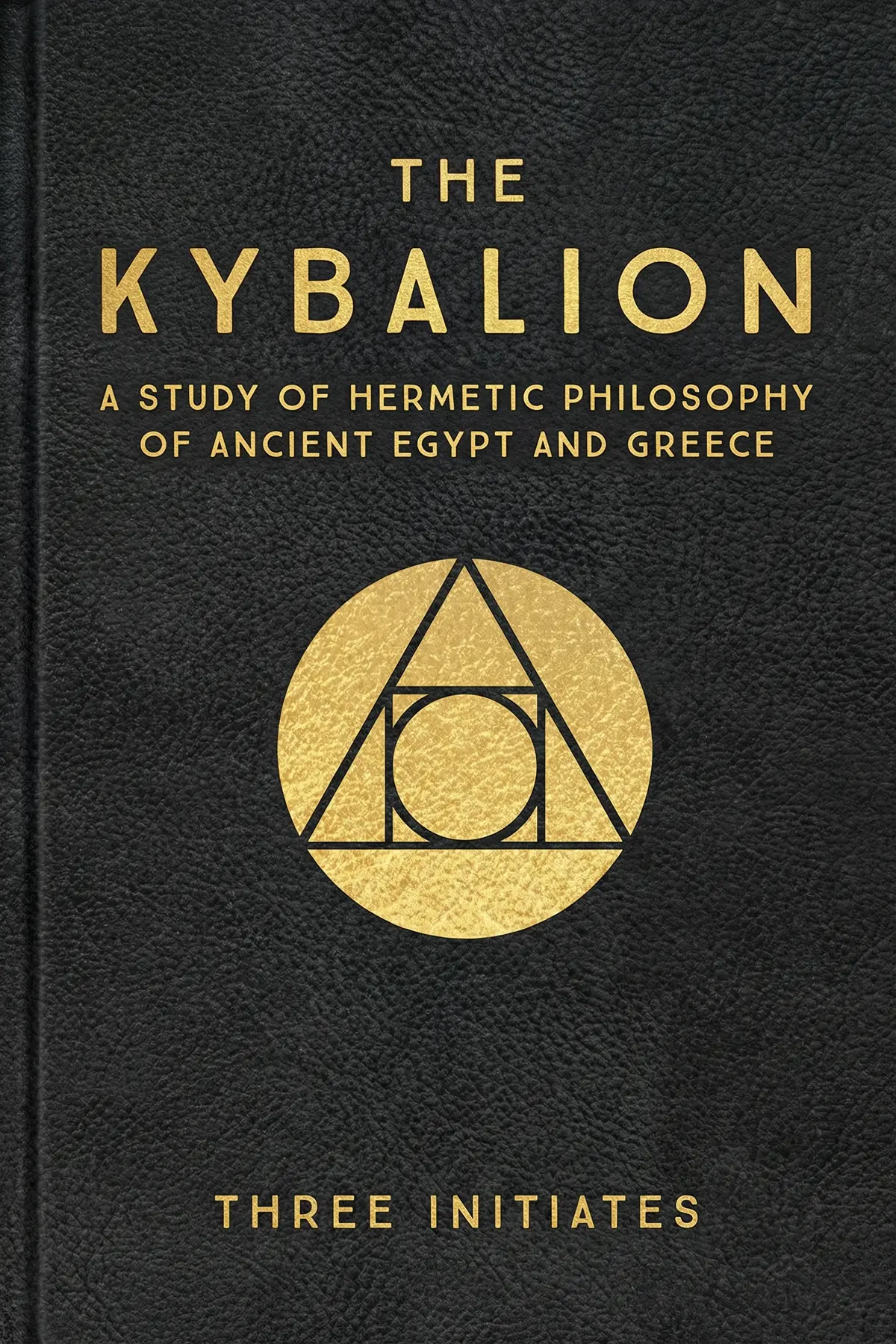
If you have ever been told to change your thinking in order to change your life, you have met ideas that a book from 1908 helped inspire. The Kybalion, published under the name Three Initiates, makes the boldest version of that claim: the universe itself is mental, so whoever masters their own mind can reshape their circumstances. Evidence points to the New Thought writer William Walker Atkinson behind the pen name.
He packed the idea into seven principles said to come from a legendary sage, running from Mentalism through Rhythm to Gender. The thread running through all of them is easy to state. The book treats reality as thought made visible, and its seven laws are offered as tools for moving from inner change to outer change.
Follow them and the roots of manifestation, vibration talk and positive thinking come into focus. Along the way you pick up a handful of lenses for moods, conflict and setbacks that are worth testing on their own terms.
1 min 37 sec
A sage who supposedly knew everything about the universe stands behind every page. Historians date his famous writings very differently, and that gap tells you how to read the rest of the book.
1 min 55 sec
The book’s founding claim puts the whole cosmos inside a single mind. Taken literally it clashes with brain science, yet a softer version gives you a practical way to loosen a situation that feels fixed.
1 min 50 sec
An old four-word maxim links the stars to your daily moods. Paired with a strict rule about causes, it turns repeating problems at work or at home into something you can trace and adjust.
1 min 51 sec
Rock, iron, gas and thought all vibrate in the book’s universe, and everything swings like a pendulum. The picture offers a surprisingly calm way to live through a bad week without reading it as permanent.
1 min 53 sec
Heat and cold, left and right, assertive and patient: the Kybalion insists these are not enemies. Its thermometer image changes how you might handle the next argument that splits a room into two camps.
2 min 02 sec
The pen name on the cover hides a teaching about three parts of every person. It ends with an unusual warning about who should hear these ideas, and why living them comes before passing them on.
1 min 09 sec
Behind its legend of an ancient sage sits one wager: thought comes before form, so the person who orders their inner world can reorder the outer one. The other six principles grow out of that wager, and the book helped prepare the ground for the New Age and self-help ideas that came after it.
You can take the wager literally, or, as modern neuroscience would push you to, treat it as an idea that can still inspire even if it is not literally true. Even on the loose reading, several habits survive. Before trying to change a stubborn situation, look at the expectation you carry into it. When a low mood arrives, place it on the pendulum and remember that the swing has turned before. When a quarrel hardens into two camps, put both on one thermometer and look for the degree that fits. And when anger rises, treat it as one end of a scale that can be moved, slowly, toward the other.
The book asks for one more thing, which is patience before preaching. Live with an idea first, and the people ready to hear it tend to find you.
Plenty of modern self-help talk about mindset, vibration and manifestation draws on ideas from a book published in 1908 under the name Three Initiates. The Kybalion makes the strongest version of the claim: the universe is fundamentally mental, so a person who masters their own thinking can reshape their circumstances. The book presents this idea as seven principles said to come down from Hermes Trismegistus, a legendary sage of ancient Egypt and Greece. Mentalism says everything arises from mind. Correspondence links the heavens to the individual. Vibration and Rhythm describe a universe always in motion and always swinging between poles. Polarity and Gender treat opposites as two ends of one thing. Cause and Effect says nothing happens by chance. Readers get a clear map of these principles and of the book's wider teaching about planes of existence and the balance of body, soul and spirit. They also see where the legend ends and the history begins, and which lenses remain useful for everyday life, such as riding out a low mood or finding middle ground in an argument, whatever one makes of the larger claims.
Readers curious about where manifestation, mindset and vibration language in self-help first came from.
Spiritual seekers who want a clear map of the seven Hermetic principles before reading the original.
People handling stress or mood swings who want a calmer frame for highs, lows and conflict.
Three Initiates is the pseudonym printed on The Kybalion, which appeared without a named author. Evidence points to William Walker Atkinson as the writer. Atkinson published widely in the late 1800s and early 1900s and belonged to the New Thought and early self-help movements. His work centered on building spiritual strength through the mind, and he drew on Hermeticism and other esoteric traditions to make them understandable to ordinary readers.
Listeners find this book very accessible and view it as essential reading, particularly for those drawn to Hermetic philosophy. They also value the profound insights, mentioning how the principles are applicable to daily life and provide clarity on numerous questions. Furthermore, the volume's aesthetic is well-received; one listener calls it a gorgeous addition to their collection and considers it a great value. However, the physical features receive varying reviews—while some enjoy the gold edges, others mention missing items like the red ribbon and gold stamping.
Wow. This little volume is a powerhouse of esoteric thought that somehow remains incredibly accessible to the modern reader. While many ancient texts feel like a chore to navigate, the 'Three Initiates' present the Seven Hermetic Laws with a clarity that is refreshing. The Law of Mentalism—the idea that the 'All is Mind'—really shifted my perspective on how I approach my daily obstacles. I found the sections on the Principle of Polarity particularly enlightening, as they offer a practical way to transmute negative emotions into positive ones. It is a beautiful handbook for any library, and the gold gilded edges give it a truly mystical feel. Frankly, it is a must-read for anyone starting their spiritual journey.
Show moreEver wonder why certain patterns repeat in your life like clockwork? The Kybalion provides the answers through its explanation of the Principle of Rhythm and the Law of Cause and Effect. This isn't just a book on magic; it’s a manual for understanding the mechanics of the universe. I’ve found that applying the 'mental alchemy' techniques has helped me maintain a much more balanced emotional state. The text is concise and moves quickly, making it a perfect companion for meditation or study. Not gonna lie, I was skeptical of the anonymous author gimmick at first, but the content stands on its own regardless of who wrote it. It’s an enlightening read that sheds light on questions I’ve had for years. Truly a masterpiece of spiritual philosophy.
Show moreLook, if you are searching for a clear roadmap to the Seven Hermetic Laws, look no further than this classic. I’ve read my fair share of 'New Age' books, but this one feels like the source material that everything else is just copying. It is an easy read that manages to pack a heavy punch in very few pages. The way it explains 'The All' as a mental construct of the universe is both mind-bending and strangely comforting. I love the physical look of the book too; the gold gilded edges make it look like an ancient grimoire. It has helped me shed light on so many personal questions regarding my own habits and reactions. This is a must-read for anyone who is ready for their ears to hear the wisdom.
Show moreThis book is a stunning addition to my shelf, featuring gorgeous gold gilded edges that make it feel like a true treasure. Beyond the aesthetics, the content is life-changing if you are willing to approach it with an open mind. The Principle of Correspondence has changed the way I look at the micro and macro worlds around me. It’s rare to find a book on Hermeticism that doesn’t require a PhD in history to understand, but this one is written for the layman. It avoids the fluff of 'The Secret' while still being accessible and encouraging. I’ve recommended it to several friends who are interested in philosophy. It’s a beautiful, enlightening piece of work that I’ll be returning to for years.
Show moreFinally got around to this classic and I can see why it’s a staple in any occult library. The clarity with which the seven principles are laid out is impressive. Even if you don't believe in 'magic' in the traditional sense, the psychological insights here are profound. It teaches you how to master your own mind rather than being a slave to your moods and external circumstances. Truth be told, I was worried it would be too 'woo-woo,' but it’s actually quite logical and structured. The physical book itself is high-quality, though my copy was missing the red ribbon marker mentioned in the description. Regardless, the wisdom inside is what matters. It's a short read that will stay with you long after you finish it.
Show morePicked this up because I wanted a foundational understanding of Hermeticism without wading through dense, archaic prose. To be fair, the authors succeed in making complex ideas like the 'Principle of Correspondence' very easy to digest. 'As above, so below' is a phrase we hear often, but this book actually contextualizes it within a larger system. I particularly enjoyed the scientific parallels, especially how the Principle of Vibration mirrors modern string theory. However, the tone can be a bit arrogant at times, frequently scoffing at what 'modern science' fails to understand. My copy arrived with beautiful gilded edges, though I was bummed to find the red ribbon marker missing. Despite the minor physical flaws and the pretense of the authors, the core philosophy is well worth the money.
Show moreAs someone who appreciates the intersection of spirituality and science, I was pleasantly surprised by the 'Principle of Vibration' chapter. It’s amazing how these 'Three Initiates' predicted concepts that are only now being explored in quantum mechanics and subatomic physics. The book is structured logically, which makes it far easier to read than most mystical texts I’ve encountered. I do think the authors lean too heavily into the 'secret wisdom' trope, which can feel a bit like a marketing gimmick. Still, the lessons on Mentalism and Polarity are immediately applicable to anyone’s life, regardless of their religious background. It serves as a great bridge between ancient thought and modern self-help. My library feels more complete with this beautiful handbook on the shelf.
Show morePersonally, I find the concept of 'Mental Transmutation' to be the most practical tool for emotional regulation I've ever encountered. Shifting from one pole of emotion to another is a skill that everyone should learn. This book does an excellent job of explaining the 'why' behind our mental states. While I agree with other reviewers that the 'Three Initiates' persona is a bit silly, the actual philosophy is sound and very helpful. My only real gripe is that the book ends just when things get really interesting, leaving you to find the 'practical' side on your own. It's a solid 4-star read that offers a lot of value for a very small price tag. Just be aware that some editions have quality control issues with the gold stamping.
Show moreThe content itself is fascinating, but the writing style is undeniably dramatic and feels a bit dated. I appreciate the breakdown of the seven laws, especially the Principle of Gender, which offers a unique take on masculine and feminine energies beyond just biological sex. However, the authors make these massive, broad-sweeping statements about 'Universal Law' without offering much in the way of practical application. It’s a lot of theory with very little 'how-to.' It reminds me of Paulo Coelho’s work—it’s meant to make you feel enlightened while you’re reading it, but the feeling fades once you close the cover. It’s a decent introduction for beginners, but those looking for serious occult depth might find it a bit empty. Plus, the lack of gold stamping on my spine was a letdown.
Show moreAfter hearing so much hype, I found myself rolling my eyes at the blatant 'New Thought' rebranding disguised as ancient Egyptian wisdom. Let’s be real: this was likely written by William Walker Atkinson in the early 20th century, not some secret trio of masters. The writing is incredibly juvenile, filled with unnecessary ALL CAPS and constant exclamation points that scream 'snake oil salesman!' It feels dangerously close to the 'Law of Attraction' nonsense you find in pop culture today. If you want actual Hermeticism, go read the Corpus Hermeticum instead of this culty schlock. It claims to be deep, but it’s mostly just 'lite lit' for people who want easy answers without doing the scholarly work. I was disappointed that the gold stamping on my cover was already peeling off.
Show moreThe Kybalion, published in 1908 under the name Three Initiates, presents seven Hermetic principles it says come from the legendary sage Hermes Trismegistus. Its central claim is that the universe is fundamentally mental, so changing your inner world is the way to change your outer conditions. The book also describes planes of existence and the balance of body, soul and spirit, and its ideas helped pave the way for New Age and popular psychology movements.
Mentalism says everything arises from mind. Correspondence holds that patterns above are repeated below, and within as without. Vibration says everything is energy moving at different rates. Polarity treats opposites as degrees of one thing, like heat and cold. Rhythm pictures life as a pendulum swinging between poles. Cause and Effect says nothing happens by chance. Gender describes masculine and feminine energies present in everyone.
The book appeared under the pseudonym Three Initiates, and evidence points to William Walker Atkinson, a prolific New Thought writer of the late 1800s and early 1900s. The book itself claims its teachings descend from Hermes Trismegistus. The pen name also carries a symbolic meaning: the three initiates stand for body, soul and spirit, the three parts of human nature the book says must be balanced.
The book’s lenses can be used whatever you make of its larger claims. Notice the expectation you bring to a stuck situation before trying to change it. Treat a low mood as one swing of a pendulum that has turned before. In a disagreement, place both views on one scale and look for the right degree. And when anger rises, move it gradually toward its opposite instead of fighting it.
Alcoholics Anonymous World Services


Daniel Goleman


Eckhart Tolle

Marianne Williamson

Deepak Chopra

Pico Iyer

Beth Moore
Paramahansa Yogananda
AUDIO SUMMARY AVAILABLE
Get the key ideas from The Kybalion by Three Initiates, plus 5,000+ more nonfiction titles.









