

A River in Darkness: One Man’s Escape from North Korea
Masaji Ishikawa
 English
Traces, step by step, how a House select committee concluded that Donald Trump knowingly pushed false fraud claims, fake electors and an armed crowd to stay in power, and why it referred him for prosecution.
1 min 02 sec
If January 6, 2021, lives in your memory as a blur of TV footage and shouting, the select committee’s report turns it into a sequence you can follow hour by hour. Its central finding is blunt: the attack on the Capitol had one cause, and that cause was Donald Trump. The January 6th Report, written by a nine-member House panel chaired by Democrat Bennie G. Thompson with Republican Liz Cheney as vice chair, builds that case largely from the testimony of Republican witnesses.
The committee argues that the riot was the final step in a campaign that began on election night, when a president who had been told he lost chose to fight the count anyway. Each pressure point it describes, from false fraud claims to fake electors to an armed crowd, went further than the one before. Follow the evidence and you can explain to anyone how the peaceful handover of power nearly broke, who stopped it, and why the committee believes someone must answer for it.
1 min 34 sec
The panel had seven Democrats and only two Republicans, which invited charges of bias. The way its members tried to answer that problem shapes how much weight every later finding in the report deserves.
1 min 36 sec
Everyone on the president’s team expected his early lead to shrink as mailed ballots arrived. What Trump did when the expected thing actually happened set the pattern for the next two months.
1 min 32 sec
The Constitution gives the vice president a role so narrow that lawyers barely argue about it. That did not stop a plan built entirely around him, complete with paperwork from seven states.
1 min 36 sec
A Georgia official, an Arizona lawmaker and a Justice Department chief each turned down a request from the president. The costs they faced afterward reveal how far the campaign was willing to go.
1 min 35 sec
Weeks before the riot, an online invitation was read by extremist groups as an instruction. Aides inside the White House saw the danger too, and asked for one simple sentence that never came.
1 min 37 sec
Once the attack began, aides, family and even a friendly TV host agreed that only one person could end it. Why the ending took so long, and how fast it came, sits at the center of the report.
1 min 42 sec
A congressional committee cannot charge anyone with a crime. This one found another way to act, and its chairman explains what he thinks the country risks if nobody answers for that day.
1 min 04 sec
The committee’s story is one of escalation. A president who had been told he lost tried words first, then paperwork, then pressure on officials, then a crowd. Each time someone in his path refused, from Pence to Raffensperger to Rosen, he reached further. What stopped him at every stage was a person willing to follow a rule, often at real risk to their own safety.
That is the image worth keeping. The handover of power survived because particular people held firm. And the most revealing moment of the day may be its shortest one: when the video finally came at 4:17, the crowd obeyed almost at once.
The next time you hear that an election was stolen, ask what the people saying it had already been told, and who checked. When the riot comes up, remember how long those 187 minutes lasted and how quickly they ended once he spoke. The committee’s final demand grows out of both facts: the man who set it in motion should be brought to justice, so that no one tries it again.
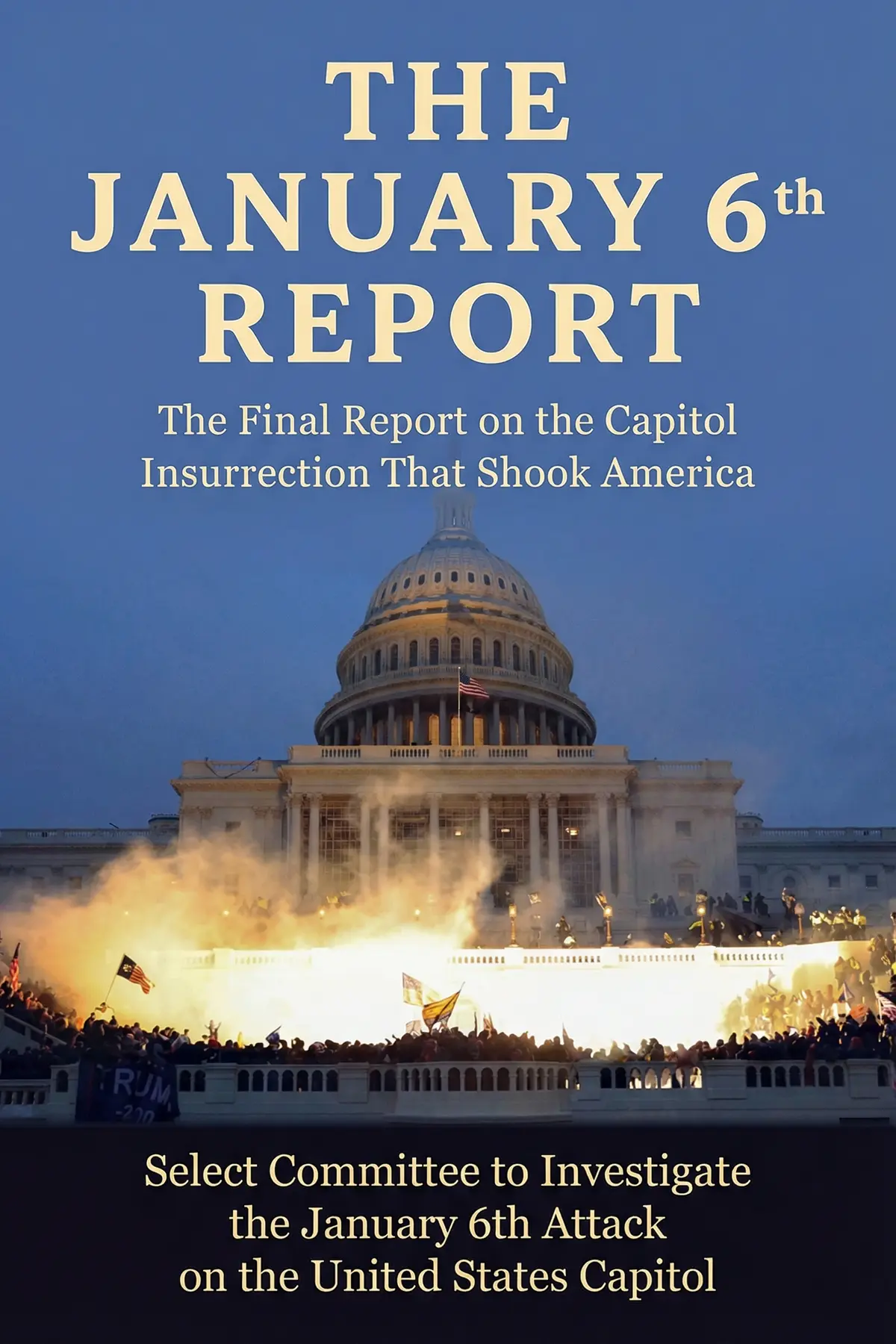
On January 6, 2021, a crowd of Trump supporters, many of them armed, forced their way into the US Capitol as Congress met to certify Joe Biden's victory. Nine members of the House of Representatives, seven Democrats and two Republicans, spent the following months investigating how it happened. They published their findings in December 2022. Their conclusion is direct: the attack had a single cause, Donald Trump. The report follows his efforts from election night onward. He called a predicted shift in the count a fraud and spent months repeating claims he had been told were false. He pressured Vice President Mike Pence, backed fake electoral certificates in seven states and leaned on officials who then faced threats. The report then reconstructs the 187 minutes during which, the committee says, he would not call off the riot. Readers get a clear timeline of how a peaceful handover of power nearly failed, drawn largely from Republican witnesses. It closes with the four crimes the committee asked the Department of Justice to consider.
Readers who followed January 6 in headlines and want the full sequence, from election night to the criminal referrals.
Students of law, government or civics studying how a peaceful handover of power is protected.
Professionals who weigh contested claims at work and want to see a case built from the other side's own witnesses.
The House select committee on the January 6th attack brought together nine members of the US House of Representatives from both parties. Bennie G. Thompson, a Democrat from Mississippi, chaired it, and Liz Cheney, a Republican from Wyoming, served as vice chair. Set up to examine an attack on Congress itself, the panel gathered testimony from many witnesses, most of them Republicans, and built its report on that record.
Listeners find this work extensively documented and comprehensive in its account of January 6th, with one listener observing that it contains the full report through Appendix 4. They value the book’s narrative quality and readability, while one review highlights its fact-based conclusions. Opinions on the paper thickness are mixed, as several listeners mention that it is thin.
This report is a harrowing, essential document that everyone needs to sit down and process regardless of their politics. The committee did an incredible job of stripping away the noise to present a clear, step-by-step timeline of how we reached that breaking point. It reads more like a fast-paced thriller than a government document, which surprised me given how thick the physical copy is. Truth is, the footnotes alone are a treasure trove of primary source material that grounds every single claim in reality. You can feel the weight of history on every page, even if the paper itself feels a bit thin for such a massive volume. It's a sobering reminder of the fragility of our democratic systems and the individuals who chose to protect them.
Show morePicked this up after watching the televised hearings and was impressed by how much additional context the full report provides. The narrative flows surprisingly well, laying out the "Big Lie" and the subsequent pressure campaigns on state officials with surgical precision. Not gonna lie, seeing the actual transcripts of communications between the White House and various conspirators makes the whole thing feel much more immediate. The section on the "187 Minutes of Dereliction" is particularly gut-wrenching when you realize how close the system came to total collapse. Even though I knew the outcome, reading the specific details of the violence against law enforcement was incredibly difficult. It serves as a permanent record that no one should be allowed to rewrite or ignore.
Show moreWow, this is a heavy read in every sense of the word. The committee has produced a master class in evidence presentation, organizing a chaotic day into a coherent and terrifying narrative. I was particularly struck by the contrast between what was being said publicly and the private admissions of defeat happening behind the scenes. Look, you don't have to be a policy wonk to appreciate how clearly the "Be There Will Be Wild" chapter explains the mobilization of extremist groups. The inclusion of maps and diagrams helps visualize the movements of the mob, making the tactical failures even more apparent. It's a heartbreaking account of a day that should never have happened, backed by the kind of documentation that's hard to dispute.
Show moreThis book provides a chillingly clear look at the events surrounding January 6th, using the words of the participants themselves to tell the story. The committee’s decision to rely heavily on Republican witnesses was a smart move that adds a layer of credibility to the findings. I found the "Just Call It Corrupt" section to be one of the most damning pieces of evidence in the entire 800-page document. Got to say, the formatting makes it quite easy to navigate, with a helpful executive summary that hits the high points before diving into the weeds. It’s not a light read, but it’s a necessary one for anyone who cares about the truth. Some of the characters involved come across as truly unlikeable, but the facts remain the most important part.
Show moreNot what I expected from a government report at all. It reads with the urgency of a true crime novel, documenting a plot that feels too wild to be real, yet the evidence is right there. The footnotes provide an incredible level of transparency, allowing you to see exactly where every piece of information originated. The fact is, seeing the photos of the damage to the Capitol alongside the testimony of the officers who were there is a powerful experience. It’s a comprehensive and sobering look at a massive failure of leadership and a direct assault on the democratic process. Even the most cynical reader will find something in these pages that challenges their assumptions about that day. The committee has done a great service for posterity.
Show moreEver wonder how much planning actually went into the events leading up to the Capitol breach? This book answers that question with brutal, meticulously researched detail that leaves very little room for interpretation or doubt. While the tone can get a bit dry and legalistic in the middle sections, the sheer volume of testimony makes it impossible to ignore. Personally, I found the chapters on the "fake electors" scheme to be the most chilling part of the entire narrative. My only real complaint is that the physical pages are quite flimsy, making it hard to highlight without ink bleeding through. Despite the weight of the subject matter, the writing is accessible enough for the average citizen to follow the complex legal theories presented.
Show moreThe chapter on Appendix 4 was a major eye-opener for me regarding the role of foreign adversaries during the lead-up to the attack. We often focus on the internal domestic actors, but seeing how our enemies leveraged these lies to further divide the country is terrifying. The report is very well-documented, though it can be repetitive since certain quotes and actions apply to multiple different legal arguments. To be fair, that repetition is probably necessary to build a bulletproof case for the Department of Justice. The writing style is surprisingly punchy for a Congressional product, avoiding excessive jargon where a simple explanation will suffice. I highly recommend the digital version if you want to follow the links to the video testimony.
Show moreFinally got around to finishing this massive volume, and the main takeaway is just how fragile our institutions really are. The report does a fantastic job of connecting the dots between the early legal challenges and the eventual violence at the Capitol. I particularly appreciated the detailed breakdown of the 187 minutes of silence from the Oval Office while the riot was unfolding. In my experience, government reports are usually sleep-inducing, but this one keeps you engaged through clear writing and a logical structure. It’s a frightening look at how easily lies can be weaponized against the state by those sworn to protect it. While I would have liked more info on the funding of the rallies, the report we got is remarkably thorough.
Show moreAs someone who follows politics closely, I found the report to be a solid foundational document, though it definitely feels like it pulled some punches. It does an excellent job detailing the actions of the former president, but I would have liked more focus on the broader GOP leadership's role. Frankly, the report skips over some of the deeper systemic issues like the rise of Christian nationalism that fueled the participants. The evidence provided is undeniably thorough, with thousands of footnotes to back up every assertion made by the committee. It's an important read, but it feels like only one piece of a much larger, more complicated puzzle. The paper quality is also surprisingly poor for a book meant to be a historical record.
Show moreAfter hearing so much conflicting news, I finally decided to go straight to the source and read the official findings myself. It's a lot to take in, and honestly, the sheer length can be a bit overwhelming if you try to tackle it all at once. The paper is quite thin, which I suppose was necessary to keep the book from being five inches thick, but it feels a bit cheap. While the evidence against the key players is extensive, the report can feel a bit narrow in its scope at times. I wish there was a bit more exploration of the social media algorithms that helped radicalize so many ordinary people. Still, the timeline of the attack itself is laid out with such clarity that it's hard to put down once you start.
Show moreThe committee concluded that Donald Trump was the cause of the attack on the Capitol. It argues that he knew he had lost the 2020 election, kept repeating fraud claims he had been told were false, pressured Mike Pence and state officials, backed fake electoral certificates in seven states, and summoned a crowd to Washington. It then says he waited 187 minutes before telling the rioters to go home.
It was produced by a House select committee of nine members, seven Democrats and two Republicans, chaired by Bennie G. Thompson of Mississippi with Liz Cheney of Wyoming as vice chair. The two Republicans were the only members of their party who had voted to create the panel. To counter charges of bias, the committee drew most of its witnesses from the Republican side.
The committee could not charge anyone, so it sent its findings to the Department of Justice and the House Ethics Committee. Its central allegations were obstruction of an official proceeding, conspiracy to defraud the United States, conspiracy to make a false statement through the fake electoral certificates, and inciting or aiding an insurrection. It also raised possible wrongdoing by team members who joined the effort or refused to cooperate.
Trump’s rally speech ended around 1:10 p.m., and by 1:25 he knew the Capitol was under attack. Family members, aides and Fox News host Sean Hannity urged him to call it off. Instead, at 2:24 he posted a message blaming Pence. Later posts asked for calm but not for people to leave. At 4:17 he released a video telling the attackers to go home, and they left at once.
The report shows that the handover of power held because individual officials refused to bend, often at personal cost: Pence would not reject the count, Raffensperger would not invent votes, Rosen would not send a false letter. It also models a useful habit for any contested claim, which is asking what the people making it had already been told. Chairman Thompson argues that trust in voting lasts only if threats to it carry consequences.
Masaji Ishikawa

John Rawls



Miles Taylor



Tracy Rosenthal

Jessica Valenti

Yanis Varoufakis
AUDIO SUMMARY AVAILABLE
Get the key ideas from The January 6th Report by Select Committee to Investigate the January 6th Attack on the United States Capitol, plus 5,000+ more nonfiction titles.









