

14 min 13 sec
Available in: English
The Innovation Stack: Building an Unbeatable Business One Crazy Idea at a Time
By Jim McKelvey
Explains the difference between copying a business and truly inventing one. It shows how solving one new problem after another builds a chain of linked inventions that even a giant like Amazon struggles to copy.
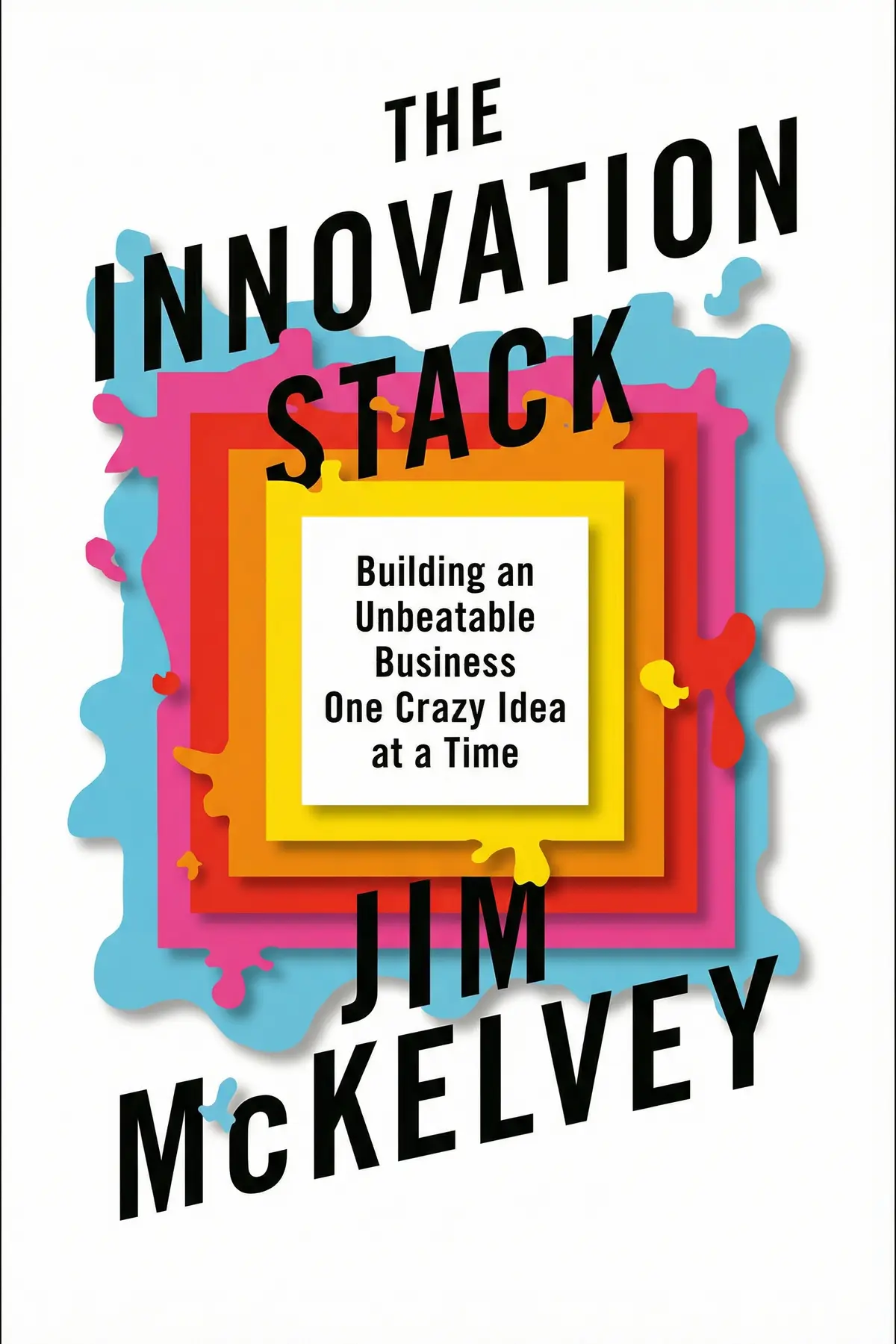
Table of Content
1. Introduction
1 min 00 sec
Most profitable businesses, even famous ones, succeed by copying something that already works and making it a little better. In The Innovation Stack, Square cofounder Jim McKelvey argues that real entrepreneurship is a different activity: taking on a problem nobody has solved, with no map to follow. If you have an idea that feels too strange for your experience, his book shows what that path demands.
His central claim is that when you try something truly new, each solution creates a fresh problem, and the inventions you are forced to make link together into an innovation stack. Such a stack is very hard to copy, because a rival would need every piece at once. The story moves from a lost sale in a glass studio to a pitch that boasted about failure, a standoff with Amazon and a banker in 1901. Along the way you get a test for whether your idea is a copy or an exploration, and a way to read the problems that pile up once you start.
2. Stop copying and start exploring
1 min 43 sec
One of the most loved burger chains in the United States invented almost nothing on its menu. A medieval city wall explains why that still counts as good business, and why McKelvey refuses to call it entrepreneurship.
3. Find the problem that only you will chase
1 min 33 sec
A customer walked away from an ugly glass faucet because of the card in her wallet. Behind that small loss sat a pricing gap so wide that McKelvey checked his math three times before he believed it.
4. Turn each solved problem into your next innovation
1 min 44 sec
Square’s founders discovered within a day of launch why nobody had built their product before. Then a pricing decision meant to win trust started losing them money, and the way out reshaped the whole company.
5. Build a stack that rivals cannot copy
1 min 41 sec
The cheapest card reader on the market retailed for $950, while Square’s cost 97 cents to make and carried a similarly low price. The reason has a lot in common with what two brothers went through when they built the first airplane in 1903.
6. Win investors by listing how you could fail
1 min 44 sec
Two founders walked into investor meetings, took the investors’ credit cards and charged them. Then they showed a slide about everything that could ruin the company, and one top investor called it the best pitch he had seen.
7. Hold your principles when a giant attacks
1 min 46 sec
Amazon copied Square’s card reader, fixed its biggest flaw and undercut its price. Square’s response looked like surrender, and McKelvey still cannot fully explain why it ended with Amazon backing away.
8. Start before you feel qualified
1 min 50 sec
A fruit and vegetable seller created a bank that ranks among the largest in the world, and a glassblower created a payments company. Their stories challenge the belief that you must master a field before you are allowed to change it.
9. Conclusion
1 min 12 sec
What McKelvey offers is a different way to judge a business idea. The question is not how good the idea looks on the first day. It is whether you will follow it outside the wall, into a chain of problems nobody has mapped, and keep solving them until the answers lock together. A lost sale of a glass spout became a flat price, a 97-cent reader, a pitch that listed its own risks and a card reader that outlived Amazon’s copy. None of it was planned. Each piece was forced by the one before it.
That gives you something to do with your own idea. Be honest about whether you are copying or exploring. If you are exploring, treat every new problem as the next block to build, and tell people how you might fail before they find it themselves. When a larger rival copies one feature, look at your whole stack before you change course.
His final advice concerns fear. Not knowing how long the work will take, or whether it will succeed, is uncomfortable, and a voice will tell you to quit. McKelvey suggests getting used to that discomfort, because exploring, in his view, beats being a tourist.
About this book
What is this book about?
Most businesses copy something that already works and improve it a little. Jim McKelvey, cofounder of Square, argues that this is a fine way to make money but not true entrepreneurship. Real entrepreneurs take on problems nobody has solved, with no map and often no relevant training. McKelvey tells how a lost sale of a glass spout in his St. Louis studio led him and Jack Dorsey to fix a card payment system that charged small merchants far more than large ones. Every fix created a new problem. A flat 2.75 percent price meant losses on small charges. Low prices demanded a card reader that cost 97 cents to make. McKelvey calls the resulting set of linked inventions an innovation stack, and he shows it at work in the Wright brothers' first airplane, in Square's standoff with Amazon and in A.P. Giannini's Bank of Italy. Readers get a way to tell whether their own idea is a copy or an exploration, a reason to treat each new problem as the next building block, and the encouragement to start before they feel qualified.
Book Information
Who it's for
Original-idea founders
Founders with an idea nobody else is pursuing who want to know what building it will really demand.
Career changers doubting readiness
Career switchers who doubt they have the training to start something new.
Underdog operators
Operators facing a larger competitor and tempted to copy its every move.
About the Author
Jim McKelvey
Jim McKelvey co-founded Square in 2009, the payments company later renamed Block, Inc. Before business, he worked as a glass artist. In 2016 he founded Invisibly, a company built around micropayments for online content. He joined the board of the Federal Reserve Bank of St. Louis as an independent director in January 2017 and has also served as a board director at Emerson Electric.
Ratings & Reviews
Ratings at a glance
What people think
Listeners find the content very accessible and amusing, with one listener observing that it breaks away from the usual business book structure. Beyond that, the writing is skillfully executed, and listeners enjoy the infusion of humor. The text provides useful perspectives, as one listener stresses its utility for founders, and listeners prize the way it broadens their understanding of entrepreneurial methods. Additionally, the narrative is quite absorbing, with one listener even comparing the story to a mystery novel.
Top reviews
Por
This book reads like a fast-paced narrative rather than a dry business manual. McKelvey manages to turn the story of a small card reader company defeating the Amazon behemoth into something that feels like a thriller. The 'Innovation Stack' concept is a brilliant way to explain why some companies are simply uncopyable even when a giant tries to clone them. I particularly enjoyed the self-deprecating humor and the realization that solving one tiny problem often forces you to solve twenty more. It’s an eye-opening perspective for anyone tired of the usual jargon that fills most startup guides. If you want a book that teaches you how to think through impossible hurdles, this is it. It’s easily the most entertaining business book I have picked up all year.
Show morePhichai
Picked this up on a whim and ended up finishing it in two sittings because the storytelling is just that infectious. It’s refreshing to read a business book where the author admits they had no idea what they were doing half the time. McKelvey’s journey from glassblowing to co-founding Square is told with a level of wit that makes complex economic theories actually digestible. The way he describes the 'perfect problem' changed how I look at market gaps entirely. Truthfully, it feels more like a mystery novel where you’re trying to figure out the secret sauce alongside the protagonist. While some might find his definition of entrepreneurship a bit narrow, the insights into building a resilient organization are gold. Highly recommended for founders who feel like they're drowning in regulations.
Show moreTakeshi
Wow, I wasn't expecting a book about credit card processing to be this entertaining. McKelvey has a gift for taking mundane business decisions and showing how they are actually radical acts of survival. The 'Innovation Stack' isn't a single invention, but rather a chain reaction of fixes that eventually creates a whole new category. I found the section on 'perfect problems'—those underserved markets that the big guys ignore—to be particularly inspiring. The writing is punchy, funny, and surprisingly humble despite the massive success of Square. It challenges the 'move fast and break things' mantra with a more thoughtful approach to systemic problem-solving. Every aspiring founder needs to grasp these concepts before they start pitching their next big idea.
Show moreTeng
Finally got around to reading this and I’m kicking myself for waiting so long. It’s rare to find a business book that doesn't follow the standard template of 'anecdote, lesson, checklist.' Instead, you get a wandering, honest exploration of what it means to build something truly new. The humor is spot-on, and the way McKelvey breaks down the 'virtuous cycle' of IKEA is masterclass-level strategy. It really opened my mind to the idea that the best businesses are often built out of desperate necessity rather than grand vision. The prose is well-crafted and keeps you moving through the technical bits without ever feeling like a chore. This is the kind of book you want to give to every friend who has a 'great idea' but is afraid to start.
Show moreSuphan
Look, the history lessons provided here are worth the price of admission alone. It’s fascinating to see the parallels between A.P. Giannini’s early banking days and a modern tech startup. McKelvey proves that 'Innovation Stacks' are a timeless phenomenon, not just a Silicon Valley buzzword. The writing is incredibly readable, and the author’s voice is genuinely likable, which is a rarity in this genre. I loved the concept that solving a problem for an unserved customer naturally leads to a series of innovations that become impossible for a competitor to copy. It’s a very optimistic take on the power of entrepreneurship to actually improve society. Highly informative and entertaining from cover to cover.
Show moreGame
Ever wonder why some startups thrive while massive incumbents fail to replicate their success? Jim McKelvey provides a compelling answer through his theory of interlocking solutions that form a defensive perimeter. The writing is snappy and avoids the usual 'ten steps to success' fluff that plagues the genre. I found the distinction he makes between a 'businessman' and a 'true entrepreneur' to be quite profound and somewhat controversial. However, some of the analogies felt a bit stretched, and the constant focus on the Square vs. Amazon narrative bordered on self-congratulatory at times. Still, the historical deep dives into Southwest and IKEA make the core thesis feel much more robust and universal. It’s definitely worth a read for the mental models alone.
Show moreIvan
As someone who has slogged through countless strategy books, I found this to be a breath of fresh air. Instead of preaching from a pedestal, the author uses a conversational tone to explore why some companies develop a 'stack' of unique innovations. The case study on Bank of America’s early days was a highlight for me, showing that these patterns aren't just limited to tech. To be fair, the book does wander into some strange tangents that don't always pay off, but the central message remains strong. I loved the idea that being first isn't as important as building a series of dependent solutions that competitors can't untangle. It’s a messy, honest look at what it actually takes to survive in a cut-throat industry.
Show moreMaya
Not what I expected at all, but in a good way. The book is less about 'how to build an app' and more about the philosophy of expanding markets through radical accessibility. McKelvey’s explanation of the 'unguarded economic border' is a great mental model for finding new opportunities. I gotta say, the story of how they essentially forced the credit card companies to change their rules was pretty badass. It’s a nice reminder that regulations are often just roadblocks waiting for someone with enough audacity to push through. My only gripe is that the author’s definitions can be a bit rigid, making it seem like his way is the only 'true' way to innovate. Still, the entertainment value alone makes it worth it.
Show moreTaw
Frankly, the core idea here is interesting but probably could have been summarized in a lengthy blog post. While the writing is undeniably witty and engaging, I felt like I was being sold the Square origin story for the hundredth time. The 'Innovation Stack' feels like a clever rebranding of established concepts like value chains or competitive moats, just with more 'startup-y' language. There are some great nuggets of wisdom, especially regarding the regulatory hurdles they faced, but they are buried under a lot of fluff. I also struggled with the author’s tendency to frame luck as purely a result of his specific philosophy. It's a decent read for inspiration, but don't expect a step-by-step roadmap for your own business.
Show moreUbolrat
To be honest, the chapter on 'perfect problems' had some merit, but the rest of the book felt like a rambling justification for success. McKelvey constantly plays up the 'scrappy underdog' trope, conveniently downplaying the massive advantages of having Jack Dorsey as a co-founder. I found the tone to be a bit cringey at times, especially with phrases like 'squaring up' appearing more often than necessary. Most of the 'innovations' he lists are just standard business decisions viewed through the rosy lens of hindsight. If you've read your fair share of Drucker or Christensen, you won't find much that's truly revolutionary here. It feels like a high-production-value sales pitch for his own ego rather than a helpful guide. I’d skip this one.
Show moreQuestions about this book
What is the main idea of The Innovation Stack?
Jim McKelvey argues that most businesses copy what already works, while real entrepreneurs solve problems nobody has solved. Doing something new means each solution creates another problem. The inventions forced by that chain link together into an innovation stack, which McKelvey sees as a company’s strongest asset because a rival would need every piece at once to copy it.
What is an innovation stack according to Jim McKelvey?
It is a set of interlocking inventions that grows as a company solves one new problem after another. Square’s stack has 14 blocks by McKelvey’s count, including simple design, low prices, no contracts and cheap but beautiful hardware. The blocks depend on each other: low prices required a card reader costing 97 cents to make, and removing any block makes the stack fail.
How did Square beat Amazon's card reader?
In 2014 Amazon released a wider reader that fixed the wobble in Square’s device and priced it 30 percent lower. Square chose not to respond, keeping its focus on beautiful design and its existing model. By Halloween 2015 Amazon had announced it was ending its reader. McKelvey says he never learned exactly why, but believes holding to Square’s principles kept it ahead.
Do you need expertise to become an entrepreneur?
McKelvey says expertise matters mostly when you copy an existing business, as Shake Shack’s owner used his restaurant skills. For truly new problems everyone starts at the same level. A.P. Giannini began as a produce seller and built the Bank of Italy, later Bank of America, and McKelvey was a glassblower before Square. The thought that you should know more first often stops people from trying.
How can I apply The Innovation Stack to my own business idea?
First ask whether you are improving something that exists or doing something nobody does. If it is new, treat each problem your solutions create as the next thing to invent rather than a reason to quit. When pitching, name the ways you could fail before others do, as Square did with its 140 reasons slide. And when a rival copies one feature, judge your whole system before reacting.
Readers also enjoyed


7 Powers: The Foundations of Business Strategy
Hamilton Helmer



Alibaba: The House That Jack Ma Built
Duncan Clark


Be A Free Range Human: Escape the 9 to 5, Create a Life You Love,
Marianne Cantwell

Be Obsessed or Be Average
Grant Cardone
Being Boss: Take Control of Your Work and Live Life on Your
Kathleen Shannon
AUDIO SUMMARY AVAILABLE
Listen to The Innovation Stack in 15 minutes
Get the key ideas from The Innovation Stack by Jim McKelvey, plus 5,000+ more nonfiction titles.
- 5,000+ titles
- Listen as much as you want
- 7-day free trial
- Cancel anytime









