

14 min 52 sec
Available in: English
The Harvard Psychedelic Club: How Timothy Leary, Ram Dass, Huston Smith, and Andrew Weil Killed the Fifties and Ushered in a New Age for America
By Don Lattin
Follows four men whose paths crossed in Harvard's early psilocybin experiments. One shared experience led them to LSD evangelism, Eastern spirituality, scholarly doubt and a health empire.
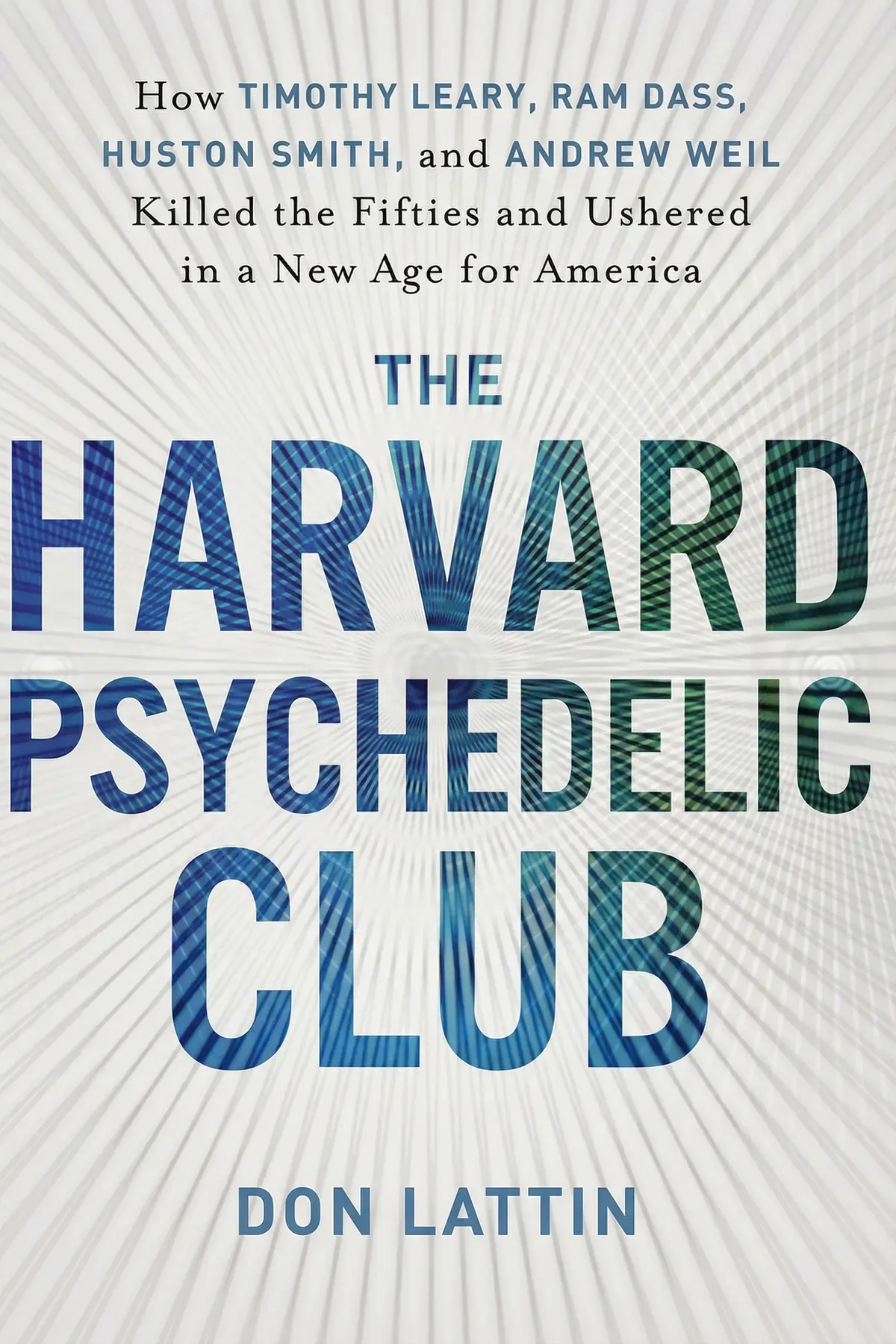
Table of Content
1. Introduction
1 min 03 sec
Most people have had a moment that felt like it changed everything, then watched its glow fade within a week. In The Harvard Psychedelic Club, journalist Don Lattin tells the story of four men who shared such moments in the early 1960s through the same psilocybin experiments at Harvard, and then went in four directions. Timothy Leary became the loudest preacher of LSD. Richard Alpert left for India and returned as the guru Ram Dass. Huston Smith, a scholar of world religions, concluded that the bliss did not last. Andrew Weil, the student who helped get the professors fired, built a national health brand.
The thread through all four lives is that a powerful experience is no shortcut to wisdom. What lasts is what a person builds around it afterward. Their story shows how the buttoned-up fifties gave way to the restless sixties, and it offers four very human models of what to do, and what to avoid, after a moment of insight.
2. Meet the two professors who opened Harvard to psychedelics
2 min 03 sec
One came from wealth and the other from chaos, and neither seemed headed for a revolution. A chance encounter on an Italian holiday put them in the same drafty building, and the sixties started there.
3. Three first trips that promised a new science
2 min 13 sec
A skeptical psychologist, a conflicted young professor and a missionary’s son who studied the world’s faiths each took the same mushroom compound. What they saw convinced them they had found something science and religion both needed.
4. Understand the jealous student who ended the experiment
2 min 10 sec
Harvard approved the research with one important condition attached: undergraduates were not allowed to take part as subjects. An undergraduate who was turned away at the door saw it differently, and his revenge reshaped four lives.
5. When more of a good thing stops working
2 min 05 sec
Freed from university rules and backed by an oil fortune, two ex-professors could take as much as they liked. What happened during two weeks of nonstop doses tells you something about every high you chase.
6. Turn a peak moment into a lasting practice
1 min 54 sec
At a California gathering where LSD was handed around freely and a famous band played, one scholar stood up with an unwelcome finding. A burned-out former professor reached it too, and went to India with it.
7. Build something durable, or drift like Leary
2 min 05 sec
One man went from botany and medical school to a household name. The other went from Harvard to prison, Algeria, Switzerland and a deal with the FBI. Their endings mark the outer limits of the club’s story.
8. Conclusion
1 min 19 sec
In 1964, before their split, Leary and Alpert wrote The Psychedelic Experience together. It laid down simple ground rules: choose a peaceful place, and keep only trusted friends around. A decade earlier Huxley had warned that these drugs can show you heaven or hell, your best self or your worst. Each member of the club met both.
What Lattin’s four lives add up to is a portrait of one powerful experience meeting four different characters. None of them found a shortcut to enlightenment, and none forgot what they had seen. The difference lay in what came next: Leary’s endless campaign, Ram Dass’s teacher and teaching, Smith’s careful doubt, Weil’s books and business.
That pattern reaches well beyond drugs. When something opens your eyes, whether a crisis, a trip or a single conversation, expect the feeling to fade, as Smith predicted, and decide what habit or work will carry it forward. Watch for Alpert’s trap of chasing the same high in bigger doses. And pay attention to setting and company, the two rules the professors wrote down, because who is in the room shapes which side of the experience you meet.
The vision was the same for all four men. The lives they built from it were not.
About this book
What is this book about?
In 1960, two Harvard psychologists, Timothy Leary and Richard Alpert, began giving psilocybin to volunteers and collecting their written accounts. Huston Smith, a scholar of world religions from MIT, soon joined them. Meanwhile an ambitious undergraduate named Andrew Weil watched from outside and resented being shut out. Journalist Don Lattin follows how that small circle formed and how a student's jealousy got the professors fired in 1963. He then traces where each man went next. Leary became the most famous preacher of LSD and ended up a fugitive and an FBI informant. Alpert went to India and came back as Ram Dass, author of Be Here Now. Smith decided that drug-induced bliss rarely lasted. Weil became a bestselling health author with a business empire. The result is a vivid, human account of how the conformist fifties turned into the sixties. It also carries a sharp lesson: one powerful experience can lead to four very different lives, depending on what each person builds from it.
Book Information
Who it's for
Curious about counterculture origins
Readers curious how the 1960s counterculture grew out of a Harvard psychology lab.
Drawn to alternative health
People drawn to psychedelics, yoga or alternative health who want the history behind them.
Watched an insight fade
Anyone who has seen a big insight fade and wants to see how four men handled theirs.
About the Author
Don Lattin
Don Lattin is an American journalist and author. He spent about two decades as a staff writer at the San Francisco Chronicle, covering religion, spirituality and psychology. He has taught journalism at UC Berkeley as an adjunct faculty member and studied sociology there, earning his degree. The Harvard Psychedelic Club came out in 2010, became a national bestseller and earned a silver medal in the non-fiction category of the 2010 California Book Award.
Ratings & Reviews
Ratings at a glance
What people think
Listeners find this narrative to be an engaging and captivating experience that offers a thoroughly researched and intellectually stimulating history of the psychedelic movement in America during a pivotal era of the nation's past. The prose is remarkably high quality, and listeners value the candid depiction of the primary individuals featured.
Top reviews
Gung
Wow, what a wild ride through a decade that changed everything we think we know about spirituality and medicine. Lattin does a fantastic job of showing how these four men essentially killed the 1950s and paved the way for the modern world. I was hooked from the start by the descriptions of the early psilocybin tests at Harvard and the eventual spiral into Millbrook. It’s rare to find a non-fiction book that reads this much like a fast-paced novel while maintaining its journalistic integrity. The author treats Timothy Leary with a fair amount of skepticism, which I appreciated given his polarizing legacy. Seeing the evolution of Richard Alpert into Ram Dass was the highlight for me personally. This is absolutely essential reading for anyone interested in how the West discovered the East.
Show moreJom
Finally got around to reading this and I’m struck by how relevant these stories still are to our current cultural climate. Lattin explores the bridge between the CIA’s early interest in LSD and the eventual explosion of the drug into the mainstream. The book paints a vivid picture of the ego-driven 'Harvard Men' who thought they were the first to discover ancient truths. It’s a fascinating study of how a small group of academics can inadvertently trigger a massive societal upheaval. I loved the details about their time in India and how those experiences transformed their initial academic curiosity into something much more profound. The prose is clear, the research is top-notch, and the narrative never feels like it's dragging. Highly recommended for history buffs.
Show moreLucas
This book is a stunning piece of investigative non-fiction that manages to be both informative and incredibly fun to read. Don Lattin has a gift for taking complex religious and psychological concepts and making them digestible for the average reader. The stories of the 'Harvard Psychedelic Club' are told with such passion that you almost feel like you're in the room during their sessions. I was particularly fascinated by the involvement of Huston Smith and how he tried to reconcile these drug-induced visions with traditional faith. It’s a brilliant exploration of how the quest for transcendence can lead to both enlightenment and absolute disaster. The book doesn't preach, it just presents the facts of these four fascinating lives and lets you decide. It is easily one of the best books I’ve read on the subject.
Show moreMint
Don Lattin provides a compelling look into a pivotal moment in American history that many of us only know through hazy stereotypes. By focusing on the intersection of Leary, Alpert, Smith, and Weil, the book manages to humanize figures who have since become myths. I particularly appreciated the framing of these four as the Trickster, Seeker, Teacher, and Healer, even if that RPG-style labeling felt a bit cheesy at times. The writing captures that shift from the buttoned-up fifties to the chaotic sixties with real grace and journalistic precision. While the narrative occasionally jumps around in time, the core story about their Harvard experiments remains fascinating. It’s a well-researched account that doesn't shy away from the egos and betrayals that defined the group.
Show moreFah
Ever wonder how we got from the 'Just Say No' era back to the current psychedelic renaissance in science? This book is the missing link that explains the origins of that cultural shift through four very different personalities. Picked this up on a whim and was surprised by how much I enjoyed the interplay between the 'Trickster' Leary and the 'Seeker' Alpert. The author's tone is perfectly expository—it’s informative without being dry, though it does get a bit gossipy regarding the Harvard fallout. To be fair, some of the connections Lattin tries to make to modern wellness feel a little forced. However, the sheer amount of research into their personal interviews makes the story feel incredibly authentic. It’s a grounded look at a very ungrounded time.
Show moreManee
As someone who grew up in the eighties, my only exposure to this stuff was the D.A.R.E. program, so this was an eye-opener. The book manages to strip away the hippie-dippie clichés to show the actual intellectual and spiritual motivations behind the early psychedelic movement. Lattin’s decision to follow four distinct paths—the seeker, the healer, the teacher, and the trickster—gives the book a great sense of balance. You get the religious perspective from Smith, the medical side from Weil, and the pure chaos from Leary. My only real gripe is that the ending feels a bit rushed compared to the deep dive into the Harvard years. Still, it’s a thought-provoking account that makes you question how much of our modern world was built on these trips. It definitely gave me a lot to think about.
Show moreSuthinee
Personally, I found the transformation of Richard Alpert into Ram Dass to be the most moving part of the entire narrative. Lattin captures the tension between the clinical setting of the Harvard labs and the wild, uncontained energy of the actual experiences. The way the author portrays Leary as the 'Trickster' is spot on; you can see his charm and his destructiveness in equal measure. It’s a well-written documentary in book form that doesn't try to idolize its subjects or turn them into villains. I appreciated the bibliography at the end because I now have a dozen other books on my 'to-read' list. The transition from the 50s into the 60s is handled with a great sense of atmosphere and timing. It’s an accessible gateway into a very complex subject.
Show moreClaire
After hearing so much about the counterculture movement, I expected a more linear and perhaps more 'literary' approach to this history. Lattin certainly did his homework, but the book feels a bit repetitive, as if chapters were written as standalone articles before being stitched together. You’ll find the same anecdotes appearing more than once, which can be a bit grating if you’re reading it in one sitting. Truth is, the sections on Andrew Weil felt slightly biased, painting him as a bit of a conniving character compared to the others. Still, as someone who knew very little about Huston Smith’s involvement, I found those parts deeply enlightening. It is a decent introduction for the uninitiated, even if the structure is a bit of a mess.
Show moreAndrew
Look, this is a solid enough book if you want a crash course in 60s counterculture, but it has some notable flaws. The author often repeats himself from one chapter to the next, which suggests the editing could have been much tighter. I also wasn't entirely convinced by the thesis that these four men alone were responsible for such a massive shift in American values. While their impact was certainly there, the book ignores larger factors like the Vietnam War or the Civil Rights Movement. That said, the personal anecdotes about the betrayals at Harvard are genuinely entertaining and provide a lot of color. It reads more like a series of long-form magazine profiles than a cohesive historical narrative. It’s worth a read, just don't expect a masterpiece.
Show moreUbolrat
The chapter on Andrew Weil really rubbed me the wrong way, as the author seems to have a personal axe to grind with him. Honestly, the book is quite disjointed and struggles to find a consistent chronological flow throughout the middle sections. I found myself flipping back several times because the name-dropping became so dense it was hard to keep track of the secondary players. It feels like Lattin had a mountain of research and felt obligated to include every single scrap of it regardless of the pacing. The repetitive nature of the storytelling makes it feel like you’re reading the same three months of 1960 over and over again. It’s not a terrible resource, but it certainly isn't the 'definitive' history I was hoping for when I bought it.
Show moreQuestions about this book
What is The Harvard Psychedelic Club about?
Don Lattin tells how Timothy Leary, Richard Alpert, Huston Smith and Andrew Weil crossed paths through Harvard’s psilocybin research in the early 1960s. After the project collapsed in 1963, Leary became a loud champion of LSD and Alpert became Ram Dass, spreading Eastern spirituality. Smith concluded that drug-induced bliss rarely lasts, and Weil became a famous health author and brand.
Why were Timothy Leary and Richard Alpert fired from Harvard?
The project barred undergraduates. Andrew Weil, a student who had been refused as a volunteer, grew jealous when his friend Ronnie Winston joined Alpert’s circle and received psilocybin from him. In 1963 Weil accused Alpert in the Harvard Crimson, with Winston as his witness. Officially Alpert was dismissed over the drugs, and Leary for leaving his classes and Cambridge without permission.
What did Huston Smith conclude about psychedelics?
Smith, an MIT scholar of world religions, found awe in psilocybin and helped lead the project. In 1966, presenting a paper at a conference in Marin County, he argued that drugs like LSD could produce euphoria and spiritual bliss. He added that there was little evidence those feelings lasted after the drug wore off. Alpert reached a similar view before leaving for India.
Who should read The Harvard Psychedelic Club?
It suits readers curious about the 1960s counterculture, about the roots of today’s interest in yoga, Eastern spirituality and alternative health, or about psychedelics. It also works well for anyone who enjoys group biographies. It follows four very different men from one shared starting point to four separate endings, from a respected guru to an FBI informant.
What lessons does The Harvard Psychedelic Club offer?
The group’s experiences suggest a few. Setting and company matter: Leary and Alpert’s 1964 guide advised a peaceful place and trusted friends. More is not always better, as Alpert’s two weeks of huge doses showed. And a peak experience fades unless something is built around it, which is why Ram Dass turned to a guru and Weil to steady work.
Readers also enjoyed

Ali: A Life
Jonathan Eig


A Life Decoded: My Genome: My Life
J. Craig Venter


A Splendid Exchange: How Trade Shaped the World
William J. Bernstein

A Long Way Gone: Memoirs of a Boy Soldier
Ishmael Beah

All Creatures Great and Small
James Herriot


AUDIO SUMMARY AVAILABLE
Listen to The Harvard Psychedelic Club in 15 minutes
Get the key ideas from The Harvard Psychedelic Club by Don Lattin, plus 5,000+ more nonfiction titles.
- 5,000+ titles
- Listen as much as you want
- 7-day free trial
- Cancel anytime









