

Aflame: Learning from Silence
Pico Iyer
 English
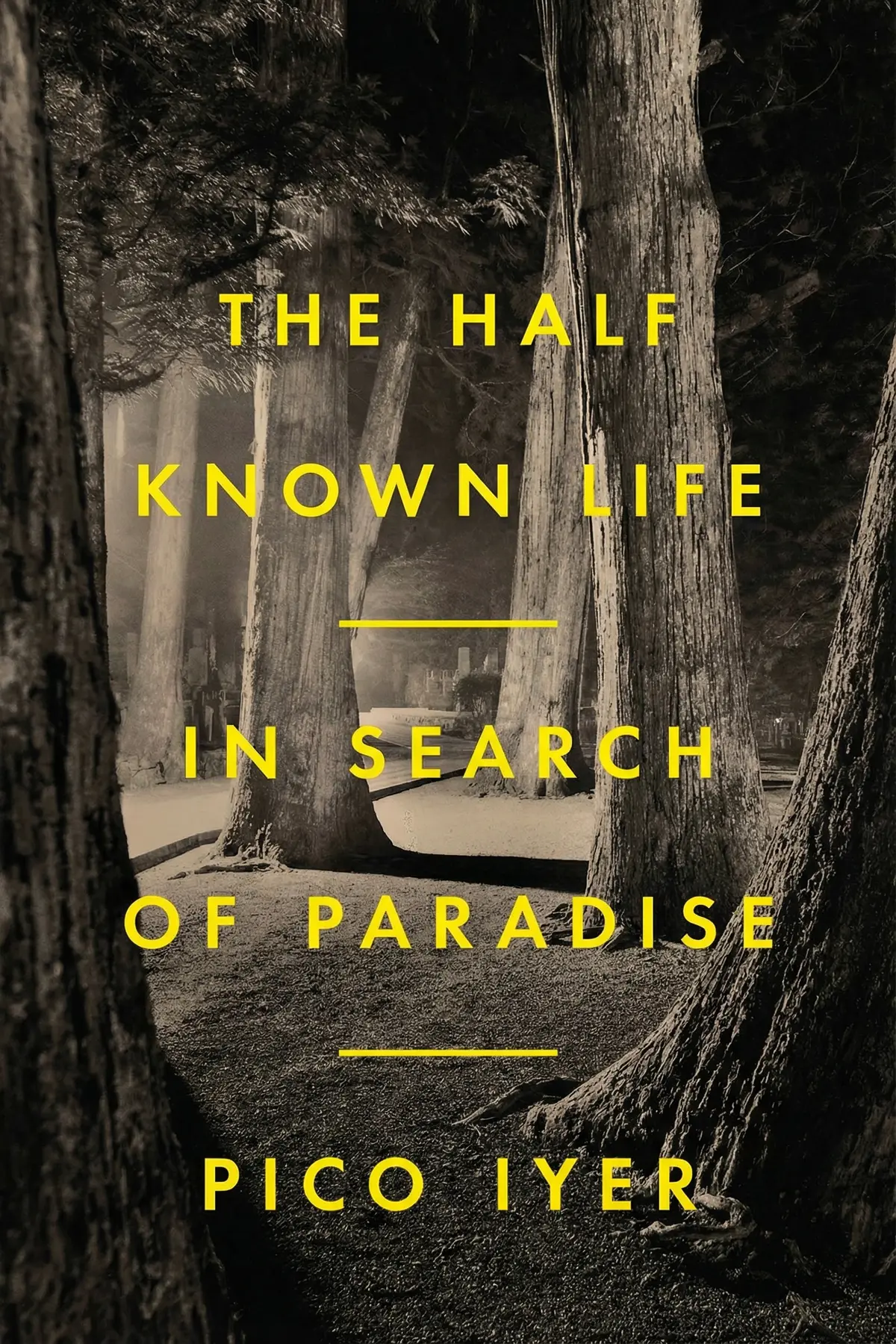
Pico Iyer travels to Iran, Kashmir, Jerusalem, Sri Lanka and Varanasi, places long called paradise. He finds them crowded, contested and alive, and shows what the human hunger for heaven on Earth reveals.
1 min 09 sec
Most of us carry a picture of a perfect place somewhere else: a valley, an island or a holy city where life would finally make sense. In The Half Known Life, travel writer Pico Iyer visits the places the world has called paradise. He finds the idea older and stranger than the picture. It began, he notes, with the Zoroastrians, who gave the ancient Persians the walled garden as an earthly image of heaven, with everything good inside and all suffering locked out.
People still try to build that garden on real ground, and the effort shapes politics today. Iyer tests the dream in Iran, Kashmir, Jerusalem, Sri Lanka and Varanasi. In every one he finds paradise crowded, fought over and very much alive. One possibility he raises is that paradise lives in the people who go looking for it, not on a map. Follow him and you learn to read a closed country by its private rooms, to see what beauty costs the people living inside it, and to hold your own longings more lightly.
1 min 56 sec
A famously rigid state greeted a visiting writer with polished English and a European-style hotel. Then one simple request changed the mood in the car, and showed how little the outside world really sees.
2 min 00 sec
A green valley of gardens and lily ponds was bought, sold and invaded again and again over the centuries. The reason it keeps attracting soldiers is the same reason travelers dream of it.
1 min 50 sec
A village procession in the Himalayas looked like a culture perfectly preserved. It reminded Iyer of a warning from the Dalai Lama about what that kind of preservation can cost when soldiers arrive.
1 min 58 sec
Inside one church, Russian, Armenian, Franciscan and Ethiopian worshippers compete for space, and two groups have even come to blows over a rooftop. What Iyer noticed there was not the conflict he expected.
2 min 02 sec
For centuries traders called it paradise, and even its own people came to believe them. Then came a long war, a fragile truce and a wave from the ocean that undid both.
1 min 50 sec
On a river where the living bathe beside the ashes of the dead, millions believe the gate to paradise stands open. Iyer asks what this place says about permanence in a life that is short.
1 min 14 sec
The Half Known Life opens with a walled garden and ends on a riverbank of ash, and the distance between the two is the book’s argument. People have always imagined paradise as a sealed place where nothing hurts. Every real place that has carried the name, from Mashhad to Srinagar to the roof of a Jerusalem chapel, turns out to be shared, disputed and full of ordinary life. The walls never keep suffering out. What survives is the wanting.
That is not as bleak as it sounds. Iyer keeps finding hope exactly where the dream looks most broken: Iranians who slip home every year, a man fishing in a lily pond between checkpoints, laughter in Jerusalem’s alleys, mourners who trust a polluted river to make them clean.
So when you know a country only by its walls, assume there is a garden behind them and stay curious about the people inside. When a place or a plan is sold to you as perfect, ask what it costs the people who live with it. And when your own idea of paradise moves out of reach again, let it go for a while. The garden blooms, fades and returns, and the flame that sends people looking for it does not go out.
The idea of a perfect place goes back a long way. The Zoroastrians gave the ancient Persians the walled garden as an earthly image of heaven, with everything good kept inside and all suffering shut out. That dream still drives politics, pilgrimages and travel plans, because people keep trying to find it, or build it, on real ground. Pico Iyer goes to see what happens there. He visits a theocracy in Iran where private life thrives behind blank walls, Kashmir's guarded gardens, the rival prayers of Jerusalem, a Sri Lanka hit by both war and tsunami, and the cremation fires of Varanasi. In each place he meets the people who live inside the dream and asks what their daily reality says about utopia itself. What comes out of the book is a way of seeing. Readers learn to look past a closed country's public face and to ask what beauty costs the people who live with it. They also find a calmer way to hold their own longing for something permanent in a life that is brief.
Travelers who want to understand the places they visit, not just photograph them.
Readers curious about Iran, Kashmir, Jerusalem, Sri Lanka and India beyond the headlines.
Anyone who keeps imagining a perfect life somewhere else and wants a calmer way to hold that hope.
Pico Iyer was born in Oxford, England, to parents from India, grew up in California and studied at Eton, Oxford and Harvard. He has been based in western Japan since 1987 and has traveled to places such as Bhutan, Easter Island and North Korea. His writing has appeared in The New York Times, Time, Harper's and The New York Review of Books. He has also written screenplays, librettos and liner notes for Leonard Cohen, and he gave three TED talks between 2013 and 2016.
Pico Iyer
Listeners find this work to be a remarkable experience featuring exquisite prose, with one review characterizing the book as a literary masterpiece. Furthermore, they value the spiritual depth, as one listener mentions how the text leads toward transcendence and enlightenment, while another emphasizes its illuminating historical background. The rhythm of the narrative earns praise as well, with one listener pointing out the fluid combination of personal stories and universal themes. On the other hand, listeners hold differing opinions regarding the emotional content, and some note that pages were absent from their particular copies.
Wow, this is exactly the kind of soul-searching literature the world needs right now. Iyer moves beyond simple travel writing to touch on the metaphysical, asking how we can possibly find a 'heaven within' when the world outside is in such turmoil. The way he references Rumi and the concept of a walled garden really resonated with my own spiritual journey. His writing is almost poetic, shimmering with a vulnerability that feels both personal and universal. It’s not just a book about places; it’s an invitation to transcend our daily anxieties through stillness and observation. This is a literary masterpiece that I will likely return to every few years.
Show moreAs someone who has always been fascinated by the intersection of travel and philosophy, this book felt like a gift. Iyer’s visit to Iran is particularly striking, capturing the way poetry acts as a bridge between fact and fiction in a country so often misunderstood by the West. He has this incredible ability to be an observant traveler who doesn't need to be the focus of the camera. Instead, he focuses on the spiritual beauty that persists even under political repression or cultural change. The prose is distilled and elegant, guiding the reader toward a sense of enlightenment and transcendence. It’s a hopeful book for a divided age, and I found it deeply moving.
Show morePicked this up hoping for a standard travelogue, but it's really more of a spiritual inquiry disguised as a map. Iyer's exploration of Kashmir feels particularly poignant, blending 17th-century history with a modern sense of displacement and conflict. Truth is, the prose is incredibly elegant, though some might find the lack of a traditional narrative arc a bit frustrating. I appreciated how he connects the physical landscape to an internal state of being. It’s a smart, humble piece of writing that stays with you long after you close the cover. While the pacing occasionally meanders, the insights into finding peace amid world conflict are worth the slower journey.
Show moreEver wonder why the most 'holy' places on Earth are often the most contested and violent? Iyer takes us to Jerusalem, the 'center of a thousand clashing pasts,' and explores this exact paradox with a historian’s eye and a traveler’s heart. I loved the anecdote about being scolded at the Church of the Holy Sepulchre for standing with his hands behind his back; it perfectly illustrates how even our attempts at piety can create friction. The book is incredibly smart and illuminating, though I’ll admit some of the sections on Iran felt a bit dense for a casual reader. Still, the message about simplicity conferring a freedom that complexity cannot is something I'm still chewing on.
Show moreJust a quick warning for potential buyers: my copy actually had several missing pages in the middle of the Jerusalem chapter! Aside from that physical defect, the content itself is quite compelling, especially the parts focusing on the paradox of seeking paradise. Iyer manages to blend regional customs and religious history into a narrative that feels both vast and intimate. Not gonna lie, the dizzying amount of detail can be a bit much at times, but the core message remains powerful. He suggests that the search for a perfect world might actually aggravate our differences, which is a bold and necessary take. It’s a 4-star book for the writing, even if the production quality was lacking.
Show moreThe chapter on Ladakh really opened my eyes to how we project our own illusions of 'purity' onto remote cultures. Pico Iyer dismantles the idea of a magically preserved Buddhist province, showing instead a complex region living off foreign influences and navigating its own internal conflicts. This kind of nuanced reporting is where he really shines, blending the roles of historian and memoirist seamlessly. I did find some of the musings on death and suffering to be a bit repetitive by the end of the book. However, his conclusion about letting life come in all its 'happy confusion' is a beautiful sentiment to leave the reader with. It’s a considerate, thoughtful piece of work.
Show moreAfter listening to an interview with the author, I was eager to dive into his perspective on the 'paradise' found in conflict zones. Pico Iyer spent decades talking with the Dalai Lama, and those sections are easily the highlight of this memoir for me. However, the pacing is quite uneven, jumping from North Korea to the Himalayas with a dizzying speed that makes it hard to ground yourself. You get these flashes of brilliance about the 'half-known life,' yet they often dissolve before a deeper understanding can take root. It’s a solid three-star read—interesting enough to finish, but lacking the profound clarity I’ve come to expect from his travel writing.
Show moreFinally got around to finishing this, and I have to say, my feelings are pretty mixed. While Iyer is undoubtedly a gifted wordsmith, this particular volume felt a bit too fragmented for my liking. One minute we’re in Varanasi, the next we’re in a Japanese suburb, and the transition often feels jarringly abrupt. In my experience, the book works better if you treat it as a series of standalone essays rather than a continuous narrative. I also noticed that the emotional depth varies wildly from chapter to chapter, leaving me feeling somewhat detached during certain segments. It’s a beautiful look at the world, but it lacks the focus that made his previous work so iconic.
Show moreThis book was a massive letdown compared to his earlier, more focused works. It feels like a collection of disjointed musings rather than a cohesive exploration of a central theme. Frankly, the constant name-dropping of famous intellectuals and authors becomes grating after a while, serving more as a distraction than a source of depth. He assumes the reader is already intimately familiar with every destination, leaving many of the cultural observations feeling half-formed and superficial. To be fair, there are a few beautiful sentences scattered throughout, but they aren't enough to save a project that feels rushed. It almost seems like the editors were pushing for a deadline rather than polished content.
Show moreNot what I expected at all, and unfortunately, not in a good way. The writing is incredibly tedious, meandering from one exotic location to another without any clear purpose or destination in mind. He spends so much time quoting better-known authors that his own voice starts to feel like an afterthought in his own memoir. I found myself skimming through the parts about Ladakh because the 'writerly observations' felt more like pretension than genuine insight. Look, I’ve enjoyed better work from Iyer, and this just felt like a collection of leftover notes that didn't quite make the cut for a stronger book. It was extremely missable and didn't offer the spiritual fulfillment it promised.
Show moreIyer visits places long called earthly paradises: Iran, Kashmir, Jerusalem, Sri Lanka and Varanasi. He starts from the Zoroastrian walled garden, an early image of heaven on Earth, and asks what life is like for the people living inside the dream. He finds each place crowded, contested and very much alive, and concludes that paradise lives in the people who seek it more than in any location.
After more than eighteen months of waiting for a visa, he finds a sharp contrast. The government of the world’s largest theocracy is closed and hard to read, and visitors have sometimes been detained before leaving. Yet the people he meets are friendly and worldly, and some return from asylum in Britain every year. He sees Iran as a culture of inner rooms, where private life thrives behind blank walls.
In Leh, Iyer recalls the Dalai Lama’s view that Tibet’s long isolation was its biggest problem: when Chinese troops crossed the border in 1949, nobody elsewhere cared. Cultures, the Dalai Lama concluded, must take part in the wider world. Iyer leaves open whether independence would bring Kashmir closer to the world or isolate it further.
It suits thoughtful travelers, readers interested in religion and the places where faiths meet, and anyone drawn to Iran, Kashmir, Jerusalem, Sri Lanka or Varanasi. It also speaks to people who keep picturing a perfect life elsewhere. Its stories, from Ethiopian and Coptic Christians who both sleep on a chapel roof to mourners at the cremation fires, show what that longing looks like up close.
The book suggests a few habits of mind. When you know a country only through its government or the news, assume there is private life behind the walls and stay curious. When a place is praised as perfect, ask what its residents have lived through, as Sri Lanka’s war and tsunami show. And hold your own hopes for something lasting more lightly.

Alcoholics Anonymous World Services


Daniel Goleman


Eckhart Tolle

Marianne Williamson

Deepak Chopra
Pico Iyer

Beth Moore
Paramahansa Yogananda
AUDIO SUMMARY AVAILABLE
Get the key ideas from The Half Known Life by Pico Iyer, plus 5,000+ more nonfiction titles.









