All About Love: New Visions
bell hooks
 English
A divorce lawyer and a couples therapist show partners which five conversations keep a relationship close: time together, money, parenting, sex and balance. Each comes with small habits a couple can start right away.
54 sec
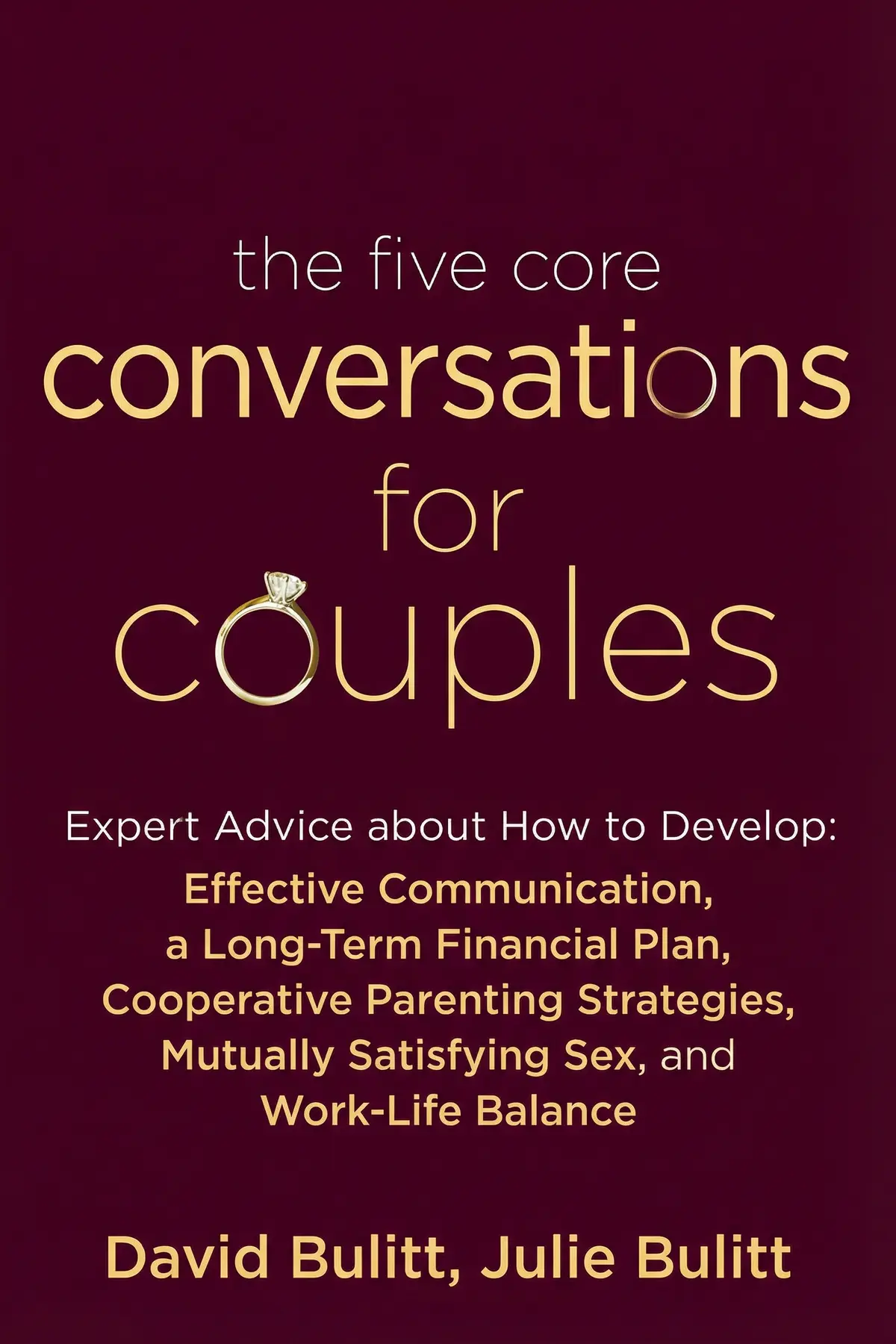
Busy couples rarely break up over one big fight. They drift, one skipped evening and one unspoken worry at a time, until the distance feels normal. In The Five Core Conversations for Couples, family therapist Julie Bulitt and her husband David Bulitt, a divorce lawyer who has spent decades with couples in crisis, argue that the drift can be stopped by talking on purpose.
In the Bulitts’ view, couples rarely fail for lack of love but for lack of the right conversations, started early and kept going. They name five: how you stay connected, how you handle money, how you raise children, how you share intimacy and how you keep your lives in balance.
Each one comes with habits small enough to try this week, from a standing date with no children or chores to a single question that stops a pointless argument before it starts.
1 min 39 sec
A couple walked into a therapist’s office sitting as far apart as the room allowed. A few weeks later they walked back in holding hands, and the change that did it was smaller than you might expect.
1 min 39 sec
The Bulitts give two rules for anger that seem to contradict each other. One forbids silence, the other demands it, and a road trip with a full bladder shows exactly where the line between them falls.
1 min 52 sec
A divorce lawyer lists money among the four main reasons couples end up in his office. The traps he describes are ordinary ones, including a purchase that feels perfectly fair and a neighbor’s new vehicle.
1 min 41 sec
Children are quick to spot the gap between what one parent said and what the other allowed. The Bulitts explain why closing that gap matters long before the real crises of family life arrive.
1 min 33 sec
One partner is ready for romance while the other wants only sleep. The Bulitts argue that how a couple talks about that moment matters as much as what happens next, and they name one thing never to do.
1 min 46 sec
A relationship can feel level even when it is loud, and a strong couple sometimes needs to spend evenings apart. The Bulitts explain what balance asks partners to add, and what it asks them to give each other.
1 min 17 sec
The Bulitts open their book with an image: two people at 75 on a front porch, hands wrinkled, telling each other they made it. Their argument is that such an ending is built decades earlier, in ordinary talk. A divorce lawyer and a couples therapist see the same thing from opposite doors. Couples who end up apart usually knew about the distance, the money worries or the clashing rules, and kept postponing the conversation.
That makes the method unglamorous, and within reach of anyone. None of the five conversations needs special skill. Each one needs a couple willing to say the awkward thing early, then keep coming back to it as life changes.
If you take one step from the book, make it the one that helped Sarah and Ron: put a regular activity for just the two of you on the calendar, with no children and no chores. Before the next large purchase or spending cut, decide it together. And the next time an I told you so is ready on your tongue, ask whether it would change anything at all.
Nobody reaches that porch by accident. Couples talk their way there, one honest conversation at a time.
Most couples do not split over one dramatic event. They drift. Busy schedules crowd out time together, money worries go unspoken, parents contradict each other in front of the children, and the distance starts to feel normal. By the time anyone acts, repair is much harder. David Bulitt, a divorce lawyer, and Julie Bulitt, a couples and family therapist, see this pattern from opposite sides of the same problem. Their answer is a set of five deliberate conversations: keeping the connection alive, agreeing on money, presenting a united front as parents, talking openly about sex and affection, and balancing attention with breathing room. The advice is concrete and small enough to use this week: a standing activity with no children or chores, no spending cuts without a joint decision, shared rules on screen time and discipline, a gentle way to say no in bed, and evenings with friends that bring fresh energy home. Readers get a practical map of the topics that tend to break couples apart, and a way to talk about each one before it does.
Busy partners with jobs and young children who have stopped making time for each other.
Couples who argue about spending, parenting rules or mismatched desire and want calmer ways to raise them.
Newly committed partners who want to talk through money, children and intimacy before problems start.
David Bulitt is a divorce lawyer in the Washington DC area who has worked with couples going through hard times for over forty years; he has also written two novels. Julie Bulitt is a couples and family therapist whose private practice includes ADHD and executive functioning coaching. She spent a decade as an adoption therapist and served as in-house therapist for The Discovery Channel. Married with four daughters, they also wrote Secrets of Strong Couples and Intentionally Us and host the podcast Conversations for Couples.
Listeners find the book’s suggestions and perspectives highly beneficial, with one noting it is full of practical tips for couples. They also enjoy the humor, accessibility, and caliber of dialogue, with one listener highlighting how it effectively serves to jumpstart discussions. Furthermore, the work is commended for its authenticity through real-life examples, and listeners prize its relatable material and overall utility.
Wow, the raw honesty in the parenting section, specifically the letters to their daughter struggling with addiction, really gutted me. It is rare to find relationship experts who are willing to show their own failures so transparently. This book moves beyond theory into the messy reality of staying together for over thirty years. The 'Five Cores' framework—covering connection, money, parenting, intimacy, and balance—is a practical roadmap for any couple. I found the advice on maintaining a 'united front' with kids to be a game-changer for my own household. Truth is, relationships require constant maintenance, and the Bulitts provide the tools to do the work without making it feel like a chore. The humor sprinkled throughout makes the heavier topics easier to digest. This is an essential read for anyone who wants to move past surface-level talk and get into the deep stuff that actually keeps a marriage alive.
Show moreEver wonder how a couple stays together when they spend their workdays dealing with broken families and messy divorces? The Bulitts share their secret sauce in this book, and it’s mostly about having the courage to have difficult conversations. I loved the focus on 'Core #2: Money Matters.' It’s such a taboo topic, but they break it down into manageable discussions about spending habits and mutual understanding. The writing is incredibly relatable and lacks the stuffy, academic tone found in most psychology books. Frankly, it felt like sitting down for coffee with a couple who has seen it all and isn't afraid to tell you the truth. The advice on intimacy was also refreshing—honest, funny, and void of the usual clichés. If you want a book that feels like real life rather than a textbook, this is the one for you.
Show moreFinally got around to reading this, and I have to say, the 'Five Cores' are spot on for jumpstarting stagnant conversations in a marriage. The authors have a way of making you feel like you aren't alone in your frustrations, whether it's about money or the lack of time for connection. The 'booty budget' humor aside, the section on intimacy was actually quite profound in its focus on emotional safety. I loved the advice about not treating your partner like a ghost during arguments—communication is everything. The book is very readable and doesn't feel like 'work' to get through. It’s an authentic look at the building blocks of a thriving relationship. We’ve already started using the questions at the end of the chapters for our date nights, and it’s been really helpful for us to get back on the same page.
Show moreThis book isn't your typical clinical manual, and that's probably why I actually finished it. David and Julie Bulitt bring a unique 'he said, she said' dynamic that feels incredibly authentic because they are actually living the advice they give. The contrast between a divorce lawyer’s cynicism and a therapist’s empathy creates a balanced perspective on the five core pillars of a relationship. I particularly enjoyed the section on intimacy; the 'booty should not be on a budget' line had me laughing out loud, but the underlying message about communication was solid. Some of the personal anecdotes felt a little long-winded, and the transitions could be smoother. However, the questions at the end of each core section are excellent for jumpstarting stagnant discussions with your partner. It’s a readable, relatable guide that doesn't take itself too seriously while still tackling heavy topics like financial 'CYA' strategies and parenting struggles.
Show morePicking this up felt like a gamble, but the conversational tone made the 'homework' sections much easier to digest than I anticipated. The authors don't pretend to be perfect, which is the book's greatest strength. They talk about their struggles as parents and the reality of keeping the spark alive after decades of marriage with total authenticity. I especially liked the concept of 'Core #5: Balance.' It reminded me that having 'me time' and maintaining outside friendships is actually healthy for the relationship, not a sign of pulling away. Some of the dialogue scripts felt a bit repetitive, and the profanity might turn some readers off, but the core messages are vital. It’s a great way to jumpstart discussions that most of us are too scared or too busy to have. Highly recommended for couples who feel like they're just roommates lately.
Show moreAs someone who usually avoids the self-help aisle, I found the Bulitts' approach surprisingly refreshing and easy to read. The book is packed with practical tips that you can actually use tonight, rather than abstract theories that sound good on paper but fail in practice. I really appreciated the real-life cases they shared from their professional lives; it was eye-opening to see how common these 'core' issues really are. The lawyer/therapist dynamic provides a 360-degree view of why marriages fail and what makes them succeed. My only gripe is that I wish the advice was more integrated into the stories themselves rather than saved for the end of the chapters. Still, the authenticity shines through. It’s a helpful, humorous, and sometimes heartbreaking look at what it takes to make love last in the real world.
Show moreAfter hearing a lot about this duo, I decided to see if a divorce lawyer and a therapist could actually agree on anything regarding marriage. The book offers some interesting perspectives on power dynamics, like the idea of taking turns 'driving' the relationship or knowing how to do each other’s household jobs. It’s definitely an engaging read, but the banter between David and Julie occasionally feels a bit too performative. Some of the stories were a bit 'meh' and didn't seem to lead to a clear takeaway. I did appreciate the financial section; looking at money through the lens of a divorce lawyer provides a dose of reality that most marriage books ignore. Is it life-changing? Maybe not for everyone, but it’s a decent resource for couples who need a push to start talking again. It’s a bit rough around the edges, but the heart is in the right place.
Show moreNot what I expected based on the subtitle’s promise of expert advice from a lawyer and a therapist. To be fair, the authors are clearly experienced in their fields, but this book reads more like a transcript of a long, occasionally bickering dinner conversation. There is a lot of profanity and what I’d call crass language that felt unnecessary and frankly unprofessional for a self-help resource. Instead of structured guidance, you get a mountain of personal stories about their kids and their own marriage. I don't feel like I need to know the intimate details of a stranger's life to learn how to communicate with my spouse. While the end-of-chapter questions offer some utility, the bulk of the text lacks the 'how-to' depth I was looking for. If you prefer the evidence-based approach of someone like John Gottman, this irreverent style will likely grate on your nerves.
Show moreThe structure of this book just didn't click for me at all. While I appreciate the transparency, it felt like there was way too much personal anecdote and not nearly enough actionable strategy. You're basically reading long stretches of dialogue between the authors, and I found myself skimming to get to the actual advice. I was hoping for more 'expert' insights from the divorce lawyer side especially, but it felt very anecdotal. Also, the use of profanity felt forced and didn't really add anything to the content. To be fair, the five core topics are the right ones to focus on, but the delivery method was distracting. It felt more like eavesdropping on a marriage than learning from professionals. I think there are much better books out there for couples who are actually in the trenches and need specific, guided help.
Show moreLook, if you want John Gottman, go buy John Gottman. This book was a massive disappointment for me because it felt more like an unfiltered memoir than a professional guide. The disrespect and irreverence they show toward each other in their 'banter' was actually painful to read at points. I found the language to be quite off-putting and crude, which I don't think belongs in a book intended to help couples build better lives together. Aside from the lists of questions at the end of the sections, there isn't much 'expert' advice here. It’s mostly just them recounting their own arguments and experiences. I didn't find their personal stories particularly helpful for my own situation, and the lack of a clear 'how-to' structure made it hard to follow. I wouldn't recommend this if you're looking for a serious, respectful approach to relationship counseling.
Show moreDavid and Julie Bulitt argue that lasting relationships depend on deliberate, ongoing conversations in five areas: staying connected, handling money, parenting, intimacy and balance. In their experience as a divorce lawyer and a couples therapist, partners often see trouble coming but postpone the talk until repair is harder. Their advice is to raise each topic early, honestly and repeatedly, with small habits that keep the relationship tended.
Start early, especially if you grew up with different attitudes to spending, and set ground rules about what the household will and won’t buy. Avoid matching your partner’s purchases out of fairness and buying out of envy of the neighbors. Agree on how many children you want, make every spending cut a joint decision, keep each other informed about savings and debts, and raise irritating spending habits before they harden.
The Bulitts reject the silent treatment: if you are upset, say so, because ignoring a partner deepens the disconnect. But they also advise silence when your words would change nothing, as with an I told you so on a road trip. Avoid topics you know will set your partner off, take care with criticism, and trust that the two of you can handle hard times together.
Share the load, so a worn-out parent can step back and recover while the other takes over. Clean up the problems you create yourself. Most of all, agree on key rules such as screen time and discipline in advance, so children cannot play one parent against the other. That united front also prepares a couple for harder challenges such as addiction, religious changes or mental health problems.
It suits couples who feel the distance growing under the weight of work and children, partners who keep clashing over money or parenting rules, and those whose physical intimacy has become a source of tension. It also helps new couples who want to talk through the big topics before trouble starts. The advice is practical, from scheduling time alone together to softening a no in the bedroom.
AUDIO SUMMARY AVAILABLE
Get the key ideas from The Five Core Conversations for Couples by David Bulitt, plus 5,000+ more nonfiction titles.