
13 min 43 sec
Available in: English
The Earned Life: Lose Regret, Choose Fulfillment
Shows why reaching your next goal rarely brings lasting happiness. Offers a present-focused way to find fulfillment by re-earning what matters every day, with simple exercises for choosing aspirations that fit who you are.
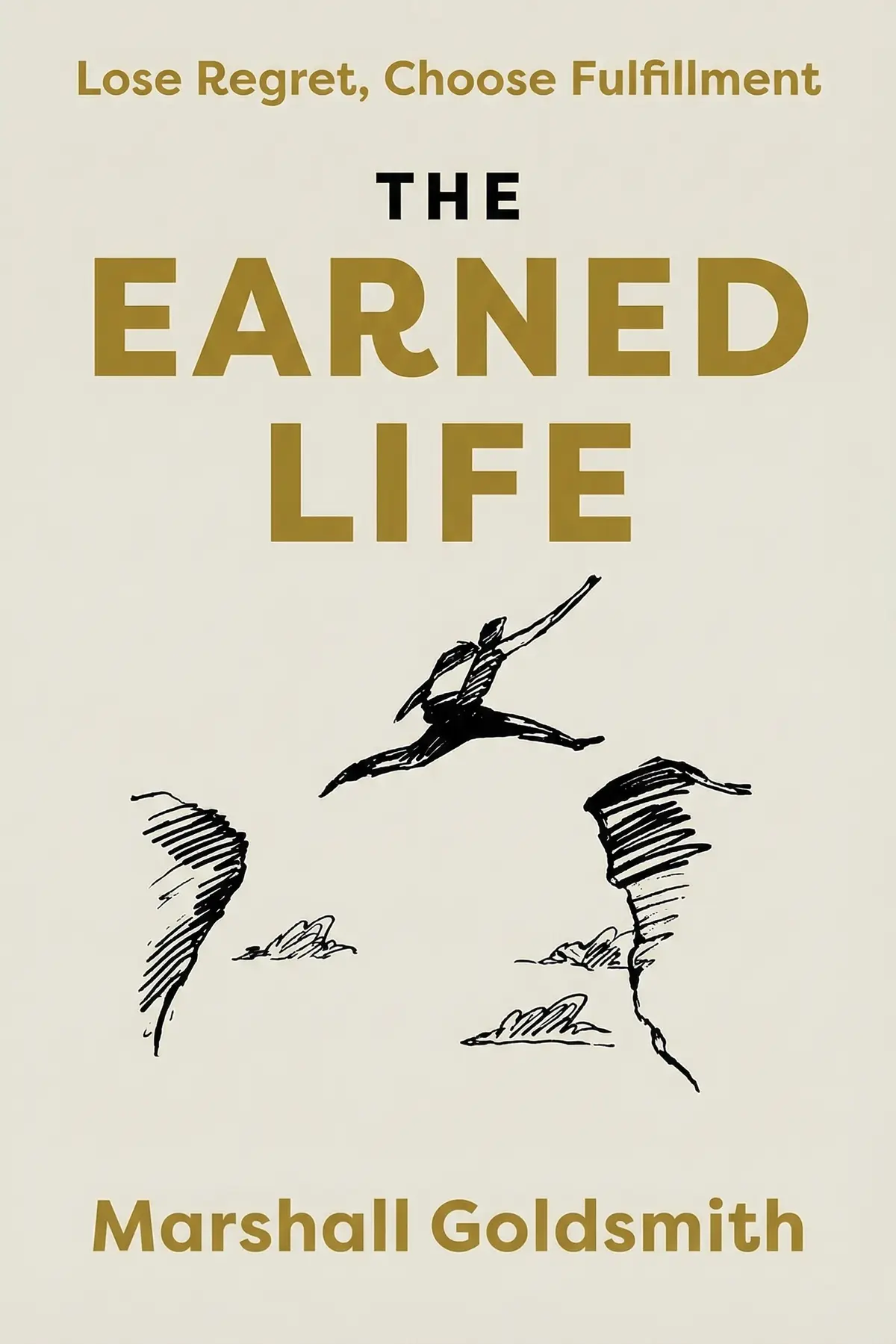
Table of Content
1. Introduction
1 min 00 sec
Most of us run on a promise that we will be happy once we land the promotion, the raise or the dream house, and most of us find the feeling gone soon after we arrive. In The Earned Life, executive coach Marshall Goldsmith argues that the fix starts with an old Buddhist idea: nothing lasts, and the only real moment is the present. Goldsmith, who has advised more than 200 major CEOs, does not ask anyone to convert. He asks readers to try the Buddha’s view as a thought experiment and see what it changes.
What it changes is the meaning of success. If achievements, reputation and even love can all fade, then none of them is something you own. They have to be earned again, day after day, so fulfillment stops being a finish line and becomes the way you choose right now. Goldsmith backs this with practical tools: two letters to write, one disarmingly simple question to ask, and a list of opposites that reveals which aspirations actually fit you.
2. Stop chasing the goal that keeps moving
1 min 47 sec
The house, the title, the raise: each one was supposed to settle things for good. An ancient teacher had a name for people caught in this loop, and it is not a flattering one.
3. Accept that nothing you earn stays earned
1 min 35 sec
Impermanence sounds like the worst possible news for anyone who has worked hard to build something. Goldsmith turns it into a reason to act, and a release from the past at the same time.
4. Thank your past self, then invest forward
1 min 56 sec
A vegan diet, a college choice and a childhood habit with a dictionary all turned out to matter decades later. Two short letters can reveal the hidden links in your own life.
5. Settle big decisions with one basic question
1 min 59 sec
The questions people ask about their lives are usually so large they cannot be answered in a lifetime. Goldsmith’s clients get unstuck with one so obvious that almost nobody thinks to ask it.
6. Choose aspiration over ambition for lasting fulfillment
2 min 10 sec
Winning the promotion or finishing the marathon feels wonderful, then strangely hollow. A philosopher’s look at becoming a parent explains which kind of goal keeps giving, and why it never quite gets finished.
7. Choose aspirations that fit who you are
1 min 55 sec
A Turkish designer would take just one creative tool to a desert island. Turned on your own personality, the same tool shows which aspirations you will keep working for and which you will quietly drop.
8. Conclusion
1 min 21 sec
The Earned Life asks readers to give up a comfortable idea: that somewhere ahead there is a point where the work is done and happiness can be kept. Goldsmith’s borrowed Buddhist lens shows why that point never arrives. Achievements fade, reputations need tending, and love has to be returned again and again. If nothing is permanent, then every ordinary day counts, and today’s effort matters more than the result you were waiting for.
That is Goldsmith’s own definition of an earned life: one where each moment’s choices and effort line up with a larger purpose, whatever the eventual result.
The tools for living it are modest. Write the two letters, one thanking the past self who did the work and one telling your future self what you are investing in now. When a big decision feels tangled, swap the vast question for a basic one, such as where you actually want to live, and follow it through every practical detail. Then build your list of opposites, cross out what does not fit and show it to someone who knows you well.
The hungry ghost keeps hunting for the next meal. The earned life notices that the effort itself is the meal, and it is served today.
About this book
What is this book about?
Many capable people live by a quiet promise: they will be happy once they get the promotion, the raise or the dream house. Then they arrive, the feeling fades, and a new target appears. Marshall Goldsmith, an American executive leadership coach who has advised more than 200 major CEOs, calls this a distorted view of happiness, and he offers an old alternative. Borrowing the Buddhist teaching that nothing lasts and only the present is real, Goldsmith asks readers to treat it as a thought experiment. If everything you value can fade, then none of it is a possession. Success, a good name and the love of others all have to be re-earned, every day. Fulfillment becomes the way you make choices now, not a prize waiting in the future. The book turns that idea into practice. Readers write a thank-you letter to their past self and a letter of intent to their future self. They learn to cut through big decisions with basic questions, to choose aspiration over ambition with help from philosopher Agnes Callard, and to use a designer's tool, dichotomy resolution, to find the aspirations that suit their personality.
Book Information
Who it's for
Professionals whose satisfaction faded
Professionals who reached a big goal and felt the satisfaction fade within weeks.
Stuck on big decisions
People facing a major life decision, such as a move or career change, who feel stuck in endless questions.
Hoping to grow calmly
Leaders and achievers who want a calmer, present-focused way to keep growing.
About the Author
Marshall Goldsmith
Marshall Goldsmith is an American executive leadership coach and author, born in 1949, who has advised more than 200 major CEOs and their management teams. He has written or edited 41 books, which have sold more than 2.5 million copies in 32 languages, including Triggers and What Got You Here Won't Get You There. He taught management practice at Dartmouth's Tuck School of Business, holds a Ph.D. from UCLA's Anderson School of Management and is a member of the Thinkers 50 Hall of Fame.
Ratings & Reviews
Ratings at a glance

What people think
Listeners find this work to be transformative and intellectually stimulating, valuing the impactful suggestions and quality illustrations provided throughout. It is characterized as essential listening, featuring compelling narratives that lead the audience toward a life of genuine satisfaction and no remorse. The presentation earns praise, with one listener pointing out its methodical, step-by-step guidance. Listeners appreciate how genuine the book feels; one review emphasizes the inclusion of real-life examples, while another listener points to the functional methods for attaining a more rewarding existence.
Top reviews
Suwit
Wow. I didn't expect a business coaching book to dive so deeply into Buddhist principles of impermanence. Goldsmith argues that we need to stop being 'hungry ghosts' chasing the next promotion and instead focus on earning our fulfillment every single day. The idea that we are a new person with every breath is liberating yet demanding because it means our past achievements don't excuse us from trying today. I found the distinction between ambition and aspiration particularly helpful for my current career transition. While some anecdotes about high-flying CEOs felt a bit distant from my reality, the core message about aligning our daily effort with a higher purpose is universal. It’s a profound shift from the typical Western achievement treadmill we are all stuck on. If you’re feeling successful but empty, this is the manual you need to read right now.
Show moreWanphen
Marshall Goldsmith's voice shines through in every chapter, making this feel like a personal coaching session rather than just another business book. His exploration of regret as the 'devilish cocktail of agency and imagination' is one of the most poignant things I’ve read this year. He argues that regret is the polar opposite of fulfillment, and that really stuck with me as I re-evaluated my daily habits. The concept of 'running out of runway'—the time we have left to achieve our destiny—added a necessary sense of urgency to my planning. To be honest, the book is worth it just for the insights into creating a life that you are constantly earning rather than just having. It is authentic, deeply thought-provoking, and packed with riveting stories that illustrate his points beautifully. Truly a must-read.
Show moreCharlotte
This book provides a riveting look at why constant achievement doesn't always lead to lasting fulfillment. Goldsmith is brutally honest about the traps of goal obsession and how it can lead us to neglect the very people we claim to be working for. His advice to attach our 'earning moments' to something greater than personal ambition is something I desperately needed to hear. The section on parental programming and how it shapes our self-image was particularly eye-opening for me personally. I gotta say, the distinction between being competent and being recognized for it was a tough but necessary pill to swallow. While the book can be a bit repetitive at times, the overall message is powerful and deeply rewarding. It’s a life-changing read if you’re actually willing to do the exercises and confront the truths they reveal.
Show moreStella
Picked this up on a whim, and I've gotta say, the 'Action, Ambition, Aspiration' framework is a total game-changer for organizing your life goals. Most self-help books conflate what we do with who we are, but Marshall separates them in a way that finally makes sense to me. The exercise where you write a letter to your past self was surprisingly emotional; it forced me to recognize how much I've actually earned already. To be fair, the writing can feel a bit repetitive in the middle chapters, but the step-by-step guidance usually keeps things moving. I appreciated the simple elegance of his anecdotes, which avoid being ego-driven and instead serve the greater purpose of the lesson. It’s a solid 4-star read that offers more concrete help than your average hustle-culture manifesto.
Show morePraepimon
After hearing so much buzz about this, I finally dove into the sections on 'referent groups' and how they influence our behavior. It’s fascinating to realize how much we do just to impress people we might not even like or respect. The book pushes you to define your own version of success rather than living someone else’s version of it. I personally found the discussion on inertia to be the most relatable part; staying the course is often just a default response rather than a choice. Truth is, some of the CEO stories felt a bit repetitive, but the 'Life Plan Review' questions at the end are gold. This is a practical approach to living a more fulfilled life that emphasizes accountability and measurement. It’s sensible advice that actually feels achievable if you’re willing to put in the hard work.
Show moreSun
The chapter on dichotomy resolution alone made this entire book worth the price of admission for me. As someone who struggles with making decisions, the idea of resolving 'either/or' quandaries to find a realistic aspiration was incredibly helpful. Goldsmith’s step-by-step guidance is clear, even if the concepts sometimes lean heavily on abstract philosophy. Look, we make 35,000 decisions a day, and this book provides a framework to filter out the noise and focus on the consequential ones. I did find the sections on specialization a bit contradictory to other personal development advice I've read, but his 'One Trick Genius' model makes a compelling case. The tone is encouraging but firm, reminding us that nobody is self-made and we must ask for help. It’s a well-thought-out guide that I’ll likely revisit when I hit my next major transition.
Show moreKiattisak
Finally got around to reading this, and the focus on 'earning' your life every single day really resonated with my current mindset. We often think of happiness as a destination, but Goldsmith argues it’s a process of constant alignment between our efforts and our purpose. The building blocks of discipline—compliance, accountability, follow-up, and measurement—provide a solid structure for anyone trying to break out of a rut. I’ll admit that some of the specific advice on marketplace potential felt a little thin for those of us not in traditional business roles. Still, the emphasis on building support networks and community is a vital reminder that we can’t go it alone. The book is authentic and filled with real-life examples that make the high-level concepts feel much more tangible. It’s a strong addition to any self-improvement library.
Show moreGioia
Ever wonder why you hit all your targets but still feel like something is missing? Goldsmith tackles this by looking at how our choices and risks must align with an overarching purpose to create a truly earned life. I really resonated with the Peter Drucker quote about our mission being to make a positive difference. However, I felt the book glossed over how to determine if there’s a real market for your unusual ambitions. It’s terrifying to think your vision might just be garbage to the rest of the world, and I wanted more guidance there. Frankly, the first portion felt a bit stale, covering motivation and confidence in ways I've seen in other tomes. But the latter half’s focus on support networks and productive habits salvaged the experience for me.
Show moreIce
Not what I expected from a top-tier executive coach, as it leans much more into social psychology and Buddhist wisdom than corporate strategy. While I enjoyed the comparison between ambition and aspiration, I found the book at odds with other works on regret I've enjoyed lately. Specifically, his view that regret is entirely within our control felt a bit oversimplified compared to the more nuanced views found in modern psychology. To be fair, the 'Action-Ambition-Aspiration' model is very elegant and provides a great lens for evaluating where you are spending your energy. The writing style is accessible, though the pacing can be a bit slow when he dives into the theory of impermanence. I’d recommend it for the exercises, particularly the one regarding your future self, which helped me clarify my long-term goals.
Show moreWichai
As someone who has read a lot of self-help, I found the first part of this book to be a bit of a retread. The information on motivation and confidence covers fairly familiar ground for anyone who has picked up a business book in the last decade. However, the latter half delivers much more concrete help regarding how to connect your daily efforts to your overarching aspirations. Not gonna lie, his advice on asking for help is something most of us high-achievers ignore to our own detriment. The idea that we must re-earn our reputation and achievements every day is both terrifying and motivating. I appreciated the specific techniques for creating productive habits, even if the tone felt a little too corporate at times. It’s a useful toolkit for anyone looking to make a positive difference in their own life.
Show moreQuestions about this book
What is the main idea of The Earned Life by Marshall Goldsmith?
Goldsmith argues that chasing goals in the hope of permanent happiness leaves us like hungry ghosts, never satisfied. Borrowing the Buddhist teaching that everything is impermanent, he says achievements, reputation and love are not possessions but things we must re-earn every day. An earned life, in his definition, is one where each moment’s choices and effort match a larger purpose, whatever the outcome.
What are the two letters in The Earned Life?
The first letter thanks your past self for something you earned through discipline, creativity or hard work. Goldsmith’s clients thanked themselves for going vegan, choosing a college where they met a spouse, or a childhood habit of looking up new words. The second letter goes to your future self and lists what you are investing in now, from career and skills to health and relationships.
What does Goldsmith mean by basic questions?
Basic questions address one single factor, such as Will this work, Can I afford this, or Do you love him. Big questions like what would make me happy can take a lifetime to answer, while basic ones force honest, clear answers. Goldsmith finds one especially useful for clients deciding their next step: where do you want to live? Following it through practical details reveals real priorities.
What is the difference between ambition and aspiration in The Earned Life?
Drawing on philosopher Agnes Callard, Goldsmith describes ambition as a set of targets, like a promotion or a marathon, whose happiness fades soon after you reach them. Aspiration is a gradual process of coming to care about new things, like becoming a parent, which is never finished. Because it keeps you growing in the present, Callard sees aspiration as the more fulfilling path.
How can I apply The Earned Life to my own goals?
Start with the two letters to your past and future selves. For a hard decision, ask one basic question, such as where you want to live, and work through the details. Then use the dichotomy exercise: list pairs of opposites, cross out those that do not matter to you and the side that does not fit, and check the result with someone who knows you well.

Readers also enjoyed

59 Seconds: Change Your Life in Under a Minute
Richard Wiseman





A Guide to the Good Life: The Ancient Art of Stoic Joy
William B. Irvine


A High-Performing Mind: Strengthen Your Mind and Live Your Best Life
Andrew D. Thompson


Abundance: The Inner Path to Wealth
Deepak Chopra
AUDIO SUMMARY AVAILABLE
Listen to The Earned Life in 15 minutes
Get the key ideas from The Earned Life by Marshall Goldsmith, plus 5,000+ more nonfiction titles.
- 5,000+ titles
- Listen as much as you want
- 7-day free trial
- Cancel anytime









