
14 min 49 sec
Available in: English
 ไทย
EnglishไทยWhat Got You Here, Won’t Get You There: How Successful People Become Even More Successful!
Shows high achievers which everyday habits quietly cost them trust, talent and promotions, and gives a practical way to spot those habits through feedback and change them so colleagues actually notice.
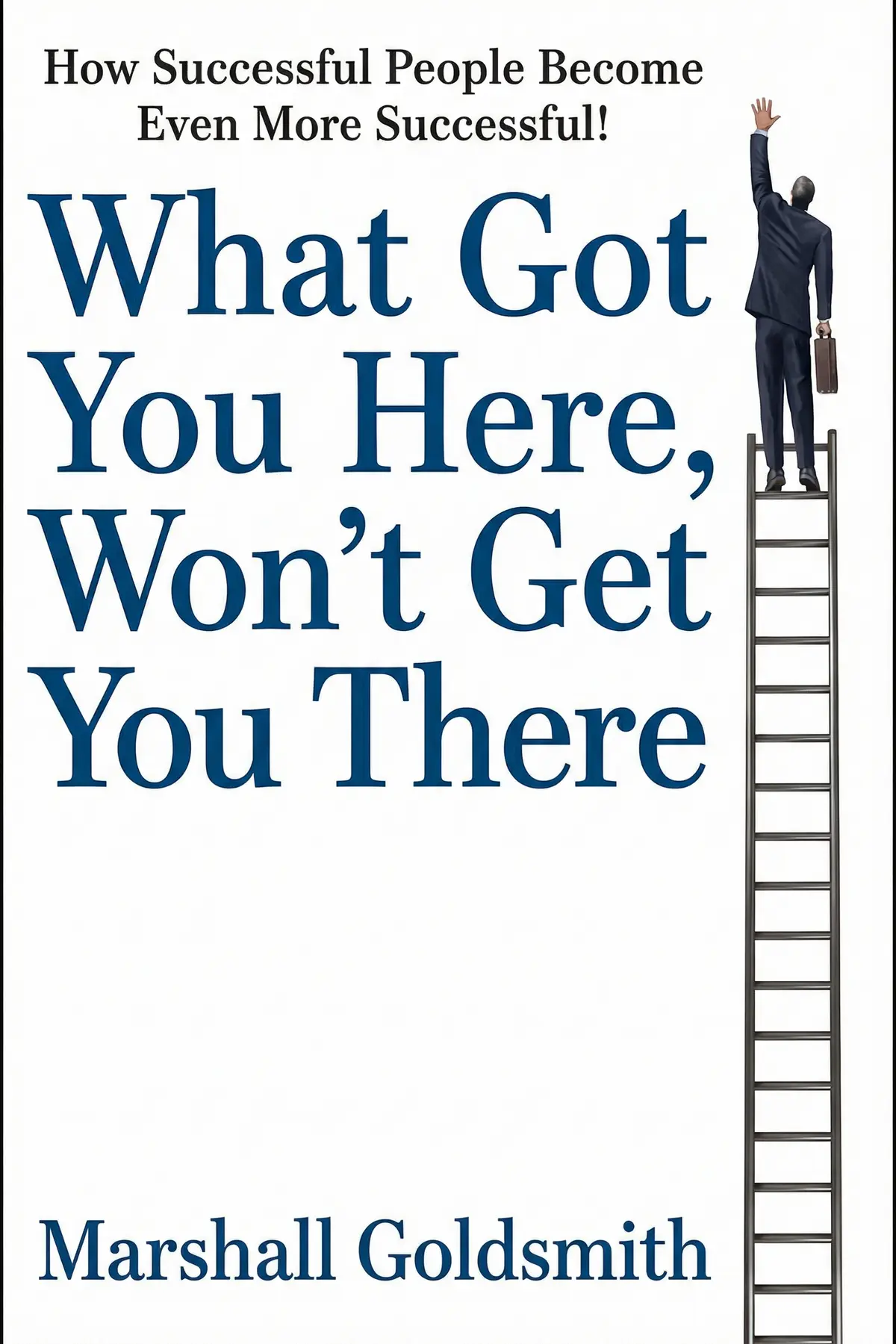
Table of Content
1. Introduction
58 sec
Many high achievers carry habits that annoy the people around them, and many are proud of those habits, sure they are part of why they won. In What Got You Here, Won’t Get You There, executive coach Marshall Goldsmith argues that those flaws are usually what will block the next promotion, the next deal or the next good hire. His blunt message to the leaders he coaches is that they probably succeeded despite some of their behavior, not because of it.
The habits that matter at the top are rarely technical. They concern how you treat people: needing to win, adding your touch to every idea, holding back praise, skipping the apology. Each one can be spotted and changed, but only with help from the people who see it every day. Ahead are a way to find your own blind spots, a few plain words that repair relationships, and a method for making colleagues believe the change is real.
2. Stop crediting your flaws for your success
1 min 51 sec
A brilliant executive believed his worst habit was protecting his creativity. His colleagues had simply given up talking to him. The story shows how success can trick capable people into defending exactly what will trip them later.
3. Chasing the target too hard can spoil the outcome
1 min 58 sec
Seminary students on their way to preach about kindness walked straight past a man in distress. A star marketer lost her best people. Both stories point to the same hidden cost of caring too much about results.
4. Let the small contests go
1 min 36 sec
A disappointing dinner at a restaurant your partner picked becomes a test most successful people fail. Goldsmith asks his clients what they would do, and their answers reveal a reflex that follows them home from work.
5. Praise an idea without taking it over
1 min 43 sec
A CEO made one small comment about packaging colors, then another, and his design team left the room deflated. The lesson concerns what happens to any suggestion once it comes from the person in charge.
6. Catch the feedback people already give you
1 min 49 sec
Three business partners were asked how much of the firm’s profit each one produced, and their numbers could not possibly be true. The gap between how we see ourselves and how others see us is wider than we think.
7. Say sorry and thank you, and mean both
1 min 52 sec
A government official faced grieving families and took the blame in three short words. A sudden drop on a flight left Goldsmith with a list of people he had never thanked. Both reveal the strength in plain courtesy.
8. Make your change visible so others notice it
1 min 52 sec
You can improve for months and still be seen as the old you. A New York mayor found a way around that problem with one short question, asked again and again until it became a slogan.
9. Conclusion
1 min 10 sec
Goldsmith’s book carries an uncomfortable message for anyone who has done well: the person who earned your current position is not quite the person who will earn the next one. The drive to win, the sharp opinions and the fixation on targets got you noticed. Left unchecked, they produce an executive nobody bothers to talk to, a manager whose best people leave, a CEO whose passing remark about the color blue leaves his designers unsure what he wants.
None of it is fixed. These habits are behaviors, and other people see them long before we do. That makes the people around you the best mirror you have. For a few days, write down the offhand remarks people make about you and look for the one that keeps returning. Choose a single habit to work on, then ask the people it affects, every month, whether it is getting better. Along the way, apologize without excuses and thank people while you still can.
Goldsmith’s frightening flight ended safely, and he came away with a list of people he owed thanks. It is a list worth starting before any turbulence.
About this book
What is this book about?
Many successful people carry habits that irritate the people around them: needing to win every point, improving every idea they hear, holding back praise, refusing to apologize. Worse, they often believe these habits helped them succeed. Marshall Goldsmith, an executive coach who has worked with top leaders, argues that most of these behaviors are obstacles to the next level of success. Goldsmith traces many of them to goal obsession, a focus on results so narrow that judgment slips, and to a blind spot about how we come across. His examples range from a CEO who changed his mind about packaging colors to a famous experiment with hurrying theology students, a merger that nearly ruined Time Warner and a mayor of New York who kept asking voters how he was doing. Readers get concrete tools: a daily log of offhand remarks that reveals patterns, a test for when a suggestion becomes a takeover, plain apologies and sincere thanks, and a monthly feedback routine that makes colleagues see the change for themselves.
Book Information
Who it's for
Leaders with silent teams
Managers and executives whose results are strong but whose teams have stopped speaking up.
Aiming for a promotion
Ambitious professionals aiming for their next promotion who suspect a habit is holding them back.
Wanting a feedback routine
Coaches and HR leaders looking for a practical feedback routine that makes behavior change visible.
About the Author
Marshall Goldsmith
Marshall Goldsmith is an American executive leadership coach who has advised more than 200 major CEOs and their management teams. He has written or edited 41 books, published in 32 languages, with more than 2.5 million copies sold. He taught management practice at Dartmouth's Tuck School of Business, holds a Ph.D. from UCLA's Anderson School of Management and is a member of the Thinkers 50 Hall of Fame.
The Earned Life: Lose Regret, Choose Fulfillment
Marshall Goldsmith
Triggers: Creating Behavior That Lasts – Becoming the Person You Want
Marshall Goldsmith
Ratings & Reviews
Ratings at a glance
What people think
Listeners view this title as an essential read for individuals in leadership, brimming with sagacious and reflective concepts that encourage them to analyze their daily interactions and shift their mental frameworks. Additionally, they value the actionable tips and clear-cut strategy that is easy to apply, regarding it as a significant tool for personal development that yields impressive results.
Top reviews
Siraporn
The transition from being a star individual contributor to a leader is rarely smooth. Goldsmith nails the reason why: the very traits that make you an expert—like your obsession with technical details—can actually sabotage your ability to lead others effectively. I appreciated the deep dive into 'adding too much value,' where your desire to improve an idea actually drains the ownership from the person who proposed it. In my experience, this is the most common mistake for new managers who can't stop tinkering with their team's output. The writing style is punchy and direct, which makes the hard truths easier to swallow. While some of the corporate anecdotes feel a bit 'old boys club,' the core behavioral science remains incredibly relevant today. It’s a profound piece of self-improvement that forces you to examine your daily interactions through a lens of humility. If you're stuck in your career, the problem might not be what you aren't doing, but what you refuse to stop doing.
Show moreWatcharee
Wow, I wish I had read this five years ago before I started managing a team. Most management books tell you what to do, but Goldsmith focuses on what to stop, which is much harder. The idea that people will only change if it is in their own best interest is a simple but powerful truth. I love the concept of the 'human Switzerland' where you treat every idea with complete neutrality. It’s a short, punchy book that doesn't waste time with unnecessary fluff. If you're looking to level up your people skills, this is the definitive guide.
Show moreSomboon
After hearing about this title for years, I didn't expect it to actually reshape how I talk to my family, not just my coworkers. The habit of starting with 'No, But, or However' is such a subtle way of shutting people down. Once you see it, you can't un-see it in every conversation you have. Frankly, the advice on practicing gratitude by saying 'thank you' instead of 'goodbye' is a small tweak that has already improved my relationships. Goldsmith’s straightforward approach is exactly what busy professionals need—less theory, more action. The book delivers amazing results by forcing you to take accountability for your own annoying behaviors. It’s easily one of the most influential management books I’ve read in a decade. Every page has a nugget of wisdom that makes you rethink your entire communication style.
Show moreYok
Finally got around to reading this staple of corporate life, and I feel personally attacked by Habit #4. Making destructive comments or sarcastic remarks just to seem witty is a trap I fall into way too often. The truth is, these habits are subtle success inhibitors that we justify as part of our 'authentic' personality. Goldsmith’s approach is refreshing because it isn’t about adding new skills to your plate, but about creating a rigorous 'to-stop' list. To be fair, some of the examples involving wives and assistants feel incredibly dated and a bit alienating to a modern reader. However, the advice on simply saying 'thank you' to all feedback—even the negative stuff—is a total game changer for professional growth. It’s practical, straightforward, and easy to act upon if you have the stomach for some ego-bruising. It’s a must-read for anyone who thinks they’ve already reached their peak.
Show moreGabriel
As someone who struggles with 'adding too much value' in every single meeting, this was a wake-up call I didn't know I needed. Goldsmith explains how a 5% improvement to someone’s idea can result in a 50% drop in their commitment to it. That math is staggering. The book is packed with these thought-provoking insights that immediately change how you view your daily encounters. I’ve already started catching myself before I say 'but' or 'however,' and the difference in my team's energy is palpable. Not gonna lie, the tone can be a bit repetitive, and the author clearly loves his own success stories. But if you can look past the ego, the practical advice is pure gold for career progression. It moves beyond abstract management theory and gives you a concrete roadmap for behavioral change. It’s a fast read that delivers amazing results if you're actually willing to listen to the feedback.
Show moreSkylar
This book doesn't offer a magic pill for success, but it does give you a very clear mirror to look into. Ever wonder why you’re hitting a ceiling despite being the smartest person in the room? Goldsmith suggests it’s probably because you’re constantly telling everyone how smart you are. The section on 'claiming credit' was particularly painful to read because it highlighted things I’ve done without even thinking. The writing is conversational and the advice is easy to implement starting today. I did find the focus on the executive suite a bit narrow, as these habits affect people at every level of an organization. Still, the emphasis on gratitude and active listening is universal. This is a profound piece of self-improvement that makes you think about how you show up for others. I'll be keeping this on my desk as a frequent reference for my 'to-stop' list.
Show moreIvan
Gotta say, I never realized how much I was alienating my peers just by starting sentences with the word 'but.' This book is full of these small, behavioral glitches that hold us back from true leadership. I appreciated the chapter on 'punishing the messenger,' which is something I’ve seen kill company cultures time and time again. To be fair, some of the author’s anecdotes feel a bit like he’s bragging about his social circle. But the core message—that your technical skills won't save you at the top—is undeniable. The advice on asking 'is it worth it?' before speaking is a simple tool that has saved me from numerous foot-in-mouth moments. It’s a must-read for those in management who are brave enough to ask for honest feedback. Even with the dated examples, the behavioral insights are top-notch.
Show moreFatima
Marshall Goldsmith manages to strip away the fluff that usually bogs down management literature. He gets right to the point: you are probably your own biggest obstacle. The concept of 'feedforward' instead of feedback is a brilliant way to handle workplace performance. It focuses on the future instead of litigating the past, which reduces defensiveness and actually gets people moving. I did take issue with the way he treats every day as a press conference where colleagues are waiting for you to trip up. That feels a bit paranoid and exhausting for a healthy work environment. However, the 20 habits he identifies are spot on for most high-achievers I know. It’s an easy-to-read guide that provides a clear path for anyone looking to refine their interpersonal skills. Definitely worth the time for the to-stop list alone.
Show moreChaiwat
While the central premise is brilliant, the book often feels like an extended advertisement for Goldsmith's coaching business. He constantly reminds the reader about his high-profile clients and the millions he gets paid, which gets a bit tiresome after the third chapter. To be fair, the '20 Habits' list is an excellent diagnostic tool for anyone in a leadership position. The chapter on 'passing judgment' hit home for me because it's so easy to impose our own standards on others without realizing it. Personally, I found the section on apologizing to be the most impactful part of the whole book. Many executives view an apology as a sign of weakness, but Goldsmith frames it as a strategic tool for rebuilding trust. It’s a solid 3-star read—great information, but you have to wade through a lot of self-promotion to get to the good stuff.
Show moreElan
Look, the advice on stopping bad habits is solid, but the delivery is stuck in a 1980s boardroom. I found myself increasingly frustrated by how the author describes women as 'moms who want it all' or focuses on their revealing outfits rather than their professional expertise. It is hard to take modern leadership advice seriously when the majority of female examples are relegated to secondary roles or treated as anomalies in a man's world. The book is essentially a guide for high-powered, aggressive men to stop being jerks to their subordinates. If you can filter out the blatant sexism and the repetitive name-dropping of Fortune 500 CEOs, there are some nuggets of wisdom regarding active listening. But frankly, in this day and age, we shouldn't have to sift through such an outdated worldview to find value. The core concepts are available in better, more inclusive books. This one needs a serious 21st-century update or it should just be retired.
Show moreQuestions about this book
What is the main idea of What Got You Here, Won't Get You There?
Marshall Goldsmith argues that many successful people succeed despite some of their habits, not because of them. Behaviors like needing to win, adding to every idea and withholding praise or apologies may seem harmless or even useful, but they hold people back as they rise. He traces many of them to goal obsession and to a blind spot about how we come across, and he offers feedback-based ways to change.
What is goal obsession according to Marshall Goldsmith?
Goal obsession is focusing so hard on a specific result that you lose sight of the bigger picture and your judgment slips. Goldsmith describes a high-performing marketing executive who took credit for her team’s wins and lost her best people. He also cites the Good Samaritan experiment, where 90 percent of hurrying theology students ignored a man in distress on their way to preach about helping strangers.
How can I get honest feedback about my own behavior?
Goldsmith suggests writing down every casual remark people make about you for several days, then labeling each one positive or negative until a pattern appears. One friend found the most common comment was that he repeated himself. For deeper input, he recommends confidential 360-degree feedback gathered by a third person, with reviewers asked to be truthful, supportive and focused on future improvement.
How do you make colleagues notice that you have changed?
Ask them. Goldsmith recommends checking in with coworkers every month for twelve to eighteen months and asking whether your behavior is improving. The question makes them watch for the effort, and over time they accept the change because they have confirmed it themselves. Ed Koch used the same approach as mayor of New York, asking people he met how he was doing.
Who should read What Got You Here, Won't Get You There?
It suits leaders and rising professionals whose results are good but whose relationships at work are strained, often without their knowing why. It also helps people who excuse habits with that’s just who I am. Its tools are small and concrete: pausing before winning a pointless argument, praising an idea without adding a but, apologizing plainly and thanking people sincerely.
Readers also enjoyed


A Bigger Prize: How We Can Do Better Than the Competition
Margaret Heffernan





A Year with Peter Drucker: 52 Weeks of Coaching for Leadership Effectiveness
Joseph A. Maciariello



60 Seconds & You’re Hired!
Robin Ryan
AUDIO SUMMARY AVAILABLE
Listen to What Got You Here, Won’t Get You There in 15 minutes
Get the key ideas from What Got You Here, Won’t Get You There by Marshall Goldsmith, plus 5,000+ more nonfiction titles.
- 5,000+ titles
- Listen as much as you want
- 7-day free trial
- Cancel anytime









