
15 min 07 sec
Available in: English
The Doomsday Machine: Confessions of a Nuclear War Planner
A former nuclear war planner shows how the American command system was built to launch fast with no way to call off a strike, how close the world came to ending humanity, and why such doomsday machines still need dismantling.
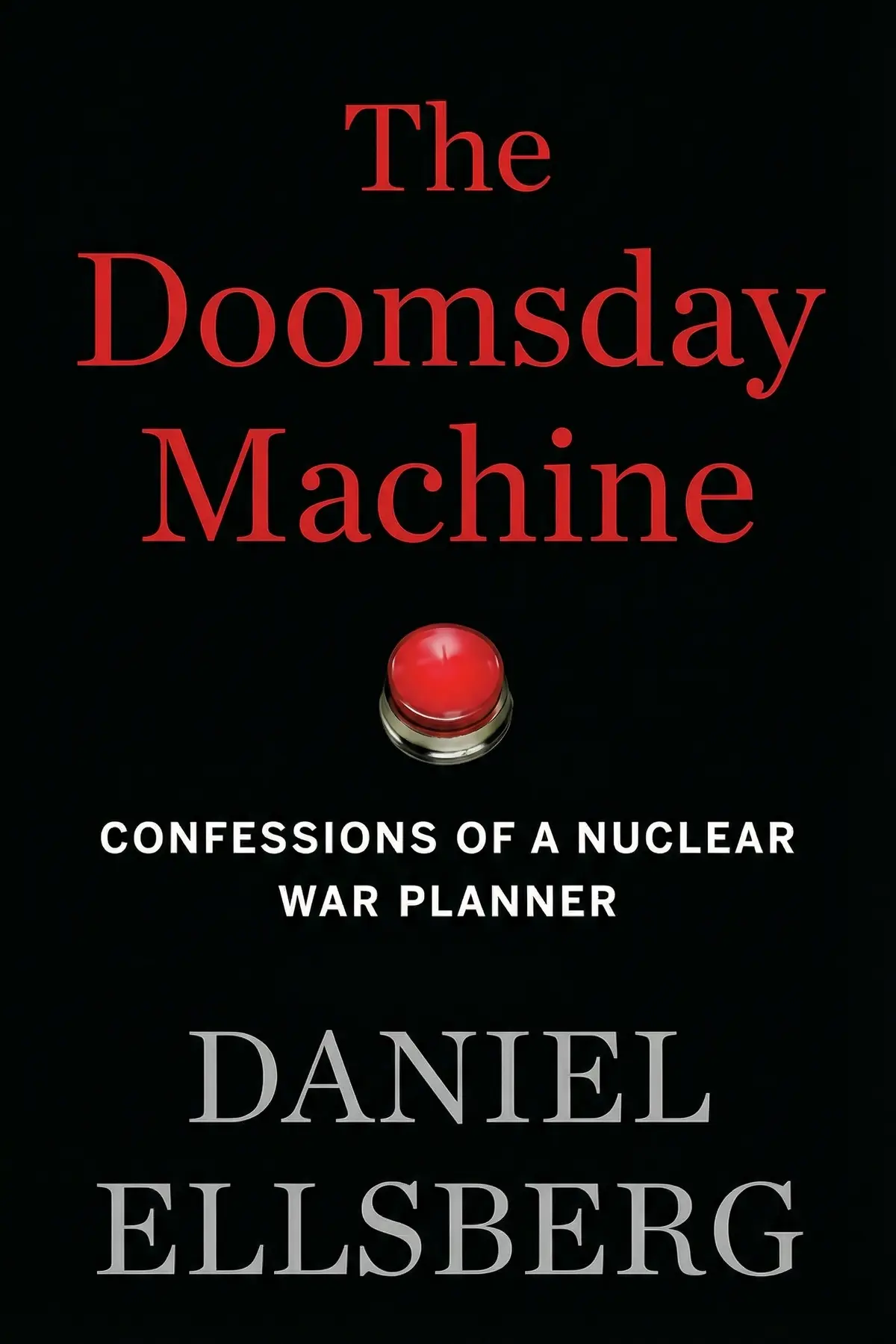
Table of Content
1. Introduction
1 min 02 sec
Most people picture nuclear war as a choice only a president can make, with a briefcase of codes always at his side. In The Doomsday Machine, former military analyst Daniel Ellsberg, who studied the American system from the inside, shows that picture was dangerously wrong. Officers far below the president could launch weapons, and once bombers were in the air, nobody could call them back.
His argument runs like this. The systems the United States and the Soviet Union built to prevent war were designed to strike fast, with restraint a distant second, and their planned attacks would have killed most of humanity. Those machines still exist, and Ellsberg believes only an informed public can take them apart. The story moves from bombed cities in the 1930s, through his years at the RAND Corporation, to a Soviet submarine in 1962. By the end, you will know how close the world came, how safety rules decay under pressure, and what ordinary citizens can do.
2. Trace how cities became fair targets in war
1 min 58 sec
Long before anyone split an atom, governments had already decided that ordinary people in their homes were legitimate targets. That earlier choice, made with planes and promises broken within months, set the stage for everything that followed.
3. The good intentions that built a deadly arsenal
1 min 53 sec
A ninth grader and a team of top scientists reached the same conclusion about atomic bombs: they would be a disaster. Both ended up helping the effort anyway, and the reason still shapes how dangerous ideas get built.
4. Learn the president's button was a comforting myth
1 min 51 sec
Two envelopes, two officers, one president: the safeguards looked solid on paper. Ellsberg spent seventy-hour weeks checking them against reality and found something far more alarming than anyone at the top seemed to know.
5. Three repairs that let a war be stopped
1 min 43 sec
When Ellsberg reported how far launch authority had spread, the people at the top reacted with shock or flat denial. What he proposed next became official policy, yet it left the deepest problem untouched.
6. Grasp the true cost of a first strike
1 min 40 sec
A document stamped for the president’s eyes only held the answer to a simple question about casualties. The figure was staggering, and it still left out the effect that would have finished the job.
7. A single refusal that saved the world
1 min 52 sec
During the most dangerous standoff of the Cold War, two superpower leaders both wanted peace. It almost did not matter, because the real decision had slipped out of their hands and into a place nobody was watching.
8. Turn public awareness into pressure to disarm
1 min 51 sec
Both major American parties oppose taking the system apart, and Ellsberg admits the goal may be impossible. He still names a precise target and a path to it, and two historical upsets suggest why he has not given up.
9. Conclusion
1 min 17 sec
Ellsberg’s book is a confession in two senses. He helped plan these weapons, believing deterrence would save lives, and he lived to see how thin the protections around them really were. Codes meant to be split sat within reach of both officers. Launch authority reached generals no president intended to empower. A first strike would have killed a billion people before anyone counted the smoke, and one October the outcome rested on a submarine officer’s refusal.
The story teaches something beyond nuclear policy. Systems built for speed shed their safeguards, and comforting claims about who is in control deserve to be checked against the documents, the way Ellsberg checked them. One person who refuses an unauthorized order can matter more than two leaders who both want peace.
The machines he described still exist. If his account unsettles you, the step he asks for is within anyone’s reach: learn what your country’s war plans allow, join or start a group working against them, and keep the subject in conversation. The end of apartheid once looked impossible too, and Ellsberg spent his life betting that informed people can manage it again.
About this book
What is this book about?
Most people believe nuclear war is a decision only a president can make, guarded by a briefcase of codes that never leaves his side. Daniel Ellsberg, who analyzed American nuclear command systems from the inside at the RAND Corporation, found that belief was badly mistaken. He traces the danger back to the 1930s, when bombing civilians in cities became an accepted strategy, and then follows his own path from a schoolboy writing about atomic bombs to a young analyst convinced that deterrence would save the world. What he discovered shook that faith. Launch codes meant to be split between two officers were reachable by both, generals far down the chain of command could order strikes, and no signal existed to recall bombers once they took off. A secret document reckoned a US first strike would kill about 600 million people, and adding Soviet retaliation pushed the toll to around a billion, before nuclear winter was even understood. The book moves through the Cuban Missile Crisis, where one Soviet submarine officer's refusal may have saved humanity, to Ellsberg's case for dismantling the high-alert systems that remain. Readers get a clear account of how safeguards decay under pressure and what citizens can do about it.
Book Information
Who it's for
Curious about nuclear command
Readers who assume only a president can start a nuclear war and want the inside story.
Studying the Cold War
History and politics students studying the Cold War, the Cuban Missile Crisis and deterrence.
Engineers and managers
Managers and engineers curious how safety systems decay when speed becomes the priority.
About the Author
Daniel Ellsberg
Daniel Ellsberg (1931 to 2023) was an American economist, military analyst and political activist. While at the RAND Corporation he gave newspapers, including The New York Times and The Washington Post, a secret Pentagon study of US decision-making on the Vietnam War, sparking a national controversy in 1971. Espionage Act charges against him were dismissed in 1973 because of government misconduct. He devised the Ellsberg paradox in decision theory, received the Right Livelihood Award and the Olof Palme Prize, and also wrote Secrets.
Ratings & Reviews
Ratings at a glance

What people think
Listeners find this work to be a revelatory and worthwhile experience, noting its meticulous detail and rigorous reporting. It is viewed as essential reading for a global audience, with one listener highlighting it as a crucial text for students of international relations. Although the prose is well-regarded, listeners are divided on the pacing; some find the narrative gripping, while others struggle to get through it.
Top reviews
Wanida
If you think the "nuclear football" is the only way a war starts, you are dangerously mistaken. Ellsberg dismantles the myth of centralized control by revealing that strike authority was delegated to numerous commanders during the Cold War. It’s a terrifying realization. The book is a masterclass in whistleblowing, exposing how "deterrence" was often a cover for first-strike fantasies that would have led to a billion deaths. I appreciated the inclusion of the "Nuclear Winter" data, which proves that even a "successful" strike would end in global starvation. Though the prose can be a bit heavy on acronyms, the urgency of the message makes it mandatory reading for everyone. Truly an eye-opening experience.
Show moreBoss
Daniel Ellsberg provides a chillingly detailed account that makes "Dr. Strangelove" look less like a satire and more like a documentary. The truth is that the level of delegation Eisenhower gave to theater commanders meant that dozens of people had the power to start a nuclear war. It is eye-opening. Ellsberg’s memory of the 1961 plan to kill 600 million people—including hundreds of millions of innocent Chinese citizens—is something that will stay with me forever. I did find the biographical bits about his brother’s house and the lost papers a bit long-winded, but the core message is undeniable. This is a rigorous, terrifying report on the institutionalized madness that still governs our world today.
Show moreRatthapong
Every citizen of a nuclear-armed nation needs to sit down and process the reality of delegation that Ellsberg exposes here. We often imagine a single button, but the reality is a sprawling, fragile system of "Doomsday Machines" that are prone to false alarms and accidents. It’s scary stuff. The book is rigorously reported, drawing on declassified documents that prove our leaders were often fantasizing about "first-strike" victories rather than true deterrence. I was particularly struck by the "Madman Theory" and how it played out under Nixon. We need to revive the disarmament movement immediately. This isn’t just history; it’s a warning for our current political climate.
Show moreTang
Wow, the section on the firebombing of Tokyo and the moral shift toward targeting civilians was the most haunting thing I’ve read all year. Ellsberg argues that the leap from conventional firestorms to the atomic bomb was shorter than we like to admit. It’s a sobering thought. He tracks the history of aerial bombardment with a critical eye, showing how we normalized the "creative destruction" of entire cities. The descriptions of "atmospheric ignition" risks during early tests are enough to give anyone nightmares. While some chapters are heavy on names and acronyms, the emotional weight of the subject keeps the pages turning. This is mandatory reading for anyone interested in ethics or military history.
Show moreNora
Ever wonder how close we actually came to total annihilation during the Cold War? This book is a gut-punch of reality that suggests we survived purely by accident. Ellsberg details a 1961 plan where the U.S. was prepared to wipe out 600 million people, including the entire population of China, even if they weren't involved in the conflict. It’s madness. The prose is gripping, though the sheer weight of the information can be quite depressing to sit with for long periods. You will never look at global security the same way again after reading about the Soviet submarines during the Cuban Missile Crisis. We are all living on borrowed time.
Show moreSamuel
As a student of international relations, I found this volume absolutely essential but occasionally overwhelming with its acronym-heavy prose. The truth is that Ellsberg’s insider perspective provides a level of detail you simply won't find in standard textbooks. He meticulously tracks how the U.S. moved from tactical defense to a first-strike posture that targeted civilian populations with chilling efficiency. My only gripe is that the middle sections drag, becoming a bit repetitive regarding the RAND Corporation’s internal politics. However, the revelations about the "missile gap" being a total fabrication are worth the price of admission alone. It is mandatory reading for anyone who wants to understand why the Doomsday Clock is ticking so loudly today.
Show moreZoey
Not what I expected from the man who leaked the Pentagon Papers, as this feels much more personal and retrospective. The story of how he lost his original documents at his brother's house adds a layer of human tragedy to the global stakes. It is quite moving. Ellsberg’s transition from a "cold warrior" at RAND to a dedicated activist is a compelling narrative arc that provides context for his later whistleblowing. Some might find the detail on "Military Keynesianism" and capitalist profit cycles a bit too academic, but I think it’s crucial for understanding the military-industrial complex. The writing quality is high throughout. It’s an eye-opening look at the men who planned the end of the world.
Show moreSaovapa
Picked this up after hearing about the "Doomsday Machine" concept, and it truly changed how I view global security. The author isn't just a journalist; he was in the room when these plans were being drawn up. That makes the information feel incredibly authentic and terrifyingly urgent. Got to say, the pacing is a bit uneven, but the "eye-opening" nature of the declassified files makes up for the slow spots. It’s essential for international relations students who think the Cold War is just ancient history. We are still living under the shadow of these hair-trigger alerts. Buy it, read it, and then try to sleep soundly.
Show moreAria
While the historical revelations about the Cuban Missile Crisis are genuinely shocking, the book suffers from a lack of focus in the middle chapters. I appreciated the detail about the USS Beale dropping practice depth charges on nuclear-armed Soviet subs, but the narrative flow is constantly interrupted by technical jargon. To be fair, Ellsberg is a whistleblower of unparalleled stature, yet his prose can be quite dense. The transition from the Pentagon Papers to his work as a nuclear war planner feels a bit disjointed at times. Still, the underlying argument about "Nuclear Winter" and the absolute certainty of global famine following any exchange is a necessary wake-up call. It’s a solid 3-star read for me; important but difficult to digest.
Show moreMilk
Frankly, I struggled to get through the dense military jargon and found Ellsberg’s self-congratulatory tone quite distracting. To be fair, the subject matter is vital, but the narrative often feels like a series of anecdotes where the author is the only person in the room with any sense. He admits to his mistakes only in the context of being "wrong to cave in" to superiors, which feels less like humility and more like a backhanded way to assert he was right all along. The constant use of alphabet-soup acronyms made the pacing feel glacial for a non-specialist reader. It’s an important document, but the execution left me cold.
Show moreQuestions about this book
What is The Doomsday Machine by Daniel Ellsberg about?
It is Ellsberg’s account of his years as a nuclear war planner at the RAND Corporation. He found that American launch authority reached far below the president, that safeguards were bypassed for speed and that no command existed to recall bombers. Official estimates put first-strike deaths near a billion. He argues these doomsday machines still exist and that public pressure must dismantle them.
Could someone other than the president launch nuclear weapons?
According to Ellsberg, yes. In 1959 President Eisenhower authorized Admiral Harry Felt in Hawaii to use nuclear weapons if communications failed, and in a blackout a dozen or more four-star generals and many three-star officers could order a strike. The two-man code system was also weaker in practice, since both officers could reach both halves of the code.
Who was Vasili Arkhipov and why does Ellsberg mention him?
Arkhipov was an officer on a Soviet submarine approaching the US blockade during the 1962 Cuban Missile Crisis. Launching a nuclear weapon required three officers to agree. Cut off from Moscow, two wanted to fire. Arkhipov refused because Moscow had not authorized it. Ellsberg suggests that without that refusal, none of us might be alive today.
What does Ellsberg want done about nuclear weapons today?
His main demand is to dismantle the rapid-response, high-alert command system that keeps American weapons aimed at Russia, which he believes would prevent a nuclear winter caused by a hasty, massive reaction. He wants public pressure on Congress and international bodies to investigate war plans, and he encourages people to start or join anti-nuclear groups and spread the word.
Readers also enjoyed

A Long Way Gone: Memoirs of a Boy Soldier
Ishmael Beah



A Promised Land
Barack Obama


A River in Darkness: One Man’s Escape from North Korea
Masaji Ishikawa

A Splendid Exchange: How Trade Shaped the World
William J. Bernstein

A Theory of Justice
John Rawls

A Spy Among Friends: Philby and the Great Betrayal
Ben Macintyre
AUDIO SUMMARY AVAILABLE
Listen to The Doomsday Machine in 15 minutes
Get the key ideas from The Doomsday Machine by Daniel Ellsberg, plus 5,000+ more nonfiction titles.
- 5,000+ titles
- Listen as much as you want
- 7-day free trial
- Cancel anytime









