

Alcoholics Anonymous
Alcoholics Anonymous World Services
 English
 ไทย
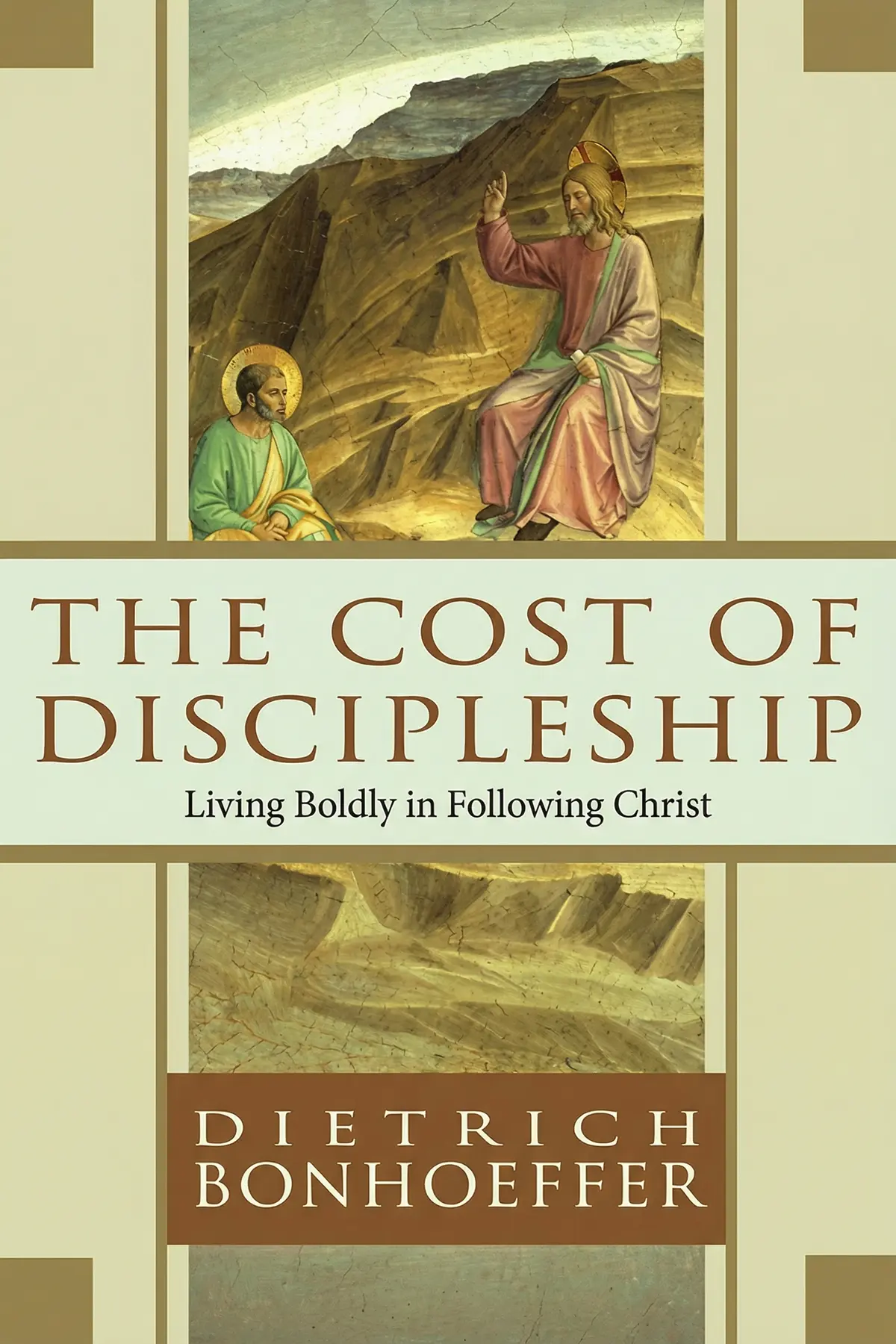
Bonhoeffer separates grace that asks nothing from grace that can cost a life. He shows how faith becomes real through concrete obedience, a self set free from self-watching and a visible community willing to resist injustice.
1 min 00 sec
If faith has become something you agree with in principle and forget by Monday, Dietrich Bonhoeffer has a name for it: cheap grace. In The Cost of Discipleship, the German pastor calls grace that asks nothing the deadly enemy of the church. He developed the book between 1935 and 1937 in courses at Finkenwalde. It was an illegal seminary of the Confessing Church, which was then in bitter conflict with a Nazified state church.
His argument runs in a single line. Real grace begins when Jesus says follow me and a person takes a concrete step. That step costs the old self and reshapes ordinary life. It also binds the follower to a visible community that will stand against injustice. Bonhoeffer later died for these convictions. Follow his reasoning and you gain a sharp test for your own beliefs: it shows you where you only agree, and where you actually obey.
1 min 50 sec
Two kinds of grace can sound identical from the pulpit. One leaves you exactly as you were, and the other may cost everything. Bonhoeffer’s Gospel pictures make the difference hard to forget, and an everyday choice puts it to the test.
1 min 53 sec
A rebel monk once sent faith back into ordinary life. A few generations later, his own slogan had become an excuse. Bonhoeffer’s grim image of ravens shows how a demanding idea can rot while it keeps its good name.
1 min 55 sec
Many people wait to feel certain before they act. Bonhoeffer turns that order around. His advice to anyone who says they simply cannot believe is blunter than most would expect, and it points at something they already know.
1 min 52 sec
A boy sent to bed works out a clever reason to go and play instead. Bonhoeffer saw the same logic among the devout, and he traced it back to the oldest failing the Bible describes.
1 min 53 sec
The most quoted line in the book sounds like a call to heroic sacrifice. Bonhoeffer’s own account of self-denial is plainer: not thinking less of oneself, but no longer looking at oneself. He knew the struggle, having once barely prayed.
2 min 04 sec
Peacemakers who would rather suffer, goodness that must be seen yet never admired by its owner, and love for enemies in a society turning murderous. The teaching at the heart of the book reads like a set of weekday instructions.
2 min 01 sec
Each disciple has to answer the call alone, with no crowd to hide in. Yet Bonhoeffer insists nobody can follow alone. In 1930s Germany, he worked out these ideas at Finkenwalde, an illegal Confessing Church seminary that the Nazi authorities shut down in 1937.
1 min 23 sec
Bonhoeffer frames the whole book around one demand: what Jesus asks of people now, whatever any church leader might wish. His answer is severe, yet he states early on that discipleship is joy. The yoke it brings is the one Jesus called easy and light. Cheap grace offers comfort and changes nothing. Costly grace asks for everything and gives back a life.
He did not leave the argument on paper. Arrested in April 1943, he was held in Tegel Prison for a year and a half. He was hanged on 9 April 1945, put to death for joining the conspiracy against Hitler. Many readers take that ending as the book lived out.
What it asks of an ordinary week is smaller but real. Find the command you are knowingly sidestepping and take the first step, trusting that belief follows obedience. Distrust any elaborate argument for why an obvious duty does not apply to you. Make peace with someone you are estranged from before your next act of worship.
By the Lake of Gennesaret, Peter heard follow me twice. The first time, he left his nets. The second time, the risen Jesus found him back at his old trade. A whole life of following lay between those two calls, and that is where the cost gets paid.
Many believers hold their faith as a set of ideas they agree with, while daily life runs much like everyone else's. Dietrich Bonhoeffer, writing in Germany in the mid-1930s as a pastor of the Confessing Church, gave that arrangement a name: cheap grace. It means forgiveness without repentance, belief without following and comfort without change. Against it he sets costly grace, the call of Jesus to follow him. That call asks for a concrete first step and the death of the old self. Bonhoeffer argues that belief and obedience cannot be separated, and that clever reasoning around a plain command is a form of self-justification. He also holds that the Sermon on the Mount, which fills about a third of the book, is meant to be lived, from making peace with an estranged brother to loving one's enemies. The book also insists that no one follows alone. Disciples belong to a visible church that shapes all of daily life, and following Christ may mean standing against the state. Bonhoeffer developed these ideas at an illegal seminary that the Nazis shut down in 1937, and he was later executed for his part in the plot against Hitler. Readers get a demanding test of their own convictions, along with Bonhoeffer's claim that this path leads to joy.
Christians who suspect their faith has become comfortable agreement and want to see what following Jesus asks day to day.
Pastors, students and small-group leaders studying grace, obedience and the Sermon on the Mount.
Readers curious how one pastor's theology led him to resist the Nazis.
Born in Breslau in 1906, Dietrich Bonhoeffer studied in Berlin and New York City before becoming a Lutheran pastor and theologian. He helped found the Confessing Church and wrote about where Christianity belongs in a secular world. He chose to leave America and go home to Germany so he could keep speaking out against the Nazis. After his arrest in April 1943 he was held in Tegel Prison for a year and a half. He was hanged on 9 April 1945, as the regime was collapsing.
Listeners find this book to be an incredible and deeply motivating listen that addresses the core of discipleship, viewing it as essential for personal spiritual development. They also value its theological depth and believe it is a valuable use of time, with one listener noting how Bonhoeffer weaves scripture throughout his writing. Furthermore, the material is praised for being intellectually stimulating, with one review emphasizing Bonhoeffer's amazing exegesis of Christ's words.
This book is essentially the blueprint for what it means to actually follow Christ instead of just admiring him from a distance. Bonhoeffer’s distinction between 'cheap' and 'costly' grace hit me like a ton of bricks because I realized how often I settle for a comfortable, low-stakes faith. The writing is incredibly dense and certainly requires your full attention, but the spiritual payoff is well worth the mental exertion. Truth is, you can’t remain the same. He weaves scripture through every argument, making it feel less like a dry textbook and more like a prophetic challenge that demands a total life overhaul. It took me months to finish because I had to stop and repent after almost every chapter. If you are serious about spiritual growth, you need this on your shelf.
Show moreAs someone who has spent years in the pews, I found this to be a devastatingly beautiful wake-up call to the reality of the cross. Bonhoeffer doesn't pull any punches when he describes the 'cost' of following Jesus, reminding us that grace is free but it isn't cheap. The way he meticulously unpacks Christ’s words from the Gospel of Matthew provides a richness that most modern devotionals completely lack. You can tell this was born out of deep suffering and the underground seminary experience, giving it an authenticity that resonates in your soul. It is not just a book of ideas. It is an invitation to a different way of existing in a hostile world. Truly, this is essential reading for every believer who wants to move beyond surface-level religion and find the heart of discipleship.
Show moreThe chapter on the 'hiddenness' of the Christian life changed my entire perspective on what it means to grow in holiness. Bonhoeffer argues that we shouldn't even be conscious of our own good works, which is a radical departure from the 'self-improvement' Christianity we often see today. His theological richness is staggering, and he manages to ground every single theory in a deep, abiding love for the person of Jesus Christ. Not gonna lie, I had to keep a dictionary and a Bible handy at all times just to keep up with his train of thought. This isn't a book you read for entertainment; it’s a book you study to show yourself approved. It speaks directly to the heart of what it means to be the Body of Christ in a world that has forgotten the meaning of sacrifice.
Show moreGotta say, I was not prepared for how much this book would challenge my comfortable American lifestyle. Bonhoeffer strips away all the excuses we make for our lack of discipleship and presents a vision of faith that is both terrifying and beautiful. His focus on the 'call' to obedience is a breath of fresh air in a world of watered-down doctrine. Personally, I found the section on the enemy to be the most profound, especially given the historical context of his writing. It’s a masterpiece of spiritual growth that demands you rethink everything you thought you knew about being a Christian. While the reading level is high, the insights are so deeply profound that they offer a lifetime of meditation. Buy it, read it slowly, and let it change you.
Show moreAfter hearing so much about Bonhoeffer’s life, I finally sat down with his primary work and I am completely blown away by his insight. He manages to weave scripture into every page, creating a theological tapestry that is both intellectually satisfying and emotionally stirring. The book highlights the absolute necessity of a visible church community, which is a message that feels more relevant now than ever before. To be fair, it is a demanding read that requires a high level of concentration, but the 'cost' of reading it is nothing compared to the reward. This is a must-read for anyone who is serious about their walk with God and wants to understand the true nature of the Gospel. It’s easily one of the most important books in my library now.
Show morePicked this up after hearing it was a classic, but I have to warn potential readers that it is quite a slog in certain sections. The translation from German feels a bit clunky at times, which makes the academic theology even harder to digest for a layperson like myself. It’s a heavy lift. Despite the slow pace, the pearls of wisdom hidden in the text are absolutely transformative for anyone seeking real spiritual growth. Bonhoeffer’s exegesis of the Sermon on the Mount is probably the best I have ever encountered, though his dense academic style makes it a difficult mountain to climb. I don't agree with every single point he makes regarding pacifism, but his heart for Jesus is undeniable. It’s a challenging read that demands patience, yet the investment of time yields a much deeper understanding of discipleship.
Show moreWow, my brain is absolutely mush after finishing this, but in the best way possible. I’ve been working through this with a mentor for the last few months, and the discussions we had were more impactful than the solo reading itself. Bonhoeffer’s insistence on radical obedience is a tough pill to swallow, especially in our modern culture that prizes comfort above all else. To be fair, some of his Lutheran sacramental theology felt a bit foreign to my own tradition, and I found myself disagreeing with his stance on baptism. However, the core message about the visible community of the church is something we desperately need to hear today. It’s a heavy, intellectual journey that requires a lot of prayerful consideration to fully grasp, but it is well worth the effort.
Show moreIn my experience, this is one of those rare books that actually deserves its reputation as a spiritual masterpiece. I opted for the audiobook version because I heard the physical text was a difficult slog, and that helped me absorb the concepts more naturally while commuting. Bonhoeffer’s amazing exegesis of Christ's words feels fresh and urgent, even though it was written over eighty years ago in Nazi Germany. My only real complaint is that he sometimes gets bogged down in very specific academic disputes that feel less relevant to a modern lay reader. Even so, the central theme of 'costly grace' is so powerful that it makes the denser sections worth the effort. It’s a convicting look at the Sermon on the Mount that will stay with me for a long time.
Show moreEver wonder why people praise this book so much while simultaneously admitting they barely understood half of it? I found myself in that exact camp, struggling through the dense academic language while longing for the simpler narrative of Bonhoeffer's own life story. While his commitment to the Gospel is inspiring, the sheer weight of the theological jargon often obscured the very points he was trying to make. Frankly, I think I preferred the Metaxas biography because it showed his faith in action rather than just explaining it in these complex, abstract terms. There are definitely moments of brilliance, especially regarding the unconscious nature of sanctification, but the readability is so low that it feels like work. I'll probably revisit this in a decade to see if I’ve matured enough to handle the prose.
Show moreLook, I hold Bonhoeffer in the highest regard as a martyr, but I found myself disagreeing with significant portions of his theological framework here. His interpretation of the Sermon on the Mount feels overly literal in ways that lead to a kind of 'vocational pacifism' that I find biblically inconsistent. It’s also quite ironic to read his strict demands for non-resistance knowing that he later joined a plot to assassinate Adolf Hitler. This creates a confusing tension in the text that makes it hard to use as a practical guidebook for modern living. While the prose is occasionally soaring and poetic, the overall structure is dense and often repetitive. It was a struggle. I think 'Life Together' is a much more accessible starting point for those interested in his work.
Show moreBonhoeffer argues that grace which asks nothing is a counterfeit, and he calls it cheap grace: forgiveness without repentance and belief without following. Real, costly grace is the call of Jesus to follow him, and a person answers it with a concrete step of obedience. That step costs the old self and is shaped by the Sermon on the Mount. It is lived inside a visible community. Bonhoeffer also states that this demanding path is joy.
Cheap grace, for Bonhoeffer, is the grace we bestow on ourselves. It offers forgiveness as a general truth, baptism without church discipline and Communion without confession, and it lets believers live by the world’s standards. He pictures costly grace through the man who sells everything for a field that holds treasure, and through fishermen leaving their nets. It is costly because following may cost a life. It is grace because it gives the only true life.
The book grew out of courses Bonhoeffer taught between 1935 and 1937 at Finkenwalde, an illegal seminary of the Confessing Church. That church was in bitter conflict with the Nazified state church. Scholars read the book as a warning to his own church and as an attempt to resist the Nazi ideology spreading through German churches. In 1934 he had told his friend Erwin Sutz that he wanted to understand what following Christ truly means.
Bonhoeffer’s own advice is practical. If belief feels empty, find the command you are knowingly refusing and obey it, because a concrete step opens the way to faith. Treat clever arguments around a plain duty as suspect. Make peace with someone you are estranged from before you worship. Be truthful enough that oaths become unnecessary. Let your faith show in a community that shares daily life, all week long.
Alcoholics Anonymous World Services


Daniel Goleman


Eckhart Tolle

Marianne Williamson

Deepak Chopra

Pico Iyer

Beth Moore
Paramahansa Yogananda
AUDIO SUMMARY AVAILABLE
Get the key ideas from The Cost of Discipleship by Dietrich Bonhoeffer, plus 5,000+ more nonfiction titles.









