

12 min 24 sec
Available in: English
The Conscious Mind: In Search of a Fundamental Theory
Explains why mapping the brain cannot tell us why experience feels like anything. Chalmers argues that consciousness is a basic feature of reality, possibly present in tiny amounts throughout the universe.
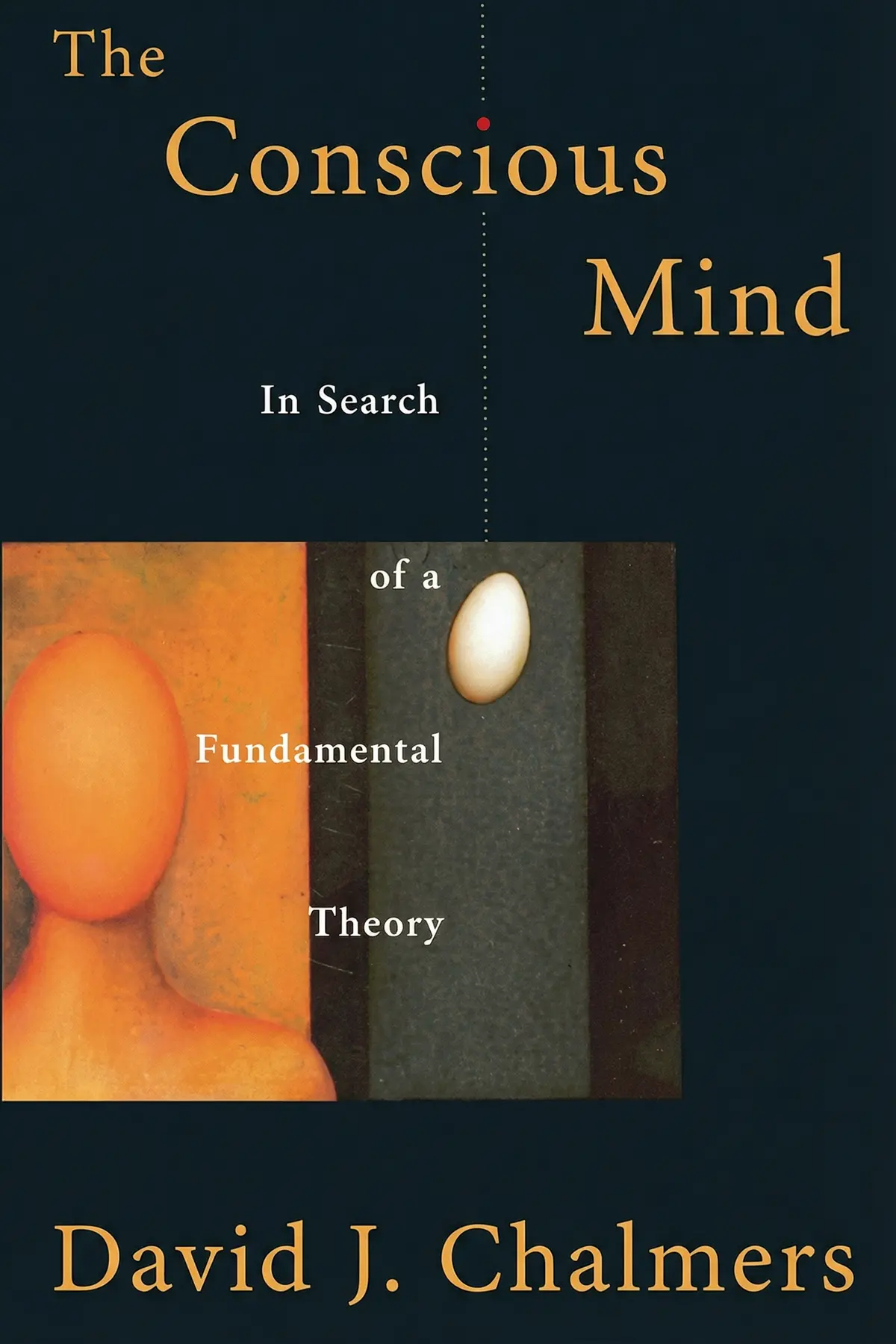
Table of Content
1. Introduction
54 sec
Science can follow a sound from your eardrum to your auditory cortex, signal by signal. It still cannot say why hearing a voice feels like anything at all. In The Conscious Mind, philosopher David Chalmers calls this the hard problem of consciousness, and he argues that brain mapping alone, however detailed, will never solve it. His case is that experience cannot be built out of matter in motion. It has to be treated as a basic part of reality, possibly present everywhere in some tiny form.
That claim caused a stir in philosophy and neuroscience in the 1990s, and it still shapes the debate. Following it gives you a clear way to tell real progress on the mind from hype. You also get a thought experiment that tests any theory of consciousness in a minute, and a sharper sense of what it would mean for a machine to feel.
2. Tell the easy problems from the hard one
1 min 57 sec
Every year brings new maps of where memory and decisions happen in the brain. One philosopher argues that all this progress, however real, leaves the most familiar fact of your life completely untouched.
3. See what a perfect brain map still misses
1 min 50 sec
You could understand every circuit inside a television and still know nothing about being moved by a film. Chalmers says neuroscience faces the same trap, and that better scanners will not get us out of it.
4. Test any theory of mind with a zombie
2 min 16 sec
Imagine someone who talks, laughs and solves problems exactly as you do, yet feels absolutely nothing. That strange figure became one of philosophy’s sharpest tools, and almost every popular theory of mind fails its test.
5. Information with an inside as well as an outside
2 min 07 sec
The words reaching your ears right now exist twice over: as vibrations in the air, and as something you are living through. Chalmers builds his whole theory on taking that second side as seriously as the first.
6. See why experience might reach electrons and machines
2 min 10 sec
If feeling is a basic ingredient of reality, it is hard to say where it stops. Chalmers follows the logic to a radical conclusion, one that loosens the tie between minds and biological brains.
7. Conclusion
1 min 10 sec
Chalmers’s argument starts from a simple observation. Science has explained a great deal of what the brain does, and every theory built from matter alone can explain more of it. Yet one item never fits: the fact that any of it is felt. Instead of hoping the next scan will settle the question, Chalmers adds experience to the list of basic ingredients, alongside photons and the forces between particles. If he is right, inner life was not invented by clever brains; we woke up in a universe where experience was there from the start, and science and spirituality may at last have somewhere to meet.
You can use the argument in ordinary life. When a headline says the brain has finally been explained, ask whether the research solved a function or the feeling. When someone says a machine is conscious, or insists that one never could be, put the zombie test to the claim and see what survives. And when you notice the color of the evening sky or a familiar voice in the next room, remember that this ordinary fact is the one physics still cannot describe.
On Chalmers’s account, the hardest thing in the world to explain is what it is like to be inside it.
About this book
What is this book about?
Neuroscience can link memory to the hippocampus and decisions to the prefrontal cortex. It still cannot say why seeing red or feeling joy is like anything from the inside. David Chalmers calls this the hard problem of consciousness, and he argues that solving the brain's other puzzles will never answer it. Chalmers sorts the questions about the mind into easy and hard problems. He tests materialism, behaviorism and functionalism and finds that each one stops at the same gap. His best-known tool is the philosophical zombie, a being that behaves exactly like us but feels nothing. His own proposal is that information has two sides, one physical and one felt, which makes experience a basic ingredient of the world. That idea leads him toward panpsychism, the view that some tiny form of experience exists everywhere. Readers come away with a clear way to tell real progress on consciousness from overblown headlines, a quick test for any theory of mind, and better questions to ask in debates about whether machines could ever feel.
Book Information
Who it's for
Curious where neuroscience stops
Curious professionals who keep reading that neuroscience has explained the mind and want to know what it has not.
Philosophy, psychology, CS students
Students of philosophy, psychology or computer science looking for the clearest statement of the hard problem.
Weighing AI consciousness
Anyone weighing claims about conscious machines who wants a principled way to judge them.
About the Author
David J. Chalmers
David J. Chalmers is a professor of philosophy and neural science at New York University, where he co-directs the Center for Mind, Brain and Consciousness. He works on the philosophy of mind and of language. He made the philosophical zombie thought experiment widely known, and his hard problem of consciousness inspired Tom Stoppard's play The Hard Problem. He has given the John Locke Lectures and won the Jean Nicod Prize, and he co-founded PhilPapers, a research database for philosophers.
Ratings & Reviews
Ratings at a glance
What people think
Listeners find the work clarifies the essence of human consciousness and regard it as essential reading, even if they acknowledge it is a challenging text. Feedback on the accuracy of the arguments is varied, with several listeners finding the explanation of consciousness unsatisfying. The pacing and mystery elements also receive a range of different reactions.
Top reviews
Mats
Rarely does a book fundamentally alter the way you perceive your own existence, but this is one of them. This is a masterful deconstruction of the 'easy problems' versus the truly baffling nature of subjective experience. Chalmers is remarkably brave for reintroducing property dualism into a field dominated by materialists who want to explain away qualia as mere biological noise. I found the sections on supervenience demanding but rewarding; they provide the necessary vocabulary for a debate that usually descends into hand-waving. If you’re looking for a quick summary, look elsewhere. This is for those willing to do the heavy mental lifting required to face the universe's greatest mystery head-on. Truly a must-read.
Show moreWyatt
The 'Hard Problem' is the ultimate mystery of the universe, and Chalmers is our best guide through the fog. Not gonna lie, this book changed my life. We often take our inner lives for granted, but this text forces you to look at the 'redness' of red or the 'pain' of a pinprick as something truly alien to a purely physical world. His prose is clear and surprisingly devoid of the usual heavy-handed jargon where possible. It’s a thick volume, and the pacing can be uneven, but the payoff is a much deeper appreciation for the enigma of the mind. He tackles the 'why' rather than just the 'how,' and that makes all the difference.
Show moreDivya
This remains the gold standard for anyone questioning the limits of modern materialism. Look, science is great at explaining how the brain processes data, but it fails to explain why that processing is accompanied by an internal experience. Chalmers nails this distinction perfectly. The book is dense and the logic is relentless, but it's the only work I've found that takes the 'feeling' of being alive seriously. It’s a must-read for anyone who feels that there’s more to the universe than just atoms bumping in the dark. He doesn't just offer an opinion; he builds a fortress of logic that is very difficult to knock down.
Show morePruet
Finally tackled this cornerstone of modern philosophy of mind, and it certainly lived up to its reputation. It is a dense, slow burn, but absolutely essential for anyone wanting to understand why physicalism often feels fundamentally incomplete. Chalmers’ logic regarding the 'hard problem' is incredibly tight, even if you eventually find his later dive into panpsychism a bit too speculative for your personal taste. Truth is, the first half of the book is much stronger than the second, providing a rigorous framework for what it means for something to be 'conscious.' He methodically dismantles the idea that we can simply explain away experience through neurobiology alone. While it’s not an easy read, the clarity he brings to the distinction between the psychological and the phenomenal is well worth the effort.
Show moreAdam
As someone who came in with a strong physicalist bias, this was a necessary and humbling challenge. You really cannot call yourself a student of consciousness without grappling with this text. It isn't an easy read by any stretch, often reading more like a math textbook than a philosophical inquiry, but the precision is necessary. While I am still not entirely convinced by his 'naturalistic dualism,' I appreciate the honesty with which he addresses the gaps in current neuroscience. The discussion on functional organization is particularly thought-provoking. Even if the panpsychism conclusion feels like a reach, the journey there is paved with fascinating questions about the nature of information and reality.
Show moreEleanor
Don't let the author's legendary long hair and rocker vibe fool you; this is serious academic business. I’ve been following the debates around the Hard Problem for years and finally sat down with the primary source material. Frankly, it’s much more approachable than I expected, though it is still a major time commitment. He is very thorough about addressing every single counter-argument, which makes for a long read but a very complete one. Even if you think property dualism is a dead end, you have to respect the rigor he brings to the table. The mystery of the mind remains, but at least now I have a better map of the territory.
Show moreWitthaya
What does it actually mean to conceive of a world identical to ours but without any internal experience? Chalmers spends so much time on these 'p-zombies' that I found myself losing interest in the actual biology of the brain. He treats consciousness as this separate, extra layer, which feels more like a clever language trick than a scientific breakthrough. To be fair, his writing is exceptionally rigorous, but it is a massive slog to get through the Boolean-style logic he applies to something as messy and organic as human thought. I appreciate the challenge to my materialist views, but the assumption that we can 'conceive' of such a world feels like a leap of faith I wasn't quite ready to take.
Show moreAudrey
Is consciousness a fundamental property of the universe or just a very complex biological function? Chalmers argues for the former with incredible tenacity, though he often gets bogged down in possible-world semantics that feel more like word games than reality. I found the first few chapters on logical supervenience very helpful for clarifying my own thoughts on materialism. However, by the time he got to the suggestion that a thermostat might have a tiny sliver of experience, I felt he had jumped the shark. It’s a foundational text for a reason, but perhaps more for the important questions it asks than for the specific, somewhat arbitrary answers it provides.
Show moreSomsak
He treats the human mind like a series of logic gates and Boolean propositions, which I found a bit frustrating. While I admire the intellectual effort, the biological reality of the brain is far more chaotic than Chalmers allows for in his tidy 'zombie' thought experiments. The book is famous for a reason, but the argument for panpsychism felt like a desperate attempt to fill a hole he dug for himself early on. It’s a slog, frankly, and the pacing really drags in the final third. I’d recommend it for the historical context of the 'Hard Problem,' but don't expect it to provide a satisfying, evidence-based conclusion that settles the matter.
Show moreNongnuch
I really wanted to like this, but I simply couldn't get past the core assumptions. Chalmers is clearly a brilliant thinker, but his entire argument for property dualism hinges on the idea that p-zombies are 'conceivable.' Personally, I don't find them conceivable at all—it's like trying to imagine water that isn't wet and calling it a logical possibility. Once that initial premise fails, the rest of the book feels like a house of cards. The pacing is agonizingly slow in the middle chapters, and he seems to dismiss the potential for future scientific discovery a bit too readily. It felt like he was guiding the reasoning toward a conclusion he had already reached before he even started writing.
Show moreQuestions about this book
What is the hard problem of consciousness?
David Chalmers uses the term for the question of why brain activity comes with felt experience at all. The easy problems ask how the brain handles perception, memory, decisions and skills, and science is making steady progress on them. The hard problem asks why seeing red or feeling joy is like something from the inside. Chalmers argues that solving every easy problem would still leave this question open.
What is a philosophical zombie?
It is a thought experiment that Chalmers made famous. A zombie, or an artificial intelligence, behaves exactly like a person: it talks, reacts and solves problems, but it experiences nothing inside. If such a being can be coherently imagined, Chalmers argues, then behavior and function alone do not guarantee consciousness. That is why he thinks behaviorism, functionalism and materialism all fall short.
What is the main idea of The Conscious Mind?
Chalmers argues that consciousness cannot be explained by physical processes alone, so it should be treated as a fundamental feature of reality. His double aspect theory holds that information has two sides: a physical, structural side described by science and a felt side experienced from within. Brains do not create feeling from nothing. Instead, they organize and reveal qualities already present in information.
Does Chalmers believe electrons are conscious?
Only in a very limited sense. Chalmers’s reasoning leads him toward panpsychism: if experience is fundamental, some minimal form of it should exist everywhere, even at the simplest levels of nature. He is clear that this does not give electrons emotions or rich inner lives. It means only that tiny traces of experience may be part of what basic things are.
How can I apply the ideas in The Conscious Mind?
Use the book as a filter. When research claims to explain consciousness, ask whether it explained a brain function or why that function feels like something. When people argue about whether machines can be conscious, try the zombie test: could the system do everything described and still feel nothing? Keeping both the outer and inner descriptions of a process in mind sharpens these debates.
Readers also enjoyed

A Guide to the Good Life: The Ancient Art of Stoic Joy
William B. Irvine

A Little History of Philosophy
Nigel Warburton

A Theory of Justice
John Rawls



Becoming Beauvoir: A Life
Kate Kirkpatrick
AUDIO SUMMARY AVAILABLE
Listen to The Conscious Mind in 15 minutes
Get the key ideas from The Conscious Mind by David J. Chalmers, plus 5,000+ more nonfiction titles.
- 5,000+ titles
- Listen as much as you want
- 7-day free trial
- Cancel anytime









