

59 Seconds: Change Your Life in Under a Minute
Richard Wiseman
 English
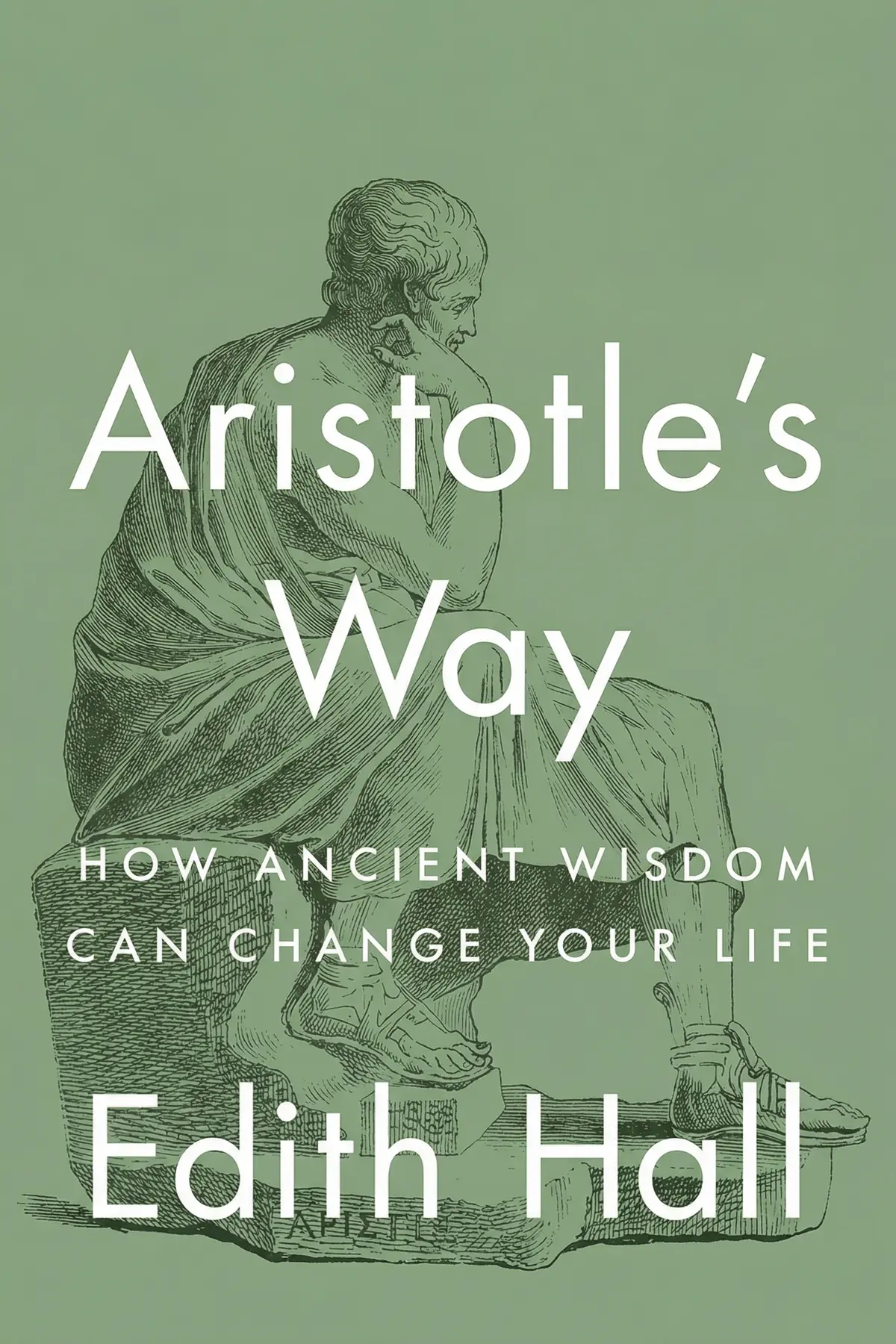
Edith Hall shows how Aristotle's thinking helps with modern problems: making big decisions, spotting misleading arguments, writing persuasively, telling friendships apart and finding the right amount of anger, generosity and desire.
1 min 08 sec
Most of us put more thought into choosing tonight’s show than into how we live, and then wonder why contentment feels random. In Aristotle’s Way, British classicist Edith Hall argues that a philosopher from the fourth century BCE already had the fix. For Aristotle, happiness is an activity, and the activity is thinking carefully about how to live.
Hall first read that idea at 20 and credits it with changing her life for the better. Her case is that the method still works because the problems are the same. Lives are short, hard choices arrive without warning, people try to mislead us and friendships fray. Reasoning about each one, patiently and with a sense of measure, is what Aristotle meant by living well.
What follows is a set of tools taken straight from his work: three checks before any big decision, a way to catch the weak link in a slick argument, a short formula for a persuasive cover letter, a map of three kinds of friendship, and a practical test for knowing when anger has gone too far.
1 min 38 sec
The man whose questions founded whole fields of study lost his parents young, spent decades as a student and a wanderer, and produced nothing we remember until his final years. His path offers a different way to see a slow start.
1 min 37 sec
Many people chase happiness as a salary, a house or a feeling that will someday arrive and stay. Aristotle tested those ideas against a sleeping man and found them all wanting, which left him with a stranger answer.
1 min 42 sec
Most daily choices are trivial, but a handful decide whom you live with and how. Aristotle had no answers to your particular dilemma, yet his writings hold a simple test that keeps panic and rumor out of the decision.
2 min 03 sec
A husband built a neat, logical case that his wife was psychologically inadequate. She did not argue with his facts. She found the one step he had slipped past her and turned his conclusion upside down.
1 min 44 sec
A job application may be the most consequential speech most people ever give, even on paper. Aristotle’s account of persuasion explains why buttering up the reader often backfires and how much less you need to say.
1 min 45 sec
Some friends vanish when a neighbor moves away, and some lovers drift apart as looks fade. Aristotle saw nothing shameful in that, and he used an old coat to describe the one kind of bond that runs the other way.
1 min 51 sec
Rival Greek schools told people to give up their appetites, their ambitions or their possessions. Aristotle refused. His alternative turns anger, generosity and desire into questions of amount, with a surprising signal for knowing you’ve gone too far.
1 min 13 sec
Aristotle never offered a shortcut. His happiness is work you do with your own mind, and Hall’s case is that the work pays off exactly where life gets hardest: the late-night urge to walk out of a marriage, the confident colleague with a rigged argument, the blank cover letter, the friend you cannot quite place. Each improves when you stop, think and look for the right measure.
Seen this way, moderation is more than a rule about appetite. The same sense of amount runs through all his advice: enough anger to resist injustice and no more, a letter long enough to make the case and no longer, a friendship asked to give only what it can.
The practice can start this week. Sleep on the next big choice, and confirm the rumor before you act on it. When an argument feels airtight, look for the shaky second premise. When anger or desire pulls hard, read the pull as a sign you are leaving the middle.
An orphan who wandered through war, royal courts and the shores of Lesbos left all of this in his final 12 years. His answer to how we should live fits in a pocket: think about it, and keep thinking.
Human lives are short, and the question of how to fill them well has not changed since ancient Greece. The classicist Edith Hall first read Aristotle's answer when she was 20 and credits it with changing her life. In this book she turns that answer into practical guidance for people living in a world far larger and faster than his. At the center is Aristotle's claim that happiness is something you do. Reason is what sets humans apart, and using it to think about how to live is what makes us happy. Hall follows that idea into everyday situations: three rules for weighty decisions, a way to catch the faulty premise hidden in a persuasive argument, an ABC for persuasive writing such as a job application, and a map of three kinds of friendship with their natural limits. Running through it all is Aristotle's ethics of moderation. Unlike rival schools that asked people to give things up, he placed virtue in the middle between two vices. Readers get a short life of the philosopher and a set of habits they can use the same week.
Professionals facing a big life decision who want a calmer way to weigh it.
Job seekers and anyone who argues for a living, from cover letters to meetings.
Readers curious about philosophy who want Aristotle's ethics turned into habits they can use.
Edith Hall, born in 1959, is a British classicist and professor who specializes in ancient Greek literature and cultural history. She has appeared on radio and television programs as an authority on Greek society, literature and theater. She was the first woman to receive the Erasmus Medal of the European Academy, holds an honorary doctorate from Athens University, and won the 2024 International Hellenic Prize for Facing down the Furies. Her other books include Introducing the Ancient Greeks.

Listeners view this work as exceptionally well-crafted and describe it as a fantastic listen. Beyond this, they value its educational substance, with one listener highlighting how it offers a practical grasp of the natural world. The title also provides a deep examination of Aristotle’s biography, and one listener remarks that it acts as a perfect entry point to the philosopher’s teachings.
Finally got around to reading this and I was genuinely impressed by how accessible Hall makes such a dense subject. She provides a practical understanding of the natural world and our place within it that feels both grounded and deeply inspiring. While many philosophy books stay trapped in the clouds, this one offers a thoughtful exploration of how to actually live a better life day-to-day. I particularly appreciated her breakdown of eudaimonia as something we actively pursue through habit rather than just a fleeting feeling. To be fair, she does take a few shots at Stoicism that might annoy fans of Marcus Aurelius, but her defense of Aristotelian 'doing' over Stoic 'enduring' is compelling. It’s an excellent introduction for those who find the original texts too intimidating. The prose is fluid and the structure makes it easy to digest in small sittings. I’ll be recommending this to anyone looking for a secular framework for ethics.
Show moreEdith Hall makes a compelling argument that we don't need religion to have a robust and meaningful moral framework. For someone like me who values logic but craves a sense of purpose, this book was a revelation. It bridges the gap between science and the 'good life' beautifully. She covers everything from the importance of friendship to how we face our own mortality. The prose is lively and she does a great job of explaining why Aristotle’s focus on the community is more relevant now than ever. Not gonna lie, I was surprised by how much I enjoyed her take on his lost work on comedy and the 'Name of the Rose' references. It’s a very readable interpretation that doesn't sacrifice intellectual integrity for the sake of being 'popular.' This is easily one of the best introductions to ancient wisdom I’ve come across in years.
Show moreTruth is, I wasn't expecting a book on ancient philosophy to be this much of a page-turner. Hall’s writing is the opposite of burdensome; it’s energetic, clear, and deeply human. She manages to show how Aristotle’s way of looking at the world can actually change your life for the better. The way she describes Aristotle as a 'socialist' who believed in the texture of life was fascinating and made him feel so much more relatable. I loved the focus on practical engagement and problem-solving rather than just abstract theory. Some might find her personal anecdotes insipid, but I thought they added a nice layer of authenticity to the book. It’s rare to find a scholar who can speak to the general public without sounding condescending. This is a great read for anyone looking to find a sense of direction in a world that often feels chaotic and meaningless. Highly recommended.
Show moreAs someone who has always struggled with the conflict between science and religion, I found Hall’s presentation of Aristotle incredibly refreshing. She positions his ethics as a third way that doesn't rely on divine command or cold, utilitarian calculations. The chapter on potentiality and actuality was especially illuminating, even if her application of those concepts to the abortion debate was a bit controversial. Truth is, her writing is extremely well-written and she has a knack for distilling complex ideas into something a modern reader can use. I did find some of her digs at the Christian tradition a bit unnecessary for the overall argument, but they didn't ruin the experience. It serves as a great read for anyone wanting to build a life based on character and intention. The focus on community and being a 'social animal' is a much-needed antidote to the hyper-individualism we see today. Definitely worth the time for the first few chapters alone.
Show moreEver wonder if ancient Greeks actually have the secret to modern happiness? Hall makes a convincing case that they do. This book is a thoughtful exploration of Aristotle's life and work, framed in a way that makes it feel incredibly relevant to the 21st century. I loved the emphasis on 'virtuous habits' and the idea that we are what we repeatedly do. Gotta say, the section on how to make better decisions using the 'mean' between extremes was very practical. There were a few moments where the writing felt a little too much like a self-help manual for my taste, especially the modern workplace examples. However, the scholarship is clearly there and she manages to make the 'father of philosophy' feel like a mentor rather than a statue. It’s a great read if you want to understand the foundations of Western ethics without having to learn Ancient Greek first.
Show morePicked this up after hearing it was an excellent introduction to Aristotle, and for the most part, that holds true. Hall has a wonderful way of explaining how the natural world informs our moral choices. The book offers a practical understanding of how to build character through small, daily actions. I found the chapter on happiness particularly strong because it moves away from the 'pursuit of pleasure' and toward the 'realization of potential.' There were parts where she leaned a bit too far into the self-help genre, which made some of the philosophical complexity feel a bit watered down. However, the writing is extremely well-written and kept me engaged through most of the chapters. Even when I disagreed with her modern applications—like her views on the reception of Aristotle through the Church—I still found her perspective worth considering. It's a solid 4-star read for any curious mind.
Show moreIt’s a decent enough primer on virtue ethics, but the book is more of an ode to Aristotle than a balanced critique. Hall clearly loves her subject, which is great, but it leads her to dismiss other schools of thought like Stoicism in a way that feels superficial and grim. She characterizes Stoicism as mere resignation, which is a common misconception that misses the nuance of their practical engagement with the world. The book is strong when it sticks to the core tenets of the Nicomachean Ethics, but it gets a bit fluffy when she tries to apply it to modern film and television. I found the referential nods to pop culture a little bit cringey and they didn't really add much to my understanding of the philosophy. It’s informative for a beginner, but if you’ve already read a bit of philosophy, you might find this a little bit bland. It’s okay, just not the life-changing experience the subtitle promises.
Show moreThis book is essentially an ode to a specific brand of secular humanism, using Aristotle as the mouthpiece. While it’s certainly informative, it often falls flat because Hall's personal biases are so front-and-center. Her unnecessary jabs at Christianity and her dismissal of Stoicism as 'grim' felt beneath a scholar of her caliber. To be fair, she does a reasonable job of presenting the basics of virtue ethics and the 'potential-act' distinction. But the advice itself? It’s often a bit bland. Most of the 'wisdom' boils down to 'be balanced' and 'know yourself,' which isn't exactly groundbreaking even if it does come from a Greek philosopher. I found the middle sections of the book to be quite repetitive. It’s a fine book for a plane ride, but don't expect it to provide anything especially pithy or life-altering if you're already familiar with the basics of philosophy.
Show moreLook, I really wanted to like this, but it felt like a chore from start to finish. The writing style was burdensome and at times felt like I was being lectured by a teacher who thinks they’re being 'hip' but is actually just out of touch. Hall tries to use Aristotle to justify everything from modern job hunting to specific political stances, and it often feels like a massive reach. I found her personal interjections and anecdotes to be dull and surprisingly insipid for someone of her academic standing. Instead of a deep dive into virtue ethics, we get a sort of 'pop-psychology' version of Aristotle that lacks the teeth of the original philosophy. It’s more of a self-help book with a Greek veneer than a serious work of history or philosophy. I’m sure Hall is lovely, but this particular approach just didn’t work for me at all.
Show moreThe writing style felt distinctly off-putting and the contemporary examples Hall uses were a total reach for me. For example, trying to connect Aristotle’s deep ontological theories to how one should write a cover letter felt like she was trying to stretch a thin premise way too far. It’s a shame because the historical context she provides is actually quite interesting. But then she’ll interject with a personal anecdote that feels totally insipid, and I lose interest all over again. I agree with other reviewers who said it felt like a chore to get through the later chapters. It’s basically a pop-psychology book that uses Aristotle as a mascot rather than engaging with the difficult parts of his thought. If I wanted a self-help book, I would have bought one. I was looking for a decent application of philosophy to modern times, but this felt more like a collection of bland life advice.
Show moreHall argues that Aristotle’s ethics still offer a practical guide to living well. For Aristotle, happiness is an activity: reason is what makes us human, and using it to think about how to live is what makes us happy. Hall applies that idea to decisions, arguments, persuasive writing and friendship, and she presents moderation, the middle path between two vices, as his crowning virtue.
Hall draws three rules from his works. Never decide in haste, which is why the Greeks advised deliberating at night, much like sleeping on it. Verify your information, since a rumor, such as one about a cheating spouse, is not a fact and may be malicious. Finally, consult an expert when a matter lies outside your own knowledge, just as you would only fly with a trained pilot.
Aristotle placed virtue in the meson, the middle between two linked vices. Too little anger means you fail to react to injustice, while too much makes you rude and obnoxious. Too little generosity makes you a miser, too much makes you wasteful. To find the middle, he invoked the maxim know thyself, noting that the wrong direction usually gives intense pleasure.
Hall turns his rhetoric into an ABC. Audience: research the people reading your letter so you can show genuine respect instead of flattering them, which tends to backfire. Brevity: persuasion about future action needs only what you want and why it is a good idea, so explain your reasons for wanting the job and for deserving it. Clarity: if readers cannot follow your case, they will not be persuaded.
Aristotle saw all close relationships as friendship of varying intensity. Utility friendships are a social barter, like a sandpiper cleaning a crocodile’s teeth for food. Pleasure friendships rest on shared enjoyment, such as making each other laugh. Both break easily when circumstances change. The deepest kind is love: unlike a worn coat, such friends grow more valued with time and, he concludes, make the best life partners.
Richard Wiseman






William B. Irvine


Andrew D. Thompson

AUDIO SUMMARY AVAILABLE
Get the key ideas from Aristotle’s Way by Edith Hall, plus 5,000+ more nonfiction titles.









