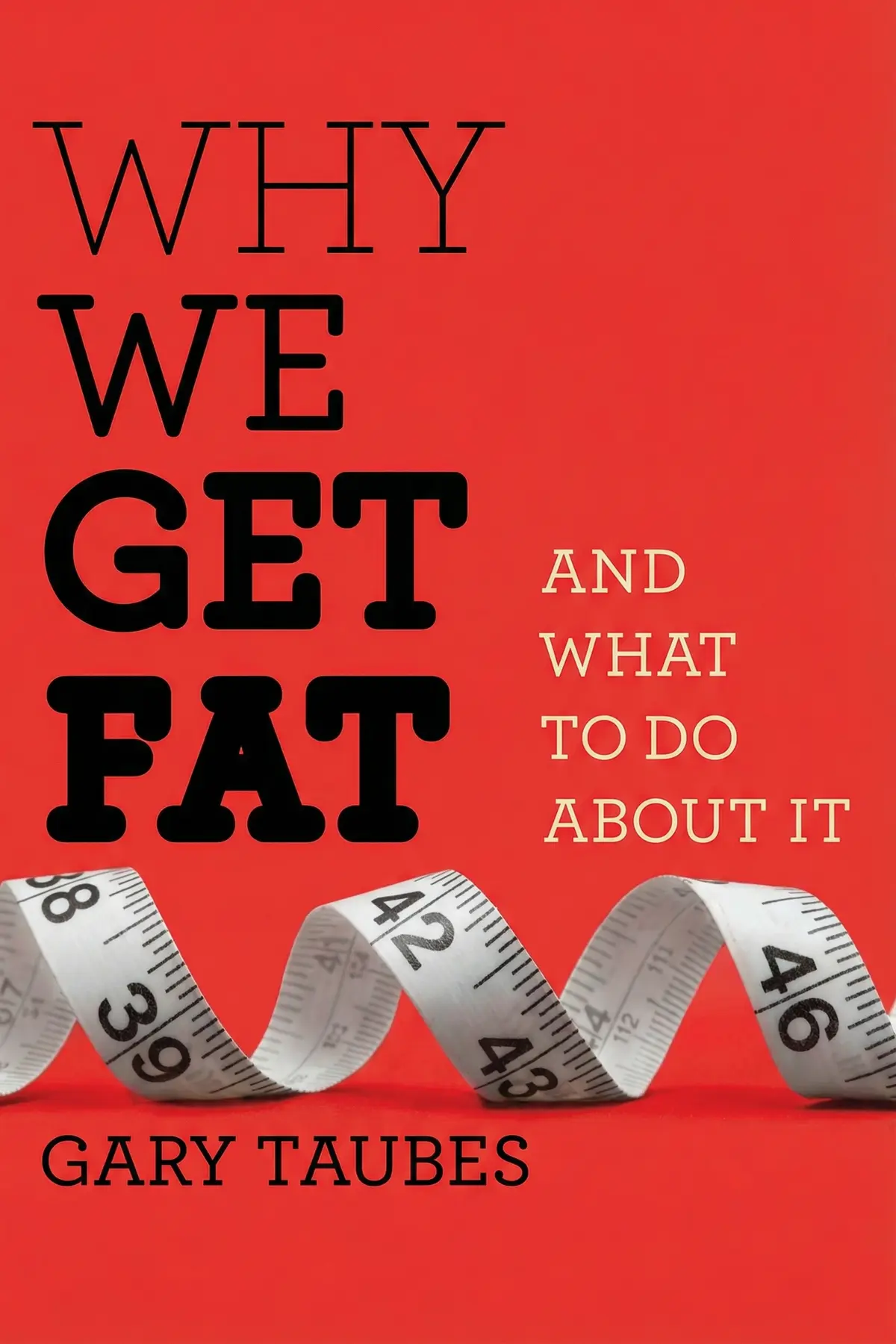
Why We Get Fat: And What to Do About It
Gary Taubes
 English
 ไทย
Explains how sugar went from royal luxury to an ingredient in nearly every packaged food, why its calories act differently in the body, and how insulin resistance may tie it to diabetes, heart disease and cancer.
57 sec
If you have eaten less and still gained weight, Gary Taubes thinks the kind of fuel matters more than the amount. In The Case Against Sugar, the science journalist argues that sugar is far from empty calories: it pushes the body to release insulin, the one hormone that tells cells to hold on to fat.
That runs against decades of advice to count calories and fear fat, advice Taubes says was shaped partly by an industry with much to protect. His case is that sugar, made cheap by technology and defended by its makers, is probably a main hidden cause of obesity, diabetes, heart disease and even some cancers in Western countries. The evidence runs from a refinery that produced in a day what once took a decade to a Pacific island whose diabetes rates climbed with its sugar intake. Afterward, the sweetener in your ketchup will look less like a treat and more like a choice.
1 min 57 sec
Sugar was once a gift fit for a king, carried across oceans at great cost. A humble root and a new kind of engine changed that, and the shift still shapes every supermarket aisle.
1 min 49 sec
Three teaspoons of sugar contain fewer calories than an apple, and the sugar industry loved to say so. A discovery about one hormone in the blood suggests that comparison misses what actually happens in your body.
2 min 00 sec
Imagine an advertisement telling you to eat more sugar for your immune system. It really ran. The same industry later found a clever legal route to fight a rival that was beating it on calories.
1 min 49 sec
For decades, fat was treated as the most dangerous thing on your plate. The scientist behind that idea had ties worth knowing about, and some long-lived peoples tell a very different story.
1 min 49 sec
Your body has a neat system for handling a sweet snack, and most days it works. When it starts to fail, the first outward sign is easy to dismiss, and the cycle that follows feeds itself.
1 min 48 sec
Over several decades, a small island community went from relatively low diabetes rates to the highest rate in the world. Its story, and a surprising result from a common diabetes drug, push the case against sugar further.
1 min 15 sec
The Case Against Sugar traces how one substance moved from a king’s treasure chest to nearly every supermarket shelf, and how those selling it worked to keep people from asking what it does. Taubes’s answer is a chain: sugar raises insulin, insulin locks fat away, and years of that pressure can wear the body into insulin resistance, metabolic syndrome and the illnesses that follow, from diabetes and heart disease to some cancers. Doctors raised the alarm for years, he notes, while a well-funded industry steered attention toward calories and fat.
What follows for daily life is simple to say and harder to do. Treat the calorie number on a label as only part of the story, and ask what a food will do to your blood sugar. Read health claims with an eye on who funded them. Above all, Taubes suggests trying to live without sugar. He compares it to smoking: smokers cannot picture life without cigarettes until they stop, and later cannot picture going back. The first step is finding out how easy going without can be.
The people of Tokelau did not change their genes. They changed their food, and their bodies answered.
Most people know candy and soda are full of sugar. Fewer notice it in yogurt, ketchup, sushi and ready meals, or question the old rule that weight comes down to calories in and calories out. Science journalist Gary Taubes argues that this rule has hidden the real problem for decades. Taubes follows sugar from the first cane fields of New Guinea to the refineries of the industrial age, then shows how its makers sold it as a health food, fought artificial sweeteners and helped turn public fear toward dietary fat. At the center of his case is insulin, the hormone that tells the body to store fat, and the insulin resistance that years of high sugar intake can produce. Readers get a clear account of how sugar may connect obesity, diabetes, heart disease and even cancer, supported by evidence such as the rapid rise of diabetes on the Pacific island of Tokelau, along with a simple challenge: try living without sugar and see how easy it becomes.
People who count calories carefully and still struggle with their weight.
Anyone with a family history of diabetes or heart disease who wants to understand the role of insulin.
Readers skeptical of nutrition headlines who want to know how industry money shaped decades of diet advice.
Gary Taubes is a science journalist who studied applied physics at Harvard and engineering at Stanford, and earned a master's in journalism from Columbia. He started at Discover magazine in 1982, has written for Science, and moved from physics into medicine and nutrition. His books include Good Calories, Bad Calories and Why We Get Fat. He co-founded the non-profit Nutrition Science Initiative and has won the National Association of Science Writers Science in Society Journalism Award three times.
Gary Taubes
Listeners find this work both gripping and meticulously documented, specifically admiring its exhaustive history of sugar alongside simple scientific clarifications. The prose is readable and direct, and listeners describe it as a transformative experience, with one listener pointing out how it clarifies today's obesity and diabetes crises. This title earns high praise for its dependability, as one listener remarks on the author's expert delivery of all existing evidence. Listeners hold conflicting views on whether sugar is truly as detrimental as claimed.
This was a terrifying wake-up call for me as a parent. Learning about 'perinatal metabolic programming' and how a mother's sugar intake can affect a fetus's future health was genuinely haunting. Taubes doesn't just say sugar is bad; he builds a wall of evidence linking it to everything from Alzheimer's to cancer. The tone is very serious and the research feels incredibly credible, though some of the population studies are definitely a bit extreme in their conclusions. Look, I’m not quitting every gram of sweetness tomorrow, but I’ll never look at a birthday cake the same way again. It's life-changing in the sense that you can't un-see the information provided here. It’s a heavy, scientific indictment of our modern food system that should be mandatory reading in schools.
Show moreSugar is the new smoking, and this book is the definitive evidence file. I was blown away by the sheer volume of data Taubes compiled to link our current obesity crisis to the surge in refined sweeteners. The chapter on gout alone was worth the price of admission for me, as it’s a connection I had never heard explained so clearly. Personally, I found the writing style to be very engaging despite the heavy subject matter. It doesn't offer a '10-step plan' to get healthy, but it gives you the knowledge to want to change your life on your own terms. It is one of those rare books that actually changes how you perceive the world around you, especially the grocery store aisles. If you're skeptical about the old 'low fat' craze, read this immediately.
Show moreGary Taubes provides a masterclass in investigative journalism by mapping out how we ended up in a world where corn syrup is in literally everything. It’s not just a diet book; it’s a deep dive into the historical and political shifts that made sugar the center of the Western diet. I found the section on the sugar industry’s influence on early nutritional research particularly eye-opening and, frankly, a little infuriating. While the writing is clear and the arguments are meticulously researched, the middle sections can drag if you aren't obsessed with old clinical trials. Still, it provides a crucial framework for understanding the obesity epidemic beyond the 'calories in, calories out' narrative we're usually fed. If you want to know why we are all getting sicker despite following 'low fat' advice, this is the book for you. It’s a dense read but undeniably important for our current health landscape.
Show moreThe most compelling aspect of this book is the way Taubes dismantles the 'everything in moderation' myth. He argues that sugar is an addictive toxin rather than just another source of energy, and his evidence is pretty hard to ignore. The writing is incredibly accessible for such a research-heavy topic, making the science of fructose metabolism easy to grasp for a layperson. Truth is, the book makes you realize how much of our 'knowledge' about nutrition was bought and paid for by big industry players decades ago. I especially liked the discussion on how sugar triggers insulin in a way that fat simply doesn't. While it could have used more discussion on natural fruit sugars, it remains a powerful critique of the Standard American Diet. Definitely worth the time if you care about your long-term metabolic health.
Show moreTo be fair, you need a decent attention span to get through the early chapters on the slave trade and the expansion of the sugar industry. Once you get past the historical context, the book becomes a scathing critique of modern nutrition science. Taubes masterfully presents the available evidence to show how we’ve been led astray by flawed studies and industry-funded research. The way he links sucrose to non-alcoholic fatty liver disease is particularly clear and well-argued. I did find his vilification of the sugar industry a bit over-the-top at times, almost like he’s trying to make them a 1990s movie villain. However, the core message about the dangers of high-fructose corn syrup is impossible to dismiss. This is a credible, deeply researched book that every health professional should probably have on their shelf.
Show moreAfter struggling with cravings for years, reading this gave me the scientific context I needed to understand what was happening to my body. Taubes explains the metabolic triggers of hunger and fat storage in a way that finally makes sense. Frankly, it’s refreshing to read a book that doesn't just blame willpower for our health issues. The history of how sugar was introduced to the Western diet was fascinating, but the real value is in the explanation of how fructose affects the liver specifically. My only gripe is that it feels a bit repetitive towards the end, and he could have spent more time on how to actually navigate a sugar-filled world. Still, it’s a brilliant piece of investigative journalism that provides a much-needed perspective on the modern diabetes epidemic.
Show moreFinally got around to reading the 'sugar bible,' and it didn't disappoint in its depth. Taubes is a top-tier explainer, and he manages to turn a dry subject like nutritional epidemiology into a compelling narrative. The book serves as a perfect exposé on why our current health guidelines are failing so many people. It’s not just about weight; it’s about the underlying insulin resistance that fuels almost every modern chronic disease. While the matter could have been far more crisp—it does tend to circle back to the same points—the evidence is meticulously presented. It’s an essential read for anyone trying to understand why our society is getting sicker despite more medical intervention. I’m definitely cutting back on the sweets and processed snacks after finishing this one.
Show moreEver wonder why your doctor focuses on fat but ignores your soda habit? This book explains the history of that massive oversight. Taubes is a master at explaining complex physiological processes like insulin resistance without making you feel like you're in a biology 101 lecture. However, the book is quite repetitive in the later chapters. He hammers the same points about metabolic syndrome over and over. I appreciated the deep dive into gout and the tobacco industry parallels, but I wish the matter were a bit more crisp. It feels more like a prosecutor building a massive case than a helpful guide for the average person. I would recommend it for the history alone, but maybe keep some caffeine nearby to stay awake during the dryer epidemiological sections.
Show morePicked this up after hearing a podcast interview with the author and wanted to see the full evidence for myself. Taubes is definitely a gifted writer, and his ability to synthesize decades of medical history is impressive. I found the connection between sugar and the rise of diabetes in indigenous populations, like the Pima Indians, to be the most fascinating part of the text. That said, the book often feels like it's trying to fit every single modern ailment into one single cause. Is sugar really the primary driver of cancer and dementia? Maybe, but the links felt a bit speculative compared to the solid data on diabetes. It’s a thought-provoking read that will make you rethink your pantry, even if you don't buy into every single 'doomsday' prediction he makes. A solid three stars for the quality of research.
Show moreNot gonna lie, I expected a practical guide to quitting sugar, not a dense 300-page indictment of the industry. The history of sugar beets and cane was interesting for about ten minutes, but then it just became a slog. My biggest issue is how Taubes completely dismisses 'calories in/calories out' as if it’s a total myth. Just because sugar affects hormones doesn't mean thermodynamics stops existing! Plus, his grudge against Ancel Keys feels way too personal and biased after a certain point. It’s hard to take a book seriously when it suggests a single scoop of ice cream a week is a catastrophe for a child. There are some good insights here regarding fatty liver, but the tone is so doom-and-gloom that it loses its impact. I’ll just stick to eating less junk rather than joining this anti-sugar cult.
Show moreGary Taubes argues that sugar is probably a principal underlying cause of the diseases common in Western nations, including obesity, diabetes, heart disease and some cancers. His reasoning centers on insulin: sugar raises it, insulin makes the body store fat, and over time high sugar intake likely causes insulin resistance, which many studies link to other diseases. He also argues the sugar industry spent decades steering blame toward calories and fat.
No. Taubes calls that one of nutrition science’s long-standing mistakes. Since the 1960s, scientists have been able to measure hormones in the blood, and insulin stood out as the hormone that stores fat instead of releasing it. Because sugar and other carbohydrates raise insulin most, he argues that the same number of calories from sugar, fat or protein has very different effects on the body.
Tokelau, an island off New Zealand, had the world’s highest diabetes rate in 2014, at 38 percent. In 1968 islanders ate a high-fat traditional diet with about eight pounds of sugar a year, and diabetes was uncommon. After a program let them move to the mainland, sugar intake reached 55 pounds a year by 1982, and diabetes, obesity and other Western diseases rose sharply among those who moved.
Taubes’s main advice is to try living without sugar. He compares it to quitting cigarettes: smokers cannot imagine life without them until they stop, then cannot imagine going back. Practical steps drawn from the book include checking ingredient lists for hidden sugar in foods like yogurt and ketchup, thinking about a food’s effect on insulin rather than only its calories, and asking who funded a health claim.
AUDIO SUMMARY AVAILABLE
Get the key ideas from The Case Against Sugar by Gary Taubes, plus 5,000+ more nonfiction titles.