

A River in Darkness: One Man’s Escape from North Korea
Masaji Ishikawa
 English
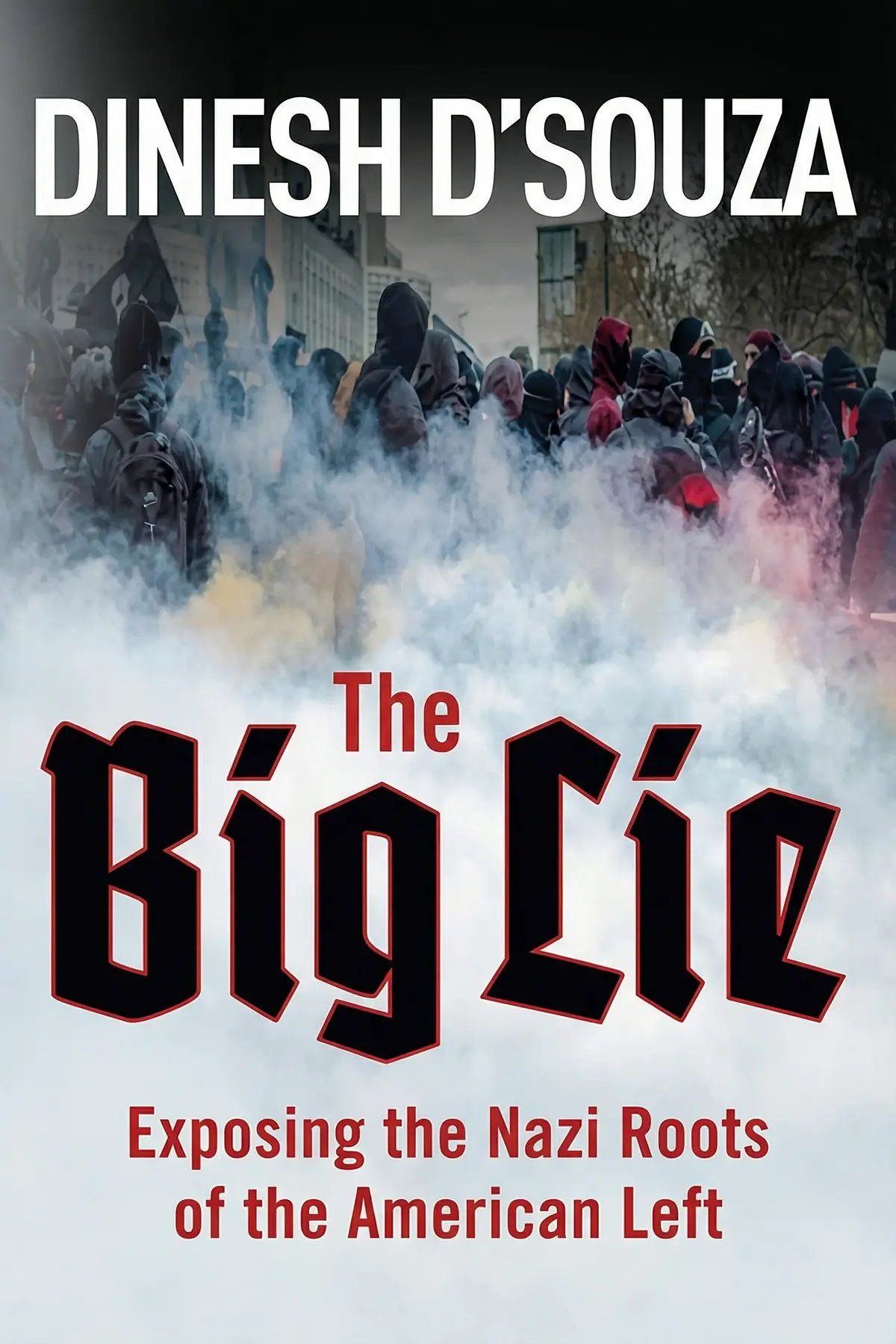
D'Souza argues that calling Trump and conservatives fascists is projection. He claims fascism, Nazi race law and eugenics trace back to socialism, progressivism and the Democratic Party, and he sets out how he thinks conservatives should respond.
56 sec
Anyone who follows American politics has heard Donald Trump and his supporters called fascists, racists, even Nazis. In The Big Lie, conservative commentator Dinesh D’Souza argues that the charge has the facts backward. In his reading, fascism, Nazi race law and eugenics all came from the Left, and from the Democratic Party in particular.
He takes a term from Sigmund Freud for what he thinks is going on. Freud called it transference: a wrongdoer pins his own guilt on the person he harmed. D’Souza says the American Left is doing this on a national scale.
Every case he raises is meant to prove it, from Mussolini’s socialist youth to Andrew Jackson’s removal of Native Americans and Franklin Roosevelt’s New Deal. What follows sets out his argument step by step, so the case can be weighed on its own terms.
1 min 31 sec
Being blamed for your accuser’s own wrongdoing is maddening at home. D’Souza believes the same move is happening across American politics, and he names the people he thinks are making it.
1 min 39 sec
Left, right and fascist are words thrown around in every political fight. D’Souza goes back to a French assembly hall and an Italian street movement to fix their meaning, and the result reshapes everything that follows.
1 min 46 sec
Mussolini and Hitler usually sit at the far right of the political map. D’Souza looks at Mussolini’s early career and Marx’s failed forecast and comes to a very different placement.
2 min 01 sec
A young German lawyer studied in Arkansas, and a Nazi ministry took notes. D’Souza follows a line from Jacksonian America to Nuremberg and asks who should carry the blame.
1 min 42 sec
Forced sterilization laws once spread across dozens of American states. D’Souza connects that history to a Philadelphia clinic and a well-known health organization, and draws a conclusion many readers will want to examine closely.
1 min 43 sec
Franklin Roosevelt led America against Hitler, which seems to settle where he stood. D’Souza challenges both halves of that story and finds a teacher for Roosevelt in an earlier White House.
1 min 42 sec
Ideas about politics rarely arrive from nowhere. D’Souza describes a chain that runs from lecture halls to newsrooms to television, and he names the philosopher whose idea of tolerance he blames.
1 min 39 sec
Germany’s opposition tried to live with Hitler and failed. D’Souza takes that history as a warning for American conservatives, and his answer reaches from tax law to the Supreme Court to the police.
1 min 07 sec
The Big Lie works like a courtroom reversal. D’Souza takes the charge most often aimed at conservatives, that they are fascists and racists, and tries to turn it back on the people making it. His exhibits include Mussolini’s writing for a socialist weekly, Jackson’s removal act, a young lawyer’s research on US race law in Arkansas, Indiana’s sterilization law and Roosevelt’s National Recovery Act. He offers each one as proof that the Left did what it accuses the Right of doing.
The book is most useful as a detailed map of one side of an argument. When someone calls a politician a fascist, ask what they mean by the word, since D’Souza’s whole case depends on defining fascism as collectivism. When anyone offers a historical comparison, look at how each link is made between a past event and a party today. Then decide whether the links hold.
The book also shows how hard the past is fought over. In D’Souza’s telling, whoever owns the story of the last century’s crimes has a weapon for the next election.
In American politics, Donald Trump and his supporters are often called fascists, racists and even Nazis. Dinesh D'Souza argues that this charge has things backward. He calls it a big lie, a case of the accuser pinning his own guilt on the accused, and he says universities, the news media and Hollywood keep it in circulation. His case runs through a series of historical claims. Mussolini, he points out, came out of Italian socialism, and Hitler put socialism into his party's name. He links Andrew Jackson's removal of Native Americans to Nazi plans for living space, Democratic segregation laws to the Nuremberg Laws, and American progressive eugenics to Nazi Germany. He reads Woodrow Wilson as a proto-fascist and Franklin D. Roosevelt's New Deal as fascist economics. The book ends with a political program. D'Souza wants smaller government, deep tax cuts, a conservative Supreme Court, firm policing of violent protest, and a united Republican Party that refuses to accommodate the Left. Readers get a clear map of one of the sharpest conservative counterarguments in current American debate, with the evidence its author relies on.
Readers who keep hearing conservatives called fascists and want to know the strongest reply from the right.
Students of American politics comparing how left and right tell the story of slavery, eugenics and the New Deal.
Conservatives looking for D'Souza's full historical case and his political plan.
Dinesh D'Souza was born in Mumbai, India, and came to the United States as an exchange student, graduating from Dartmouth College in 1983. He worked as a policy analyst in the Reagan White House and held fellowships at the American Enterprise Institute and Stanford's Hoover Institution. From 2010 to 2012 he was president of The King's College in New York City. His 2010 book The Roots of Obama's Rage became the basis for his 2012 film 2016: Obama's America. He writes mainly about Christianity, patriotism and American politics.
Listeners find the volume extensively researched and data-driven, highlighting its flawless supporting evidence. Additionally, they value its accessibility and deem it essential reading, with one listener remarking that it is a fast read. Furthermore, the book is lauded for its historical precision, with one review describing it as an exhaustive history of the American Left, and for revealing perspectives that clarify contemporary political trends. The caliber of writing is superior, and listeners rate it among the most significant works on American political culture, with one review highlighting its copious documentation of Fascism and National Socialism's creation.
Finally got around to reading this provocative work. To be fair, I expected a standard political rant, but what I found was an exhaustively researched history of the American Left that blew my mind. D’Souza’s breakdown of how the Democratic Party’s past—from slavery to the Trail of Tears—mirrors authoritarian tactics is chilling. Not gonna lie, the parallels he draws between early 20th-century progressivism and European fascism are tough to stomach but remarkably well-documented. The writing is incredibly clear and moves fast, making a dense subject feel accessible. While some of the modern-day comparisons feel a bit hyperbolic, the sheer volume of citations makes it hard to dismiss. It’s an eye-opening read that challenges the mainstream narrative about who the "real" fascists are in today's society. Whether you agree with his politics or not, the historical deep-dive into the roots of the Democratic Party is hard to ignore.
Show moreDinesh D’Souza has truly outdone himself with this impeccable documentation of political history. Personally, I was most impressed by the thirty pages of sources that back up his claims about the roots of National Socialism. He argues that the Left has projected its own history of racism and control onto the modern Right to create a massive smokescreen. It’s fascinating to see him use the Italian dictator Mussolini’s own words to link FDR’s New Deal to fascist ideologies. Frankly, the chapter on the Enlightenment was a bit dense, but it provides a necessary foundation for his thesis. This isn’t just a book for Trump supporters; it’s a necessary education for anyone who thinks they know American history. If you want to understand the "Big Lie" being pushed by the media, start here. The writing is sharp and the research is exhaustive.
Show moreWow, just wow. I finished this in two sittings because I couldn't put it down. D’Souza is a master at exposing the hypocrisy of the American Left. He shows how the "Big Lie" is used to demonize decent people while the real culprits hide behind a mask of progressivism. The chapter comparing Lincoln to Hitler—not as equals, but as targets of the same type of smears—was particularly insightful. I appreciate that he doesn't just complain; he offers a way forward for the conservative movement through cultural renewal. To be fair, some of the analogies are extreme, but given the current political climate, they feel necessary. This is easily one of the most important books on political culture written in the last decade. Every patriot should have a copy on their shelf to combat the media narrative. Impeccable research throughout.
Show moreEver wonder why the media is so obsessed with calling everyone a fascist? This book provides the answer. D’Souza peels back the layers of propaganda to show that fascist ideology is actually a brainchild of the Left. He points out that the real fascists are the ones trying to shut down free speech and riot in the streets. I found the historical accuracy regarding the 1960s civil rights movement especially refreshing, as he gives credit where it's actually due. It’s a quick read despite being filled with facts and deep scholarly digging into German and Italian history. Not gonna lie, I was skeptical at first, but the evidence is right there in the footnotes for anyone to see. Whether you love the current president or hate him, you need to understand the history presented in these pages. It’s an eye-opening journey.
Show moreI've been looking for a book that actually explains the current political climate without the usual bias, and this hit the nail on the head. D'Souza exposes how the Left uses "consciousness raising" to manufacture grievances and stir up violence against their opponents. The comparison between modern street skirmishes and the Brown Shirts of the 1930s is spot on and very disturbing. It’s a tough, emotional read at times, but absolutely necessary to understand our world. I love that he highlights the Republican role in the civil rights movement, something that is often erased from modern history books. The truth is, the Democratic Party hasn't changed its tactics as much as they'd like us to believe. This book is a powerful tool for anyone who wants to fight back against the "Big Lie" with logic and facts.
Show moreLook, the truth can be uncomfortable, but D'Souza doesn't shy away from it in this work. This book is an exhaustive history of the American Left that every citizen should read before the next election. He meticulously details how the institutions of the Democratic Party were the ones responsible for slavery, segregation, and the displacement of Native Americans. The media wants to project that onto the Right, but the receipts are all here in his extensive bibliography. The writing quality is top-notch, and the pace never sags despite the heavy subject matter. I did feel that the section on modern-day "denazification" was a bit provocative, but I understand the point he’s trying to make about reclaiming our culture. It’s an eye-opening and incredibly important piece of work that will change the way you see the daily news cycle.
Show moreAs someone who identifies as a moderate, I found many of the arguments in this book to be surprisingly compelling. I've been hearing the "fascist" label thrown at the Right for years, so seeing D'Souza flip the script was quite an experience. The section on the "one-drop rule" and how American eugenics influenced German policy was absolutely haunting. The truth is, the Democratic Party has a very dark history that they rarely acknowledge in public schools. My only gripe is that the tone can get a bit too vitriolic at times, especially when he discusses modern activists like Antifa. It’s a very fast read, but you’ll want to take breaks to digest the heavy implications. It definitely forces you to look at our political divide through a different lens, even if some of the Hitler comparisons feel a bit much.
Show morePicked this up after hearing a lot of buzz online. D'Souza’s writing quality is excellent, and he has a knack for making complex historical movements easy to understand for the average reader. I was particularly fascinated by the discussion of how "lebensraum" was actually influenced by American expansionism under Democratic presidents like Andrew Jackson. The book is impeccably documented, citing everyone from Robert Paxton to Edwin Black to bolster its claims. While I think he oversimplifies the "States' Rights" argument a bit, his overall thesis about the centralizing power of the state is hard to argue with. It’s a well-researched deep dive into the roots of National Socialism and its surprising connections to early American progressivism. Definitely one of the more thought-provoking books I’ve read this year. Highly recommended for history buffs who want a different perspective.
Show moreThe research presented here is certainly extensive, but the conclusions feel somewhat forced. I’ll admit that D’Souza brings up some uncomfortable historical facts that I never learned in college. For example, the Democratic roots of the KKK and the Trail of Tears are undeniable. However, the attempt to link modern-day healthcare debates to Nazi eugenics feels like a bridge too far for me. The author writes with a great deal of passion, which makes for an engaging read, but it also makes me question his objectivity. Look, I think it’s important to challenge the media’s narrative about the current administration, but I’m not sure this book does it in the most persuasive way for a neutral reader. It’s a good starting point for a conversation, even if the partisan lens is a bit too thick at times. Interesting, but flawed.
Show moreThis was a massive disappointment from a supposedly serious scholar. Frankly, the logic in this book is so circular it made my head spin. D’Souza claims that because some Democrats owned slaves 150 years ago, modern-day progressives are essentially Nazis. It’s a ridiculous stretch that ignores the massive party realignments of the 20th century. He uses Wikipedia-level research to cherry-pick facts while ignoring the Republican Party’s own role in Indian removal and segregation during the late 1800s. For instance, claiming no Republican ever owned a slave in 1860 is just factually wrong and easily debunked. The tone is incredibly aggressive, bordering on incitement, and the writing feels more like a screenplay for a documentary than a serious academic work. Save your money and read an actual history book by a non-partisan academic instead of this biased hogwash. It lacks any shred of scholarly integrity.
Show moreD’Souza argues that the Left’s claim that Trump and conservatives are fascists, Nazis and racists is a big lie, a case of accusers projecting their own guilt. In his reading, fascism grew out of socialism, the Nazis learned from Democratic policies on Native Americans and segregation, and American progressives promoted eugenics. He says the American Left has far more in common with fascism than it admits.
He defines fascism as collectivism, the idea that the group outweighs the individual, and he points to its founders. Mussolini came from a socialist family, wrote for a socialist weekly and by 1912 sat on the board of the Italian Socialist Party. Hitler’s party had socialist in its name. D’Souza says fascism arose when Marx’s prediction of a worker revolt failed and Mussolini rebuilt socialism around the nation.
D’Souza calls Roosevelt the first American führer. He argues that the Soviet Union, not Roosevelt, did most of the work of defeating Hitler. He also calls the New Deal fascist because the National Recovery Act let government set wages, prices and output across industries. He says Mussolini and Hitler saw Roosevelt as a fellow dictator, and that Roosevelt learned from Woodrow Wilson, whom he calls a proto-fascist.
He wants them to convince the public that the Left are the real fascists and to unite behind a Republican Party that refuses compromise. His policy list includes repealing Obamacare and the Dodd-Frank Act, limiting welfare, cutting corporate tax, privatizing government functions and putting conservative judges on the Supreme Court. He also wants Republicans to win blue-collar and minority voters, and he wants police to act firmly against violent protests.
Masaji Ishikawa

John Rawls



Miles Taylor



Tracy Rosenthal

Jessica Valenti

Yanis Varoufakis
AUDIO SUMMARY AVAILABLE
Get the key ideas from The Big Lie by Dinesh D’Souza, plus 5,000+ more nonfiction titles.









