
Civilization: The West and the Rest
Niall Ferguson
 English
 ไทย
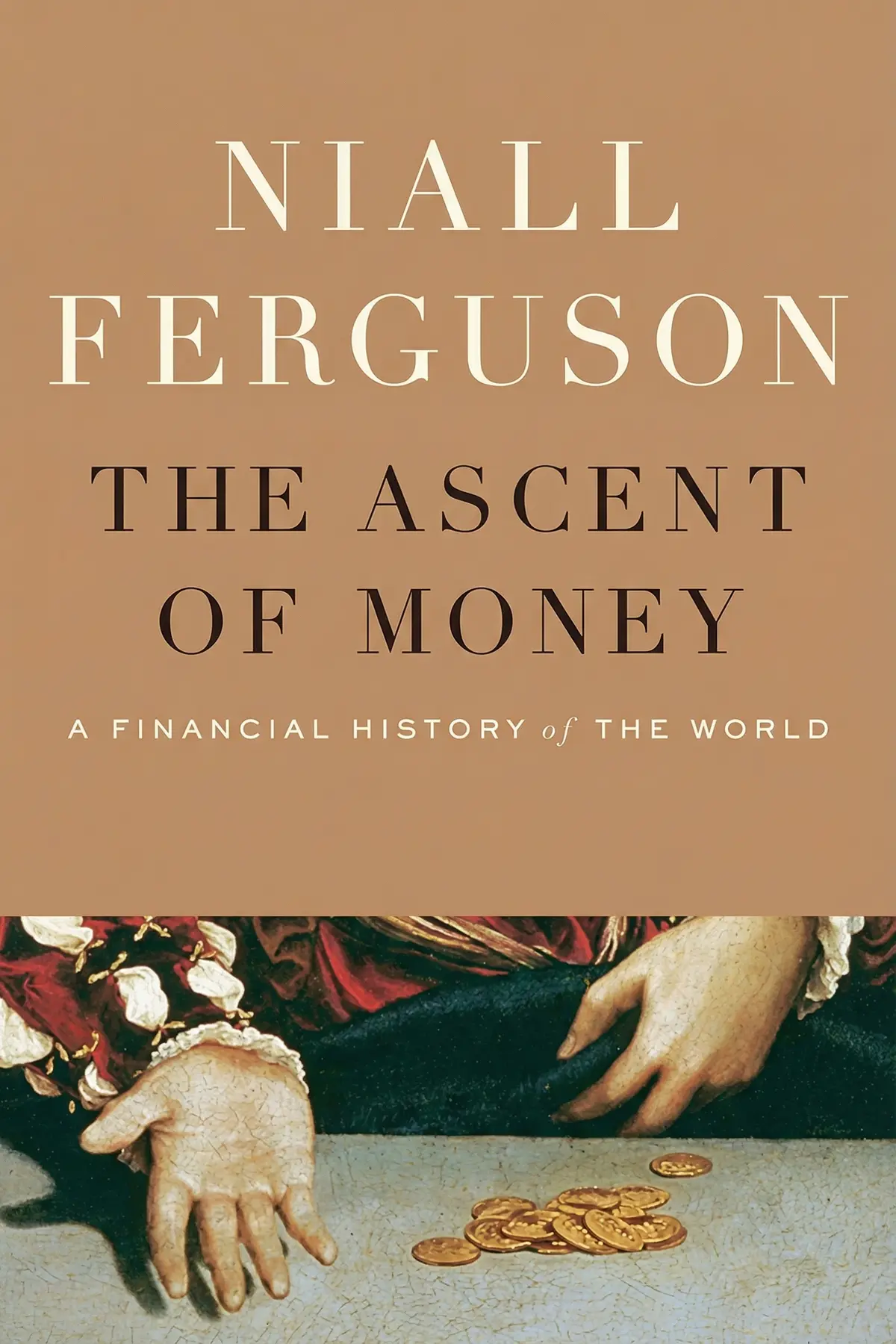
Shows how money, credit, banks, bonds and stock markets evolved over centuries, why finance is the strongest engine of prosperity humans have built, and why the same system keeps producing bubbles, inflation and crashes.
1 min 02 sec
Most people use money every day without seeing the system behind it, so a crash or a price spike feels like weather nobody can forecast. In The Ascent of Money, Niall Ferguson, a senior fellow at the Hoover Institution, argues that finance behaves like a living species: firms that adapt are copied and multiply, while those that cling to old habits die out.
Seen that way, the system becomes something you can read. Ferguson’s case has two sides. Finance, resting on trust and credit, is the best tool people have found for moving money to where it does the most good, from a Dutch trading company to a small loan for a village business. Yet because it runs on human moods and bends to political goals, it swings from euphoria to panic and shares its rewards unevenly. Follow his history and you will be able to explain where money comes from, why bubbles keep forming, and how one country’s housing policy shook banks across the world.
1 min 52 sec
Spanish conquerors shipped home mountains of gold and silver, expecting to grow rich. Their plan backfired in a way that still explains what happens when governments print too much, and why a banknote is worth anything at all.
1 min 44 sec
Put 100 euros in a bank and, without anyone printing a note, the economy can end up with far more than 100 euros. The trick goes back to clay tablets, and it keeps the whole system moving.
2 min 06 sec
Banks, bonds, shares and insurance look like a random toolkit. Each was invented to solve a specific problem, and the way they spread, and sometimes vanish, follows a pattern borrowed straight from Charles Darwin.
2 min 20 sec
Bankers are usually cast as the villains of poverty. Ferguson makes the opposite case, and he uses a small country that outplayed a giant empire richer in gold and silver to prove it.
2 min 07 sec
Market bubbles follow a familiar pattern, yet investors keep getting caught by surprise. The reasons have less to do with numbers than with memory, honesty and the comfort of following a crowd.
2 min 21 sec
Governments can erase their own debts, rescue the uninsured or put more families in their own homes. Each goal sounds reasonable, and each shows how a political decision can land on someone’s savings years later.
1 min 11 sec
Ferguson’s history leaves an uncomfortable but useful picture. Finance is neither a machine run by experts nor a casino run by villains. It is closer to an ecosystem: alive, competitive, prone to sudden die-offs, and still the best way anyone has found to steer money toward the people and places that can use it. Its strength and its danger have the same source, the trust millions of strangers place in each other’s promises.
That picture changes how you can act. When prices are climbing and everyone seems to be getting rich, remember the balloon and the 25-year career, and check whether you can explain where the gains come from. When a government or a lender offers something that sounds generous, follow the risk to whoever will end up holding it, as those Norwegian towns discovered in 2008. And when you put money in a bank, recall that your deposit is someone else’s loan, one small link in a chain that runs from clay tablets to a global system.
Crashes will come again, as extinctions always have. What survives them is whatever adapts.
News about markets, inflation and banking crises can make finance feel like a force nobody understands. Niall Ferguson treats it as something with a history and a pattern. He argues that the financial system evolves much as living species do. Firms that adapt are copied and grow, those that cannot are wiped out, and great crashes such as 1929 and 2008 clear the ground for something new. Ferguson traces the pieces as they arrived: clay tablets in Mesopotamia, the banks and bonds of medieval Italy, the Dutch joint-stock company, Scottish insurance and modern mortgage markets. Along the way he shows why money's value rests on trust, how lending multiplies the money supply, and why access to credit does more than anything else to lift people and nations out of poverty. He is just as clear about the flaws. Because finance mirrors human nature, it is unequal and prone to herding, panic and bubbles. When politicians bend it to their goals, as with hyperinflation or subprime mortgages, ordinary savers pay. Readers gain a working map of where money comes from and why it keeps breaking.
Professionals who follow market news but cannot explain where money comes from or why crashes happen.
Young savers and first-time investors who want to recognize a bubble before joining it.
Students of economics or history looking for one clear story of how finance shaped the world.
Niall Ferguson was born in Glasgow, Scotland, in 1964. He is a senior fellow at the Hoover Institution and has taught at Harvard University, the London School of Economics and New York University. The Ascent of Money became a television series that won an International Emmy in the documentary category in 2009. His other books include Civilization, Empire and The Square and the Tower. He co-founded the University of Austin in 2021 and was knighted in 2024 for services to literature.
Niall Ferguson
Niall Ferguson

Listeners find the work absorbing and masterfully composed, offering deep historical background on the evolution of currency and financial markets. Furthermore, they value its educational depth—one listener highlights how it is loaded with factual data—and its capacity to simplify complex financial events. Listeners also commend the narrative style, which merges compelling tales with specific technical financial points, viewing it as essential reading for anyone curious about the world of finance.
Ferguson manages to turn what could have been a dry recitation of ledger sheets into a sweeping epic of human ingenuity. His central thesis—that financial evolution is as fundamental to human history as any technological breakthrough—is argued with such vigor that it’s hard not to be swept up. I particularly enjoyed the sections on the Medici and how the Italian Renaissance was essentially bankrolled by early financial innovation. It’s fascinating to see how the bond market actually dictated the outcome of major wars. Frankly, if you want to understand why the West rose to prominence while others lagged, this is the blueprint. The writing is incredibly dense with data yet moves at the pace of a thriller, making the complex world of 'Planet Finance' feel accessible. It is easily one of the most informative books on my shelf.
Show moreMoney is the root of most progress—that's the bold claim here, and Ferguson defends it with an incredible mountain of data. This isn't just a book about coins and paper; it's a history of how humanity learned to manage risk and time. The section on the 'evolutionary' nature of finance was particularly enlightening, showing how institutions mutate or go extinct based on their environment. I was captivated by the account of how the Rothschilds used their superior information networks to dominate the 19th-century markets. Look, you might not agree with his pro-market stance, but you can't deny the depth of his scholarship. The footnotes alone provide a better education than most college courses. It’s a dense, rewarding read that completely changed how I look at my bank account.
Show moreThe footnotes alone are worth the price of admission, revealing a depth of research that puts most pop-history to shame. Ferguson is at his best when he’s digging into the archives of the House of Rothschild or explaining the hubris of Long Term Capital Management. He has this knack for taking the 'nitty-gritty' details of quantitative finance and making them feel like essential plot points in the story of mankind. I particularly liked his exploration of insurance as a way of spreading risk, which is something we often take for granted. It’s a very informative read that doesn't stoop to 'simplify' the history, yet remains remarkably clear. Even if you aren't a numbers person, the historical drama keeps you turning the pages. Excellent work.
Show morePicking this up years after the Great Financial Crisis offers a bizarrely prophetic experience, even if the author's timing was slightly off. Ferguson was finishing this manuscript just as the subprime disaster began to boil over in 2008, and those frantic footnotes add a layer of unintended tension. He brilliantly tracks the evolution from clay tablets to 'Chimerica,' explaining how the symbiotic relationship between Chinese savings and American spending shaped our current era. While I think he’s a bit too dismissive of the human cost of these financial 'mutations,' his ability to explain bond markets and insurance without putting the reader to sleep is impressive. The prose is sharp, occasionally arrogant, and always engaging. It’s a must-read for anyone trying to grasp the invisible forces that actually run the world.
Show moreThe way this book weaves nitty-gritty financial mechanics with historical anecdotes is nothing short of masterful. I finally feel like I understand the story of John Law and the colossal bubble he created in Regency France, despite having read about it elsewhere. Ferguson has this Scottish grit to his analysis that makes even the most boring aspects of insurance and real estate feel vital. He argues that poverty is caused by a lack of financial institutions rather than the presence of rapacious ones, which is a provocative take. My only real gripe is that it feels very Western-centric; I would have loved to see more on alternative systems outside the Anglo-American bubble. Still, the storytelling approach makes the medicine go down smoothly. It’s definitely a high-quality historical survey.
Show moreEver wonder why certain countries thrive while others remain trapped in cycles of debt? Ferguson argues that it comes down to the 'ascent' of financial tools like banks, bonds, and stock markets. I found his analysis of the US-China 'Chimerica' relationship to be the most prescient part of the book, especially given the current trade climate. He writes with a certain 'master of the universe' flair that can be polarizing, but his command of the subject is undeniable. The book successfully bridges the gap between historical narrative and economic theory. It’s not perfect—the 2008 publication date means it misses the final fallout of the Lehman collapse—but the long-term context it provides is invaluable. It’s an essential addition to any history buff's library.
Show moreFinally got around to reading this, and the chapter on 'Chimerica' remains the most clear-sighted analysis of US-China relations I’ve encountered. Ferguson’s ability to draw parallels between the pre-WWI era and our modern globalized world is both impressive and a little terrifying. He treats finance as a living, breathing ecosystem, which helps explain why bubbles are almost an inevitable part of the process. I did find some of the behavioral economics sections toward the end a bit rushed compared to the deep historical dives earlier on. Also, the lack of focus on regulatory oversight feels like a major blind spot in light of what happened right after the book was published. Regardless, the storytelling is top-notch and the historical context is something every voter should understand.
Show moreWhile the prose is undeniably sharp, I found it difficult to stomach Ferguson’s blatant apologetics for Western imperialism. He presents the spread of financial institutions as a purely benevolent evolution, ignoring the 'labor' and exploitation that underpinned these systems. Truth is, he does a great job of making the mechanics of the Mississippi Company or the Rothschild empire understandable, but the ideological bias is thick. He puts a polished, academic mask over the rougher edges of history, making imperialism sound like a simple matter of credit management. If you can filter out the center-right preaching, there is a lot of factual value here. However, I’d recommend reading this alongside Naomi Klein’s 'The Shock Doctrine' just to keep your perspective balanced. It's a smart book, but it's far from objective.
Show moreDoes anyone actually understand the stock market after reading these types of books, or am I just a dolt? Ferguson is clearly a world-class academic, and his research is deep, but some of the more abstract concepts still felt like they were sliding off my brain. I appreciated the chapter on the 'property-owning democracy' and the dangers of excessive leverage, but the jump from historical bonds to modern derivatives was a bit dizzying. To be fair, the book is packed with fascinating stories—the rise of the bond market during the Napoleonic wars was a highlight. But by the end, I felt like I had learned more about Ferguson’s political leanings than the actual 'how-to' of finance. It's a solid history, but don't expect it to make you a Wall Street expert overnight.
Show moreNot gonna lie, this felt more like a manifesto for the Chicago School of economics than a balanced historical account. Ferguson spends so much time justifying the Darwinian 'survival of the fittest' in finance that he ignores the catastrophic human toll of these market failures. His take on the Chilean 'economic miracle' is incredibly one-sided, glossing over the political violence that made it possible. I also found the constant imperialist undertones to be quite grating after a while. Sure, he’s a brilliant writer and the stories about the Medici are well-told, but the underlying ideology is hard to ignore. It feels like he’s trying to prove that 'Planet Finance' is the only way for civilization to exist. If you’re looking for a critical look at capitalism, this definitely isn’t it.
Show moreNiall Ferguson argues that the financial system evolves like a living species, through market selection: firms that adapt grow and are copied, while outdated ones die out, sometimes in mass extinctions like 1929 and 2008. Built on trust and credit, finance is in his view the most efficient way to create and direct capital. Because it mirrors human nature and bends to politics, it is also irrational, unequal and unstable.
Through lending. Ferguson’s example begins with a 100 euro deposit. The bank keeps a small reserve and lends about 90 euros, which the borrower deposits at another bank. That bank keeps a little and lends roughly 80 euros. The balances now add up to 270 euros. This expansion of money pays for investment and spending, and without it, he argues, the system would stall.
Ferguson blames it on how American home lending was freed from regulation. Then, in 2003, the George W. Bush administration promoted subprime loans to widen home ownership. Lenders who knew borrowers were likely to default repackaged the loans and sold them worldwide to buyers who missed the risk. When defaults started, house prices fell, and pension funds and even some Norwegian town governments were left with worthless debt.
Ferguson gives three reasons. Careers are short: the average Wall Street chief executive works about 25 years, not long enough for many to absorb how markets rise and fall. Some executives commit fraud, inflating share prices to earn bonuses. And many investors do not understand the system and are drawn in by stories of huge profits. Herd behavior then pushes prices up until they collapse.
It suits readers who want to understand the financial news rather than just follow it: savers and new investors, professionals whose work touches markets, and students of history or economics. It explains why money is worth anything, how credit grows the economy, how small loans help the poor, and why inflation, bubbles and political meddling keep putting savings at risk.







Yanis Varoufakis

Ben Macintyre


AUDIO SUMMARY AVAILABLE
Get the key ideas from The Ascent of Money by Niall Ferguson, plus 5,000+ more nonfiction titles.









