Empire: How Britain Made the Modern World
Niall Ferguson
 English
 ไทย
Niall Ferguson explains how six institutions, from fierce competition and open science to property rights and thrift, turned Europe from a backwater into a world power, and why others are now catching up.
1 min 18 sec
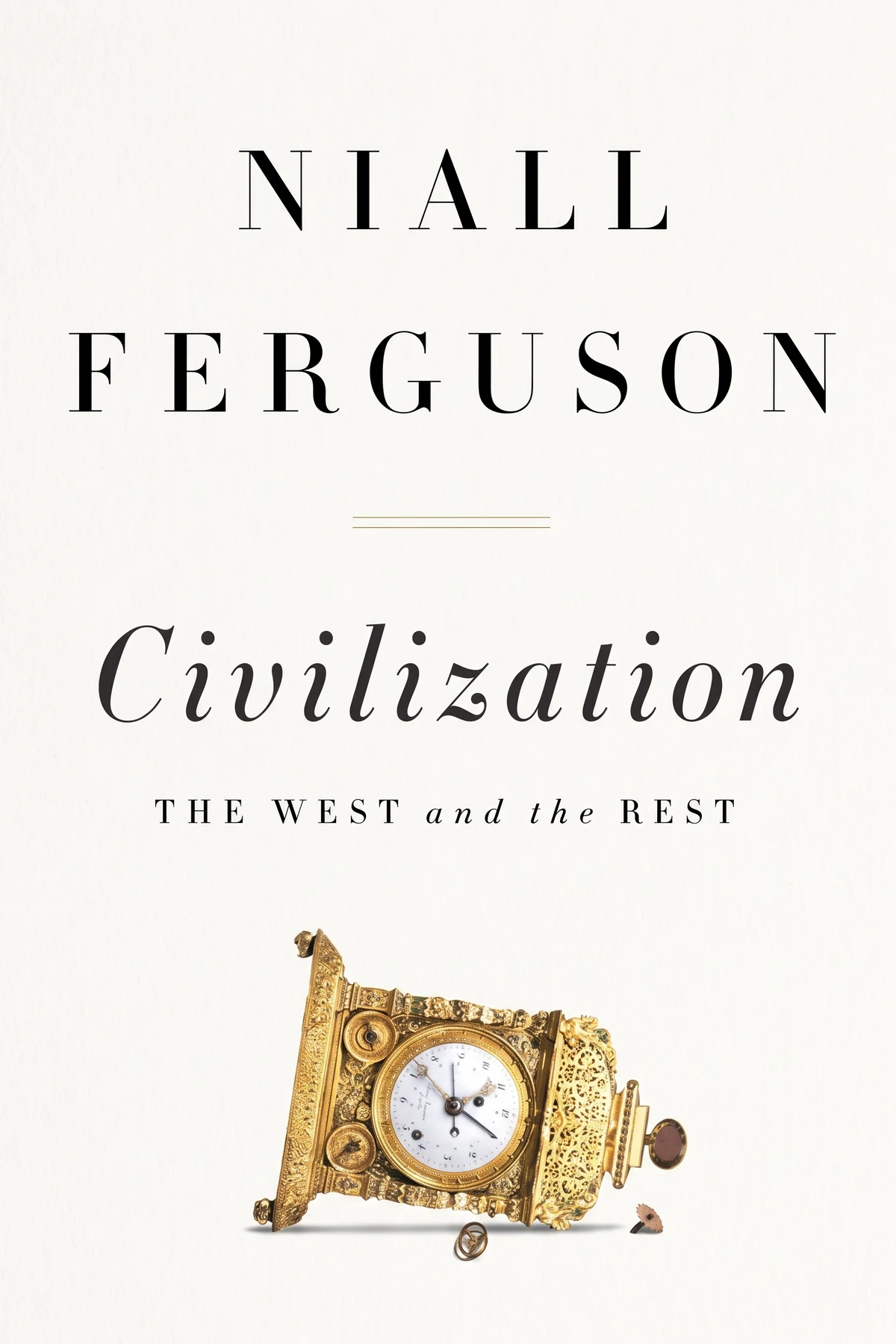
Most people carry a vague story about why some nations grew rich while others fell behind, and it rarely survives a hard question. In Civilization: The West and the Rest, historian Niall Ferguson replaces that story with a sharper one, beginning with a reversal. In the fifteenth century, Europe was a violent, unsanitary backwater beside China, which could mobilize workers to build the Forbidden City. By 1900, Western empires held sway over just under two thirds of the planet’s territory and population, along with 79 percent of its economic output.
Conquest alone cannot explain the swing, Ferguson argues, because China and the Ottomans ran vast empires too. What set the West apart were six institutions he calls killer applications: competition, science, property rights, medicine, the consumer society and the work ethic. Any society can install them, and any society can let them lapse. Follow his case and you gain a short set of questions for judging why a nation, or an organization, rises or stalls, including the one Ferguson worries about most: whether the West still remembers its own apps.
2 min 06 sec
Europe spent most of three centuries at war with itself, and its people suffered for it. Ferguson argues that the same misery handed the continent the tools it would later use to dominate the globe.
2 min 01 sec
One empire fought with artillery the world feared. Another, once far stronger, was still loading its guns with stone. The difference began with who was allowed to read and print.
1 min 54 sec
Two European powers colonized the same pair of continents and ended up with opposite outcomes: a superpower in the north, centuries of upheaval in the south. Ferguson traces the split to one early decision.
1 min 58 sec
The Black Death once halved Europe’s population, and malaria guarded the tropics. Ferguson shows how beating disease became an engine of expansion, then makes a claim about colonial rule that many will want to argue with.
1 min 58 sec
The Soviet Union could match the West in weapons and heavy industry, yet its citizens still wanted what people in the West had. Ferguson argues that the missing ingredient was a kind of power most histories leave out.
1 min 50 sec
After the Reformation, Protestant nations pulled ahead of Catholic ones, and Ferguson thinks he knows why. He also notices something unexpected about religion in China during its recent economic boom.
2 min 07 sec
Japan rebuilt itself on Western lines and caught up fast, then copied one thing too many. Meanwhile, Ferguson warns, the West may be erasing the very habits the rest of the world is borrowing.
1 min 20 sec
Ferguson’s history ends up as a portable test. Strip away the flags and battles, and he sees five centuries of Western dominance resting on habits a society either practices or neglects: rivals that force improvement, ideas free to circulate, property that comes with a voice, medicine that keeps people alive, shoppers whose demand drives work, and a culture of effort and saving. None of them belongs to the West by birth. Japan, Southeast Asia and Turkey borrowed them, and Europe, by Ferguson’s account, is letting some slip. Nor is the record clean. The same story holds the slave trade and mechanized war, and Ferguson’s kinder verdicts on empire are ones he admits others dispute.
The framework is most useful turned on something close to you. When a country, a company or a team seems to be losing ground, look for the app it has stopped running. Check whether anyone still competes with it, whether people can challenge its beliefs, whether members own a share of what they build and whether anything is being saved. And if you borrow from a winner, remember Japan and copy only what explains the success.
The Ottoman gunners with their stone cannon balls did not lack courage. They lacked a printing press.
In the fifteenth century, Europe was a violent, unsanitary patchwork of quarreling states, far behind the great civilizations of the East. Five hundred years later, Western empires controlled most of the world's land, people and economic output. Niall Ferguson sets out to explain that reversal and to ask whether it can last. He rejects the idea that empire alone made the difference, since China and the Ottomans had huge empires too. His answer is six institutions he calls killer applications: competition, science, property rights with representative government, modern medicine, the consumer society and the work ethic. He follows each through vivid cases, from Prussian artillery and Ottoman stone cannon balls to the opposite fates of British and Spanish America and the Soviet failure to supply jeans and Coca-Cola. The book ends with a warning. Japan, Southeast Asia and Turkey have copied the apps, while the West, in Ferguson's view, is forgetting its own. Readers get a clear framework for why nations rise and stall, and a provocative argument to test.
Readers who want one clear argument for why the West pulled ahead and whether it can stay there.
Students of history, economics or politics looking for a framework to debate.
Managers and founders curious how competition, trust and incentives shape any institution's rise or decline.
Niall Ferguson, born in Glasgow in 1964, is a senior fellow at the Hoover Institution and has taught at Harvard University, the London School of Economics and New York University. He was knighted in 2024 for services to literature. His books include Empire, The Ascent of Money, whose television adaptation won an International Emmy in 2009, and The Square and the Tower. Civilization was also adapted as a documentary series. He writes opinion columns and co-founded the University of Austin in 2021.

Listeners find this historical account to be deeply insightful and thoroughly documented, tracing five centuries of Western civilization. The prose is highly engaging, complemented by the author’s superb narration, and listeners describe it as a captivating journey that maintains their interest from start to finish. They value the stimulating subject matter and consider it essential, while one listener remarked that it helped bridge several gaps in their own knowledge of history.
Finally got around to reading this, and it really filled in some massive gaps in my understanding of why certain nations succeeded while others struggled. The author’s focus on property rights in North versus South America was particularly illuminating and offered a fresh perspective I hadn't considered before. While some critics find Ferguson a bit too glib, I appreciated his ability to distill complex geopolitical trends into digestible, fascinating stories. It feels like a well-researched defense of Western values, though it does occasionally veer into a territory that feels a bit too partisan. Regardless of your political leanings, it’s a must-read for anyone who wants to understand the mechanics of global power. I’m personally glad I took the time to work through this dense but rewarding historical survey.
Show moreFrankly, I found the comparison between the development of North and South America to be the most compelling section of the entire work. Ferguson argues that the different approaches to property rights and the rule of law set these two continents on entirely different trajectories. It’s a powerful argument that makes sense of why the United States became a superpower while its southern neighbors struggled with instability. The prose is brilliant, and the author narrates the history of the last half-millennium with a confidence that is hard to ignore. This isn’t just a dry textbook; it’s a vivid, often provocative exploration of why our world looks the way it does today. For those interested in geopolitics, this is absolutely a must-read that will stick with you.
Show moreAs someone who usually finds history dry, I was surprised by how much this felt like a fascinating journey rather than a lecture. Ferguson has a way of making complex economic theories feel relevant to our current global situation, particularly in his analysis of work ethics and consumption. He doesn’t shy away from controversial topics, and his take on the potential collapse of modern civilization is genuinely sobering. Some of the tangents, like the discussion on the French Revolution in the medicine chapter, felt a bit disorganized, but they were still interesting. This is a brilliantly narrated book that covers an incredible amount of ground without ever becoming boring or repetitive. It’s a thought-provoking piece of work that definitely filled in some major holes in my knowledge.
Show moreNiall Ferguson’s take on global history is nothing if not breathless, leaping through five centuries of dominance with the energy of a man who’s had too much coffee. He identifies six specific "killer apps"—from competition to the Protestant work ethic—that supposedly allowed the West to pull ahead of the Rest. While the statistics he throws around act like intellectual Molotov cocktails, I couldn’t help but feel a little exhausted by the sheer speed of his arguments. It is an insightful look at how institutional development shaped the modern world, even if it feels a bit simplistic at times. The narrative is engaging and brilliantly paced, making it a great entry point for anyone curious about the "Great Divergence." Truth is, it’s a thought-provoking journey that managed to hold my interest through some very dense subject matter.
Show moreEver wonder why the Industrial Revolution happened in Britain rather than China, which had been technologically superior for centuries? Ferguson tackles this question head-on, arguing that a unique combination of competition and science created a superior framework for growth. The chapter on consumption was especially eye-opening, showing how the desire for better clothes and goods fundamentally changed the global economy. Some parts of the book are definitely more compelling than others, and I found his take on the decline of the West to be a bit alarmist. Still, the writing is sharp and the author manages to make economic history feel like a high-stakes thriller. It’s a fascinating historical journey that challenges you to rethink what makes a civilization truly great in the long run.
Show moreAfter hearing so much about Ferguson's polarizing reputation, I went in expecting a polemic but found a remarkably well-researched narrative instead. The way he compares the development of diverse cultures through the lens of institutional "apps" is a clever, if slightly gimmicky, way to frame the story. I particularly enjoyed the section on medicine and how it was used both as a tool for progress and a justification for colonial rule. There are moments where he seems to oversimplify the role of luck, which is where his argument differs sharply from thinkers like Jared Diamond. Look, the book isn't perfect, but it’s an incredibly engaging read that makes you feel smarter for having finished it. It’s definitely one of the more thought-provoking books I’ve picked up this year.
Show moreThis book is essentially 500 years of history condensed into a high-octane roller coaster ride that rarely slows down for nuance. Ferguson is a master storyteller, and his ability to weave together disparate threads like the Ming dynasty and the American Revolution is truly impressive. He makes a compelling case for why things like the rule of law and the work ethic were essential to Western ascendancy. However, the sheer volume of information can be overwhelming, and I found myself needing to pause frequently to process his rapid-fire statistics. Not gonna lie, some of his pop-culture references felt a bit out of place in a serious academic work. Despite that, the book remains a fascinating historical journey that successfully bridges the gap between scholarly research and popular reading.
Show moreTo be fair, the chapter on medicine and its role in colonial Africa was eye-opening, even if the author's tone can be a bit dismissive at times. I appreciated the deep dive into the specific institutions that helped the West gain its footing, particularly the emphasis on competition between petty European states. However, I felt that Ferguson’s focus on the "Best" countries meant he ignored a lot of the world that didn't fit his specific narrative. The writing is certainly engaging, but I occasionally felt like I was being lectured by a very smart, very confident professor who wasn't open to questions. It’s a solid read if you’re looking to fill in historical gaps, but take some of the broader conclusions with a grain of salt. It is an insightful book, but it lacks the balance I was hoping for.
Show morePicked this up on a whim and was immediately struck by how Ferguson uses statistics as weapons to drive his points home. He moves at 120 miles per hour, jumping from the Ottoman Empire to the invention of the printing press in just a few paragraphs. While I found the concept of the "six killer apps" useful for organizing the information, it did feel a bit like history for the iPhone generation. There are plenty of aha moments throughout the book, but I wish he had spent more time exploring the counter-arguments to his thesis. Gotta say, I found it to be a gripping read that offered a lot of food for thought regarding the future of Western dominance. It’s a well-researched effort, even if it feels like it’s trying a bit too hard to be provocative.
Show moreThe whole "killer apps" branding feels like a desperate attempt to sound hip, which is ironic for a book defending traditional Western institutions. Ferguson is clearly a brilliant researcher, but his tone can be incredibly condescending to anyone who doesn't subscribe to his specific worldview. He dances through five hundred years of history, often ignoring the darker aspects of imperialism to focus on his chosen themes of competition and medicine. While some of the anecdotes are interesting, the overall structure felt a bit disorganized and prone to strange tangents about the French Revolution. I wanted to like this more, but it felt more like a political manifesto than a balanced historical analysis. In my experience, there are better books on this subject that offer more nuance without the elitist snark.
Show moreFerguson argues that the West went from a fifteenth-century backwater to controlling most of the world’s land, people and output by 1900 because it developed six institutions he calls killer applications: competition, science, property rights with representative government, modern medicine, the consumer society and the work ethic. Empire alone cannot explain it, he says, since China and the Ottomans had huge empires too.
They are competition among Europe’s warring states, which produced banks and bond markets; the scientific revolution, helped by literacy and printing; property rights tied to representative government; modern medicine; a consumer society in which demand drove industry and wages; and a Protestant work ethic that rewarded effort, trust and saving. Ferguson treats each as an institution that other societies can adopt.
He is uncertain and leans toward worry. Western economies were hurt by the financial crisis and carry heavy debts, while China keeps growing. He argues that Westerners have forgotten some of their own apps, working fewer hours and saving less because of easy credit, and that teaching since the 1960s has weakened their self-confidence. The rest are rising largely by adopting Western institutions.
Ferguson says many have. Japan remade its institutions and dress on Western lines in the late nineteenth century, Southeast Asian nations copied the Western industrial model after World War II, and Turkey even adopted a Western alphabet. But copying blindly is risky: Japan imitated Western empire as well, which ended in disaster in 1945.
Use the six apps as a checklist for any country, company or team that seems to be losing ground. Ask whether it still faces real competition, whether people can question its beliefs and share findings, whether members have a stake in what they build, whether it gives people things worth working for, and whether it saves. When borrowing from a successful rival, copy only what explains the success.


Michael Axworthy

Tom Standage

Ishmael Beah




William J. Bernstein

Ben Macintyre

AUDIO SUMMARY AVAILABLE
Get the key ideas from Civilization by Niall Ferguson, plus 5,000+ more nonfiction titles.