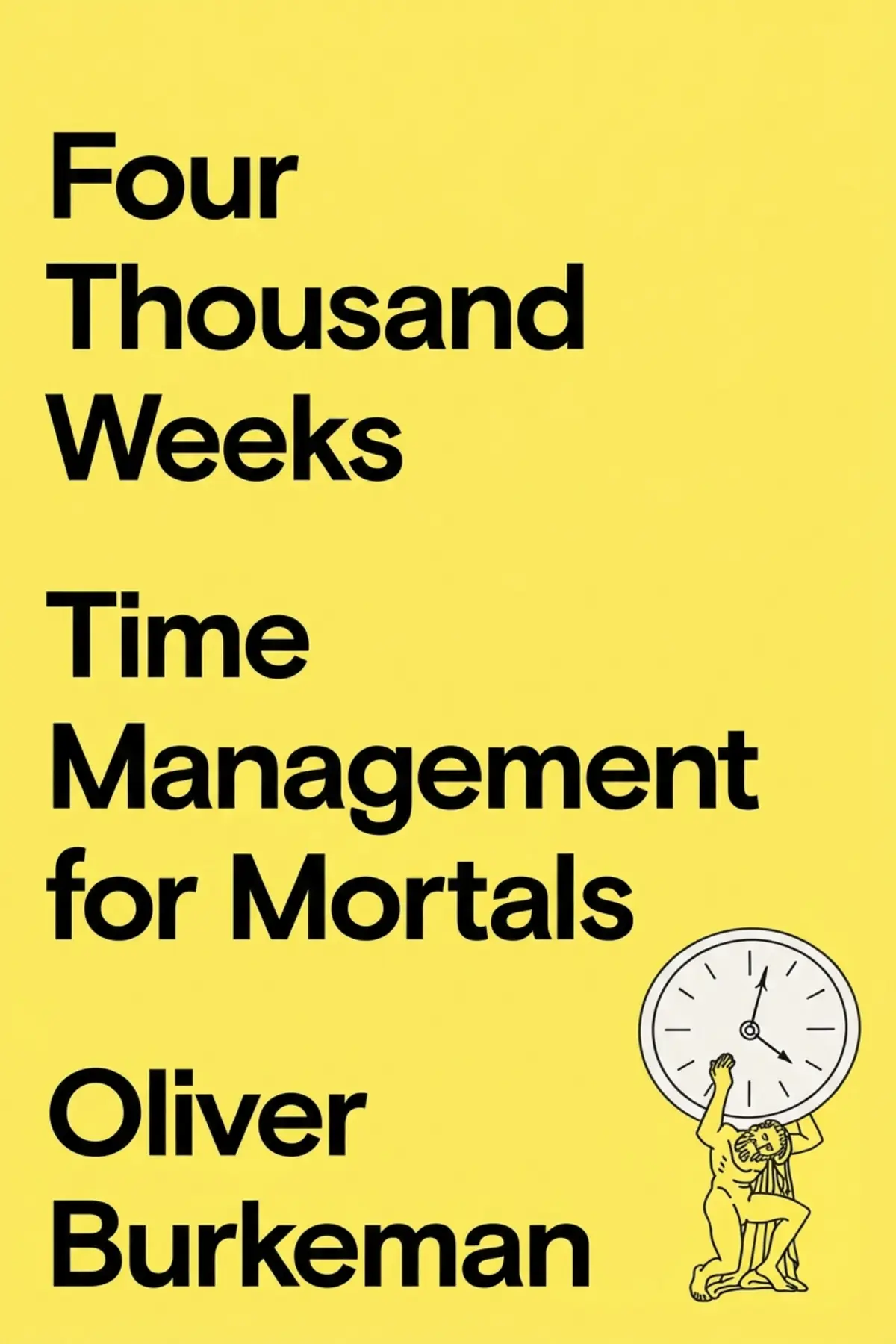
Four Thousand Weeks: Time Management for Mortals
Oliver Burkeman
 English
 ไทย
Explains why forced positivity and goal-setting slogans often make people less happy. It offers older methods built on facing the negative instead: picturing the worst, accepting failure, tolerating uncertainty and remembering death.
1 min 08 sec
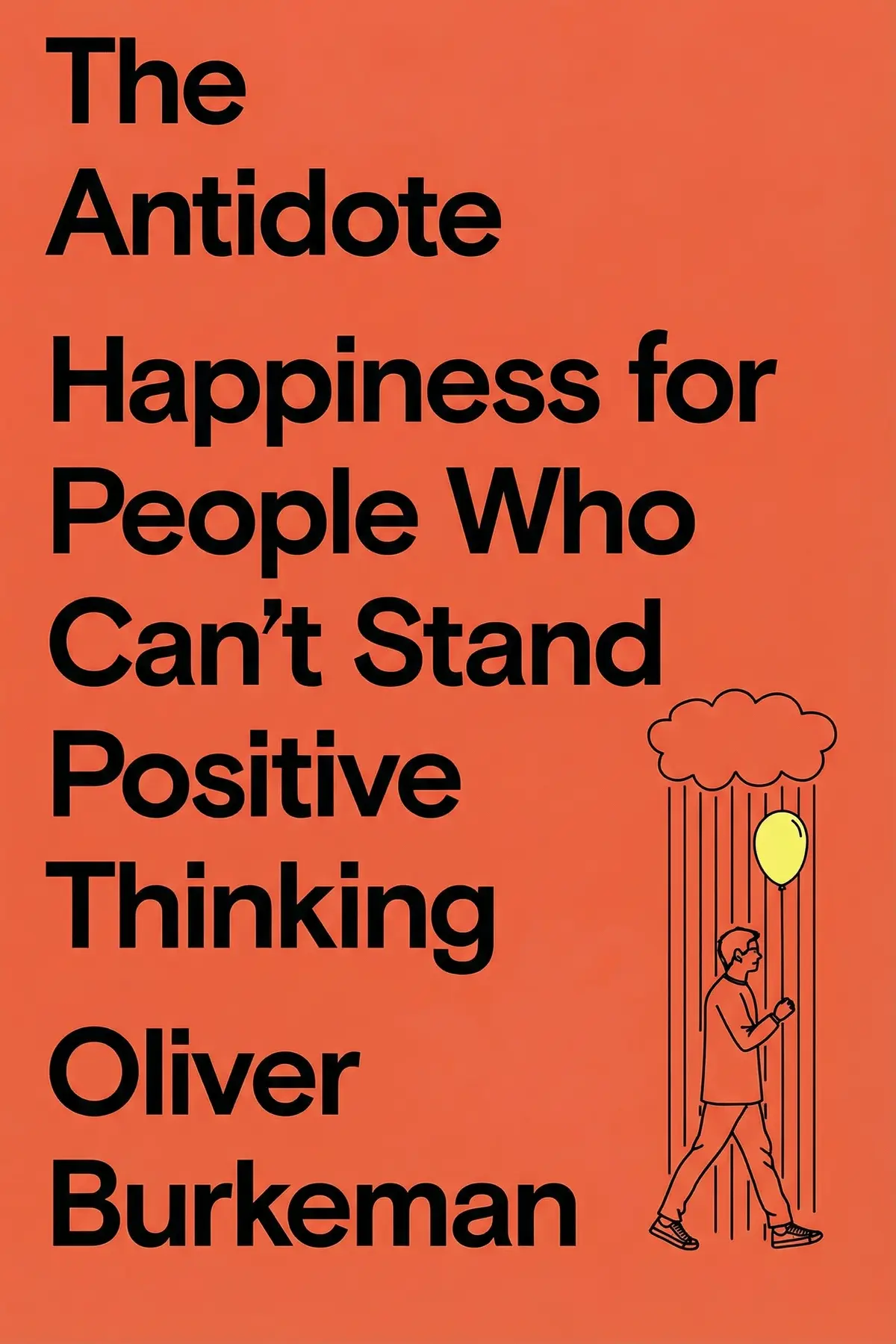
If a cheerful self-help book has ever left you feeling worse than before, the fault may lie with the method. In The Antidote, journalist Oliver Burkeman argues that the push to think positively is often what keeps us unhappy: the harder we chase good feelings, the further they slip away. His alternative sounds backward but has a long history behind it.
Stoic philosophers, Buddhist teachers, a Stoic-minded psychologist and a Mexican holiday all point the same way. Calm comes from turning toward the things we try hardest to avoid, namely failure, uncertainty, fear and death. Every idea that follows supports that claim.
Burkeman begins by taking apart the happiness industry, including a celebrated study of goal-setting that turned out to be invented. Then he offers older tools: rehearsing the worst on purpose, treating moods like weather, and keeping mortality in sight. What you get is a handful of practices for steadiness that work even on days when you feel nothing like positive.
1 min 54 sec
Bestselling advice promises a better life through goals and affirmations. Yet a fake study, a white bear and a set of uncomfortable experiments suggest the chase itself may be what keeps people stuck.
1 min 49 sec
A motivational speaker told a packed hall to erase one word from the dictionary, and days later events made a fool of him. The story hints at how much of what we call success is something else entirely.
1 min 48 sec
A Roman emperor claimed that events themselves cannot hurt us. His school turned that idea into a strange daily exercise, and it also explains why comforting a worried friend can make things worse.
1 min 52 sec
A psychologist sent anxious clients onto the subway with one embarrassing task. What they discovered there reveals how badly we predict our own discomfort, and what to do about it.
1 min 43 sec
People spend years hunting for closure and clear answers that never arrive. A psychologist invented a word for the opposite attitude, and it turns out to be a skill anyone can practice at work.
1 min 57 sec
Procrastination usually gets blamed on a lack of motivation. A Buddhist image of sky and weather, and an experiment with electric shocks, suggest the real obstacle is something else.
1 min 38 sec
One of the happiest nations in the world throws a party for its dead. Ancient Rome had its own ritual of mortality, built to protect its most powerful men at their moment of triumph.
1 min 09 sec
The Antidote never asks anyone to be gloomy. It asks them to stop treating every bad feeling as an emergency. Burkeman’s case is that the effort to feel good is often what keeps us anxious, and that the people who found steadier ground, from Roman generals to Ellis’s subway riders, got there by walking toward what they feared. Failure, uncertainty, loss and death stay in the picture. Looked at directly, they lose most of their grip.
The practices that follow are modest. Before something matters, picture it going wrong, and notice how much more you value what you already have. Stage one small embarrassment on purpose and measure it against your dread. When a friend is spiraling, hold back the easy promise that the worst won’t happen. And on a day when you don’t feel like working, treat the mood as weather and start anyway.
None of this guarantees happiness, and Burkeman would say that’s the point. The calm he describes belongs to someone who has stopped needing to win the chase: the weather keeps changing, and the sky stays where it is.
Self-help promises happiness through affirmations, big goals and relentless optimism. Oliver Burkeman thinks much of that advice is thin, some of it is false, and a good deal of it makes people feel worse. He points to the white bear you cannot stop picturing once you are told not to, to experiments in which repeating flattering phrases lowered people's mood, and to a famous study of goal-setting that never took place. His alternative is what he calls the negative path to happiness. Stoic philosophers deliberately imagined losing what they valued. The psychologist Albert Ellis sent fearful clients onto the subway to embarrass themselves on purpose. Buddhists treat moods as passing weather, and Mexicans toast death itself on the Day of the Dead. Readers get a set of practical habits for steadiness that do not depend on feeling good first. They learn to rehearse the worst so it loses its grip, to keep working when motivation is missing, to stop over-reassuring anxious friends, and to keep mortality in view so that ordinary life feels worth savoring.
Readers worn out by self-help optimism who still want practical ways to feel steadier.
Professionals who stall on work, dread embarrassment or lie awake rehearsing worst cases.
Anyone curious how Stoic and Buddhist ideas apply to failure, uncertainty and mortality today.
Oliver Burkeman, born in 1975, is a British author and journalist. As a feature writer at The Guardian, he wrote the weekly psychology column This Column Will Change Your Life. He won the Foreign Press Association's Young Journalist Award and was shortlisted for the Orwell Prize. His 2021 book Four Thousand Weeks draws on philosophy and psychology to explore how people handle time and find happiness.
Listeners find this work intellectually stimulating and accessible, featuring captivating prose that offers an intriguing perspective on the concept of happiness. They enjoy its unique approach to positive thinking, as one listener points out how the material assists in coexisting with both pleasant and unpleasant feelings. The book earns praise for its self-improvement content, with one review emphasizing its useful meditation instructions, while listeners also treasure the title's humor and easy-to-follow style.
Picked this up after years of failing at 'manifesting' and feeling like a failure because I couldn't visualize my way into a better life. The story about the cancer patient who felt guilty for her relapse because her 'positive thoughts' weren't strong enough broke my heart and clarified everything for me. Burkeman writes with a dry, British wit that makes heavy topics like death and failure feel approachable rather than depressing. I especially loved the sections on Stoicism and how imagining the worst-case scenario can actually lower your anxiety. This isn't just another self-help book; it’s a necessary correction to a toxic culture of optimism. It provides a toolkit for finding contentment by taking in the totality of life, rather than filtering out the bad parts.
Show moreWow, this was exactly what my cynical heart needed to hear this month. Burkeman explores why our relentless drive for security and 'closure' actually makes us feel more precarious and anxious. One of the most fascinating parts was the 'Museum of Failure,' which reminds us that success is often just the final iteration of many, many mistakes. To be fair, some of the Buddhist concepts were simplified, but for a popular psychology book, it strikes a great balance between research and storytelling. It helped me realize that I don't need to be 'motivated' to get things done; I just need to show up regardless of my mood. It’s liberated me from the pressure of constant cheerfulness and allowed me to embrace the 'strange, excited comfort' of life's mysteries.
Show moreTruth is, I’ve spent way too much money on books that promised to change my life in ten easy steps, and none of them worked. 'The Antidote' doesn't promise a miracle; it suggests that 'not-doing' and sitting with discomfort might be the real key to a better life. I loved the concept of 'openture'—the idea of staying open to the messy, unresolved parts of existence instead of constantly seeking closure. Burkeman’s narration on the audiobook is excellent, making the complex philosophical arguments feel like a conversation at a pub. It’s a refreshing reminder that it’s okay to be human, to fail, and to not have everything figured out. Truly life-changing in a quiet way that respects the reader's intelligence.
Show moreEver wonder why the more you try to be happy, the more miserable you feel? Burkeman dives deep into this paradox, arguing that our cultural obsession with 'positive thinking' is actually the problem. Instead of forcing a smile, he explores the 'negative path'—embracing uncertainty and even failure as legitimate parts of a well-lived life. The chapter on the dangers of goal-setting, using the 1996 Everest disaster as a cautionary tale, was particularly chilling. It’s a refreshing, intellectual take on a genre that is usually filled with fluff. While some of the philosophical bits felt a little rushed, the overall message is incredibly grounding. To be fair, he relies heavily on his background as a Guardian journalist to keep things readable, which makes the complex psychological research far more digestible for a casual reader.
Show moreFinally, someone had the guts to say that 'the secret' to happiness is mostly nonsense. This book argues that true contentment comes from 'negative capability'—the ability to stay in uncertainty without reaching for facts or reason. The truth is, sometimes life is just hard, and trying to 'positive-think' your way out of it only adds a layer of shame to your suffering. I found the section on meditation particularly helpful because it focused on observing thoughts rather than trying to silence them. It’s a bit repetitive in the middle, but the insights into how we handle failure make it worth the price of admission. Highly recommended for the skeptics among us who want a healthier, more realistic way of living without the saccharine sweetness of traditional motivational speakers.
Show moreAfter hearing so much about the 'cult of optimism,' I found this deep dive into the benefits of pessimism surprisingly uplifting. Burkeman suggests that by confronting our mortality and the possibility of failure, we actually strip them of their power over us. The chapter on 'Memento Mori' was a standout, showing how different cultures, like those in Mexico during the Day of the Dead, embrace death as a part of life rather than a taboo. My only gripe is that some of the solutions seem geared toward a very specific, disciplined personality type. As a procrastinator, I found the advice to 'just work regardless of mood' much easier said than done. Nonetheless, it’s an incredibly thought-provoking read that challenges the modern obsession with safety and security.
Show moreThis book is a cogent synthesis of psychology and philosophy that offers a much-needed reality check for the modern world. I loved the reference to 'The Wire' at the start of a chapter—it set the tone perfectly for a book that values realism over hokum. Burkeman explains how our obsession with setting rigid goals can lead to 'goalodicy,' where we pursue a target even when it’s clearly become destructive or deadly. It’s a fascinating look at how Murphy’s Law applies to our mental states: the more we try to control our feelings, the more out of control they become. It’s witty, well-researched, and thankfully devoid of the usual 'rah-rah' energy found in this genre. It's a toolkit for a more genuine existence.
Show moreFrankly, this should be required reading for anyone who feels exhausted by the pressure to 'stay positive' during difficult times. The book explores the 'negative path' to happiness, which involves embracing insecurity rather than trying to outrun it. I was particularly struck by the discussion on how our pursuit of safety often makes us objectively less safe, referencing security expert Bruce Schneier. While the author can be a bit of a curmudgeon at times, his insights into the futility of thought-suppression are backed by solid psychological research. It’s not a perfect guide—the ending feels a bit abrupt—but it’s an engaging and often hilarious look at the 'mystery' of being alive. It definitely changed my perspective on what it means to be successful.
Show moreIt’s a bit ironic to read a self-help book that spends its first fifty pages mocking the entire concept of self-help books. Burkeman is a talented writer, and his journalistic background shines through in his interviews, but the transition from criticizing others to offering his own 'antidote' felt a little bumpy. He relies heavily on Alan Watts and ancient Stoics, which is fine, but if you’ve already read primary sources like Seneca or Marcus Aurelius, you might find this a bit redundant. Look, it’s a great introduction for the uninitiated, but the 'negative path' isn't quite as revolutionary as the marketing suggests. Still, it’s a readable and occasionally funny critique of the optimism industry that might help you stop suppressing negative thoughts, even if it doesn't offer a perfect solution.
Show moreLook, I really wanted to like this, but the author’s tone frequently crossed the line from 'skeptical' to just plain 'obnoxious.' He spends so much time deriding motivational speakers that he forgets to build a cohesive argument of his own. The inconsistency is frustrating: he mocks others for a lack of rigor while building his entire thesis on cherry-picked anecdotes and pop-philosophy. If you want to learn about Stoicism, you are much better off reading primary sources or more focused commentary like 'A Guide to the Good Life.' It felt like a collection of magazine columns stretched out into a book length without enough new material to justify the page count. Personally, I found the constant 'ra-ra-ra' of his anti-optimism just as tiresome as the optimism he hates.
Show moreBurkeman argues that positive thinking often fails to make people happier and can make them less happy, because trying to force good feelings backfires, much like trying not to picture a white bear. He proposes a negative path instead: accepting failure, tolerating uncertainty, picturing the worst on purpose and keeping death in mind, drawing on the Stoics, Buddhism, psychology and cultural traditions such as Mexico’s Day of the Dead.
According to Burkeman, people who rely on affirmations often have low self-esteem, so a glowing phrase clashes with how they already see themselves. The mind protects that existing self-image and rejects the message. In several experiments, people with low self-esteem who repeatedly wrote that they were lovable ended up less happy than before, which suggests the phrases can reinforce the very negativity they were meant to fix.
Negative visualization, which the Stoics called the premeditation of evils, means deliberately imagining losing something you value or facing a feared outcome. Burkeman explains two benefits: real misfortunes usually turn out milder than what you rehearsed, and the thing you imagined losing becomes precious again instead of taken for granted. Albert Ellis applied a similar idea by having fearful clients embarrass themselves on the subway.
Burkeman borrows a Buddhist image: the mind is the sky and moods are passing weather. When you put off a task because you don’t feel like it, the real problem is believing you must feel motivated before starting. Notice the reluctance, accept that it will pass, and do the work alongside it instead of waiting for enthusiasm to arrive.
It suits readers who find upbeat self-help hollow but still want to feel calmer and more resilient. People who fear failure or embarrassment, struggle with uncertainty at work, procrastinate, or avoid thinking about death will find concrete practices. It also works as an accessible introduction to how Stoic and Buddhist thinking can be applied to modern life.

Richard Wiseman





William B. Irvine


Andrew D. Thompson


Deepak Chopra
AUDIO SUMMARY AVAILABLE
Get the key ideas from The Antidote by Oliver Burkeman, plus 5,000+ more nonfiction titles.