
13 min 04 sec
Available in: English
The Alcohol Experiment: A 30-day, Alcohol-Free Challenge to Interrupt Your Habits and Help You Take Control
By Annie Grace
Shows why cutting back on drinking feels so hard, and how a 30-day alcohol-free experiment can loosen alcohol's hold. The method is to question honestly each reason you drink instead of relying on willpower.
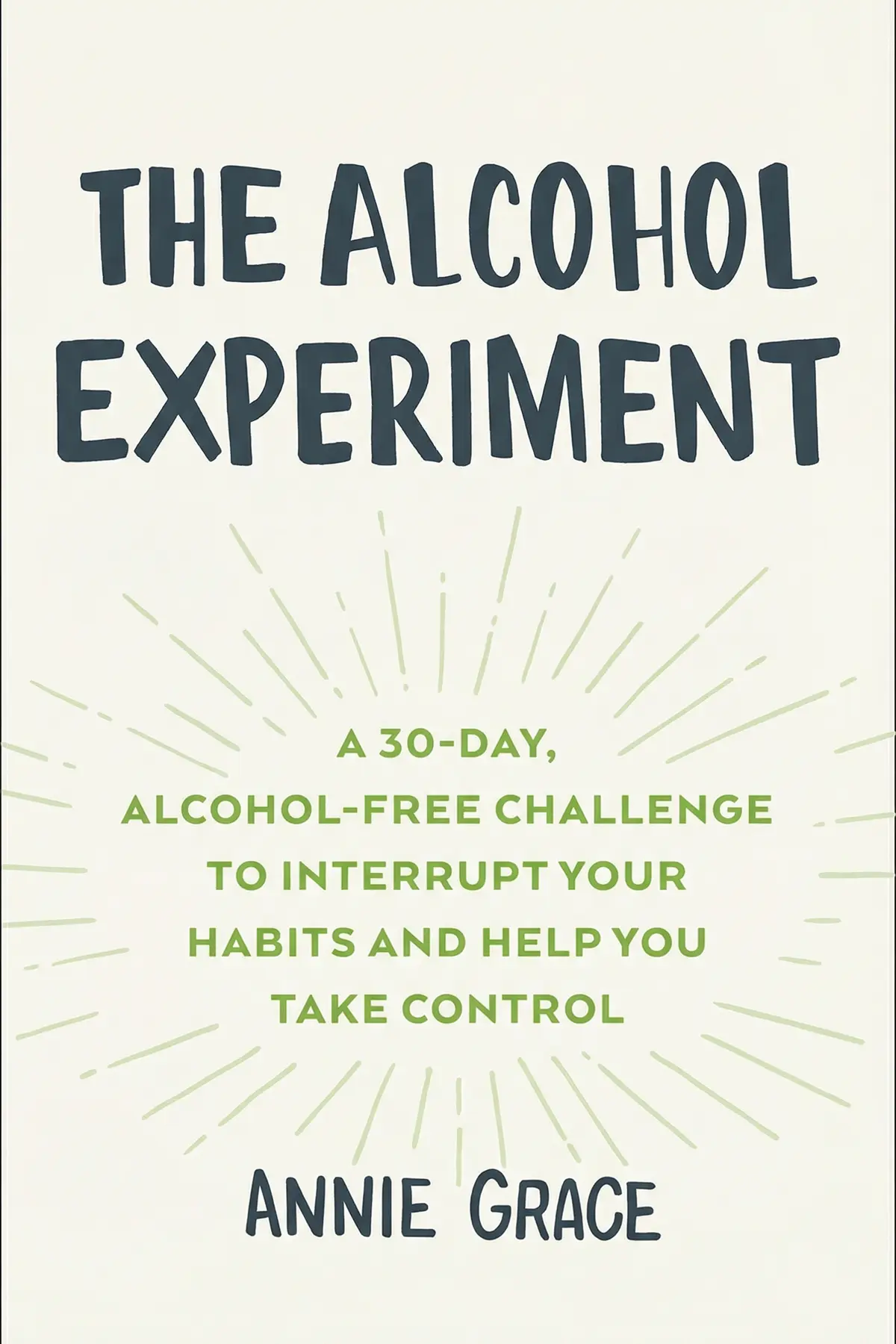
Table of Content
1. Introduction
1 min 00 sec
If your evenings keep ending with a glass you half wish you had skipped, the problem may not be weak character. In The Alcohol Experiment, former marketing executive Annie Grace argues that drinking less is hard because two parts of the mind disagree. The conscious part wants to cut back, while an unconscious part has spent years learning that alcohol helps.
Her answer is a 30-day break from drinking, run as an experiment: a month to test each of those old beliefs against what actually happens. The whole book rests on one claim. Change lasts when you take apart the beliefs that make alcohol feel necessary, and it rarely lasts when you simply fight the urge.
Along the way, Grace visits a goat farm, a splash of Baileys in morning coffee, the brain chemistry behind the second glass and a friendship that grew closer once the margaritas stopped. What you take from it is a method for questioning any reason you drink, and a forgiving way to measure your progress.
2. Stop relying on willpower to drink less
1 min 51 sec
A plate of homemade cookies can undo a whole day of good intentions in seconds. Grace uses that small moment to explain why knowing better so rarely changes what ends up in your glass.
3. Question the taste you think you love
1 min 40 sec
A farmer who cannot smell his own goats and a friend who cannot taste the liqueur in her coffee share a blind spot. Grace turns it into a quick test anyone can run on their favorite drink.
4. See what makes one glass turn into two
1 min 47 sec
The first drink of the evening feels wonderful, yet stopping there feels almost impossible. Two brain chemicals working against each other explain the pull, and naming them changes how the next glass looks.
5. Drinking to relax leaves you more stressed
1 min 58 sec
Relaxation tops most people’s list of reasons to drink. Grace takes that belief apart with two lists and a look at what alcohol does to your stress hormones in the days after a big night.
6. Deeper friendships without a drink in hand
1 min 56 sec
Friends may push back when you stop drinking, and one of Grace’s friends stopped making plans altogether. What happened when they finally met sober surprised them both.
7. Count a slip as progress and keep going
1 min 46 sec
One drink in the middle of a 30-day challenge can feel like total failure. Grace borrows a lesson from the corporate world that turns the same month into a result worth celebrating.
8. Conclusion
1 min 06 sec
Grace’s case comes down to this: alcohol keeps its hold through stories, and stories can be checked. Society treats drinking as relaxation, fun and friendship. She sees an addictive, harmful substance that adds stress, slows the brain and blocks the very closeness people hope it brings. Each belief, from the taste to the calm to the social glue, weakens once you look at it with fresh eyes, the way a visitor notices the goat farm smell its owner has long stopped noticing.
The month is the tool. Before you start, take a photo of yourself and note your weight; Grace expects many people to be pleasantly surprised after thirty days without the extra calories from drinking. When a reason to drink comes up, run it through awareness, clarity and turning it around. Choose one line you will not cross. And if you slip, do the arithmetic before the self-criticism.
Your brain may tell you to pour a drink tonight. The same brain, Grace argues, can be reprogrammed, one alcohol-free day at a time.
About this book
What is this book about?
Many people who drink know they would feel better drinking less. They are tired of hangovers, the extra calories and the money spent, yet the evening glass keeps appearing. Annie Grace argues that this is no failure of character. It is a conflict between a conscious mind that wants change and an unconscious mind trained for years to believe alcohol helps. Her answer is a 30-day break used as an experiment. During that month, readers examine each belief they hold about drinking: that it tastes good, that it relaxes them, that it brings friends closer. Grace offers a simple three-step tool for this, explains the brain chemistry that makes one glass call for another, and shows how alcohol raises stress hormones for days. The book also deals with the social side and with setbacks. It covers how to answer friends who push you to have just one, how to set lines you will not cross, and how to count a slip as a percentage instead of a defeat. Readers get a practical, low-pressure way to take back control, one day at a time.
Book Information
Who it's for
Professionals questioning nightly drinks
Professionals who unwind with a nightly glass and suspect it now costs more than it gives.
Struggling to cut back
People who have tried to cut back on willpower alone and keep ending up at the bar.
Considering a sober month
Anyone curious about a sober month who wants a forgiving, practical plan.
About the Author
Annie Grace
Annie Grace grew up in a one-room log cabin near Aspen, Colorado, with no electricity or running water. After a master's degree in marketing, she became the youngest vice president in her multinational company at 26 and later led marketing across 28 countries. Her drinking grew heavy over those years. Looking for a way to regain control without feeling deprived or stigmatized, she stopped drinking, left her executive role and wrote This Naked Mind. She lives in the Colorado mountains with her husband and three children.
Ratings & Reviews
Ratings at a glance

What people think
Listeners find this work to be a captivating experience filled with deep insights grounded in scientific study. The content is often called transformative, as it guides listeners to grasp the biological impact of alcohol and reevaluate their personal habits. They also value the actionable strategy, with one listener mentioning the structure of daily segments, alongside the sincere tone. Listeners note improvements in both their physical wellbeing and mental clarity after following the plan.
Top reviews
Prayoon
Picked this up on a whim after a particularly rough hangover, and I wasn’t expecting the results to actually stick. The daily reading format is the real secret sauce here because it keeps the goal small and manageable instead of overwhelming you with a lifetime commitment. Annie Grace breaks down the biology of ethanol in a way that feels like a revelation rather than a lecture. I’ve noticed a massive shift in my morning energy levels and my skin looks ten years younger. Truth is, I didn't think I had a 'problem,' but this experiment showed me how much space alcohol was taking up in my subconscious. It’s a fascinating, heartfelt guide that prioritizes mindfulness over willpower. I’m moving on to This Naked Mind next because this approach just works for my brain.
Show moreSirichai
Finally, a resource that doesn’t make you feel like a total failure for having a drink. As someone who has tried the traditional 12-step route and found it too rigid, Grace’s 'experiment' mindset was a breath of fresh air. She doesn't demand you swear off booze forever on day one; instead, she invites you to be a curious observer of your own life. The chapter on how marketing has conditioned us to view alcohol as a necessary social lubricant was eye-opening. Not gonna lie, the first week was tough, but by day 20, the mental fog had completely lifted. My sleep has improved dramatically and the constant low-grade guilt is gone. This is a practical, compassionate tool for anyone questioning their relationship with alcohol. It’s about freedom, not restriction.
Show moreTakeshi
Does alcohol actually help with anxiety, or is it just a temporary mask that makes the next day ten times worse? This book answered that question for me with cold, hard facts that were impossible to ignore. I’ve struggled with 'hangxiety' for years, and following this 30-day program has done more for my mental health than any supplement or self-help book I’ve tried recently. I loved that it’s broken down into daily readings, which makes the commitment feel less daunting for a busy professional. The stories from the community were a nice touch, even if they felt a bit repetitive after a while. I feel more empowered and in control than I have in a decade. If you're feeling stuck in a cycle of drinking and regretting, just buy the book. It’s a small investment for your sanity.
Show moreParichat
Wow, I never realized how much space booze was taking up in my brain until I committed to these thirty days! I started this because my doctor mentioned my liver enzymes were slightly elevated, and I’m so glad I did. Annie Grace makes the science accessible without being condescending, and the daily structure kept me accountable when I usually would have given up by Tuesday. I’m way less anxious and much more calm during my kids’ bedtime routine now. (Bet my husband is loving this new, less irritable version of me!) The book is life-changing because it changes how you think, not just how you act. Experience your future social engagements sober and actually remember them. This is an excellent, heartfelt guide to reclaiming your time and your health.
Show moreTariq
After hearing about 'The Alcohol Experiment' on a podcast, I decided to give it a go just for the health stats. I ended up staying for the radical mindset shift. The way Annie Grace explains the 'dynorphin' response changed everything for me. It finally clicked why that second glass of wine never feels as good as the first one. I’ve completed the 30 days and honestly, I don't miss the headaches or the midnight wake-up calls. My mental clarity is at an all-time high, and I feel empowered to make choices based on facts rather than social pressure. It’s a fascinating read that turns the traditional 'sobriety' narrative on its head. Highly recommended for the sober curious who want to understand the 'why' behind their habits.
Show moreNum
This book provides a fascinating deep dive into why we reach for the glass in the first place. I appreciated the heavy focus on scientific research regarding dopamine and cortisol, as it helped me understand my own anxiety loops. To be fair, some of the chapters feel a bit like a sales pitch for her online community, which can be distracting when you’re trying to focus on the daily tasks. However, the systematic deconstruction of social drinking 'benefits' is incredibly effective. The tone is mostly encouraging, though it occasionally veers into being a bit too 'cheerleadery' for my personal taste. If you can get past the repetitive 'poison' terminology, there is a wealth of life-changing information in these pages. It’s a solid 30-day roadmap for anyone looking to recalibrate their internal chemistry.
Show moreYok
As someone who identifies as an athlete, I was initially skeptical of the 'couch-potato' vibe some other reviewers mentioned. However, I found that the focus on physical health and performance actually resonated with my lifestyle quite well. The book emphasizes how even moderate drinking sabotages your recovery and metabolic health, which was the push I needed. Frankly, the middle section of the challenge dragged a bit, and I didn't find the journaling prompts all that inspiring. But the core message about breaking mental ruts is powerful. I didn't end up quitting forever, but I now have the tools to drink mindfully rather than out of habit. It’s a practical deconstruction of a very normalized drug. Most people could benefit from this perspective shift, even if they don't follow it to the letter.
Show moreOksana
The systematic deconstruction of my daily rituals was the most uncomfortable yet rewarding part of this journey. Grace is excellent at pointing out the invisible scripts we follow, like needing a glass of wine to cook dinner or to wind down after work. In my experience, the science-heavy chapters were the most compelling, while the more emotional 'grace notes' felt a bit fluffy. Some sections definitely feel like they are leaning into diet culture, which might be a turn-off for some readers. Still, the impact on my overall well-being is undeniable. I’ve lost weight, my blood pressure has stabilized, and I’m much more present for my family. It’s not a magic bullet, but it’s a very effective toolkit for anyone wanting to see what life looks like without a blur.
Show moreMint
Look, the physiological information Annie Grace shares is top-notch, but the delivery is often hit-or-miss for me. While I found the breakdown of acetaldehyde and brain chemistry helpful, the constant referrals to alcohol as 'poison' felt preachy and eventually became annoying. It seemed like she ran out of steam in the final third of the book, with some chapters—like the one on social media—feeling like they were written for a much older, less tech-savvy audience. I also felt the 'Einstein was bored too' anecdotes were a bit trite for a book that claims to be science-based. It’s a decent guide for a 30-day break, but it often contradicts itself by saying it's an experiment while clearly pushing for total abstinence. It’s worth a read, but keep a critical eye on the uneven writing.
Show moreSun
Personally, I found this to be one long sales pitch for the author's other programs and websites. While the first few chapters offered some interesting statistics, the book quickly became redundant and surprisingly judgmental for something that claims to be 'grace-based.' The author continuously degrades studies that don't support her point while citing equally flawed research that does. I also found the chapter about not believing social media to be incredibly patronizing, as if the reader has never used the internet before. It attempts to speak to people with severe dependencies and casual weekend drinkers simultaneously, and the result is an uneven tone that doesn't quite serve either group well. I finished the thirty days, but I did it despite this book, not because of it. There are better resources out there.
Show moreQuestions about this book
What is The Alcohol Experiment about?
Annie Grace offers a 30-day alcohol-free challenge framed as an experiment. She argues that drinking less is hard because the conscious mind wants to stop while the unconscious mind holds years of beliefs that alcohol helps. During the month, readers test those beliefs one by one, including that alcohol tastes good, relaxes us and brings friends closer, and replace them with what they actually observe.
What is the ACT method in The Alcohol Experiment?
ACT is Grace’s three-step tool for testing a belief about drinking. First, become aware of the belief by saying it out loud, such as I drink because it tastes good. Second, seek clarity by examining the evidence, for example how your first taste of alcohol actually felt. Third, turn the belief around into a truer statement, such as I don’t drink for the taste.
Does alcohol really reduce stress, according to Annie Grace?
Grace argues it does the opposite. Alcohol only mutes stress until the next morning and leaves the cause untouched, while adding new problems such as hangovers at work. Physically, the body counters this depressant by releasing cortisol and adrenaline, which she says take a week to clear, so regular drinkers live with raised stress hormones almost constantly.
What should I do if I drink during a 30-day challenge?
Don’t treat it as failure. Grace suggests thinking like a business that celebrates small percentage gains. Someone who normally drinks nightly and abstains for 30 days cuts their yearly drinking by 8 percent, and slipping on five of the thirty days still means an 84 percent success rate. She also recommends setting a non-negotiable line, such as memory loss, that triggers a stricter response.
Who should read The Alcohol Experiment?
It suits regular drinkers who are not looking for a lifelong vow but want to see how life feels without alcohol for a month. It helps people who have relied on willpower and slipped, people who drink to cope with work stress, and anyone worried about how friends will react to a sober stretch.
Readers also enjoyed






A Guide to the Good Life: The Ancient Art of Stoic Joy
William B. Irvine




A High-Performing Mind: Strengthen Your Mind and Live Your Best Life
Andrew D. Thompson
AUDIO SUMMARY AVAILABLE
Listen to The Alcohol Experiment in 15 minutes
Get the key ideas from The Alcohol Experiment by Annie Grace, plus 5,000+ more nonfiction titles.
- 5,000+ titles
- Listen as much as you want
- 7-day free trial
- Cancel anytime









