



14 min 12 sec
Available in: English
The 5 Resets: Rewire Your Brain and Body for Less Stress and More Resilience
Shows how to read stress as a signal from an overloaded brain, then calm it with five small resets covering goals, screens, body, breaks and self-talk, each shaped to fit your own life.
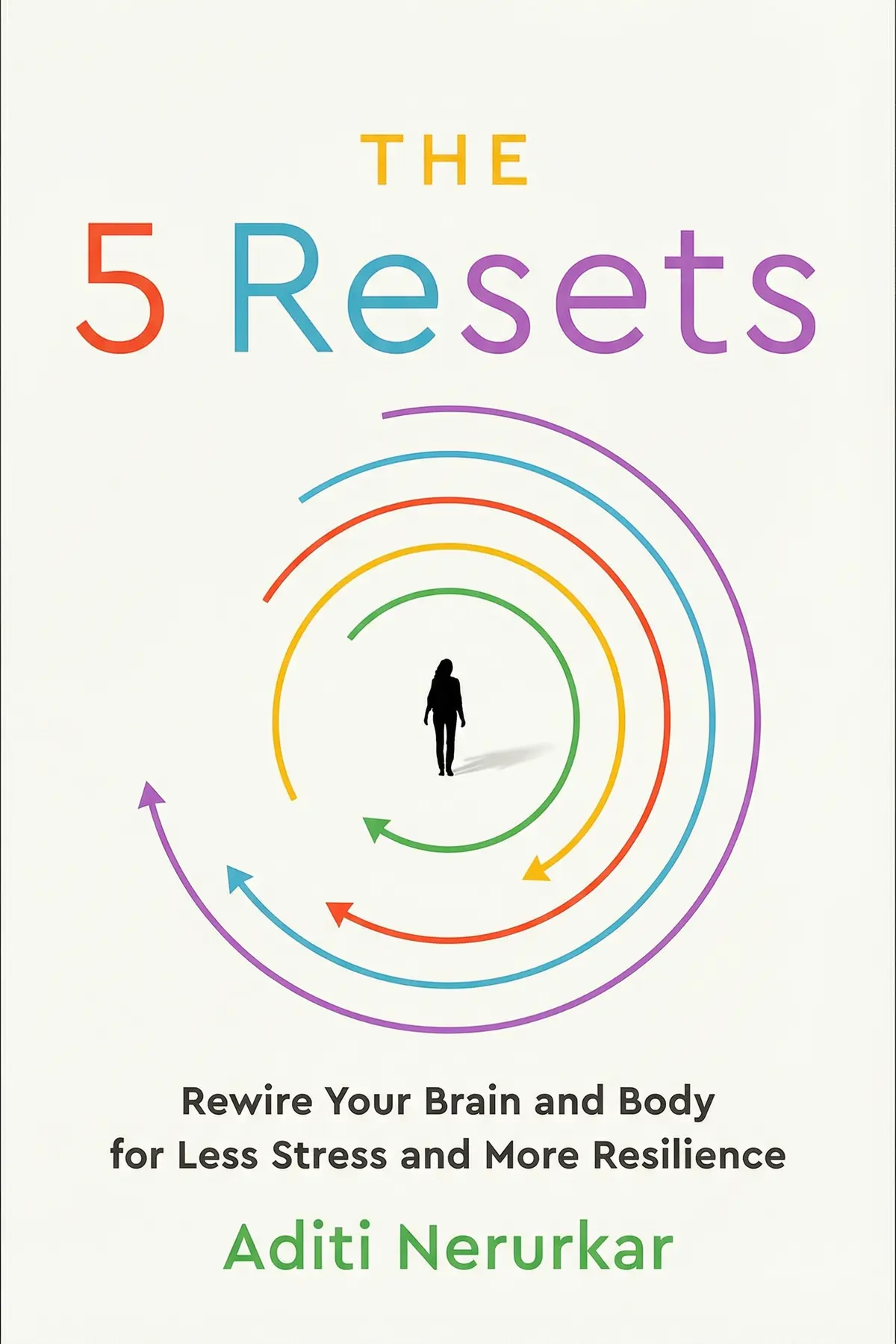
Table of Content
1. Introduction
1 min 06 sec
If stress has you sleeping badly, snapping at small things and running on empty, the fix may be smaller than you fear. In The 5 Resets, Harvard physician Aditi Nerurkar argues that stress is a message: a sign that the brain’s survival alarm has taken over from its planning center and has not handed control back.
She has a sharp way of showing how neglected this is. Stress, she has said, plays a part in nearly 80 percent of doctor visits, yet only 3 percent of doctors offer help managing it. Her response is five resets, each a modest change to how you set goals, use your phone, move and eat, take breaks and talk to yourself.
The claim running through all of them is that you do not need a new life to feel steadier. You need a few small adjustments, chosen to fit your own, that let the calmer, thinking part of your brain lead again. Along the way you get a method for reading your own stress signals and practices to try this week, from a quiet hour before bed to a fake commute.
2. Hear stress as your body's warning signal
1 min 44 sec
A young doctor stood calmly at a cardiac patient’s door while her own heart behaved like the patient’s. What she took from that moment changes how you might respond to your next bad week.
3. Get your calm, thinking brain back in charge
1 min 39 sec
A part of your brain the size of a bean cannot tell a predator from a deadline. That confusion explains why modern pressure feels so exhausting, and where relief has to start.
4. Pick one small goal that truly matters
1 min 45 sec
A woman relearning to walk after a stroke passed through three distinct zones on her way back. Her path suggests a way to sort your own priorities before a crisis forces you to.
5. Quiet your phone to rescue focus and sleep
1 min 44 sec
One woman was sure she had ADHD. Her turning point came on an ordinary day, and it pointed to a cause of scattered attention that most of us carry in a pocket.
6. Calm your mind through your body and plate
1 min 42 sec
Your stomach and your brain are in constant conversation, and so are your breath and your worries. A doctor shows how to use those links when your thoughts refuse to settle.
7. Step away to work better and think clearer
1 min 44 sec
A professional who could not keep up with her field found her productivity again by doing less. The principle behind her recovery suggests some stress helps, and too much quietly ruins your output.
8. Swap your inner critic for self-compassion
1 min 39 sec
A tiny coffee stain sent a new mother and founder into a spiral of self-doubt. What happened that morning shows how stress gives the harshest voice in your head a louder microphone.
9. Conclusion
1 min 09 sec
Go back to the young doctor in the doorway of the cardiac unit, composed on the outside, heart pounding inside. The 5 Resets reads like the advice she needed that day. Her stress was her body reporting that the survival brain had taken the wheel and that something in her life had to give. The resets are the answers she settled on: a clear sense of what matters, quiet from screens, a body and mind pulling together, room to breathe at work and a kinder inner voice. None of them asks for a new life. Each asks for a small change, shaped to the life you already have.
Start with the signal itself. When your heart races or your breath turns shallow, read it as a message and ask what you are carrying. Then choose a single reset for this week, perhaps a device-free hour before bed or five lines of thanks each night, and notice what shifts. Nerurkar treats this work as ongoing and personal, something to approach with curiosity.
Your stress has been talking for a long time. The resets are how you begin to answer it.
About this book
What is this book about?
Many people treat stress as something to push through until the weekend, the holiday or the next quiet month. Harvard physician Aditi Nerurkar argues that this approach backfires. In her view, stress is the body's message that the brain's survival alarm has taken charge from its planning center and is staying there, wearing us down toward burnout. Nerurkar knows that alarm from the inside: as a young doctor working 80-hour weeks, she had an episode of racing heart and dizziness at the door of a cardiac patient's room. Her answer is five resets. They cover getting clear on what matters most, finding quiet in a world of screens, syncing brain and body, taking real breaks from work and replacing the inner critic with self-compassion. Each reset comes with concrete practices, from a MOST goal and a device-free evening hour to stop-breathe-be pauses, a fake commute and a nightly list of five things you are grateful for. None requires a dramatic overhaul. Readers get a way to read their own stress signals and a set of small changes they can adjust to the life they already have.
Book Information
Who it's for
Professionals near burnout
Professionals running on long hours who feel close to burnout and want small changes, not a life overhaul.
Distracted by their phones
People whose phones scatter their focus and whose sleep suffers for it.
Parents, founders and managers
Parents, founders and managers juggling roles while a harsh inner critic gets louder.
About the Author
Aditi Nerurkar
Aditi Nerurkar is a physician connected to Harvard Medical School who focuses on stress management and resilience. She has been medical director of an integrative medicine program, writes a Forbes column on public health and how stress affects mental health, and has appeared on MSNBC and NBC News more than 300 times. She has pointed out that stress plays a part in nearly 80 percent of doctor visits, yet only 3 percent of doctors offer help managing it.
Ratings & Reviews
Ratings at a glance
What people think
Listeners find the writing highly accessible and skillfully composed, offering actionable methods for handling daily pressure. They value its down-to-earth tone and utility, while one listener highlights how it helps transform stress and trauma into growth. The prose receives favorable reviews, with one listener even calling it fun to read. However, listeners express conflicting views regarding the clarity of the language.
Top reviews
Mats
Finally, a self-help book that doesn’t feel like a chore to get through! Dr. Aditi Nerurkar has managed to write something that is both scientifically grounded and genuinely fun to read. Her "Stop-Breathe-Be" technique is so simple that I started using it immediately during my morning commute. I’ve read dozens of books on stress management, but this one stands out because it focuses on small, sustainable shifts rather than demanding a total life overhaul. The anecdotes about her patients were incredibly relatable and helped illustrate how these techniques work in real-world scenarios. It’s a rare find that manages to be both informative and deeply empathetic. I’m recommending this to all my stressed-out colleagues who need a realistic path back to sanity.
Show moreLincoln
This book is a breath of fresh air for anyone drowning in the "hustle culture" that defines our current era. Nerurkar reframes stress not as an enemy to be defeated, but as a biological signal that we need to tune into. The Fourth Reset on monotasking was a massive wake-up call for my scattered brain. I’ve always prided myself on doing five things at once, but seeing the science behind why that’s destroying my focus was eye-opening. The "living a lifetime in a day" concept is something I’m still trying to wrap my head around, but it’s a beautiful goal to strive for. The prose is clear, and the 15 techniques are practical enough to implement tonight. Truly life-changing stuff if you actually apply it!
Show moreMason
The concept of "living a lifetime in a day" changed my entire perspective on what a "good day" looks like. I used to think I had to wait for vacation to feel any sense of peace or joy, but Nerurkar shows how to bake those moments into the daily grind. The Fifth Reset is where the book really shines for me, specifically the shift from self-criticism to self-compassion. It sounds cheesy, but the way she frames it as a biological necessity for resilience makes it click. The book is structured so well that you can jump back and forth between techniques as needed. I’m already seeing a difference in my sleep and overall mood after just two weeks of following the resets. Absolute recommendation for anyone feeling overwhelmed.
Show moreKatya
Picked this up during a particularly brutal week at work and it was exactly the medicine I needed. What I appreciate most is that Nerurkar doesn't ask you to quit your job or move to a cabin in the woods to find peace. She acknowledges the reality of our noisy, digital, high-pressure lives and gives us ways to navigate it. The "Get Clear on What Matters Most" section helped me stop obsessing over the small stuff and refocus on my actual health. It's an easy read, but the implications are huge if you actually do the work. The mix of personal stories and clinical expertise makes it feel both professional and personal. I honestly think this should be required reading in our overworked culture.
Show morePrinya
After hearing Dr. Nerurkar on a podcast, I was eager to dive into the full text to see if the hype was real. The "Resilience Rule of 2" is a total game-changer for someone like me who tends to over-commit to new habits and then burn out by Wednesday. It’s written in a very accessible way, making the medical insights feel approachable rather than intimidating or overly clinical. Truth is, while some of the advice on digital boundaries felt familiar, the way she structures the five resets provides a much-needed roadmap for modern living. I particularly appreciated the focus on the mind-body connection and the practical "Stop-Breathe-Be" technique. The writing is engaging and keeps you moving through the chapters without feeling bogged down by dense jargon. It’s a solid 4-star read for anyone feeling the weight of the daily grind.
Show moreAria
As a chronic multitasker, the fourth reset was a reality check I didn't know I needed. We often think that doing more is the solution to stress, but this book argues the opposite with such grace and clinical authority. I loved the "Resilience Rule of 2"—it stops you from trying to change everything at once and failing. The writing style is very fluid and easy to digest, which is perfect when your brain is already fried from a long day at work. My only minor gripe is that I wanted a bit more of the deep-dive research data. She mentions "research suggests" quite a bit, and as a bit of a science nerd, I wanted the footnotes! Still, the practical strategies are top-notch and very easy to apply to a busy schedule.
Show moreDavid
Ever wonder why you're always feeling "on" even when you're supposed to be relaxing? This book explains the physiological reasons behind that constant state of high alert. Dr. Nerurkar does a fantastic job of translating Harvard-level science into a language that feels like a warm conversation. The "Stop-Breathe-Be" method has become my go-to for those mid-afternoon slumps where I usually just reach for more caffeine. It’s not just about "self-care" in the fluffy sense; it’s about rewiring how your brain perceives threats in the modern world. Some sections felt a bit repetitive, especially toward the end, but the core message is vital. It’s an easy, engaging read that actually gives you a plan of action rather than just theory.
Show moreAraya
Dr. Nerurkar has a way of making complex clinical concepts feel like a conversation over coffee. I picked this up because I was struggling with focus, and the section on syncing the brain and body really hit home for me. In my experience, most doctors just tell you to "stress less" without giving you the "how," but the 15 techniques here are actual tools. Look, I’m usually skeptical of anything that mentions "gratitude journals," but the science-backed approach here makes it feel less like a trend and more like a prescription. The flow of the book is excellent, and the MOST goals framework actually made my to-do list feel manageable for the first time in months. A very solid and helpful read for the modern age.
Show moreDimitri
I really wanted to love this, but it felt a bit like a summary of things I’ve already read elsewhere in the wellness space. To be fair, the first reset regarding the MOST goal (Motivating, Objective, Small, Timely) was a helpful framework for narrowing down my priorities. However, much of the remaining content, like limiting digital engagement or practicing gratitude, felt like common knowledge that didn't offer a groundbreaking perspective. The patient stories were okay, but at times they felt like they dragged on longer than necessary to make a simple point. If you are new to the world of wellness and stress management, this is a great starting point. If you’ve already been down this rabbit hole, you might find yourself skimming through the later sections looking for something more substantial.
Show moreChiw
Not what I expected based on the hype I saw online. Frankly, the concepts felt a bit "pie in the sky" and lacked the concrete, groundbreaking tools I was looking for. I found the constant anecdotal stories about Jeanette and other patients to be more of a distraction than a help. While the doctor's tone is very kind and well-meaning, the advice to "just breathe" or "write five things you're grateful for" felt a bit surface-level for someone dealing with serious, chronic burnout. It’s a well-written book for sure, but it just didn’t offer anything new for me personally. If you’ve never read a book on mindfulness, you’ll love it. For everyone else, it might feel like a repeat of every blog post you’ve seen since 2015.
Show moreQuestions about this book
What is The 5 Resets by Aditi Nerurkar about?
Nerurkar argues that stress is a message from the body, a sign that the brain’s survival center, the amygdala, has taken control from the prefrontal cortex and is not letting go. Modern pressures keep that alarm on, which leads toward burnout. Her five resets are small, personal changes to goals, screen habits, body care, work breaks and self-talk that help return the calmer, thinking brain to charge.
What are the five resets?
The five resets are getting clear on what matters most, finding quiet in a noisy world, syncing your brain and your body, coming up for air, and bringing your best self forward. Each comes with practical tools, such as a MOST goal, a device-free evening hour, the stop-breathe-be pause, monotasking with time blocks, and a nightly gratitude list.
What is a MOST goal?
A MOST goal is Nerurkar’s tool for the first reset. The letters stand for Motivating, Objective, Small and Timely. The goal should inspire you, be measurable, avoid overwhelming change and have a near deadline. She suggests writing it down, then planning backward from the moment you reach it so the path breaks into steps you can start on now.
How can I use The 5 Resets to sleep better?
The second reset targets screens and sleep. Nerurkar suggests turning off nonessential notifications and keeping a quiet hour each evening with all devices off, filled with reading or relaxation exercises. She also recommends a bedroom free of electronics, a regular sleep schedule and a calming routine before bed, such as gentle stretching, meditation or soothing music.
Who should read The 5 Resets?
It suits people who feel stretched thin by work, family or constant digital noise and want practical steps rather than a dramatic overhaul. The examples include a stroke survivor relearning to walk, a woman who thought she had ADHD, a professional overwhelmed by changes in her field and an entrepreneur raising a newborn, so the advice covers many kinds of pressure.
Readers also enjoyed





Alcoholics Anonymous
Alcoholics Anonymous World Services

A Liberated Mind: How to Pivot Toward What Matters
Steven C. Hayes


AUDIO SUMMARY AVAILABLE
Listen to The 5 Resets in 15 minutes
Get the key ideas from The 5 Resets by Aditi Nerurkar, plus 5,000+ more nonfiction titles.
- 5,000+ titles
- Listen as much as you want
- 7-day free trial
- Cancel anytime









