

14 min 30 sec
Available in: English
The 4 Pillar Plan: How to Relax, Eat, Move and Sleep Your Way to a Longer, Healthier Life
A physician's plan for better health built on four everyday areas: relaxing, eating, moving and sleeping. Each gets small practices a busy person can keep, from 3-4-5 breathing to a twelve-hour eating window.
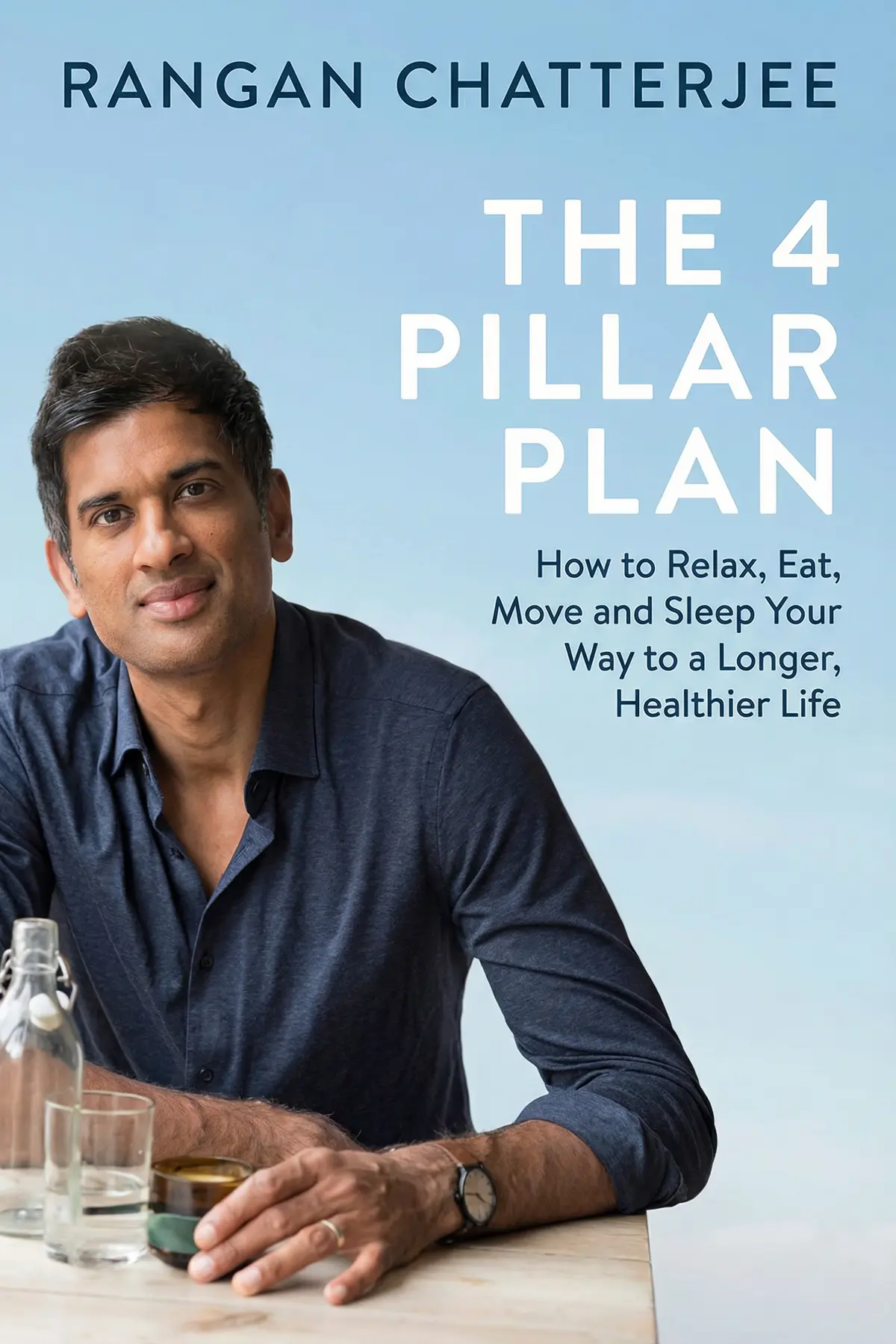
Table of Content
1. Introduction
1 min 03 sec
If staying healthy feels like a second job you never have time for, Rangan Chatterjee thinks you were sold the wrong picture of health. In The 4 Pillar Plan, the British physician argues that doctors mostly treat illness at the surface, while the deeper causes sit in how we live each day. His answer rests on four pillars: relax, eat, move and sleep.
None of them sounds radical, and that is deliberate. His case is that we should stop splitting health into separate burdens that demand excessive effort, and that simple, practical changes in one or more of the four areas can bring a noticeable improvement, even for someone who feels short on time. Each pillar comes with a concrete practice: a fifteen-minute daily break, a breathing pattern you can do in your car or at the office, a twelve-hour eating window, a few strength moves in the kitchen and a screen-free stretch of at least ninety minutes before bed. By the end you will have a handful of habits small enough to start tonight, and a simple way to check whether they are working.
2. Look past the symptom to the cause
1 min 41 sec
A rash, a low mood and rising blood sugar seem like separate problems with separate cures. A physician explains why the usual fix often leaves the real trouble untouched, and where he looks first.
3. Fifteen calm minutes that protect your health
2 min 04 sec
Your body still reacts to a crowded inbox the way an ancestor reacted to a predator. Chatterjee’s fix takes a quarter of an hour and a breathing count simple enough to remember in traffic.
4. Retrain your taste buds by cutting sugar
1 min 32 sec
Two groups tasted the same dessert, and one found it far sweeter than the other. What separated them reveals how a common ingredient changes the way all your food tastes.
5. A twelve-hour eating window that helps your body repair
1 min 40 sec
Your body collects a kind of daily mess, much like a family home by evening. Chatterjee describes a simple timing rule that gives it the hours it needs to tidy up.
6. Move often through the day instead of training hard
1 min 58 sec
Doing too little exercise is a familiar worry. Doing too much gets far less attention, yet Chatterjee points to heart concerns and a striking finding in soldiers that should make busy people rethink their workouts.
7. Score your sleep in under a minute
1 min 35 sec
Counting hours tells you surprisingly little about how well you sleep. Chatterjee offers three plain signs, and a simple score out of six, that reveal whether your nights are actually doing their job.
8. Build an evening that ends in easy sleep
1 min 41 sec
A glowing alarm clock or a standby light seems too small to matter. Chatterjee disagrees, and his own evening, from a 6:30 cutoff to a red night-light, shows how to set up a better night.
9. Conclusion
1 min 16 sec
The 4 Pillar Plan asks very little of any single day, and that is why it can work. Chatterjee’s case is that the rash, the low mood or the rising blood sugar often trace back to ordinary habits, and that ordinary habits are also where repair begins. A body pumping cortisol, a palate dulled by sugar, a schedule that never lets the body clean up, a week of sitting broken by an exhausting workout, a bedroom lit by standby lights: each is a small strain, and each has a small answer.
Pick one place to begin. If stress is loudest, book fifteen phone-free minutes into tomorrow and try a few rounds of 3-4-5 breathing at your desk. If food is the issue, clear the cupboard of sweets and choose a twelve-hour eating window you can share with the people you live with. If sleep is the weak point, score yourself on the three signs, cover the little lights in your bedroom and switch off every screen 90 minutes before bed. Chatterjee also suggests one screen-free day each week, time to be fully present with family, friends or a book.
None of this needs a new life. It needs the same small choices, made again tomorrow.
About this book
What is this book about?
Most people believe getting healthier takes time they do not have: strict diets, punishing workouts, a life rebuilt from scratch. Rangan Chatterjee, a British physician, disagrees. In his view, medicine spends too much effort treating symptoms, such as a cream for a rash or a pill for low mood, while the causes often sit in everyday habits that can be adjusted. He sorts those habits into four pillars: relax, eat, move and sleep. Each one comes with practices that fit into a busy day. He suggests a daily fifteen-minute break without screens and a simple 3-4-5 breathing exercise. He gives a plan for cutting sugar and a twelve-hour eating window that gives the body time to repair itself. Walking and five strength moves you can do at home take the place of grueling workouts, and he explains why too much exercise can do harm. A three-question sleep test leads to a dark bedroom and a screen-free evening routine. Readers get a balanced, low-effort plan they can start in one area and extend to the others, with Chatterjee's own evening schedule as a model.
Book Information
Who it's for
Professionals feeling stretched thin
Busy professionals who feel too stretched to get healthier and want small habits that fit a full day.
Looking past symptoms
People with stress, poor sleep or a sugar habit who want to look past symptoms to everyday causes.
All-or-nothing with exercise
Anyone who swings between doing no exercise and punishing workouts.
About the Author
Rangan Chatterjee
Rangan Chatterjee is a British physician, author, television presenter and podcast host. He became widely known through the BBC One series Doctor in the House, which has been shown in more than 70 countries. He has worked as the resident doctor on BBC Breakfast and contributes regularly to BBC Radio. He hosts the podcast Feel Better, Live More, and his books, including Happy Mind, Happy Life, have reached the Sunday Times bestseller list. His TED talk, How To Make Disease Disappear, has passed 5 million views.
Ratings & Reviews
Ratings at a glance

What people think
Listeners find the book highly accessible and value its top-notch suggestions and helpful information. It also receives acclaim for its positive impact on health, with listeners highlighting that it is authored by a fantastic Functional Medicine doctor who offers practical steps for getting better. Furthermore, listeners really enjoy the photographs featured within the pages.
Top reviews
Palm
After hearing Dr. Chatterjee on his podcast, I knew his written approach would be just as compassionate and clear. The book is physically stunning with gorgeous photography that makes the healthy habits feel aspirational rather than a chore. Truth is, I already knew I needed more sleep, but the way he explains the 'commotion' before bed actually gave me the push to change. I love the 3-out-of-5 rule for the pillars because it removes the guilt of not being perfect every single day. It’s a refreshing departure from the 'all or nothing' keto or marathon-training books that usually dominate the shelves. This feels like a roadmap to better health that doesn't require you to quit your job or move to a farm to see results.
Show moreBua
Ever wonder why small changes never seem to stick? This book answers that by focusing on sustainable, bite-sized habits rather than drastic overhauls. Dr. Chatterjee treats the reader with genuine empathy, which is a far cry from the cold, clinical tone of most medical guides. I particularly appreciated the 'Eat' pillar, especially the advice to de-normalize sugar without feeling like you’re on a restrictive diet. The '3-4-5' breathing technique has also become a staple in my daily routine to manage work stress. It’s a comprehensive guide that feels like a warm hug from your family doctor. I've already recommended it to several friends who are struggling with burnout. It is a beautiful, practical, and highly informative read.
Show moreMalee
The section on 'Relaxation' really opened my eyes to how much 'me-time' I was lacking. Most of us focus so much on diet and exercise that we completely ignore the mental component of health. I’ve started implementing the 'screen-free Sabbath' on Sundays, and the difference in my anxiety levels is palpable. Not gonna lie, I was skeptical about the gratitude journal at first, but it really does help shift your mindset. The photography throughout the book is also top-notch, making the whole experience of reading it feel very calming and meditative. It’s rare to find a health book that you actually want to display in your home. This is a must-have for anyone looking to reclaim their peace of mind and physical vitality.
Show moreAnna
Dr. Chatterjee’s focus on the 'pillars'—Relax, Eat, Move, and Sleep—makes total sense for a busy professional. I’ve read dozens of health books, but this is the first one where I felt like the author actually understood my life. The '12-hour window' for eating is a simple way to introduce intermittent fasting without the stress of counting calories. It’s a beautiful book to look at, too, filled with photos that illustrate the exercises and recipes perfectly. The tone is encouraging rather than judgmental, which made me actually want to follow the advice. I've already noticed an improvement in my energy levels after just two weeks of following the 'Move' suggestions. This is functional medicine at its most accessible.
Show moreSamira
Finally got around to finishing this, and I’m genuinely impressed by the production quality. Dr. Chatterjee writes with a level of kindness and accessibility that is rare in the medical field. He doesn't just tell you what to do; he explains the 'why' behind things like cortisol spikes and insulin resistance in a way that actually makes sense. The '3-4-5' breathing and the glute exercises have already made a difference in how I feel daily. It’s a must-read for anyone feeling burnt out by modern life and looking for a way back to feeling human again. I love that he focuses on adding good habits rather than just taking away 'bad' ones. It is easily one of the best health books of the year.
Show moreLuke
Picked this up because I wanted a health book that didn't feel like a lecture. It’s incredibly easy to digest, with a layout that allows you to dip in and out of the specific areas you want to improve. Frankly, if you’ve already read 'Why We Sleep' or 'How Not to Die,' you might find some of the information repetitive. However, Chatterjee’s talent lies in synthesis; he takes complex ideas from functional medicine and turns them into realistic actions. I’ve started the 'movement snacking' throughout the day and already feel less stiff at my desk. While it isn't necessarily reinventing the wheel, the presentation is far superior to most dry medical texts I've encountered. It's a solid 4-star guide for the modern, busy person.
Show moreAmara
Wow, a doctor who actually talks about lifestyle instead of just reaching for the prescription pad. Dr. Chatterjee’s approach to functional medicine is exactly what the modern healthcare system needs. The 'Move' section was a highlight for me because it doesn't demand hours at the gym; it just asks for consistency. I’m doing the five-minute kitchen workout while the kettle boils, and it’s surprisingly effective for waking up my glutes. My only minor gripe is that the book is quite large, making it more of a coffee table reference than something you'd read on the bus. Regardless, the advice is excellent and the 'five ingredient' rule for food has totally changed how I grocery shop. Very glad I bought this.
Show morePick
In my experience, health books are usually either too dense or too fluffy, but this hits the sweet spot. Dr. Chatterjee breaks everything down into Relax, Eat, Move, and Sleep, giving five actionable steps for each. You don't have to do them all, which makes the plan feel actually achievable for someone with a full-time job and kids. I found the advice on limiting caffeine to before noon and creating a 'darkness' environment for sleep very helpful. It’s not necessarily 'new' info, but the way it’s packaged makes it feel fresh and very doable. I would have liked a bit more detail on the microbiome section, but for a general overview, it’s excellent. Definitely worth a spot on your bookshelf.
Show moreOscar
Look, I’ll be the first to admit that 'drink more water' isn't revolutionary advice. However, the way this book connects all the dots between our gut bugs and our mental health is quite fascinating. The focus on the microbiome and the importance of eating five different colored vegetables daily is presented without any of the usual 'superfood' hype. I did think some of the case studies felt a little too 'miraculous' to be entirely relatable, but the core principles are solid. It’s a great gift for anyone who wants to take better care of themselves but doesn't know where to start. The layout is clean and the advice is very realistic for someone living in the real world. A very helpful, common-sense guide.
Show moreLayla
The 4 Pillar Plan is basically a distilled version of every major health trend from the last five years. To be fair, it’s a great introductory text for someone who is just starting their wellness journey and hasn't heard of microbiome health or intermittent fasting. But for seasoned health enthusiasts, it feels a bit 'light' on the actual science. There’s a lot of reliance on personal anecdotes and case studies from his TV show, which can feel a bit like he's promoting his own brand rather than providing hard evidence. If you want a deep dive into the 'why,' look elsewhere. If you just want a pretty book that tells you to walk more and eat vegetables, this will do the trick. It's fine, but slightly overrated.
Show moreQuestions about this book
What is The 4 Pillar Plan by Rangan Chatterjee about?
Chatterjee, a British physician, argues that medicine focuses too much on treating symptoms while many health problems come from everyday lifestyle. He groups healthy living into four pillars: relax, eat, move and sleep. Each comes with small, practical habits, such as a daily fifteen-minute break, cutting sugar, a twelve-hour eating window, regular walking and a screen-free evening routine. He says changes in one or more of the pillars have helped many of his patients, including some with depression or type 2 diabetes.
What is 3-4-5 breathing?
It is a simple exercise Chatterjee designed to bring stillness into a busy day. You breathe in for three seconds, hold your breath for four, then breathe out over five. It can be done in a car, at a desk, during a lunch break or sitting on the floor at home. He suggests starting with a short session and building up slowly to several minutes as it becomes comfortable.
How does micro-fasting work in The 4 Pillar Plan?
You eat all your meals within the same twelve-hour window each day and fast for the remaining twelve, drinking only water, tea or coffee. Chatterjee says this supports autophagy, the body’s daily cleanup and repair process. Choose a window that suits your life, involve the people you live or work with, and do not worry about the odd day that slips. Once it feels easy, the window can be narrowed to eleven or ten hours.
Can too much exercise be bad for you, according to Chatterjee?
Yes. Alongside the large share of people who move too little, he points to cardiologists who worry that frequent endurance events like marathons may harm the heart, and to research on US army personnel linking extreme training to leaky gut, which stresses the immune system. His advice is to build movement into the day through walking and short strength sets rather than adding punishing workouts to an already stressful schedule.
How can I improve my sleep using The 4 Pillar Plan?
First, rate your sleep on three signs: waking refreshed, waking at a steady time without an alarm, and falling asleep within about half an hour. Then make the bedroom as dark as you can with blackout blinds, tape over standby lights or unplugged devices. Keep fixed times for bed and waking, and stop using screens at least 90 minutes before bed, as Chatterjee does with his own No-Tech 90 routine.

Readers also enjoyed





AUDIO SUMMARY AVAILABLE
Listen to The 4 Pillar Plan in 15 minutes
Get the key ideas from The 4 Pillar Plan by Rangan Chatterjee, plus 5,000+ more nonfiction titles.
- 5,000+ titles
- Listen as much as you want
- 7-day free trial
- Cancel anytime









