

13 min 30 sec
Available in: English
The 3-Minute Rule: Say Less to Get More from Any Pitch or Presentation
Shows how to win a pitch or presentation in three minutes by cutting to about 25 sentences that answer four questions, then shaping them with an honest setback, a well-timed hook and a callback.
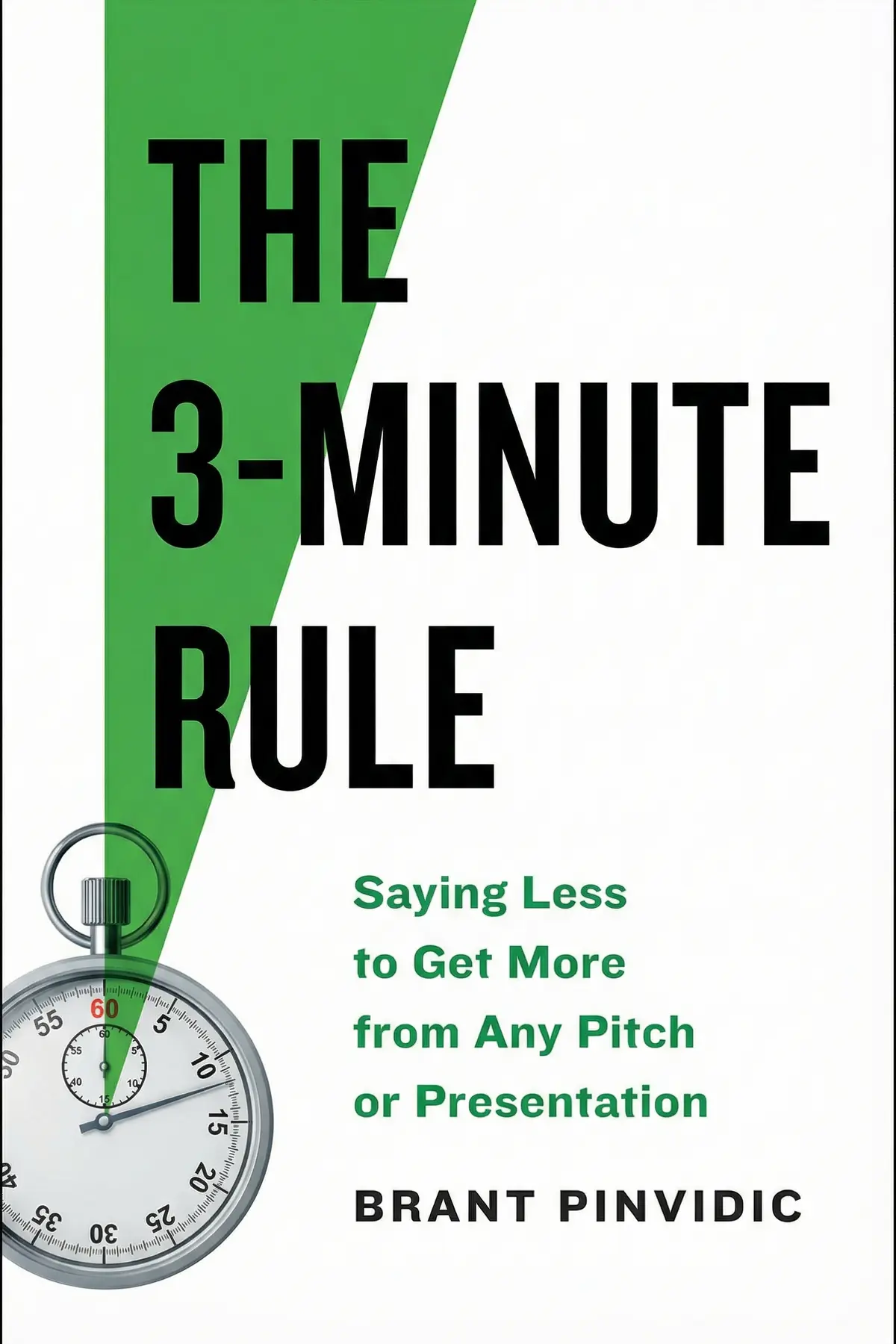
Table of Content
1. Introduction
59 sec
If a room has ever drifted away during your presentation, the outcome was probably settled long before your best slide appeared. In The 3-Minute Rule, television producer Brant Pinvidic argues that any audience is leaning toward yes or no by the end of the first three minutes, however long the meeting runs. Everything after that is judged through the early verdict.
Pinvidic has taken part in nearly 10,000 pitches over two decades in Hollywood, and he says each of the more than 300 shows and films he sold was pitched in under three minutes. His case is that short beats thorough. A pitch of about 25 chosen sentences, answering four plain questions and arranged with a few storytelling moves, persuades better than an hour of detail, and it is short enough for listeners to carry to the people who make the final call. By the end, you will be able to draft that pitch for your own product, project or idea, sentence by sentence.
2. Win the room before minute three ends
1 min 34 sec
You may have a full hour booked, but the meeting is decided much sooner than that. Pinvidic explains what happens in those first minutes and why the usual way of preparing works against you.
3. Hand your audience a pitch they can retell
1 min 30 sec
Your meeting can go perfectly and the deal can still die in a corridor you never walk down. The weak link is someone you never meet, and how much of your pitch reaches them.
4. The four questions every winning pitch must answer
1 min 47 sec
Most experts insist their subject is too complicated for a short pitch. Pinvidic has heard that objection from hundreds of leaders, and he answers it with a template simple enough to fit on a card.
5. Cut your pitch to 25 sentences that earn their place
1 min 44 sec
A pirate-themed reality show in the mid-2000s reveals that the most persuasive fact about your offer may not describe the offer at all. Finding that fact changes what survives the cut.
6. Open with the moment you knew, then prove it
1 min 40 sec
Pinvidic sold Bar Rescue with an opening line about a personality and a strange detail from a bar blueprint. Together they show how to turn your own belief into something a room can feel.
7. Admit your biggest problem before they find it
1 min 29 sec
Hiding a weakness feels like the safe choice in a pitch. Pinvidic borrows a moment from the movies to show why it backfires, and how the problem you fear most can become your best defense.
8. Save your best line until they almost say it
1 min 40 sec
Leading with your most impressive claim feels obvious, yet it can put the whole room on guard. A plumber who rebuilt a working hotel’s pipes shows the better place for your strongest line.
9. Conclusion
1 min 07 sec
Pinvidic’s case rests on two plain facts about attention: people decide early, and they repeat only what they can remember. A three-minute pitch respects both. It reaches the audience before their verdict hardens, and it travels intact to the Jerry in legal who never sat in the meeting.
Most of the work is subtraction. Length can feel like rigor, yet each extra detail competes with the few that make someone care, the way Mark Burnett’s name outweighed an entire premise. What survives the cut is then shaped like a story: a reason for being there, a setback admitted, and a payoff the audience reaches a moment before you name it.
You can begin with your next presentation. Write one sentence for every question the audience might ask, keep the 25 that matter most, and find the problem you hope nobody raises so you can raise it yourself. Then hold your best line back until the room is ready for it.
Three minutes is too short for everything you know. It is long enough for the part that makes them want to hear the rest.
About this book
What is this book about?
Most people prepare for an important pitch by adding more: more slides, more detail, more jokes and speaking tricks. Brant Pinvidic argues that this gets persuasion backward. Busy, skeptical audiences have leaned toward yes or no within three minutes, and they can pass on to their own decision-makers only what they remember. Drawing on two decades in television, nearly 10,000 pitches and more than 300 shows and films sold, Pinvidic offers a method for building a pitch that fits the limit. You respond to four questions covering what the offer is, how it works, whether you can back it up, and whether you can deliver, then trim the answers to roughly 25 sentences. Then you add a few more elements: an opening that gives your reason for being, an all is lost moment, named after a movie device, that admits a problem, a hook with a vivid edge, and a callback. Readers get a step-by-step way to turn a complicated product, project or company into a short pitch that holds attention and survives being retold in a hallway.
Book Information
Who it's for
Founders who pitch
Founders pitching investors, partners or customers who keep running out of time before the good part.
Managers and specialists
Managers and specialists whose proposals must win approval from people who never attend the meeting.
Building long slide decks
Anyone who builds long slide decks and suspects the audience stopped listening early.
About the Author
Brant Pinvidic
Brant Pinvidic spent a long career in Hollywood as a television producer and award-winning film director, serving as an executive producer on Bar Rescue and Extreme Makeover: Weight Loss Edition. He has sold more than 300 TV shows and movies. Today he consults for and coaches senior business leaders, writes a column for Forbes and hosts the podcast Why I'm Not. The 3-Minute Rule is his first book and became a number one bestseller.
Ratings & Reviews
Ratings at a glance
What people think
Listeners find the material engaging and simple to digest, noting the author's direct and accessible prose. They value the caliber of the content, with one listener characterizing it as a concise recipe for a successful business introduction. The work earns praise for its utility, as one listener points out how it dramatically increases chances for success. Listeners prize the transparency of the message, with one mentioning how it aids in refining communication, and they particularly enjoy the author’s narrative style.
Top reviews
Leila
Pinvidic’s background in Hollywood production really shines through in the way he structures this guide. It isn’t just another dry business manual filled with corporate buzzwords; instead, it offers a visceral, high-stakes approach to getting your point across before the audience checks out. The WHAC model—What is it, How it works, Are you sure, Can you do it—is a masterclass in the economy of language. I found the distinction between the initial "Phase 1" hook and the deeper "Phase 2" details particularly enlightening for my own client calls. To be fair, some of the storytelling feels a bit self-congratulatory at times, but the core methodology is undeniable. It forces you to strip away the fluff and focus on what actually moves the needle in a professional conversation. Definitely a must-read for anyone in a high-pressure environment.
Show moreJeeranan
Finally, a sales book that doesn't feel slimy or manipulative. Most marketing experts preach the "Big Promise" model where you lead with a massive, life-changing claim, but Pinvidic argues that this actually triggers a person’s skepticism immediately. By following his three-minute framework, you're essentially providing a clear, rational explanation that allows the listener to reach their own conclusion. In my experience, this builds way more trust than a flashy pitch ever could. The "Are You Sure?" section was a huge lightbulb moment for me because I realized I usually provide proof too late in my presentations. It’s a fast read, very straightforward, and easy to apply to almost any professional scenario. I've already started restructuring my website copy to follow this flow.
Show moreIff
Wow, this actually works. I spent years trying to follow the "more you tell, the more you sell" philosophy, only to find myself getting "no" after "no" from potential investors. After reading this, I realized I was overwhelming them with information before they even understood the basic mechanics of my product. The "Are You Sure?" step—backing up your claims with hard figures—needs to be succinct, and this book shows you exactly how to do that. It’s a very quick read, but I’ve found myself going back to it three or four times this week to refine my latest pitch deck. If you want to be heard in a world that’s constantly distracted, this is the blueprint you've been looking for.
Show morePreeda
After hearing Brant on a podcast, I knew I had to grab a copy of this for my team. We’ve all been guilty of "over-talking" ourselves out of deals, and this book is the perfect antidote to that specific brand of anxiety. It helps you clarify your message so that people actually understand what you're offering within the first sixty seconds. I’ve even started using the "Can you do it?" logic when I’m negotiating schedules at home—it’s that versatile. It’s written in a very casual, accessible style that makes it easy to digest over a single weekend. Truly one of the most useful communication books I’ve added to my shelf in a long time. Highly recommended for any entrepreneur or sales professional.
Show moreCarlos
Stop trying to "sell" and start explaining. That’s the heart of Pinvidic’s message, and it’s a breath of fresh air in an industry full of "hacks" and "closers." This book is about respect—respecting your audience's time and their intelligence. By giving them the information they need in the order they need it, you earn the right to have a longer conversation later. I specifically appreciated the advice on cutting out the "negative problem" fluff in the intro. Just get to the point. The 3-Minute Rule is concise, actionable, and arguably the best investment you can make if you struggle with public speaking or presentation anxiety. I’ve already recommended it to three colleagues this morning. It's the alchemy of a perfect pitch.
Show morePakinee
I was skeptical about the three-minute limit when I first picked this up, thinking it was just a gimmick. Truth is, most of us spend way too much time rambling and not enough time being precise. This book provides a rigid structure that actually gives you more freedom because you know exactly where you're going with your thoughts. I appreciated the specific breakdown of the nine statements for the intro, though I did find some of the examples a bit repetitive toward the middle of the book. While the "What is it?" section is great, I wish there was more depth on how to handle truly hostile audiences who don't want to give you those initial minutes. Still, it’s a solid resource for anyone who feels like they’re being ignored in meetings.
Show moreAnawin
As a small business owner, I struggle with explaining my services without getting bogged down in the technical weeds. Brant Pinvidic’s advice to move the "juicy details" to a second phase was exactly what I needed to hear. Since implementing the WHAC structure on my landing page, I’ve seen a noticeable uptick in engagement. However, I’ll say that the author occasionally skips over the "reason for being" in his own examples, which left me a little confused about where to slot in my company's mission statement. Is it part of the "What" or a separate lead-in? Regardless of that minor gripe, the focus on brevity is a game-changer for my email outreach. It’s worth the price just for the validation tips in the "Can you do it?" chapter.
Show moreSatit
The concept of 'WHAC' is simple yet profound enough to change how you talk to everyone, from your boss to your spouse. Pinvidic explains that our brains are hardwired to process information in a specific sequence, and if you mess that up, you lose the connection. I particularly liked the "callback" technique he mentions toward the end; it’s a subtle way to reinforce your value without sounding like a broken record. My only real critique is that the book leans heavily on the author's Hollywood success stories. They are entertaining, sure, but sometimes I had to work a bit harder to translate those TV pitch scenarios into my world of B2B software sales. It’s a 4-star read for the utility, even if the tone is a little flashy.
Show moreWoravit
There’s a lot of good advice here, but I can’t help feeling like this entire book could have been a long-form blog post. The core methodology—the WHAC framework—is excellent and highly practical, but the surrounding chapters feel a bit like filler to hit a publisher's page count. I found the author's perspective on directness over "the big reveal" to be the most valuable takeaway. It challenges the traditional "Steve Jobs" style of presentation in a way that feels more authentic for the average person. Look, if you need a step-by-step guide to force you into being concise, this will help. Just be prepared for a lot of anecdotes about television pilots that might not feel relevant to your specific industry or daily job.
Show moreChamlong
Maybe I’m just not the target audience for this. I picked it up hoping for deep psychological insights into persuasion, but most of it felt like common sense repackaged with a catchy acronym. If you’ve ever taken a basic communications class or read a few articles on "elevator pitches," you probably already know 70% of what’s in here. The Hollywood stories are fun, but they don't necessarily provide a "recipe" that works for more complex, technical fields where three minutes isn't enough to cover the regulatory hurdles. I gave it two stars because the writing is clear and the "Phase 1 vs Phase 2" idea is decent, but for me, it just didn't live up to the hype of being a game-changer.
Show moreQuestions about this book
What is the main idea of The 3-Minute Rule?
Brant Pinvidic argues that any audience is leaning yes or no on a pitch within three minutes, and that later minutes are filtered through that first judgment. A short pitch also survives being retold to other decision-makers. So he recommends building a pitch of about 25 sentences that answers four questions and uses a few storytelling elements, keeping details for follow-up conversations.
What are the four questions in The 3-Minute Rule?
Each pitch should cover four points: what the offer is, how it works, whether the claims hold up, and whether you can deliver. The first two help the audience picture your offer, the third backs your claims with facts and figures, and the fourth shows you can deliver. Pinvidic suggests stretching each into related questions, such as what problem a service solves or what reviews and statistics support it.
Why does Pinvidic recommend 25 sentences?
Twenty-five short sentences fit comfortably in three minutes while covering the essentials. His rule of thumb gives nine to what it is, seven to how it works, six to are you sure and one to can you do it. You get there by writing one sentence per audience question and cutting anything dull, unimportant or in need of long explanation.
What is the all is lost moment in a pitch?
Borrowed from film, it is the point where you admit a problem that threatened your idea and explain how you solved it or will solve it. Pinvidic argues that audiences distrust a story with no setbacks and start looking for hidden flaws. Raising the problem yourself keeps them listening, builds credibility and turns a weakness into a strength.
In what order should a three-minute pitch run?
Pinvidic suggests opening with your reason for being, then answering what it is, how it works and are you sure. Next comes the all is lost moment, followed by the hook and its edge, then the callback to your opening, and finally your answer to can you do it. Elements can overlap, as the butt funnel story did in his Bar Rescue pitch.
Readers also enjoyed








AUDIO SUMMARY AVAILABLE
Listen to The 3-Minute Rule in 15 minutes
Get the key ideas from The 3-Minute Rule by Brant Pinvidic, plus 5,000+ more nonfiction titles.
- 5,000+ titles
- Listen as much as you want
- 7-day free trial
- Cancel anytime









