

15 min 03 sec
Available in: English
The 100-Year Life: Living and Working in an Age of Longevity
Shows why a life that may last 100 years breaks the plan of study, work and retire. It also shows how to rethink money, work, health and identity so the extra decades help you instead of hurting you.
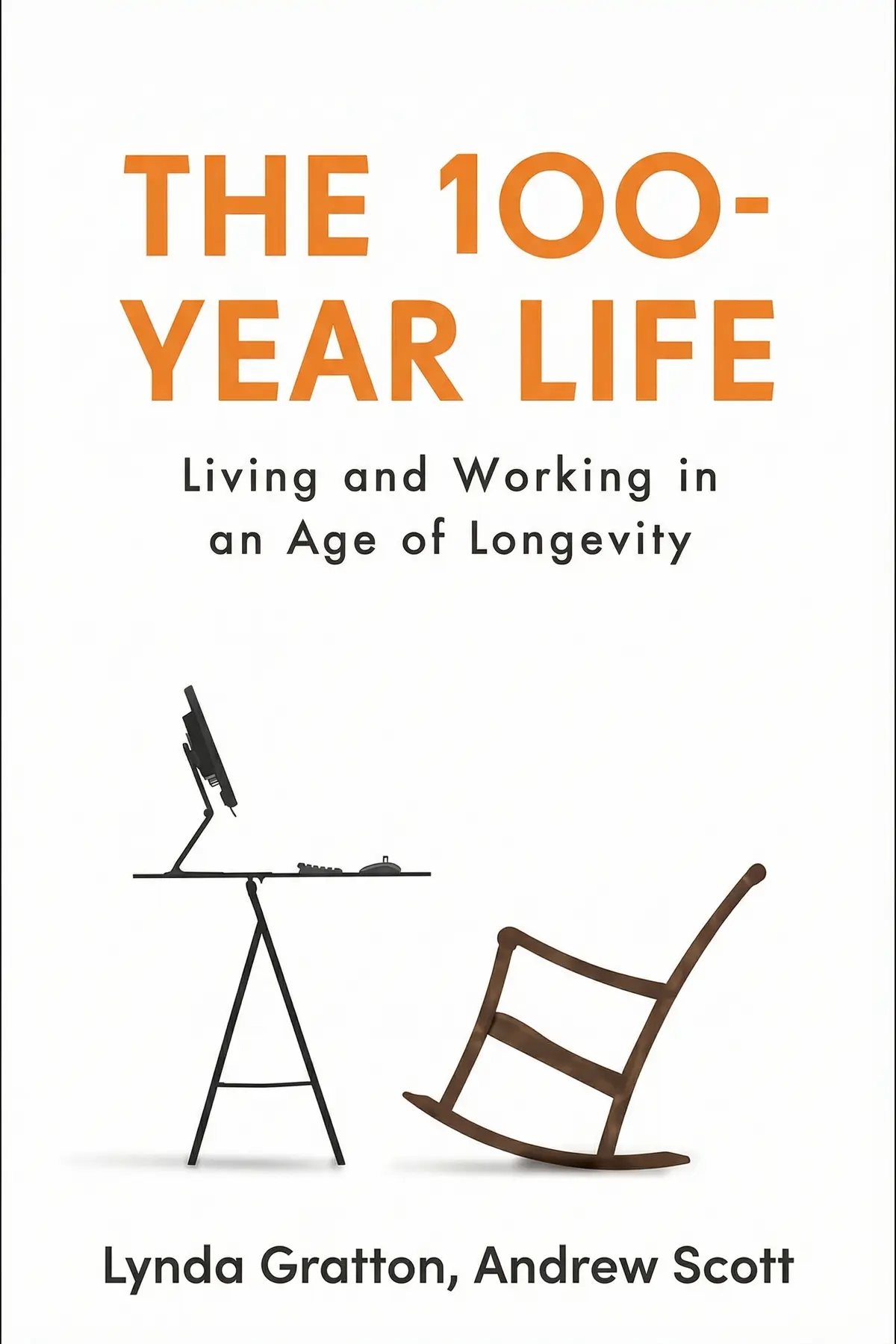
Table of Content
1. Introduction
1 min 01 sec
Most people still plan as if life ends around 80: study, work for four decades, then retire. In The 100-Year Life, London Business School professors Lynda Gratton and Andrew Scott argue that this plan is running out of time. A child born in 1914 had a one percent chance of reaching 100. A child born in 2014 has about an even chance.
Their case is that a longer life breaks the old three-stage model, and that the people who do well will be the ones who rebuild it. That means paying for many more years, staying useful as machines take over routine work, protecting health and self-knowledge, and exploring more than once. Along the way you get the simple arithmetic behind failing pensions, a way to spot which parts of a job a robot cannot take, five quick questions that test your money sense, and a reason to change course at 45 or even 75.
2. Plan for a life that may reach 100
1 min 47 sec
Your idea of a normal lifespan probably came from watching your grandparents. Medicine has been moving that limit one stage of life at a time, and the latest stage may matter most for your own plans.
3. See why your parents' retirement plan won't fit you
1 min 53 sec
A man born in 1945 had five working years behind every year of rest. A woman born in 1998 has barely one. The gap between them shows why a familiar plan is coming apart.
4. Do the work that machines cannot copy
2 min 02 sec
A factory worker who assembles the iPhone and an Apple employee who never touches one create very different amounts of value. The size of that gap shows which kinds of work will survive a long career.
5. Treat your health and self-knowledge as assets
1 min 40 sec
Back pain at 50 is one thing if you expect to live to 70, and something else if you expect to reach 100. Two assets you cannot sell turn out to matter as much as savings.
6. Build several exploration stages into your career
1 min 44 sec
Exploring is usually treated as something for people in their twenties. The authors point to two more windows later in life, and to a way of working that puts the making ahead of the money.
7. Test your money sense with five questions
1 min 49 sec
Interest, inflation, mortgages, single stocks and bonds: five short questions show whether you understand the basic forces that decide how far your savings will stretch. Answering all five correctly, the authors say, makes you a sharper saver and planner.
8. Know who you are before choosing a path
1 min 50 sec
We question strangers at parties with real curiosity and almost never ask the same questions of ourselves. A longer, freer life makes that one-sided curiosity expensive, and certain kinds of friendship help correct it.
9. Conclusion
1 min 17 sec
The 100-Year Life is a book about time arriving sooner than expected. The extra years are already in the statistics: within a century, a one percent chance of reaching 100 became an even chance. Yet most of us still follow a plan built for Jack, who retired at 62 and died at 70. Gratton and Scott’s message is that a longer life pays off only for people who redesign its whole shape. That means more years of saving, work that no script can capture, a body and mind kept in repair, and several rounds of exploring.
Some moves follow directly. Redo your retirement arithmetic with 100 as the end point and see how many working years stand behind each year of rest. Answer the five money questions honestly and study the one you got wrong. Sort your work into scripted and human tasks and grow the human ones. And when your mid-forties or your seventies bring restlessness, take it as a signal to explore.
Jane, born in 1998, cannot copy Jack’s life, and neither can most people listening. Nobody has to. A long life leaves room to be several people in turn, as long as you know which one you are now.
About this book
What is this book about?
Most people still plan their lives around an end point near 80. Lynda Gratton and Andrew Scott argue that this is out of date. Better medicine, hygiene and education have lengthened lives at every stage. A child born in 2014 has roughly an even chance of reaching 100. For a child born in 1914, the chance was one percent. The authors show what that does to the familiar model of school, one long career and a short retirement. Through two people, Jack, born in 1945, and Jane, born in 1998, they show why pensions and savings that once lasted easily now fall short. They then look at what a long working life demands: work that artificial intelligence cannot copy, health and self-knowledge treated as real assets, and several planned periods of exploration. Readers get simple arithmetic to test their own retirement plans and a way to sort scripted tasks from human ones. They also get five quick questions that measure financial literacy, and the case for building friendships that give energy back over a much longer life.
Book Information
Who it's for
Young professionals
Professionals in their twenties and thirties whose parents' career and pension model no longer adds up for them.
Weighing a new direction
Mid-career workers in their forties wondering whether to change direction or start something of their own.
Saving for retirement
Anyone saving for retirement who wants to test their money basics and plan for decades more.
About the Author
Lynda Gratton
Lynda Gratton is Professor of Management Practice at London Business School, where she designed the elective on the future of work. She founded the advisory firm HSM Advisory and is a Fellow of the World Economic Forum. Her eleven books have sold more than a million copies. Andrew J. Scott is a professor of economics at London Business School and a consulting scholar at Stanford University's Center on Longevity. He co-founded The Longevity Forum and studies how longer lives change the way people work, live and handle money.
Ratings & Reviews
Ratings at a glance

What people think
Listeners find the work stimulating and perceptive, noting its thorough research and variety of viewpoints. They view it as a must-read for anyone over 20 and value its exploration of the consequences of living longer. Feedback on the caliber of the writing is divided.
Top reviews
Saranya
Ever wonder why the old retirement model feels so broken? This book provides a brilliant framework for understanding why the traditional three-stage life—education, work, retirement—is becoming obsolete. Lynda Gratton and Andrew Scott argue convincingly that as we approach the 100-year life, we must transition to a multi-stage existence. I found the concept of 'intangible assets' like productive, vitality, and transformational assets to be a total game-changer for my career planning. While the financial advice is solid, it is the focus on personal flexibility and lifelong learning that really resonated. If you are anywhere between 20 and 60, you need to read this to prepare for the marathon ahead. It is not just about living longer; it is about living better through constant re-creation. This is an essential roadmap for a future that is already unfolding around us.
Show moreLillian
This book is a roadmap for a future that's already here, whether we like it or not. I've been feeling behind in my career because I've switched fields twice, but this book made me realize I'm actually ahead of the curve. The authors' focus on 'keeping options open' as a rational financial and life strategy was incredibly validating. I particularly enjoyed the discussion on how our identities will need to become more fluid as we take on different roles over ten decades. It’s a very optimistic book, which is rare for something written by an economist and a psychologist. They don't ignore the challenges of funding a long retirement, but they emphasize the opportunities for experimentation and personal growth. I’ve already recommended this to several friends who are feeling 'stuck' in their 30s. It’s a perspective-shifting masterpiece.
Show moreDivya
Wow, I didn't realize how much I needed to rethink my definition of 'middle age' until I read this. The 100-Year Life is an incredibly empowering look at the future of humanity. Instead of fearing old age, I now see the potential for a life filled with different chapters—some for learning, some for earning, and some for exploring. The authors are brilliant at connecting economic trends with psychological needs. I loved the advice to engage in 'challenging conversations' with partners about how roles will shift over time. It’s not a light read, but it is a deeply rewarding one if you’re willing to put in the mental effort. It has changed the way I look at my career, my health, and my relationships. Truly an essential guide for the 21st century.
Show moreChamnong
Finally got around to finishing this after it sat on my nightstand for months, and I'm glad I did. The authors do a fantastic job explaining how a longer life isn't just a 'long old age,' but rather a chance to stretch out our younger years. I loved the section on the 'Yahoos'—the young adults holding options who are delaying traditional milestones like marriage or homeownership. It made me realize that what looks like indecision in the younger generation is actually a strategic response to a century-long lifespan. The book is very encouraging, though it does lean heavily toward a middle-class perspective with plenty of career choices. Not everyone has the luxury of taking a 'gap year' at age 50 to reskill. Despite that limitation, the insights on maintaining social networks and health as 'assets' are worth the cover price alone.
Show moreArjun
As someone staring down the barrel of a forty-year career, I found this perspective incredibly refreshing and necessary. Gratton and Scott successfully shift the conversation from the 'burden' of aging to the 'gift' of time. I was particularly struck by the idea of 're-creation' instead of just 'recreation.' Instead of just chilling out on weekends, we need to use our downtime to build new skills and networks. The breakdown of how Jane (born in 1998) will navigate her life compared to Jack (born in 1945) was eye-opening. It made me rethink my own retirement timeline completely. My only gripe is that it can be a bit repetitive, and the authors spend a lot of time on macro-economics that might bore some people. Still, the core message is vital: we need to stop living like our parents and start planning for a much longer, more fluid journey.
Show moreErn
Picked this up because I wanted to understand how my kids' lives will differ from my own, and it delivered. The statistics are mind-blowing—the fact that a child born today has a 50% chance of reaching 100 changes everything about how we should approach education. I appreciate that the authors didn't just focus on money; they looked at the 'vitality assets' like health and friendships that actually make a long life worth living. Some of the chapters on corporate structures were a bit dense, but the overall message about the death of the three-stage life is hard to ignore. It is a call to action for governments and individuals alike. It gave me a lot to think about regarding my own 'middle-aged' transition. It’s a solid 4-star read that would be a 5 if it were about fifty pages shorter.
Show moreMint
The academic tone of this book might be a bit of a hurdle for some casual readers. While the core premise—that we need to rethink our life stages due to increased longevity—is fascinating, the delivery often feels like a dry textbook. To be fair, the authors provide a lot of data, which I appreciated, but the narrative felt padded in several places. I especially struggled with the repetitive nature of the 'Jane, Jack, and Jill' personas. They were useful at first to illustrate cohort differences, but by the middle of the book, I found myself skimming those sections. There is a lot of focus on financial planning and government policy, which is important, yet I wanted more on the psychological shifts required for such a long life. It is a thought-provoking read, but honestly, you could get 80% of the value just by reading the introduction and the final summary.
Show moreChamlong
Truth is, I have mixed feelings about this one. On one hand, the central argument about the 'multi-stage life' is one of the most important ideas I’ve encountered this year. It explains so much about current social shifts. On the other hand, the prose is quite dry and feels like a series of interconnected white papers. I found myself agreeing with the authors' points but getting bored with the delivery. They also tend to gloss over the demographic issues of shrinking populations and the actual difficulty of 're-skilling' when you’re 60. It’s easy to say 'go back to school,' but the logistics and costs are daunting. It’s a good book to skim for the big ideas, but don't expect a fast-paced or emotional read. It’s more of a strategic manual than a self-help book, which is both its strength and its weakness.
Show moreWoravit
After hearing so much about the 'multi-stage life,' I was surprised by how much the book focused on rigid financial planning. While the authors mention intangible assets, they always seem to circle back to the 'bottom line.' It feels very geared toward HR professionals and policy makers rather than the average person looking for life advice. The case studies of Jack, Jill, and Jane felt a bit like cardboard cutouts rather than real people with messy lives. However, the data on life expectancy and the 'cohort effect' is genuinely interesting and well-researched. I’d say it’s a necessary read for anyone in a leadership position, but for a general reader, it might feel a bit clinical. It’s a solid 3 stars for the information, even if the 'soul' of the book is a bit lacking.
Show moreFatima
Not what I expected given the hype surrounding the longevity economy. Frankly, the authors seem to be writing for a very narrow, elite audience of high-earning professionals. They suggest becoming a 'personal entrepreneur' and constantly pivoting your career, but they offer very few solutions for the average worker who doesn't have a massive financial cushion. I found the writing style quite clinical and detached, which made it hard to stay engaged for nearly 300 pages. Most of the actionable advice is common sense: save more money, exercise, and keep learning. Also, for a book revised in 2020, its skepticism about remote work felt outdated almost immediately. If you have a PhD and work in a corporate office, you might find this revolutionary. For the rest of us, it feels like a lot of academic fluff surrounding a very simple observation that we are all living longer.
Show moreQuestions about this book
What is the main idea of The 100-Year Life?
Lynda Gratton and Andrew Scott argue that living to 100 is becoming normal, and that this breaks the traditional three-stage life of education, one long career and retirement. To make longer lives work, people need to save more, keep doing work that machines cannot copy, look after their health and self-knowledge, and plan several periods of exploration across their lives.
Why do the authors say pensions are no longer enough?
They compare Jack, born in 1945, who worked 42 years and was retired for eight, with Jane, born in 1998, who may work 44 years and then live 35 more. Jack had about five working years behind each year of retirement. Jane has just over one, a fifth as much, while state and company pensions are paying out less and less.
What are the Big 5 Questions in The 100-Year Life?
They are a quick financial literacy test. They ask what $100 at two percent interest becomes after five years (just over $110), and whether one percent interest with two percent inflation buys more or less (less). They also ask whether a single stock is safer than a mutual fund (false), whether a 15-year mortgage costs less interest overall (true) and what rising rates do to bonds (prices fall).
Which jobs do the authors think are safe from artificial intelligence?
Citing MIT economist David Autor, they say routine tasks, manual or mental, will move to machines however complex they are. People keep the advantage in complex problem solving, innovation and dealing with others. Their example: a Foxconn worker assembling iPhones adds about $2,000 of value, while an Apple employee, working on the design, adds about $640,000.
How can I apply The 100-Year Life to my own career?
Redo your plans with 100 as the end point, and work out how much of your salary you will need in retirement. Treat the transitions at 18 to 30, the mid-40s and the 70s or 80s as times to explore, perhaps as an independent producer. Invest in health, in knowing your strengths and values, and in friendships that span more than one part of your life.
Featured in
Readers also enjoyed

60 Seconds & You’re Hired!
Robin Ryan



Be A Free Range Human: Escape the 9 to 5, Create a Life You Love,
Marianne Cantwell
Be the Unicorn: 12 Data-Driven Habits That Separate the Best Leaders from the
William Vanderbloemen
AUDIO SUMMARY AVAILABLE
Listen to The 100-Year Life in 15 minutes
Get the key ideas from The 100-Year Life by Lynda Gratton, plus 5,000+ more nonfiction titles.
- 5,000+ titles
- Listen as much as you want
- 7-day free trial
- Cancel anytime









