

14 min 07 sec
Available in: English
The 10 Laws of Career Reinvention: Essential Survival Skills for Any Economy
A practical guide to leaving a career that no longer fits. It covers picturing the work life you want, getting past fear-driven excuses, moving your skills into a new field and recruiting people who help.
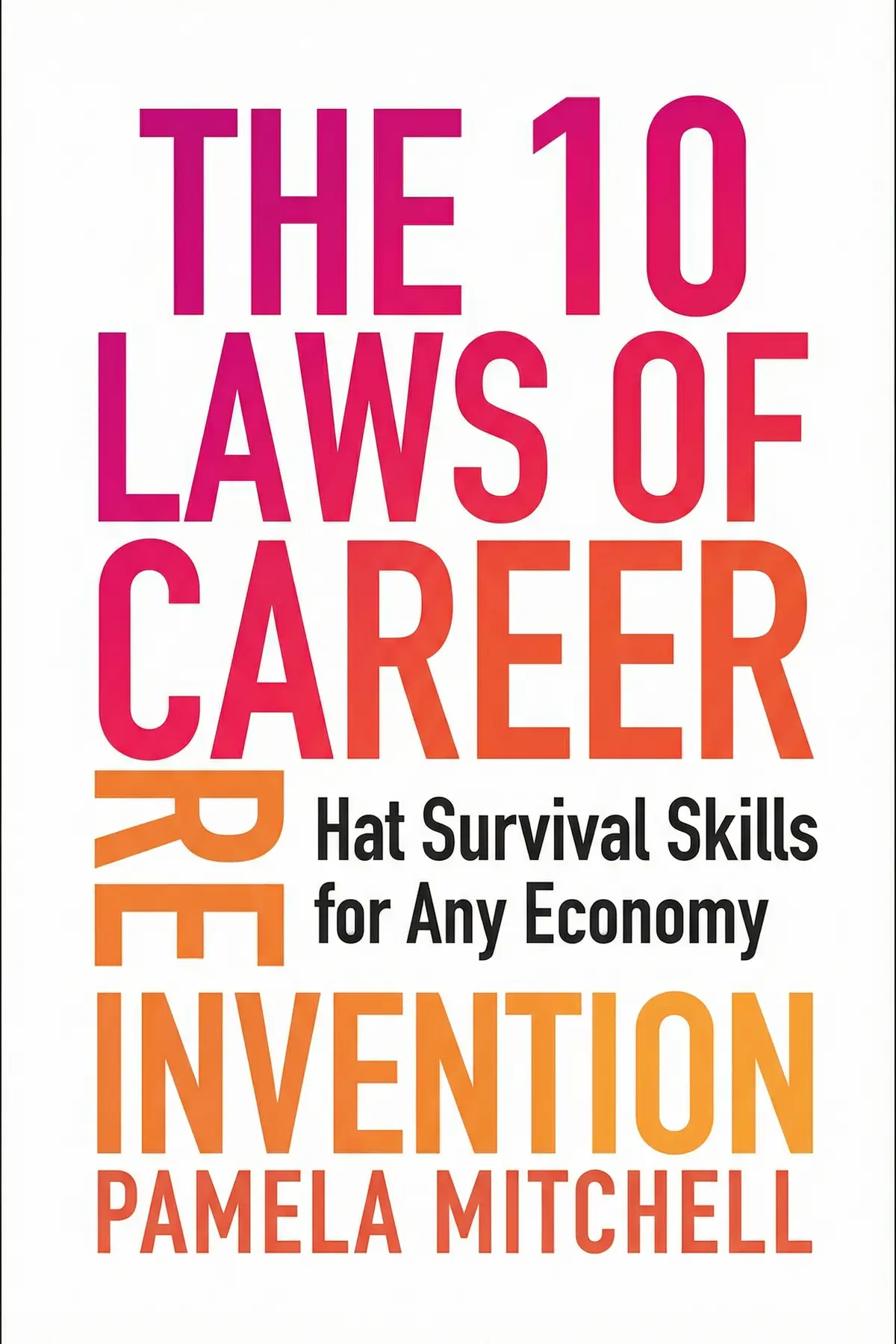
Table of Content
1. Introduction
1 min 04 sec
Many professionals know they want out of their career long before they know where to go, and most stall right there. In The 10 Laws of Career Reinvention, career coach Pamela Mitchell argues that the way forward begins with a detailed picture of an ordinary day you would love to live. Mitchell left Wall Street, then entertainment, before founding The Reinvention Institute, and she treats changing fields as a skill anyone can learn.
Her case is that switches fail less from lack of talent than from predictable traps. Fear produces excuses. The mind panics at unknown odds. An old identity refuses to let go, and plans ignore how slowly other people move. Each trap has a practical answer.
Along the way you will meet a FedEx executive who landed at a disease agency, a shop founder who flew to a conference with her baby strapped to her chest, and a five-seat board you can assemble for free. By the end, your next move should look like a series of steps you can actually take.
2. Picture your ideal workday before choosing a job
1 min 25 sec
Most people hunting for a new career start by browsing job titles. Mitchell starts somewhere far more personal, and she has a warning about one dream job that looks glamorous from the outside.
3. Trust your gut over impressive-sounding plans
1 min 26 sec
Your mind is excellent at building arguments for a career move, and that is exactly the problem. Mitchell points to a more honest advisor that most professionals have been trained to ignore.
4. Catch the three excuses that keep you stuck
1 min 22 sec
The reasons you give for not changing careers yet probably sound perfectly sensible. Mitchell sorts them into a few families, and once you can name the family, the reason starts to look very different.
5. Unknown odds scare you more than bad ones
1 min 33 sec
Given the choice, people will often take a gamble they are likely to lose over one whose odds are a mystery. That strange preference shapes which careers you are willing to consider.
6. Carry your skills forward, leave the old title behind
1 min 32 sec
A senior executive lost his post at a delivery giant and landed a leadership role in public health. What made the jump possible, and what he had to give up, applies to almost any switch.
7. A personal board that keeps you moving
1 min 25 sec
Companies never leave big decisions to one person, yet most career changers try to go it alone. Mitchell describes the people you need around you, and a few you should firmly keep off the list.
8. Speak your new industry's language like an insider
1 min 37 sec
Career changers with strong résumés often hear nothing back and never learn why. A single word that means one thing in finance and another in entertainment shows how easily outsiders give themselves away.
9. Keep your faith when progress runs slow
1 min 34 sec
A carefully planned one-year career switch can collapse for reasons that have nothing to do with you. Mitchell explains what to expect from the calendar, and what kind of confidence survives the wait.
10. Conclusion
1 min 09 sec
Mitchell’s laws describe a change that happens in two places at once. Inside, a vague wish to escape becomes a vivid picture of a day you would enjoy, and you learn to hear your body, see through excuses and stop flinching at the unknown. Outside, you translate what you can do into terms a new field understands, and you surround yourself with people who will tell you the truth. Her conviction is that switching careers is a learnable route, open to anyone who knows where the traps lie and borrows the methods of those who went first.
The book’s own exercise is a good place to begin. Write down five things you have wanted to do for a long time and still have not done. That is what your mouth says you want. Beside each one, note what you did, or failed to do, to make it happen. That is what your actions say. Then close the gap between the two with a single move, such as a call to an insider or a name for an empty seat on your board.
The gold clock for fifty years at one company is gone. In its place is the ability to start again, as often as you need to.
About this book
What is this book about?
Few people now spend fifty years with one employer. Most will change jobs many times, and many will change industries. Most of us still approach the switch with fear, a vague wish to escape and no real method. Pamela Mitchell, a career coach who has reinvented her own working life several times, argues that the switch follows patterns anyone can learn. She begins inside your head. Picture the working day you want in detail, trust your body's signals over an intellect drawn to impressive titles, and catch the three kinds of excuses that fear produces. She explains why unknown odds frighten people more than bad ones, and why that fear keeps them on familiar paths. Then she turns outward. You separate the skills you own from the job functions you performed, let go of your old work identity, assemble a five-person reinvention board, and learn the vocabulary and culture of your target industry from insiders. Finally, she prepares you for delays you cannot control and shows how to build the lasting confidence that draws people to help you.
Book Information
Who it's for
Professionals feeling stuck
Professionals who feel locked into the wrong career and want a method for leaving it.
Career changers hearing nothing
Career changers whose applications to a new industry keep getting no reply.
Senior professionals between roles
People who lost a senior role and wonder whether their experience counts anywhere else.
About the Author
Pamela Mitchell
Pamela Mitchell worked on Wall Street and in entertainment before becoming a career coach and public speaker, and she has changed her own career several times. She founded The Reinvention Institute, which helps professionals transform their careers. She also runs corporate workshops and a private group coaching community called Future Self HQ. Harvard Business Review named The 10 Laws of Career Reinvention a Top Shelf recommended pick.
Ratings & Reviews
Ratings at a glance
What people think
Listeners find the book superb for career reinvention, as it provides actionable tactics and beneficial advice for determining a professional path. They appreciate its easy-to-read style and motivational tone, with one listener noting that it is the best book they have read regarding job-seeking.
Top reviews
Tun
This is easily the best resource I’ve encountered for anyone seriously contemplating a professional pivot. Mitchell has a profound insight into the psychological hurdles we face when leaving a comfortable, albeit miserable, career path. The strategies are incredibly practical and go way beyond the standard advice you find in LinkedIn articles. I found the section on understanding the laws of the new economy particularly enlightening because it validates why our parents' advice no longer works in the modern market. Personally, I’m adding this to my permanent library for future reference. It came at a perfect time in my life, and I feel much more equipped to handle the trek ahead.
Show moreElena
Imagine your perfect Monday morning and then work backward—that simple prompt changed my entire perspective on my job search. This book is a masterclass in career reinvention that doesn't sugarcoat the difficulty of the process. Mitchell provides the tricks gathered by those who have successfully made the leap, and her enthusiasm is a great motivator. I’ve read a lot of books on job-seeking, but this is the first one that felt like it was speaking directly to my desire for a meaningful life. It’s practical, readable, and filled with strategies that you can implement immediately. If you're ready to escape the old mindset of the 50-year career, buy this.
Show moreJoshua
If you're feeling stuck in a cubicle that drains your soul, Pamela Mitchell’s book acts like a compass for the lost. It doesn't just offer fluffy motivation; it provides a blueprint for those who realize the era of the 50-year gold clock is dead. I particularly appreciated the exercise of reverse engineering my ideal workday to find a realistic path forward. The truth is, switching industries feels like rocket science until someone breaks it down into these manageable laws. While some sections felt a bit repetitive, the practical guidance on avoiding common pitfalls is worth the price of admission alone. It’s a very readable, common-sense approach to a very complex life transition.
Show moreLeah
Mitchell’s writing style is what really sets this apart from other dry, academic career guides. She writes with an enthusiasm that is infectious, making the daunting task of changing industries feel entirely doable for the average person. The book walks you through the necessity of rethinking our work lives in a world where gold clocks are relics of the past. One of the best parts is the discussion on avoiding common pitfalls—it's like having a mentor who has already made the mistakes for you. My only minor gripe is that some of the laws overlap quite a bit, but the core message remains powerful and the strategies are highly actionable.
Show moreAna
After hearing several people recommend this for career transitions, I finally picked it up during a period of professional burnout. Mitchell’s insight into why we feel locked into certain paths is truly profound and helps demystify the fear of the unknown. The book is incredibly practical, offering a step-by-step trek through the landscape of modern employment. I loved the emphasis on the fact that switching careers isn't rocket science; it's a skill that can be learned with the right tricks. While I found a few of the exercises a bit abstract, the majority of the strategies for deciding on a new direction were spot on. It's a great value for anyone seeking actual change.
Show moreSophia
To be fair, I expected a bit more new information from this volume. While the tone is encouraging and Mitchell is clearly an expert, a lot of the advice felt like stuff I’d heard before in various professional development podcasts. The idea of visualizing your bliss and then working backward is a solid concept, but the execution in these specific chapters felt a bit thin at times. Not gonna lie, I was hoping for more granular data on specific industry shifts rather than just general laws. It's a decent read if you're just starting your journey, but seasoned job-seekers might find it a bit elementary. Still, it’s a quick, motivational read that keeps you moving.
Show moreSiraporn
Gotta say, the core message here is vital for the modern workforce. We are all going to change jobs and industries multiple times, so learning how to navigate those shifts is essential. However, the book's structure felt a little rigid for my taste. While the 10 Laws provide a nice framework, real life is often much messier than these chapters suggest. I appreciated the common-sense approach to career development, but I wish there were more diverse case studies included for those in non-corporate roles. It’s a solid 3-star read: helpful for a quick mental reset, but perhaps not the definitive bible on the subject I was hoping for.
Show moreSamira
Look, the transition from one industry to another is terrifying, but this book makes it feel like a structured adventure. Pamela Mitchell breaks down the different laws governing our professional lives with a level of clarity that is refreshing for the most part. I particularly liked the focus on reverse engineering your goals, as it turns an abstract dream into a concrete plan. The truth is, we are no longer in the era of guaranteed stability, so these tools are essential. My only complaint is that the tone can be a little too cheerleader-ish at times, which might not sit well with cynical readers. Nevertheless, the guidance on navigating pitfalls is useful for any professional.
Show moreGung
Ever wonder why some people seem to transition between careers so effortlessly while others stay stuck for decades? This book attempts to answer that by laying out a path that anyone can follow if they are willing to put in the work. It covers a lot of ground, from understanding new challenges to the specific ways we should act and think in a shifting market. In my experience, the advice on avoiding pitfalls was the most valuable part, though some of the other laws felt like filler to hit the '10' count. It’s a decent guide, though I think it works best as a companion to more specialized industry books. Definitely a should-read.
Show morePete
I wanted to like this more, but I found myself skim-reading most of the second half. Frankly, it felt like a long-form version of a Blinkist summary rather than a deep dive into the mechanics of reinvention. The book starts strong by dismantling the myth of the lifelong company man, but then it devolves into standard self-help tropes that don't always translate to the real world. I’ll try it again later... maybe, but for now, it didn't provide the 'aha' moment I was looking for. It's a bit too much 'think positive' and not enough 'here is the technical how-to' for my specific needs in a niche industry.
Show moreQuestions about this book
What is the main idea of The 10 Laws of Career Reinvention?
Pamela Mitchell argues that changing careers is a process anyone can learn. It starts with a detailed vision of the life you want and continues with practical steps: trusting your gut, catching fear-driven excuses, transferring skills instead of job functions, building a support team, learning your new industry’s language and keeping realistic expectations about time. Knowing the common pitfalls in advance is what makes the switch manageable.
What are the three excuses Pamela Mitchell describes?
Mitchell says excuses come from fear and fall into three groups. In the first, you put responsibility on someone else, such as a company that offers no new opportunities. In the second, you blame circumstances, such as not having a college degree. In the third, you claim you misunderstood the rules, such as assuming someone would call you back. Her test for each is whether there is really no way around the obstacle.
What is a reinvention board?
It is Mitchell’s version of a company’s board of directors, built around your career change. It has five roles: a master connector who knows many people, a clued-in colleague who knows your strengths and weaknesses, a warm and fuzzy friend for hard moments, a drill sergeant who rejects excuses, and a native from your target industry. Spouses, partners and parents should stay off it because the decision affects them most.
How can I switch industries without starting from scratch?
Separate your job functions from the skills behind them. A lawyer who drafts contracts is using writing skill, which also matters in public relations. Because his skills in management and logistics carried over well, Reggie Mebane went from being FedEx’s chief operating officer to serving as the Center for Disease Control’s chief management officer. Mitchell adds that you must let go of your old job identity so others can see you in the new role.
Who should read The 10 Laws of Career Reinvention?
It suits people who want to leave a career but feel stuck, whether by fear, by doubts about their experience or by a job search that is going nowhere. It is especially useful for anyone moving into an unfamiliar industry, since it covers finding insiders, learning industry vocabulary and culture, and coping with the delays that come with most career changes.
Featured in
Readers also enjoyed

60 Seconds & You’re Hired!
Robin Ryan



Be A Free Range Human: Escape the 9 to 5, Create a Life You Love,
Marianne Cantwell
Be the Unicorn: 12 Data-Driven Habits That Separate the Best Leaders from the
William Vanderbloemen
AUDIO SUMMARY AVAILABLE
Listen to The 10 Laws of Career Reinvention in 15 minutes
Get the key ideas from The 10 Laws of Career Reinvention by Pamela Mitchell, plus 5,000+ more nonfiction titles.
- 5,000+ titles
- Listen as much as you want
- 7-day free trial
- Cancel anytime









