

14 min 27 sec
Available in: English
 ไทย
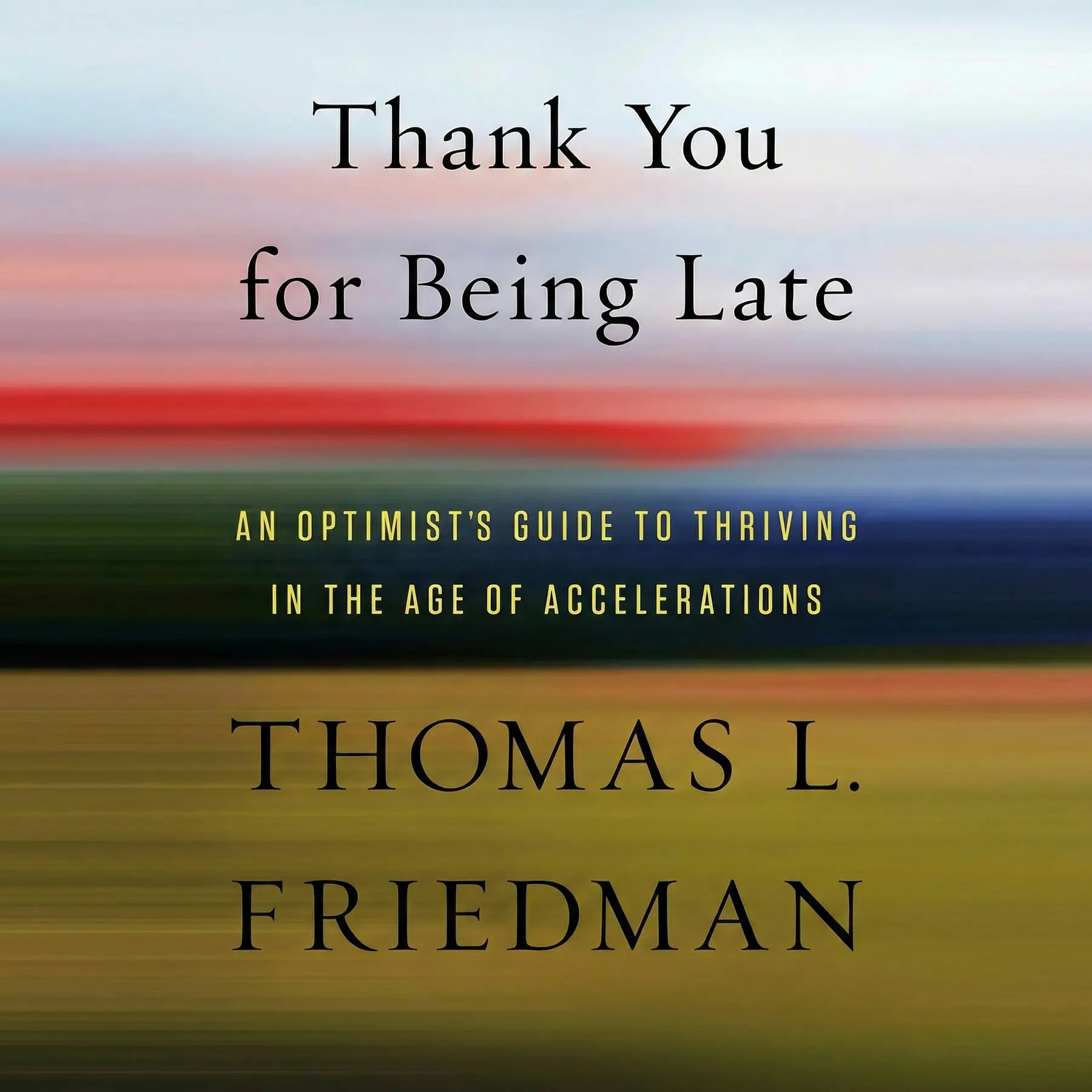
EnglishไทยThank You for Being Late: An Optimist’s Guide to Thriving in the Age of Accelerations
Explains why technology, global markets and climate change all sped up at once around 2007, what that does to jobs, careers and whole regions, and how individuals and communities can stay steady by moving and cooperating.
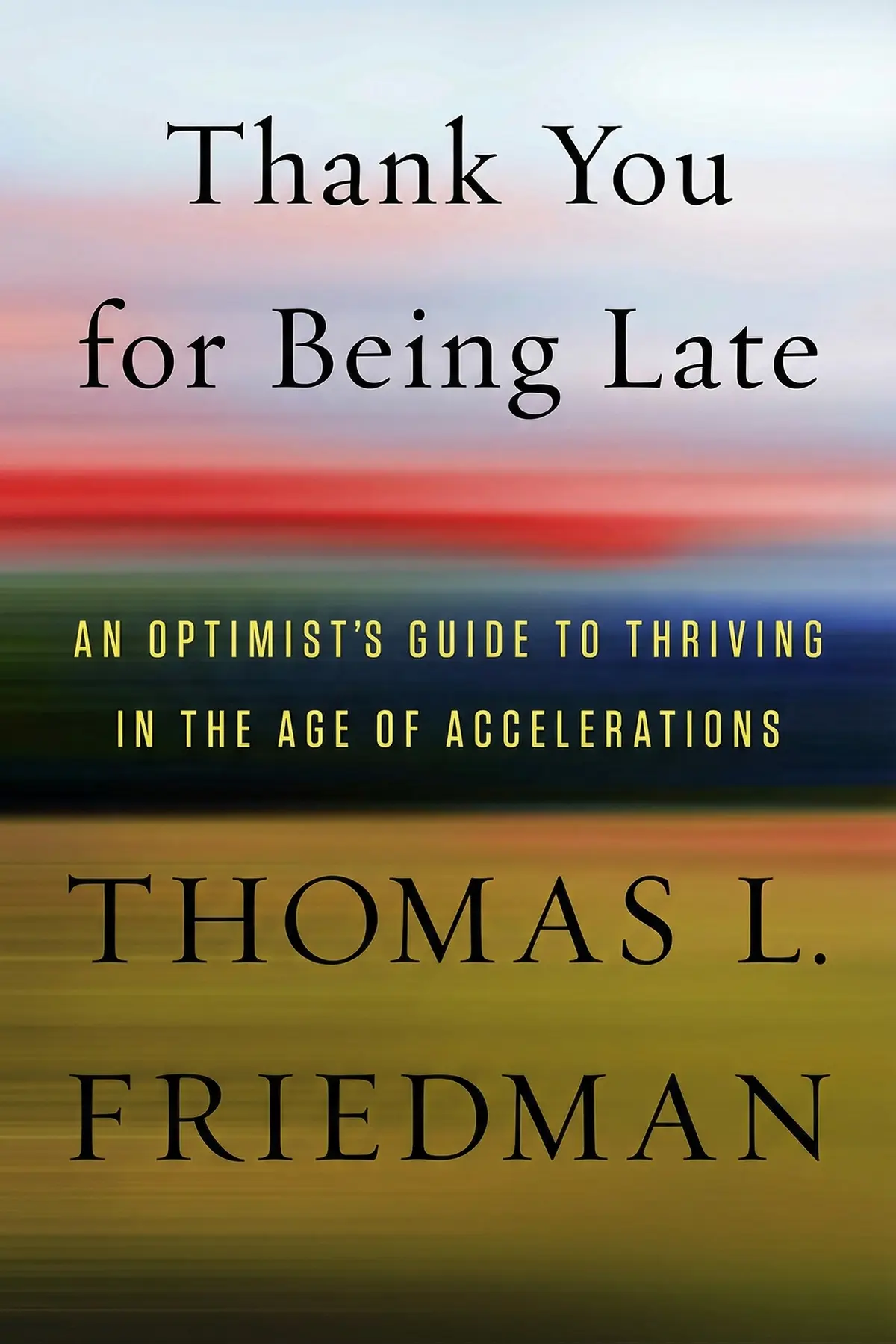
Table of Content
1. Introduction
1 min 03 sec
If the world feels like it changes faster than you can keep up, that feeling has a birthday. In Thank You for Being Late, New York Times columnist Thomas L. Friedman dates it to 2007, the year the first iPhone went on sale, Twitter reached a global scale and Airbnb was started in a San Francisco apartment. His argument is that three forces, technology, global markets and climate change, all began speeding up together that year, and that the steady ground earlier generations stood on is not coming back.
Stability is still possible, Friedman says, but only the kind a cyclist has: you keep it by moving. And he is an optimist. His case ends in a Minnesota suburb and in a conversation with a doctor about loneliness. Ahead lies a map of the three accelerations, what they are doing to jobs, careers and entire regions, and the human habits that keep people and communities upright while everything around them picks up speed.
2. Read 2007 as the year everything sped up
2 min 04 sec
A phone, a global tweet and a home-sharing startup in a San Francisco apartment all arrived in the same twelve months. Friedman sees in that coincidence the start of an age that demands a different idea of what being stable means.
3. Spot which jobs software will reach first
2 min 02 sec
Milking a cow once meant mud and muscle. Today it can mean a dashboard. Friedman uses the dairy barn to show which kinds of work are most exposed, and how quickly the tools themselves go out of date.
4. Global flows now outweigh diplomas, and you can use them
2 min 06 sec
A single photo of a dress, shared hundreds of thousands of times, emptied a store’s shelves overnight. Friedman reads that moment as a warning about the old bargain between education and a safe career.
5. See the weather behind today's migration headlines
2 min 17 sec
A heat index in Iran that sounds like an oven setting, and a July hotter than any month ever recorded. Friedman links these numbers to the people leaving their homes, and to a pressure that is still growing.
6. Build something real with basic skills and a connection
1 min 36 sec
A family in Turkey started a data company in the very year the world sped up. Its staff had little formal schooling, which is exactly why Friedman finds its story so encouraging.
7. Learn from a divided town that pulled together
1 min 51 sec
In one Minnesota suburb, 70 percent of voters back school funding even though only 15 percent of residents have school-age children. Friedman grew up there, and he thinks its story holds the real answer to an age that refuses to slow down.
8. Conclusion
1 min 28 sec
Friedman’s book holds two pictures side by side. One is a world speeding up on three fronts at once: chips doubling in power, a dress selling out after 816,000 retweets, a July ranked the hottest of all 1,639 months on record. The other is a Minnesota suburb where 70 percent of voters still back school funding, though only 15 percent of residents have school-age children. The first picture explains why the old, static kind of stability is gone. The second shows where a new kind can come from.
His optimism rests on the link between them. Acceleration knocks people off balance, but it also gives anyone with basic schooling and a connection the means to build, share and solve. What keeps a person or a town upright is motion, together with other people.
That points to a few habits worth starting. Look back five years to see how your work has really changed, and plan to keep learning instead of resting on what you already know. Join the flows, whether networks, open calls for ideas or groups working on shared problems. And guard the human contact that technology makes so easy to skip, since isolation is a danger of its own.
A bicycle stays up only while it moves, and it goes farther when others ride beside it.
About this book
What is this book about?
Many people feel that the world keeps changing faster than they can adjust. Thomas L. Friedman argues that the feeling is accurate and has a starting point: 2007, the year the first iPhone appeared, Twitter went global and Airbnb began. That year, he says, three forces began accelerating together: technology, global markets and climate change. Friedman follows each force through vivid cases. Computers now help run dairy farms in upstate New York, a single photo shared online can sell out a dress, and atmospheric carbon has reached levels not seen in 800,000 years while July 2016 set a heat record. Jobs vanish, products age within a few years and droughts push people across continents. Yet the book is subtitled an optimist's guide. Friedman shows how the same tools let people with basic schooling build real companies, and how his hometown of St. Louis Park, Minnesota, turned itself into a thriving, cooperative community. Readers get a clear map of the forces reshaping work and society, and a practical idea of stability for an age that will not slow down.
Book Information
Who it's for
Professionals sensing skills aging
Professionals who sense their skills aging and want to understand the forces behind it.
Students and career changers
Career switchers and students deciding what to learn in a world that keeps changing.
Citizens and community leaders
Community leaders and citizens looking for a hopeful, practical response to technology, globalization and climate change.
About the Author
Thomas L. Friedman
Thomas L. Friedman, born in 1953 in Minneapolis, Minnesota, began as a reporter and won two Pulitzer Prizes in the 1980s for his coverage of Lebanon and Israel, and a third in 2002 for commentary on the war on terror. Since 1995 he has written the foreign affairs column at The New York Times, widening it to cover finance, globalization, technology and the environment. His other books include The World Is Flat and The Lexus and the Olive Tree.
Ratings & Reviews
Ratings at a glance
What people think
Listeners find this book consistently entertaining and immersive, praising the high quality of writing and the abundance of meaningful insights. It is frequently called thought-provoking, with one listener highlighting its ability to alter how people perceive the future, while others value the thorough information and its connection to modern happenings. Regarding the tempo, feedback is varied, with several listeners describing the organization as somewhat disjointed.
Top reviews
Riley
Finally got around to reading this and frankly, it changed how I view the morning news. Friedman explains that we are living through a period of "supernova" acceleration where human adaptability is struggling to keep pace with technological growth. The way he links Moore’s Law to social instability is nothing short of brilliant. I appreciated the optimism he maintains throughout the text, even when discussing daunting topics like environmental collapse or job displacement. It’s an engaging read that manages to be both incredibly informative and surprisingly emotional towards the end. Some might find his writing style a bit too conversational, but I found it refreshing compared to most dry, academic policy books. This is a must-read for anyone trying to make sense of the 21st century.
Show moreAhmed
As someone who struggles to keep up with the breakneck speed of current events, this book was a godsend. It provides a comprehensive framework for understanding the "three great accelerations" that are reshaping our planet right now. I was particularly struck by the section on Mother Nature and why we can no longer ignore the ecological costs of our progress. Friedman’s writing is exceptionally engaging, making even the most complex global market trends feel accessible and relevant to daily life. It’s a thought-provoking piece of work that encourages you to pause and reflect on where we are headed as a species. Even if you don't agree with every one of his policy suggestions, the sheer amount of insight packed into these pages is worth the price of admission.
Show moreBenjamin
This book should be required reading for anyone who cares about the intersection of public policy and technological growth. Friedman makes a brilliant case for why we need to move faster to keep up with the environment we've created. I loved the section on Mother Nature; it’s one of the few books that treats climate change as an integral part of globalization rather than a side issue. The "Thank You for Being Late" concept—using pauses to reflect—is a beautiful takeaway for our hectic lives. Personally, I didn't mind the Minnesota section as much as others did, as it grounded his grand theories in real human communities. It’s a comprehensive, visionary work that manages to stay grounded in common sense.
Show moreAnthony
Truth is, the Minnesota memoir at the end caught me off guard, but it ended up being my favorite part. After hundreds of pages about silicon chips and global markets, Friedman brings it all back to the importance of "anchors" and local community. He argues that the faster the world moves, the more we need those deep, human connections to keep us stable. This isn't just a book about gadgets; it's a book about how we survive and thrive as a society. The writing is top-tier, engaging the reader from the very first page with a mix of high-level theory and personal anecdotes. It changed my view of the future from one of fear to one of cautious optimism. If you're looking for a comprehensive guide to our confusing times, this is it.
Show moreWitthaya
Friedman has this uncanny ability to make you feel like you're having a deep conversation with a very smart, albeit slightly rambling, uncle. He synthesizes complex trends—technology, globalization, and climate change—into a cohesive narrative about why our current era feels so chaotic. I found the deep dive into 2007 particularly fascinating; it really was the year the foundation of our modern digital life was laid. However, the book isn't without its flaws. It feels about a hundred pages too long, and some of the anecdotes about his hometown in Minnesota felt a bit like a detour from the main thesis. If you can handle the occasional name-drop and repetitive point, it’s a stellar guide for understanding the "Great Acceleration." It forced me to rethink how I approach my own career in this fast-paced environment.
Show moreNadia
The chapter on the "Great Acceleration" really puts things into perspective for anyone feeling overwhelmed by the modern world. Friedman argues that we need to build "floors" under people rather than "ceilings," which is a powerful metaphor for social safety nets in a digital age. I found his analysis of the "Market" and "Mother Nature" to be incredibly relevant, especially given the current political climate. My only real gripe is that he can be a bit repetitive, hammering home the same points about 2007 over and over again. Despite the occasional bloat, the core ideas are robust and worth pondering. It’s a dense read, so take your time with it. The insight into how companies like Airbnb and GitHub changed the landscape of trust was particularly enlightening for me.
Show moreNoi
Ever wonder why the world feels like it’s spinning off its axis lately? This book offers a compelling explanation by weaving together threads of technology, global trade, and environmental change. It is an ambitious project that mostly succeeds in painting a picture of our interconnected reality. I especially enjoyed the discussion on "high-imagination" jobs and how we need to rethink education for the future. Friedman’s tone is generally positive, which is a nice change of pace from the usual doom-and-gloom futurist predictions. The pacing is a bit uneven, particularly when he dives into the minutiae of his childhood in Minnesota. Still, the overall message about the importance of human connection in an automated world resonated deeply with me.
Show morePetch
To be fair, I expected something a bit more focused given the author’s reputation for sharp analysis. The first half of the book is classic Friedman—insightful, data-driven, and genuinely eye-opening regarding the technological shifts of the last decade. He makes a compelling case for 2007 being a historical tipping point. But then the narrative shifts gears entirely into a nostalgic memoir about growing up in St. Louis Park, Minnesota. While his points about community and social capital are valid, the transition felt jarring and somewhat disjointed from the tech-heavy beginning. It felt like two separate books were mashed together without a strong enough bridge. I still learned a lot, but I spent a significant portion of the final chapters wondering when he’d get back to the point.
Show moreSumalee
In my experience, Friedman is best when he's connecting dots that other people haven't even seen yet. Unfortunately, in this volume, he seems to be rehashing a lot of common knowledge that has been circulating in tech circles for years. His obsession with the year 2007 is interesting at first, but it quickly becomes a repetitive crutch for the entire first half of the book. Not gonna lie, I found myself skimming through some of the more long-winded technical explanations. The writing style is undeniably polished and "universally popular," yet it lacks the "seminal" feel of his earlier works like The World Is Flat. It’s a decent primer for someone who isn't very tech-savvy, but more informed readers might find it a bit patronizing.
Show moreSirirat
Look, I wanted to love this, but it felt like a series of recycled New York Times columns stretched out into a bloated manifesto. Friedman spends an exhausting amount of time telling the reader that technology is moving fast—a point most of us figured out years ago. The constant name-dropping of CEOs and world leaders gets tiresome quickly, adding a layer of elitism that obscures his actual arguments. He treats the reader like they’ve been living under a rock, excitedly explaining basic concepts like the cloud or smartphone apps as if they were revolutionary secrets. The last third of the book is a meandering trip down memory lane that has very little to do with the "accelerations" promised in the title. It desperately needed a more aggressive editor to trim the fat and keep the message concise.
Show moreQuestions about this book
What is the main idea of Thank You for Being Late?
Thomas L. Friedman argues that since 2007, three forces have been accelerating together: technology, driven by chips that double in power about every two years, global markets built on digital flows, and climate change with population growth. Disruption is now nearly constant, so stability must be dynamic, like riding a bicycle. His answer is to keep adapting and to work together for the common good.
Why does Friedman say 2007 was a turning point?
In that single year the first iPhone came out, Twitter reached a global scale and Airbnb was founded in a San Francisco apartment. Mobile data traffic on AT&T’s national network then grew by more than 100,000 percent between 2007 and 2014. Friedman sees technology, markets and climate all picking up speed at the same moment, launching an era of constant adaptation.
What does the book say about jobs and automation?
Friedman shows computers taking over milking on upstate New York dairy farms, and warns that many middle-level jobs are being replaced by software and a handful of lowly laborers. He cites a 2013 University of Oxford study finding that 47 percent of American jobs faced a very high risk of automation within 20 years, and notes that technologies become outdated every five to seven years.
How can I apply the ideas in Thank You for Being Late?
Treat stability as something you keep by moving, so plan to keep learning instead of relying on one education. Connect to global flows of ideas and information, the way General Electric opened its problems to contests worldwide. Support shared goods in your community, as St. Louis Park voters do with schools. And, following Surgeon General Vivek Murthy’s warning about isolation, make time for face-to-face conversation.
Readers also enjoyed

Abortion: Our Bodies, Their Lies, and the Truths We Use to
Jessica Valenti


Adults in The Room: My Battle With Europe’s Deep Establishment
Yanis Varoufakis


Age of Anger: A History of the Present
Pankaj Mishra

A Different Kind of Power: A Memoir
Jacinda Ardern
AUDIO SUMMARY AVAILABLE
Listen to Thank You for Being Late in 15 minutes
Get the key ideas from Thank You for Being Late by Thomas L. Friedman, plus 5,000+ more nonfiction titles.
- 5,000+ titles
- Listen as much as you want
- 7-day free trial
- Cancel anytime









