

15 min 33 sec
Available in: English
Talking Across the Divide: How to Communicate with People You Disagree with and Maybe Even Change the World
By Justin Lee
Shows how to talk with people who hold opposing views without starting a fight. You listen first, avoid five common barriers and ask for one small step, so that a stuck disagreement can start to move.
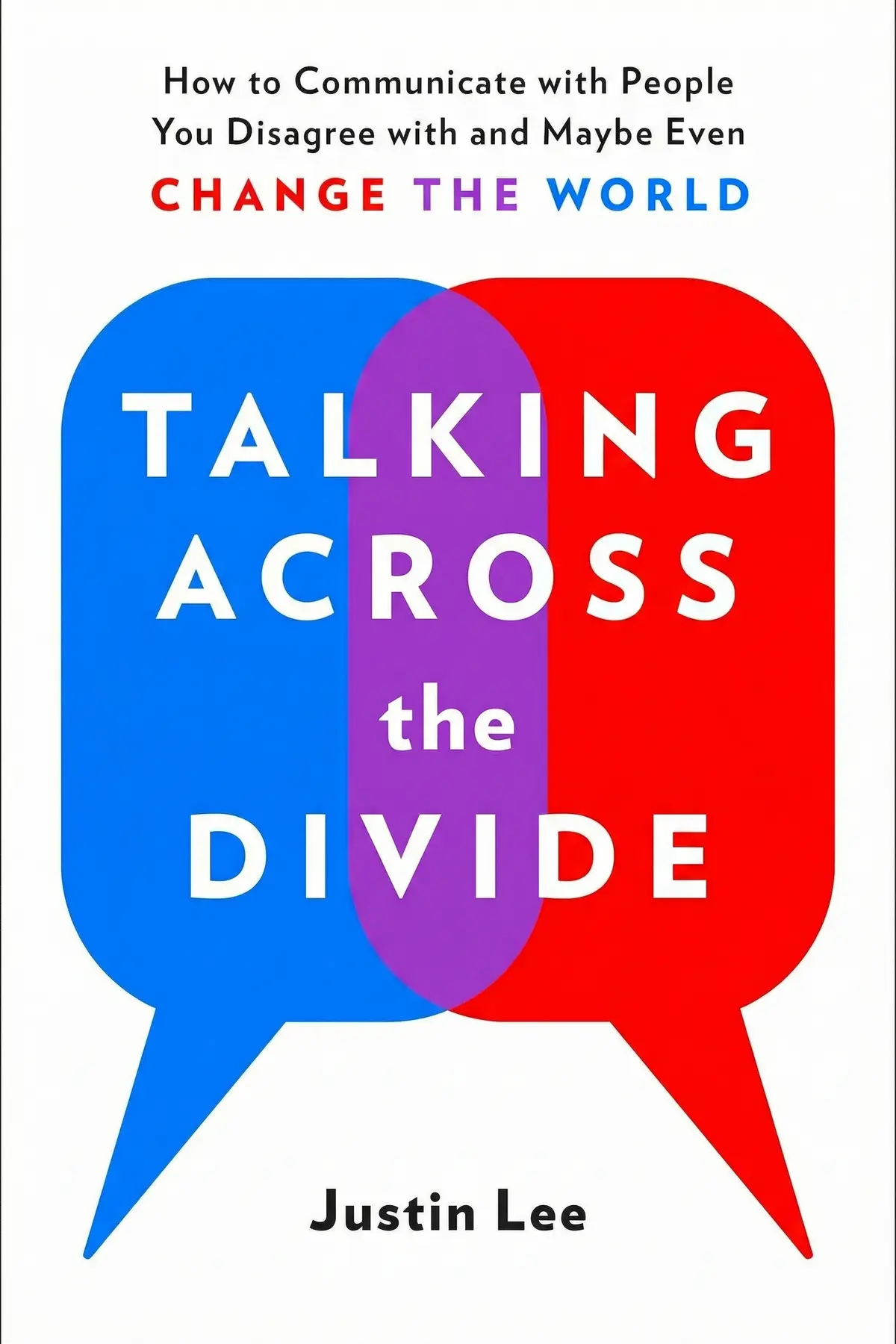
Table of Content
1. Introduction
59 sec
If every family dinner or group chat about politics leaves both sides more dug in, there is a reason, and Justin Lee thinks it can be fixed. In Talking Across the Divide, Lee, who spent two decades bringing Christians and gay people into conversation, argues that arguing is itself the problem: tell someone they are wrong and they usually hold their view more tightly.
His alternative, strategic dialogue, starts with listening and treats a changed mind as a series of small steps. The book’s case is that people shift when they feel heard, when no one makes them look foolish, and when they are asked for one step at a time. Lee refined the method helping conservative parents accept their LGBT children.
Ahead: how echo chambers push us apart, the five barriers that block a changed mind, and the modest request that should close every hard conversation.
2. See how online echo chambers push views apart
1 min 55 sec
Two people can type the same words into a search box and come away with opposite pictures of reality. That gap helps explain why the people you love seem to drift further away every year.
3. Be the one voice that breaks the echo
1 min 54 sec
A famous experiment showed how easily people agree with an obviously wrong group. It also revealed what it takes to break that spell, and why a debate is the worst tool for the job.
4. Earn a hearing by retelling their story
1 min 53 sec
A rousing speech feels like the natural way to win someone over, yet it rarely moves anyone who disagrees. Lee’s first move is far quieter, and it asks more patience than most people expect.
5. Cast the other person as the hero
1 min 59 sec
Telling someone their belief is wrong seems honest and direct, yet it almost guarantees failure. Lee’s alternative borrows from storytelling, and he has tested it on one of the most painful divides he knows.
6. Loosen group loyalty with personal questions
1 min 55 sec
Beliefs backed by a whole community resist even the best argument, and change itself feels uncomfortable. Lee turns both problems around, using people’s wish to be individuals and a discomfort they never considered.
7. Correct false facts without making anyone feel foolish
1 min 55 sec
A soda boycott once spread to a company that had nothing to do with the original complaint, and some people still believe the story. Lee explains why facts alone so often fail, and what to add.
8. End every hard talk with one small ask
1 min 56 sec
One reasonable-sounding reply to a relative can turn a single disagreement into an attack on everything he believes. Lee shows how to keep the conversation small enough to move, and what to request at the end.
9. Conclusion
1 min 07 sec
Lee’s method asks for something unusual: patience with people you believe are wrong. Echo chambers push views to the edges, and arguments push them further. Strategic dialogue works the other way, through many small acts of listening that make it safe for someone to move. Remember the person in Asch’s study who held out once a single ally spoke up. You can be that ally for someone surrounded by agreement, provided you arrive ready to listen first.
Before your next hard conversation, listen to more than one person on the other side and practice retelling one of their stories until they would recognize it. Bring paper and a pen, and let your anger go onto the page so the room stays calm. When you speak, make them the hero of the story, keep to the single branch you came to discuss, and close with one modest request that moves both of you toward what you each care about.
Minds rarely change in one evening. They change a step at a time, and each step begins with someone who felt heard.
About this book
What is this book about?
Many families and workplaces now include people on opposite sides of heated issues, and every attempt to settle things seems to push them further apart. Justin Lee argues that the usual method, arguing, is part of the problem. When people are told they are wrong, they tend to dig in. Lee spent two decades bringing Christians and the LGBT community into conversation and helping conservative parents accept their LGBT children. From that work he built strategic dialogue, a method that begins with preparation and patient listening. Next it works through five obstacles to changing someone's mind: protecting the ego, loyalty to a team, the pull of comfort, false information, and the defense of a worldview. Along the way he explains how online echo chambers and search algorithms drive group polarization, and why one dissenting voice can still make a difference. Readers get a practical sequence they can use with a relative, a colleague or a community: gather the other side's story, retell it so they feel heard, cast them as the hero, correct facts without condescension, and finish by asking for one realistic next step.
Book Information
Who it's for
Dreading family gatherings
People with relatives or friends on the other side of political or religious issues who dread the next family gathering.
Leaders of divided groups
Team leads and organizers trying to get opposing camps talking instead of fighting.
Advocates hoping to persuade
Advocates who want to change minds without hardening their opponents.
About the Author
Justin Lee
Justin Lee founded The Gay Christian Network, a nonprofit, interdenominational organization that supports dialogue between gay people and Christians, as well as people on both sides working through related questions. He has also served as executive director of Nuance Ministries. His two decades in LGBT Christian advocacy give him long experience bridging political and theological divides. He is also the author of Torn: Rescuing the Gospel from the Gays- vs. -Christians Debate, published in 2012.
Ratings & Reviews
Ratings at a glance
What people think
Listeners find the work excellently composed and value the communication techniques presented, with one listener noting that it offers useful advice for navigating challenging conversations.
Top reviews
Tippawan
Justin Lee's approach to bridge-building is exactly what we need in this hyper-polarized climate. Having appreciated his previous work in 'Torn,' I was eager to see how he would apply those lessons to broader social conflicts beyond just religious circles. The way he breaks down 'strategic dialogue' into manageable phases makes the prospect of talking to an ideological opponent feel less like a battlefield and more like a classroom. His insights into 'ego protection' and 'team loyalty' helped me realize why my previous attempts at persuasion failed so miserably. This isn't just a book about being nice; it’s a tactical manual for anyone who cares about moving the needle of progress through empathy. While the methods require immense patience, the practical suggestions for listening and 'defining your ask' are gold. I have already started using these techniques with my extended family, and the shift in atmosphere is palpable.
Show moreRatchanee
Wow, I didn't expect a book about communication to be such an emotional rollercoaster for my own ego. Lee forces you to look in the mirror and realize that you might be the one blocking the dialogue by being too attached to your 'team.' The chapter on 'Worldview Protection' was a lightbulb moment for me. It explained why my brother-in-law gets so defensive even when I’m being perfectly logical. The book provides a clear roadmap for breaking down these walls without compromising your own values. It’s rare to find a guide that is both this practical and this deeply human. I loved the emphasis on self-care, acknowledging that this work is draining and thankless. This should be mandatory reading for anyone in leadership or activism. Truly a masterpiece of grace and clear communication.
Show moreSkylar
Ever wonder why your Facebook arguments never actually result in someone changing their mind? This book explains exactly why that happens and how to actually get through to people. Lee’s focus on 'lowering the barriers' instead of 'winning the argument' is a total game-changer. I found the section on 'Comfort' particularly enlightening, as it explains why people cling to wrong ideas simply because the alternative is too scary to contemplate. The book is well-written, compassionate, and provides practical suggestions that you can start using immediately. It’s not a magic cure-all, and Lee is honest about the fact that some people just aren't ready to talk. But for those who are, this is the best guide I’ve found for making those conversations count. Highly recommend for any bridge-builders out there.
Show morePrapaiwan
Finally got around to finishing this after seeing Lee's work with LGBTQ and evangelical groups mentioned online. The book is incredibly well-written and offers a refreshing take on communication skills that goes beyond the standard 'agree to disagree' fluff. I particularly liked the section on overcoming misinformation, as it doesn't just tell you to fact-check people but explains why facts often fail to change minds in the first place. My only real gripe is that some of the strategies feel like they require a very specific, controlled environment to work effectively. It’s a bit harder to apply 'strategic listening' when you're being blindsided by a comment at a loud party. Still, the core message about pursuing truth through connection rather than combat is powerful and timely. It’s a solid resource for anyone tired of the constant shouting matches on social media.
Show moreMuk
The chapter on 'making an ask' changed how I view conflict resolution entirely. Most of the time, we enter arguments wanting the other person to admit they are 100% wrong, which Lee correctly identifies as a recipe for failure. By narrowing the goal to something small and achievable, you actually make progress. I found the five barriers—ego, team loyalty, comfort, misinformation, and worldview—to be a very helpful framework for diagnosing why a conversation went off the rails. To be fair, Lee does lean heavily on his personal niche, which makes some sections feel a bit repetitive if you aren't interested in that specific conflict. However, the overarching communication skills are top-notch and easy to digest. It’s a very readable guide that offers a glimmer of hope in a very dark political era.
Show moreSomkid
As someone who tends to shut down during political debates, Lee’s 'strategic dialogue' framework felt like a total lifeline. I’ve always been an 'avoider,' but this book gave me the tools to engage without feeling like I’m going to have a panic attack. The writing style is conversational and warm, making complex psychological concepts like 'ego protection' easy to understand. I especially appreciated the 'debrief' section where you evaluate what went well and what didn't after a tough talk. It turns communication into a skill you can actually practice and improve over time. My only minor complaint is that it can feel a little simplistic when dealing with truly bad-faith actors. But for the 90% of people who are just misinformed or defensive, this is an excellent handbook for building bridges.
Show moreNora
After hearing Justin Lee speak on a podcast, I knew I had to pick up this manual for civil discourse. It builds beautifully on the themes of empathy he explored in his previous books, but with a much more tactical edge. The focus on 'strategic listening' is something I’ve already started trying to implement in my workplace. It’s a lot harder than it sounds to let someone speak without mentally preparing your rebuttal! The book is a bit repetitive in the middle, and I wish there were more examples outside of the religious/LGBTQ sphere to show the techniques in different contexts. Nevertheless, the core message is vital. We need more people willing to do the hard work of understanding those they disagree with, and this book provides a very clear map for that journey.
Show moreWittaya
Does the world really need another self-help book about talking to our political enemies? While Lee is clearly a compassionate writer, his heavy reliance on storytelling as a primary tool for persuasion feels a bit shaky to those of us who value hard data. The 'five barriers' like ego protection and team loyalty are solid observations, yet I felt the advice was often too generic to solve deep-seated systemic issues. It is well-meaning pabulum in some chapters, though the section on strategic listening is genuinely shrewd. I appreciate the effort, but I’m not sure these anecdotal successes scale to the national level where interests are fundamentally at odds. If you are looking for a gentle introduction to civil discourse, this works, but don't expect a magic wand for our cultural crises. It’s a valiant mission, just perhaps a bit too idealistic for my cynical tastes.
Show moreAisha
Look, the truth is that this book is a bit of a mixed bag for me. On one hand, Justin Lee is an incredibly gifted communicator who writes with a level of nuance that is rare these days. On the other hand, the heavy focus on storytelling over data is a hard pill for me to swallow. He argues that stories are more persuasive, and while he’s probably right, I hate that we live in a world where that's the case. The steps for dialogue are clearly outlined, but they feel very 'one-on-one,' making them hard to apply to broader social media interactions. It’s a good book for repairing a relationship with a specific friend or family member. However, I’m skeptical about how much it can really do to heal the larger divide in our country.
Show moreNitaya
Not what I expected based on the title, which promised a universal toolkit for bridging the modern American divide. Instead, I found a book that draws almost exclusively from the author's specific background in LGBTQ and evangelical Christian mediation. While that work is noble, it doesn't always translate to other high-stakes conflicts where belief systems are diametrically opposed. The advice feels like a collection of nice anecdotes that rely on everyone involved being a 'good actor' in the conversation. Frankly, the techniques for 'strategic dialogue' seem way too time-consuming for the average person to use in daily life. I was hoping for more statistics and less storytelling. If you aren't already part of a religious community, a lot of the examples might feel irrelevant or unrelatable. It just didn't offer the scalable solutions I was looking for in today's political climate.
Show moreQuestions about this book
What is the main idea of Talking Across the Divide?
Justin Lee argues that arguing usually makes people hold their views more tightly. His alternative is strategic dialogue: prepare by listening to the other side, retell their story so they feel heard, steer around five barriers to a changed mind, and end by asking for one small step. He built the method over two decades of bringing Christians and the LGBT community into conversation.
What are the five barriers to changing someone's mind?
The five barriers Lee lists are protecting the ego, loyalty to a team, comfort, misinformation, and defending a worldview. People guard their pride, stay loyal to their group, prefer the status quo, may hold false facts and resist challenges to beliefs that support many others. For each he offers a response, such as casting the other person as the hero, asking personal questions, raising a new discomfort or telling your own discovery story.
Why does Justin Lee say arguing does not work?
In an argument or debate, Lee says, neither side really listens; each waits for a turn to speak. Telling someone they are wrong threatens their sense of self, so their defenses go up and they tend to double down. Strategic dialogue focuses on making both people feel heard and understood, which creates the open setting where a change of mind becomes possible.
How can I apply strategic dialogue with a family member?
Start by listening and repeating their story back to them. Keep paper and a pen nearby to write down angry thoughts instead of interrupting. Avoid moving to big worldview questions, as in Lee’s example of not attacking the Bible when Uncle Earl opposes gay marriage. Know their position and interest, and your own, then ask for one small step toward common ground.
Readers also enjoyed

A Promised Land
Barack Obama

A River in Darkness: One Man’s Escape from North Korea
Masaji Ishikawa

A Theory of Justice
John Rawls



A Warning
Miles Taylor



AUDIO SUMMARY AVAILABLE
Listen to Talking Across the Divide in 15 minutes
Get the key ideas from Talking Across the Divide by Justin Lee, plus 5,000+ more nonfiction titles.
- 5,000+ titles
- Listen as much as you want
- 7-day free trial
- Cancel anytime









