

Acting with Power: Why We Are More Powerful Than We Believe
Deborah Gruenfeld
 English
Elaine Fox explains how to judge when a situation calls for holding steady or changing course. She uses four skills you can train: mental agility, self-awareness, emotional awareness and intuition.
59 sec
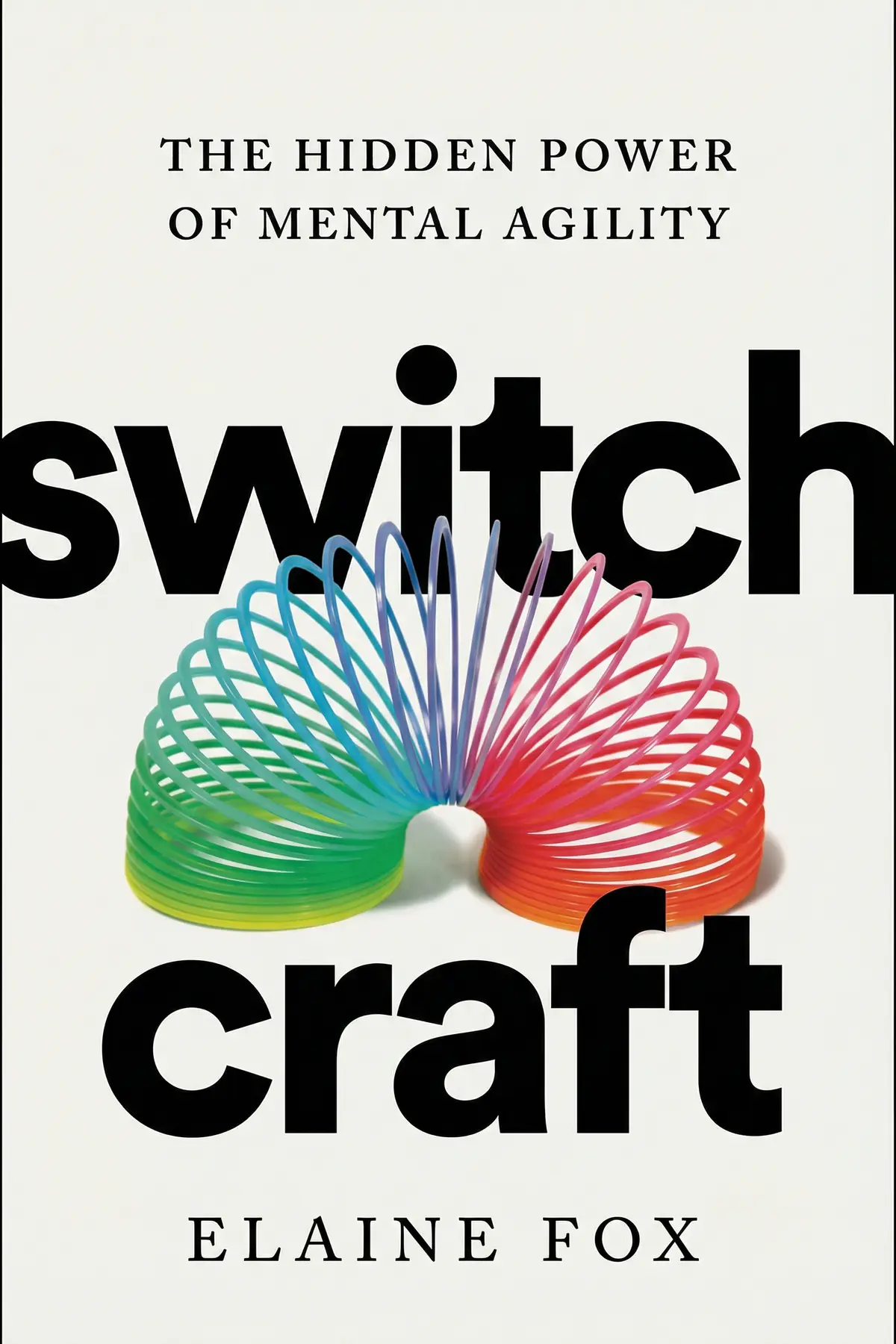
Uncertainty is one of the few certain things in life, and most of us handle it badly in one of two ways: we change course too fast, or we cling to what is familiar long after it has stopped working. In Switch Craft, psychologist and neuroscientist Elaine Fox describes a third option, the skill of judging in the moment whether a situation calls for sticking or switching. She calls it switch craft, and she argues it can be learned.
Fox builds it on four pillars: mental agility, self-awareness, emotional awareness and intuition. Each gets its own story and its own practice. The stories range from an Australian dentist who let most of his clients go to a woman kidnapped in Dublin and a hunch on a New York beach that proved right. Along the way come small, specific exercises, from a thought diary to a coin moved across a desk each morning, that turn flexible thinking into a daily habit.
1 min 57 sec
A dentist in Australia had money, a thriving business and a life he hated. What he did next looks reckless on paper, yet it doubled his income and gave him time with the people he loves.
1 min 51 sec
Researchers looked at how teenagers notice, remember and explain the events around them. In those who struggled, three mental habits moved as one. In those who thrived, something kept them apart.
2 min 04 sec
An ancient instruction carved at Delphi still turns up in philosophers, poets and statesmen. Fox argues that flexible thinking goes nowhere useful without it, and that one personality trait matters more than the rest.
2 min 13 sec
Held captive for eight days by armed men, a Dublin woman chose to be polite to one kidnapper and to shout at another. Her reasoning shows what emotions can do once you understand them.
2 min 02 sec
A charming, friendly stranger did nothing wrong, yet a young hotel worker could not shake her unease around him. Weeks later she learned why, and the lesson is that this kind of hunch can be trained.
1 min 17 sec
Paddi Lund, Jennifer Guiness and the young Elaine Fox faced very different moments, yet each did the same thing. They read the situation honestly, checked it against what they knew about themselves, and acted on that reading even when habit or appearances pointed elsewhere. That is switch craft as Fox describes it: four ordinary capacities, agility, self-knowledge, emotional awareness and intuition, working together so you can tell when holding steady is wise and when a change is overdue.
What makes the idea useful is that none of it is fixed. Fox presents each pillar as a skill that grows with practice, and the practice is modest. Keep a short record of your decisions, noting whether you stuck or switched and what led you there. When something annoys you, find a second explanation before settling on the first. Write down how you feel at different points in the day until patterns appear. And move that coin to a new corner of your desk tomorrow morning.
None of this removes uncertainty, which Fox treats as one of life’s few guarantees. It changes how you meet it. The next time a choice leaves you torn, you will have a clear question to ask, and four places to look for the answer.
Life is full of choices, and many of them leave us second-guessing the job, the partner or the plan we passed over. Faced with that uncertainty, people tend either to change too quickly or to hold on to something familiar that no longer serves them. Psychologist and neuroscientist Elaine Fox proposes a better response, a skill she calls switch craft: knowing, in the moment, whether to stick or to switch. Fox rests switch craft on four pillars. Mental agility lets you approach problems flexibly and reinterpret events. Self-awareness grounds your choices in your personality, beliefs and values. Emotional awareness helps you read and regulate your own feelings and other people's. Intuition, trained through close attention to context, lets you act on what your brain has noticed before you can explain it. Each pillar comes with a story, from a Brisbane dentist who rebuilt his practice around happiness to a kidnapping in Dublin. Each also comes with simple exercises readers can begin right away: a thought diary, a habit of finding second explanations, and a coin moved to a new corner of the desk every morning.
Professionals torn between staying in a role and making a change, who want a clearer way to decide.
People prone to worry or low moods who want to stop one negative thought from pulling in others.
Managers and parents who must keep adjusting plans as circumstances shift.
Elaine Fox is a psychologist and neuroscientist from Dublin. Her career has taken her through Ireland, New Zealand and the UK. At Oxford she was professor of psychology and affective neuroscience, and from 2013 to 2019 a European Research Council Advanced Investigator fellowship funded her large study there of what makes some people prone to anxiety, depression and addiction and others resilient. In 2022 she became head of the School of Psychology at the University of Adelaide. Her earlier book, Rainy Brain, Sunny Brain, has been translated into more than 20 languages.

Listeners appreciate the functional blueprint for cognitive agility and the emphasis on flourishing despite life's many unknowns. Although views on the scientific depth differ, many consider the four-pillar system of self-awareness and intuition to be an eye-opening manual for self-improvement. They also highlight the compelling true stories that ensure the concepts remain very approachable. Furthermore, the inclusion of practical activities is highly regarded, with one listener mentioning how the perspective-taking strategies helped them break free from rigid thought patterns.
Finally got around to reading this during a major career transition, and the timing could not have been better. The story of Jennifer Guinness and her tactical emotional control while being held captive was absolutely riveting and illustrated the pillar of emotional awareness perfectly. It’s one thing to be told to 'be flexible,' but Fox actually provides the mental framework to execute that flexibility when life feels chaotic. I loved the section on emotional granularity; learning to describe exactly how I feel has already helped me stop ruminating on minor setbacks. Some might say the advice is simple, but simple is exactly what you need when you are overwhelmed by uncertainty. Personally, I found the combination of neuroscience and real-world performance coaching to be the perfect blend for a self-improvement book. It’s a treasure trove of insights that I’ll be revisiting whenever I feel my thinking becoming too rigid or conservative.
Show moreEver wonder why some people just seem to bounce back from disaster while others get stuck in a rut for years? This book answers that question by diving into 'mental agility' and the ability to pivot when circumstances change. Fox uses her experience as a psychologist to show that intuition isn't just magic; it’s actually the brain processing deep patterns that our conscious mind hasn't caught up to yet. I found the section on 'perspective-taking' to be particularly transformative for my personal relationships, helping me see through the lens of others' interests rather than just my own. The writing is accessible and the anecdotes, from dental practices to kidnapping survivors, keep the pace moving quickly. Not gonna lie, I was skeptical about the 'coin' exercise at first, but it really does train you to be more situationally aware of your surroundings. This is a must-read for anyone feeling paralyzed by the complexity of the modern world.
Show moreSwitch Craft completely changed how I view my own 'gut feelings' by explaining the actual neuroscience behind our intuition. I used to think intuition was just being impulsive, but Elaine Fox demonstrates that it's a pillar of mental agility that can be trained and refined over time. The four pillars system—Agility, Self-Awareness, Emotional Control, and Intuition—gave me a concrete vocabulary to describe why I was feeling stuck in my current role. I found the advice on 'decentering' to be particularly effective for managing my daily anxiety about work projects. The book is incredibly enlightening and helpful for anyone who feels overwhelmed by the constant choices we have to make in a rapidly changing society. It's written in a way that is easy to digest but still feels authoritative. I’ve recommended it to several friends who are going through big life shifts; it’s the perfect guide for learning how to flourish in the face of the unknown.
Show moreAs someone who struggles with making decisions under pressure, I found the concept of 'stick or switch' incredibly liberating. Elaine Fox breaks down mental agility into four distinct pillars, making the daunting task of self-improvement feel manageable and structured. I particularly enjoyed the story of Paddi Lund; it served as a poignant reminder that radical change is possible even when you feel trapped by success. While some of the advice on mindfulness felt a bit familiar, the focus on 'intellectual humility' offered a fresh perspective I hadn't considered before. The truth is, we all get stuck in rigid patterns, and this book provides the necessary tools to break free. It's an engaging read that balances psychological theory with practical application, even if it occasionally skims the surface of the neuroscience. I've already started the 'coin on the desk' exercise to sharpen my situational awareness, and I’m noticing small shifts in my focus.
Show moreThis book provides a surprisingly grounded framework for navigating uncertainty without feeling like you are drowning in academic jargon. I really valued the emphasis on 'context sensitivity,' which is an idea often ignored in other books that push a one-size-fits-all solution for success. Fox argues that the right choice depends entirely on the situation, and 'switch craft' is the art of figuring out which tool to use and when. The discussion on intellectual humility was a highlight for me, especially the advice to celebrate failures as learning data points rather than personal defects. My only minor gripe is that some chapters felt a bit longer than necessary, repeating the same themes of agility several times. Still, the actionable advice at the end of the chapters makes it worth the read for anyone looking to build more resilience. It’s a practical, encouraging guide for the modern era.
Show morePicked this up on a whim at a book sale and was pleasantly surprised by how much I ended up highlighting. As a rather conservative and cerebral person, I’ve always tried to solve every problem with logic, but Fox convinced me that emotional awareness is just as vital for effective action. The way she explains how positive emotions leave us more inventive and open to switching tasks was a total lightbulb moment for me. I’ve started using her 'thought diary' method to track my core beliefs, and it’s already revealing some biases I didn't know I had. While the writing can be a bit repetitive at times, the overall message is powerful: change shouldn't be feared, but it shouldn't be forced either—it’s about knowing when to stick and when to switch. It’s a great addition to any library focused on cognitive psychology and personal growth.
Show moreLook, if you’ve already read a dozen books on cognitive behavioral therapy or mindfulness, you might find this a bit repetitive. The core message is essentially: stay flexible, know yourself, and trust your gut, which isn't exactly groundbreaking territory in the self-help genre. That being said, the 'Switch Craft' framework is a useful way to organize these thoughts, and the specific exercises, like the thought diary, are helpful for daily practice. I appreciated the critique of the MBTI, as I've always felt those personality tests were too black-and-white for real life. However, I was hoping for more manual-style guidance on navigating specific professional pivots rather than just high-level explanations of why these pillars matter. It’s a decent, well-written book that serves as a good reminder of healthy habits, but it didn't quite provide the 'aha' moment I was searching for. It’s a solid three-star read for me.
Show moreNot what I expected in terms of scientific depth, but the anecdotal evidence was compelling enough to keep me turning the pages. The author’s personal story about the boyfriend in New York and her intuition regarding his character was a great way to open the chapter on situational awareness. However, the book struggles to bridge the gap between these interesting stories and providing a truly 'how-to' guide for complex life changes. I liked the focus on 'bracketing' and breaking down problems into smaller components, which feels very much like Husserlian phenomenology applied to modern stress. In my experience, the book works better as a collection of interesting psychological observations rather than a cohesive manual for life. It’s a pleasant read that will definitely give you some food for thought, but don't expect it to provide a step-by-step roadmap for reinventing your entire life.
Show moreThe chapter on mental agility promised so much more than it actually delivered for someone with a background in psychology. Frankly, the writing style reminds me a lot of Malcolm Gladwell, prioritizing snappy anecdotes over rigorous scientific evidence or deep conceptual exploration. While it’s certainly an easy read, I felt like I was constantly waiting for a 'meatier' discussion that never arrived. The word 'agile' seems to appear in almost every second sentence, which becomes distracting after the first few chapters. To be fair, the four pillars—agility, self-awareness, emotional control, and intuition—are solid foundations, but the book doesn't go much beyond common sense. If you are looking for a deep dive into the mechanics of the brain, you will likely be disappointed by this surface-level approach. It’s more of a basic primer for those brand new to self-help than a serious psychological text.
Show moreFrankly, I expected much more from a Professor of Psychology than just basic self-help advice like 'meditate' and 'prioritize your tasks.' While the four pillars are a nice way to categorize the concepts, the actual content felt very thin on new research and very heavy on anecdotes that felt a bit cherry-picked. Every time the book started to get into the actual neuroscience, it would pull back and tell another story instead. It felt more like a pep talk from a performance coach than a deep exploration of the mind's ability to adapt. If you have any prior knowledge of psychology, you’ll likely find yourself skimming large sections of the text. Pffff, it’s just the usual 'be flexible' mantra wrapped in a new buzzword. I was looking for a solid scientific manual, but what I got was a very light, surface-level guide that didn't offer many original insights.
Show moreSwitch craft is Fox’s name for the ability to make the right call at the right moment, above all the call between sticking with a situation and switching to something new. She argues that uncertainty is unavoidable and that people often respond by changing too quickly or clinging to the familiar. Switch craft is the learnable alternative, built on four pillars that support flexible, well-judged decisions.
Fox names mental agility, self-awareness, emotional awareness and intuition. Agility is the readiness to stick or switch and to reinterpret events. Self-awareness covers personality, especially openness to experience, along with beliefs and values. Emotional awareness means understanding and regulating your feelings and reading other people’s. Intuition is the gut sense of a situation, which grows more reliable the more attention you pay to context.
Fox suggests seeking out varied experiences, because the brain predicts better with more past data. She also recommends learning what normal looks like in a setting, so that unusual behavior, such as nervous customers in a cafe, stands out. Her simplest exercise is to put a coin on one corner of your desk and move it to a different corner every morning, training your awareness of your surroundings.
Fox treats all emotions as useful signals, but she offers ways to regulate them when they push you toward impulsive action. First, change the situation, for example by leaving people who upset you. Next, shift your focus to something more positive. Then reframe events from an outsider’s view or the bigger picture. Finally, adjust your body’s response through sleep, caffeine and exercise.
It suits anyone facing frequent decisions under uncertainty: professionals weighing whether to stay or move on, managers adapting large projects, parents adjusting to growing children and partners in long relationships. It also helps people prone to anxiety or low mood, since Fox explains how negative biases feed each other and offers simple exercises, such as finding second explanations for events that annoy you.
Deborah Gruenfeld




Anthony Pratkanis



William B. Irvine


AUDIO SUMMARY AVAILABLE
Get the key ideas from Switch Craft by Elaine Fox, plus 5,000+ more nonfiction titles.









