

A Short History of Nearly Everything
Bill Bryson
 English
Shows how the search for a biological basis of race keeps coming back in new disguises. It explains what genetics, IQ research and medicine actually reveal about human difference, so you can judge claims about genes and groups.
1 min 04 sec
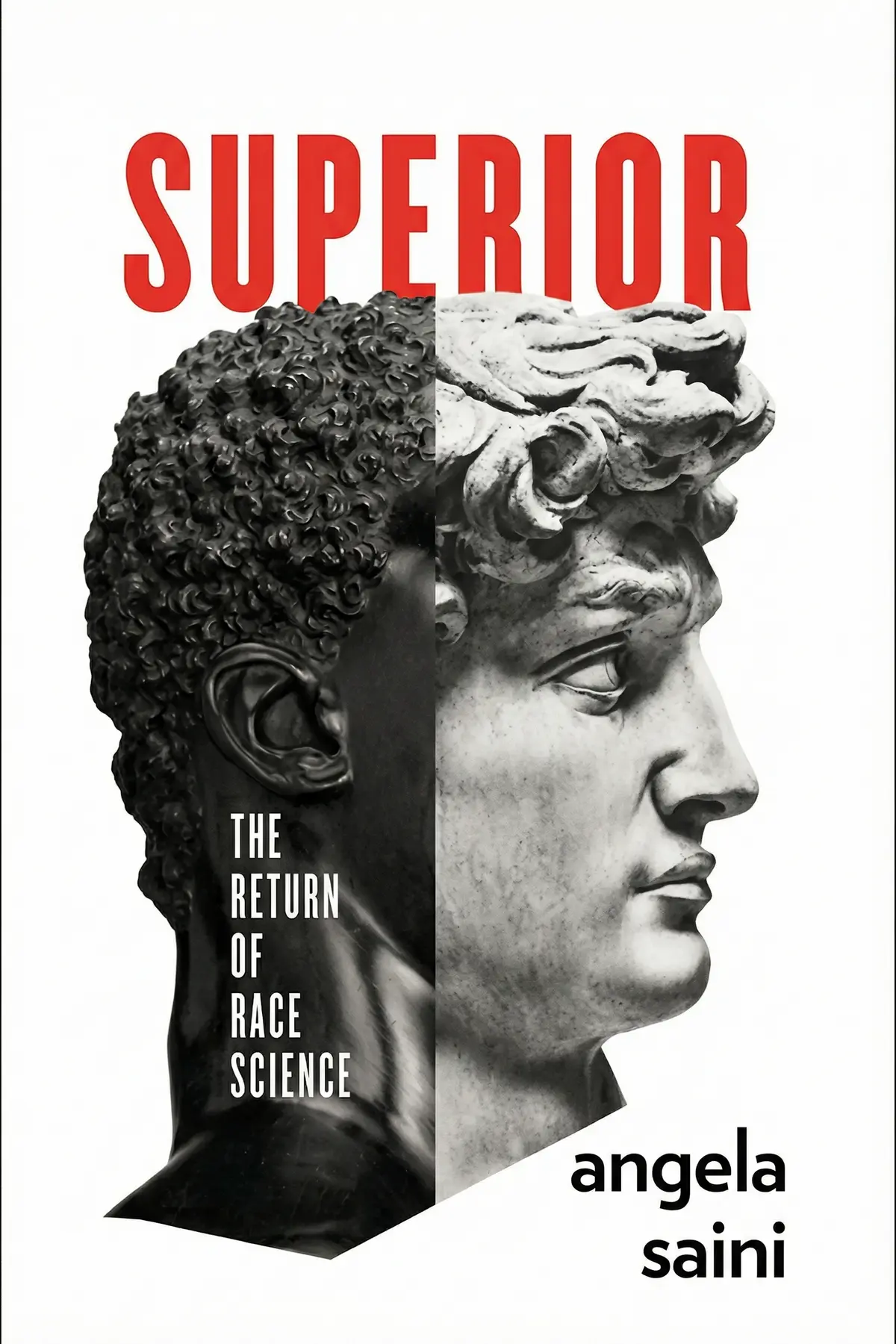
Many people still carry a loose sense that race is written into our genes. Genetics says otherwise: genetics professor Mark Jobling reckons that if a disaster left only the people of one country alive, about 85 percent of human genetic diversity would survive. In Superior, science journalist Angela Saini follows the long hunt for a biological basis for race, from Enlightenment naturalists to modern political movements.
Her case is that race is a social construct, made of language and culture. Yet race science keeps coming back with new labels, new journals and new statistics, and knowing its disguises is the best defense against it.
The trail runs from a Swedish botanist’s ranking of humanity, through eugenics, to IQ gaps, so-called racial diseases and a skeleton from an English gorge. Afterward, a headline about genes and groups will sound different, because you will know which questions to ask before believing it.
1 min 54 sec
Even the botanist famed for a popular system of sorting living things could not classify humans without ranking them. His labels, and a doctor’s invented disease, show how prejudice slips into work that looks objective.
1 min 58 sec
Eugenics laws outlived the Second World War by decades in some places. Then a handful of geneticists found a pattern that turns the idea of separate human races on its head.
1 min 59 sec
A journal founded by frustrated race scientists in 1960 is still in print, and its allies use a name designed to win arguments before they begin. Learn to see what that name hides.
1 min 55 sec
A Berkeley anthropologist found the title of his own textbook turned into a slogan by people he disagreed with. Even an antiracist geneticist’s project could not escape the same trap.
1 min 54 sec
A seafaring people with unusual spleens raises an uncomfortable question about intelligence. An adoption study and the test scores of British schoolboys point somewhere most people do not expect to look.
1 min 56 sec
Some illnesses get described as belonging to one race. A study of tens of thousands of patients and a surprising map of blood pressure rates suggest the label hides something else.
2 min 00 sec
A skeleton dug up in an English gorge in 1903 upset many Britons’ picture of themselves when his genes were read in 2018. In India, the same urge to own a glorious past has turned deadly.
1 min 15 sec
Superior follows one impulse across three centuries: the wish to make the way we sort people look like a verdict of nature. It has worn Linnaeus’s ladder, the language of eugenics, the pages of the Mankind Quarterly, the gentle phrase human biodiversity and the columns of IQ tables. Each time the evidence went against it, it changed costume. Saini grants that race can give people a sense of belonging, the pull that sends her straight to the Indian galleries of a big museum. Even so, race is not a biological category.
The habits that follow are modest. When a claim ties genes to a group, set it against Lewontin’s finding that variation within groups exceeds variation between them. When test scores or disease rates differ, look first at income, diet, stress and treatment, as the adoption study and Africa’s low hypertension rates suggest. And when someone calls themselves a race realist, or slides from culture to biology in the middle of a sentence, notice the move.
Cheddar Man’s bones never changed. Only the story told about them did.
For more than two centuries, scientists and the people who fund them have tried to prove that race is written into human biology. Angela Saini, a science journalist, follows that effort from Carl Linnaeus's ranked categories and a disease invented to explain why enslaved people fled, through eugenics and its sterilization laws, to a journal founded in 1960 that still prints race science today. Her argument is that the best current evidence treats race as a social construct, yet the idea keeps returning under new names: race realism, human biodiversity, population differences. Saini shows how genetics undercuts it, since there is more variation inside groups than between them. She also shows how IQ gaps and so-called racial diseases follow income, diet, stress and treatment more closely than ancestry. Readers get a clear history of a dangerous idea, along with a set of questions for judging any new claim about genes and groups, from a headline about test scores to a nation's story about its glorious ancestors.
Readers who keep meeting claims about genes and group differences and want to test them.
Managers, trainers and students working on bias who need the science behind the debate.
Curious listeners puzzled by how discredited ideas keep resurfacing online and in politics.
Angela Saini is a British science journalist and broadcaster. She has presented radio and television documentaries for the BBC and written for National Geographic, Wired and Foreign Policy. She holds a master's degree in engineering from the University of Oxford and has taught science writing at MIT. Superior was a finalist for the LA Times Book Prize, and her later book The Patriarchs reached the final round of the Orwell Prize for Political Writing. She has also received a Gold Award from the American Association for the Advancement of Science.

Listeners find this work to be a bold historical deep dive into the roots of scientific racism, with one listener highlighting its efficient presentation of data and arguments. Additionally, the prose is described as sophisticated and polished, and listeners consider the subject matter to be both captivating and deeply moving.
Saini's investigation into the persistent phantom of 'race science' is nothing short of chilling. She weaves a complex narrative that stretches from Victorian skull-measuring obsessions to the modern, tech-funded resurgence of 'human biodiversity' groups. The writing is incredibly eloquent, making a dense subject feel urgent and accessible. I found the section on how certain journals still provide a platform for pseudoscientific racism particularly eye-opening. It is a poignant reminder that science is a human endeavor, often stained by the same biases that plague society at large. The book doesn't just debunk; it deconstructs the very foundations of how we think about human variation. Essential reading for anyone who thinks we live in a post-racial scientific era.
Show moreWow. This isn't just a science book; it’s a necessary autopsy of how we’ve been lied to for centuries. Saini manages to be both a rigorous journalist and a passionate advocate for the truth. Her breakdown of the 'Cheddar Man' discovery was a highlight, showing how DNA evidence can dismantle nationalist myths in a heartbeat. The prose is sharp, moving with a rhythm that keeps you hooked even when the history gets dark. While the final chapters feel like a quiet shout of rage against the alt-right's appropriation of genetics, the tone remains largely objective. We need more books that challenge the 'neutrality' of the laboratory. It definitely changed how I view population genetics.
Show moreThe chapter on the 'Cheddar Man' discovery was the absolute highlight for me, serving as a blunt instrument against the nationalist myths currently gripping the UK. Saini is a phenomenal writer who knows exactly how to balance scientific data with human-interest reporting. She doesn't just tell you that race is a construct; she shows you the blood-soaked history of how that construct was built. The way she links the atrocities of the Third Reich to the 'polite' eugenics of the 1920s American elite is terrifyingly well-done. It is an ambitious book that covers a lot of ground without losing its emotional core. If you want to understand why 'scientific' racism keeps coming back like a zombie, read this.
Show moreTo be fair, I expected a dry academic text, but Saini writes with a refined eloquence that makes even the most infuriating history of eugenics feel like a page-turner. She masterfully connects the dots between the 'scientific' justifications for slavery and the modern-day obsession with IQ disparities. The research is deep, the tone is measured, and the impact is profound. I was particularly struck by the stories of scientists who lost their careers for refusing to play along with the racial hierarchies of their time. This is a poignant reminder that the 'truth' in science is often whatever the people in power want it to be. It’s an ambitious work that deserves a spot on every shelf.
Show moreAs someone who grew up in India, seeing Saini tackle the genetic justifications for the caste system was incredibly validating. She takes a global perspective on racism, proving that this isn't just a European or American problem. Her writing is sophisticated yet clear, stripping away the 'sciency' jargon that racists use to hide their prejudice. The way she explores the intersection of history, culture, and biology is brilliant. She makes a compelling case that our obsession with dividing humanity into neat little boxes says more about our politics than our DNA. It is an extraordinary examination of how power uses science as a shield. I haven't been this challenged by a book in years. Absolutely brilliant.
Show moreAfter hearing so much buzz about Saini’s previous work, I finally dove into Superior and found it to be a masterclass in journalistic storytelling. She takes a very ambitious historical analysis of scientific racism and makes it personal. The truth is, the book does get slightly repetitive in the middle sections when she’s interviewing fringe academics. However, her core argument—that race is a social reality rather than a biological one—is supported with such impressive data that it's hard to look away. I appreciated her honesty about how even well-meaning anti-racist scientists accidentally fall into the trap of using racial categories. It’s a bit long-winded at times, but the poignancy of her conclusion makes it worth the effort.
Show morePicked this up because I’ve always been skeptical of how IQ scores are used to categorize entire populations like they’re fixed biological markers. Saini does a brilliant job comparing these 'scientific' metrics to the hollow personality tests used in corporate offices—they offer the veneer of data without any of the necessary context. Her critique of 'p-hacking' and sloppy methodologies in behavioral genetics is spot on. My only minor gripe is that she occasionally paints with a broad brush when discussing modern geneticists. Not every population study is a eugenics project in disguise. Still, the historical context she provides on the funding of 'race science' is absolutely vital. It’s a dense read but undeniably important for our current political moment.
Show moreEver wonder why we still use 18th-century classifications for 21st-century genetics? Superior provides a fascinating, if sometimes frustrating, answer to that question. Saini’s style is very much that of a broadcast journalist—quick, engaging, and heavy on the interviews. I found the sections on the Indian caste system particularly interesting, as it showed that 'race science' isn't just a Western obsession. Some of the arguments felt a little bit one-sided, and I wish she had engaged more deeply with the counter-arguments from population geneticists. However, her exposé on the shady funding sources behind 'human biodiversity' research is worth the price of the book alone. It's a solid, thought-provoking read that definitely sparks conversation.
Show moreFrankly, Saini's treatment of population genetics feels a bit shallow compared to the work of specialists like David Reich. She’s an excellent journalist, but there are moments where she seems out of her depth regarding the actual mechanics of the genome. She tends to focus more on the 'shady characters' of the alt-right than on the actual science of human variation. While it’s important to expose the racists, I wanted more depth on how we *should* talk about diversity if the old categories are broken. It’s a well-crafted book with a lot of interesting history, but it feels like it’s more interested in winning a political argument than exploring the nuances of biology. A decent introduction, but incomplete.
Show moreLook, while the author's heart might be in the right place, this book feels more like a political manifesto than a rigorous scientific inquiry. Saini seems to suggest that any mention of biological differences between populations is a gateway to the Holocaust. She ignores a vast amount of genomic data that allows scientists to cluster individuals by ancestry with high precision. For instance, her dismissal of Mendelian genetics feels sophomoric and driven by a need to fit a politically correct narrative rather than follow the data where it leads. By equating every hereditarian claim with racism, she does a disservice to the complexity of the field. It’s an eloquent book, sure, but it’s scientifically unsound. If you want real population genetics, read David Reich instead.
Show moreSaini argues that race is a social construct built from language and culture, not biology. Even so, from Linnaeus’s ranked human categories through eugenics to today’s self-described race realists, people have kept searching for a biological basis for it. Genetics shows more variation within groups than between them, and Saini traces how race science survives by changing its vocabulary, its journals and its statistics.
Saini accepts that groups score differently on IQ tests but argues that environment explains those gaps almost entirely. She notes that parents’ scores account for only 15 percent of the variation in their children’s scores. According to a 1986 study, black children adopted by white middle-class families scored 13 points above children adopted by black families, and in Britain it is working-class white boys who score lowest.
It is the label adopted by writers linked to the Mankind Quarterly, a journal Reginald Ruggles Gates founded in 1960, and by figures such as Jared Taylor of the American Renaissance Foundation. The name suggests their claims are simply factual. The anthropologist Jonathan Marks argues the research is funded to support policies that keep inequality in place, and that it blurs race and culture to sound reasonable.
When a claim links genes to a group, recall Lewontin’s finding that variation within groups is larger than variation between them. When IQ scores or disease rates differ, look first at income, schooling, diet, stress and treatment, as Saini does with hypertension, which is twice as common among black Americans yet rarest in Africa. And watch for new terms, such as human biodiversity, that carry old ideas.
It suits readers who meet claims about genes and group differences in the news, at work or online and want to judge them. Students of science and history, managers and trainers working on bias, and anyone curious why a discredited idea keeps returning will find it useful. Saini covers archaeology, genetics, psychology and medicine, with cases from Britain, the United States, India and China.
Bill Bryson

Virginia Woolf

Jeff Hawkins

Tracy Rosenthal


Jessica Valenti




AUDIO SUMMARY AVAILABLE
Get the key ideas from Superior by Angela Saini, plus 5,000+ more nonfiction titles.









