


13 min 23 sec
Available in: English
Strategic Risk Management: Designing Portfolios and Managing Risk
Shows investors how to build portfolios that hold up in severe crashes by combining trend-following with volatility targeting, smarter rebalancing and drawdown rules, instead of paying for full protection or treating risk as an afterthought.
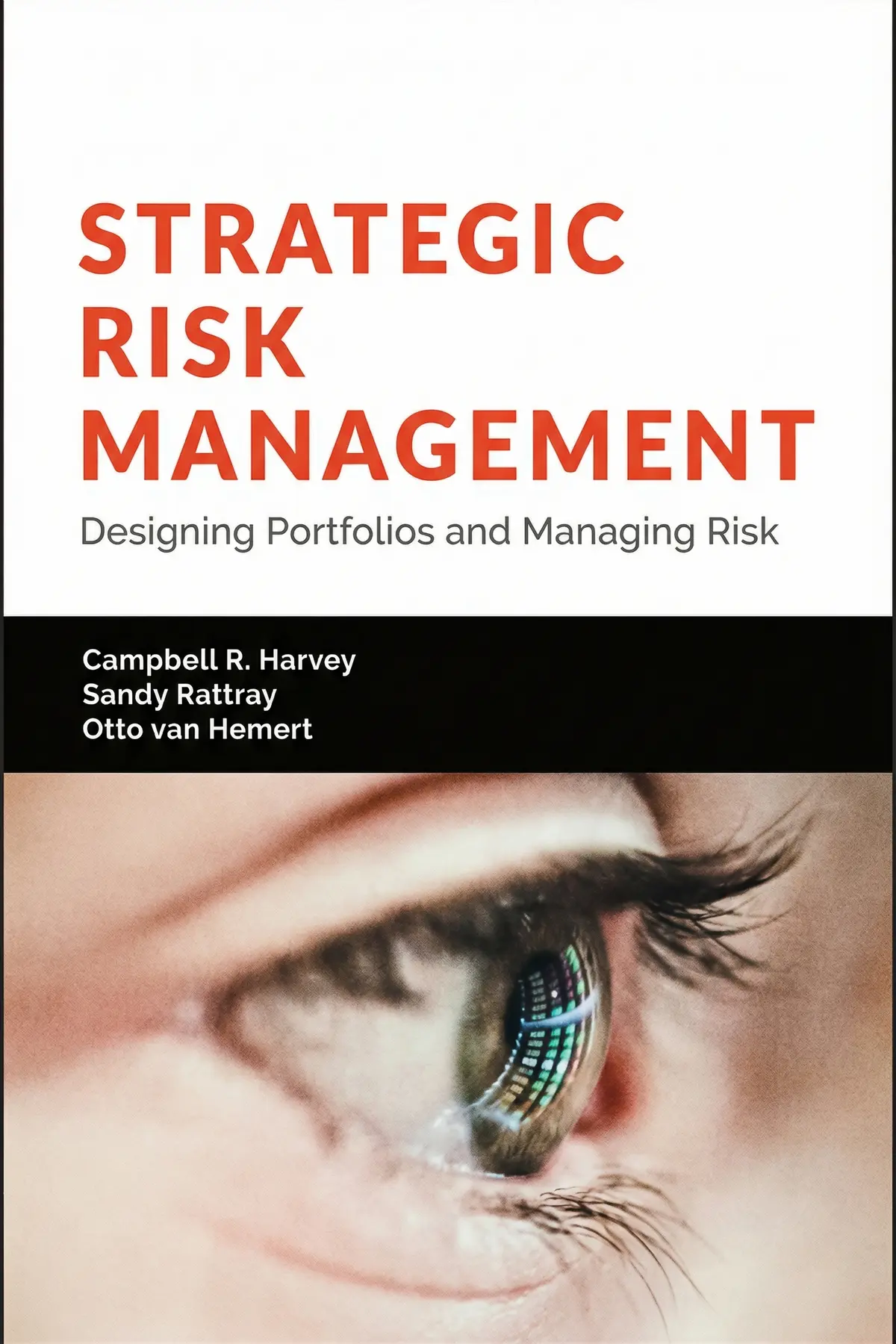
Table of Content
1. Introduction
1 min 12 sec
A portfolio usually reveals how fragile it is during a crash, which is the worst moment to start thinking about risk. In Strategic Risk Management, Campbell R. Harvey, Sandy Rattray and Otto Van Hemert argue that risk control belongs inside the design of a portfolio from the first day, not bolted on after the returns are chosen. Their central claim is that a fully crisis-proof portfolio costs more than almost anyone can pay, while a crisis-resilient one is within reach.
The recipe mixes strategies that tend to earn money when markets fall, such as trend-following, with tools that adjust the portfolio as conditions change: volatility targeting, smarter rebalancing and clear rules for when a manager has lost their touch. The authors then test the whole approach against the pandemic crash.
What a listener gains is a way to judge any hedge by two numbers at once, what it saves in a crisis and what it costs in calm years, plus a short set of rules for keeping losses small enough to stay invested.
2. Build protection you can afford to keep
1 min 38 sec
Every investor wants a portfolio that thrives in booms and survives busts. The authors explain why that dream has a price tag few can pay, and what a realistic version of it looks like.
3. Let market trends pay you when stocks fall
1 min 31 sec
Some strategies have made money in market crises for decades. A fair worry is whether they still work when bond yields climb, and the answer changes how a trend portfolio should be built.
4. Hold your portfolio's risk steady on purpose
1 min 39 sec
In calm years a portfolio feels safe, then a storm doubles its daily swings. One simple adjustment keeps risk at the level you chose, and it happens to protect you in crashes as well.
5. Rebalance with strategy to avoid deepening a market slump
1 min 33 sec
Rebalancing back to a target mix is usually sold as pure discipline. The authors show when that habit costs money, and how a few changes turn it into a source of protection.
6. Set drawdown rules before a manager slips
1 min 35 sec
Every manager has bad years, and some lose their edge for good. Telling the two apart in the middle of a loss is hard, which is why the authors want the rules written before it happens.
7. Match the fund style to your goals
1 min 40 sec
Many investors distrust funds run by algorithms and prefer a human at the controls. The long-run numbers tell a different story, and the real question turns out to be which risks each style exposes you to.
8. See which defenses held up in a real crash
1 min 23 sec
Backtests can make almost any strategy look brilliant. The pandemic crash gave the authors a test their methods had never seen, and it also exposed a weakness in how most institutions organize risk.
9. Conclusion
1 min 12 sec
The authors’ case comes down to a change in when risk gets considered. Most investors pick assets for return and think about protection once prices are already falling. Harvey, Rattray and Van Hemert put risk first, inside the design, so the portfolio already knows what to do when a crash arrives. Trends turn it defensive, volatility targeting shrinks its exposure, rebalancing waits instead of buying a falling asset, and limits set in calm times decide the fate of a struggling manager.
None of this makes a portfolio immune. It makes losses smaller and the cost of protection bearable, and that is what lets an investor stay invested through the next shock.
The first step is a look at what you already hold: what in it would earn money in a sharp fall, and what that protection costs you in a quiet year. If you rebalance on a fixed schedule, let a clear downtrend delay it. If someone else manages your money, agree on a drawdown limit and a time frame before you ever need them.
A crash is the one exam you cannot study for during the test.
About this book
What is this book about?
Most portfolios are built for returns first, with risk considered only when prices are already falling. By then the choices are bad ones. Campbell R. Harvey, Sandy Rattray and Otto Van Hemert argue that risk control has to be part of the design from the beginning. Their starting point is a hard truth: a portfolio that is fully protected against every crash costs more than almost anyone can afford. A resilient one is possible, though. The authors show how trend-following can earn money during market falls, how volatility targeting keeps risk at a chosen level, why routine rebalancing can deepen losses in a long slump, and how preset drawdown limits help decide when to keep or replace an investment manager. They also compare systematic and discretionary hedge funds and the risks each carries. The ideas meet a real test in the COVID-19 crash, where the integrated approach cut drawdowns and exposed the weakness of keeping investment and risk management apart. Readers get a way to judge any hedge by what it saves in a crisis and what it costs in calm years.
Book Information
Who it's for
Self-directed investors
Investors who manage their own portfolio and want it to survive the next severe crash.
Allocators and finance professionals
Allocators and finance professionals who hire, review or replace fund managers.
Finance students
Students of finance who want a clear map of trend-following, volatility targeting and rebalancing.
About the Author
Campbell R. Harvey
Campbell R. Harvey is a Canadian economist and professor of international business at Duke University's Fuqua School of Business, a research associate at the National Bureau of Economic Research and a senior fellow at the Oxford-Man Institute. He was president of the American Finance Association in 2016, and his research covers asset allocation as risk changes and separating luck from skill. Sandy Rattray is chief investment officer of Man Group and helped create the VIX index. Otto Van Hemert is Director of Core Strategies at Man AHL, previously ran a systematic global macro fund at IMC and taught finance at NYU Stern.
Ratings & Reviews
Ratings at a glance

What people think
Listeners find the quality of research in this book to be excellent. However, perspectives on its effectiveness and risk management components are varied; one listener points out that it is best suited for professional investors with high math and statistical abilities, whereas another listener suggests it is not suitable for investors or risk management.
Top reviews
Jonathan
After hearing so much about Harvey’s research, I finally dove into this framework and found the section on the COVID-19 pandemic incredibly revealing. The authors provide a rare look at how their strategies performed during a real-world black swan event, which adds a layer of credibility most finance books lack. Truth is, many academic theories fall apart when volatility spikes, but their data on trend-following and volatility targeting suggests a more resilient path. I especially appreciated the deep dive into 'crisis alpha' and how to generate returns when everything else is bleeding. It is a dense read, but the empirical evidence justifies the effort for any serious practitioner. While the math can get intense, the logic behind moving away from simple dollar-neutrality toward beta-neutrality is a game changer for portfolio construction.
Show moreJoseph
Wow, the data provided on trend following as a form of crisis alpha is incredibly robust and well-presented. The authors make a compelling case that traditional asset allocation is failing because it treats risk management as a separate silo. Instead, they advocate for a unified system where the rate of asset accumulation matches the specific investment horizon. This makes so much sense when you consider how quickly market regimes can shift. I was particularly impressed by the discussion on long-short quality trades as a defensive mechanism. It’s rare to find a book that balances high-level theory with practical, out-of-sample testing from recent history. This should be required reading for anyone managing significant capital in today's unpredictable environment.
Show morePawinee
Ever wonder why traditional hedges like bonds have failed to protect portfolios in the most recent market shifts? Harvey, Rattray, and van Hemert answer this by demonstrating why we need a more dynamic, strategic approach to risk. Their work on 'crisis alpha' is probably the best explanation of the concept I have encountered in years. The book proves that trend-following remains a crucial component of any portfolio that hopes to survive a major tail event. I appreciated the specific focus on how these strategies were put to the test during the 2020 crash. It’s one thing to show a backtest from the 1990s, but seeing the real-time efficacy is another thing entirely. This is a top-tier resource for institutional risk management.
Show moreRohan
Finally got around to finishing this, and the timing couldn't be better given the current market climate. The authors offer a sophisticated roadmap for building a crisis-resilient portfolio without the astronomical costs usually associated with hedging. I loved the breakdown of how different defensive strategies—like quality long-short—perform during recessions versus simple market corrections. It’s a masterclass in quantitative strategy that doesn't shy away from the complexities of real-world implementation. The discussion on systematic versus discretionary approaches was particularly balanced and insightful for such a technical book. If you want to understand the 'why' behind modern risk management, this is the definitive text. It is scientifically backed and empirically rigorous, exactly what you want from this team.
Show moreAstrid
The chapter on volatility targeting alone changed how I view my equity exposure during market stress. Most investors think risk is something to be avoided, but Harvey and his co-authors argue it should be integrated directly into the investment process. This book moves past the old-school mean-variance models to look at how dynamic scaling can actually improve Sharpe ratios in credit and equities. Frankly, the data on why gold is an unreliable hedge was eye-opening for me. I still have some reservations about how 'ad-hoc' some of the tail hedging strategies feel when grouped together. However, the move toward a holistic, risk-aware approach is clearly the right direction for the industry to head in.
Show morePalm
Strategic rebalancing is an idea that seems so obvious once it’s explained, yet few actually do it well. The authors explain that delaying a rebalance until the trend is in your favor can significantly mitigate the 'short vol' nature of periodic rebalancing. I found this section to be the most practical part of the book for my own process. The writing is technical but clear, though I did find myself skimming some of the more dense statistical proofs. Gotta say, the distinction between systematic and discretionary fund management was handled with a lot of nuance. They don't just bash human traders but show how algorithmic rules can complement human expertise. It’s a well-rounded look at modern risk despite being a bit dry in parts.
Show moreRosa
As someone who spends all day in spreadsheets, I found the technical depth of this book incredibly refreshing. It covers a vast range of defensive strategies, from put options to currency carry, with a level of rigor you don't often see. My only real gripe is that it can feel a bit repetitive when they go over the different asset classes. To be fair, the emphasis on drawdown control and preset exit rules is vital for anyone who has struggled with the human element of trading. The book effectively highlights how volatility rises during stress, making a strong case for cutting risk dynamically. It’s a heavy lift, but the insights into tail hedging and credit protection make it worth the time. A very professional piece of work.
Show morePensuda
Look, this isn't for the casual retail investor looking for a quick tip or a weekend read. This book requires a high level of mathematical and statistical ability to truly grasp the nuances of their arguments. I found the chapters on strategic rebalancing quite intuitive, but the technical execution feels geared toward institutional desks rather than individual portfolios. To be fair, the research is top-notch, yet I can't help but feel it’s essentially a polished collection of white papers. It offers some interesting insights into portfolio construction, but it's nothing revolutionary if you've already been following the latest in quantitative finance. It is a solid reference for professionals, though likely too opaque for those without a heavy quantitative background.
Show moreArm
This book feels more like a collection of high-quality white papers than a cohesive narrative journey. Each chapter stands well on its own, but the transitions between volatility targeting and drawdown strategies can be a bit jarring. In my experience, the math required will be a significant barrier for most individual investors. It's clear the authors are brilliant, but they don't always succeed in making the material accessible to a broader audience. That said, the insights into how rebalancing acts as a short straddle are worth the price of admission. It’s a useful book to have on the shelf for reference, even if you don't agree with every single conclusion they reach regarding tail risk.
Show moreNarongrit
Not what I expected given the pedigree of the authors involved in this project. While the research quality is high, the book reinforces my fear that the asset management industry is stuck in a loop of backtesting. They add tools like trend-following and vol-scaling simply because they worked historically, rather than advancing a truly new theory of risk. Personally, I found the framework to be a bit of a Frankenstein’s monster of various strategies that don't always feel theoretically cohesive. It’s disappointing to see such brilliant minds relying on what seems like a reactive approach to market downturns. If you are looking for a revolutionary breakthrough in financial theory, you might want to look elsewhere. It feels more like a defense of current quantitative practices than a step forward.
Show moreQuestions about this book
What is the main idea of Strategic Risk Management?
Harvey, Rattray and Van Hemert argue that risk management should be built into portfolio design from the start instead of handled separately. A fully crisis-proof portfolio is too expensive for most investors, but a crisis-resilient one is possible by combining strategies that earn money in downturns, such as trend-following, with tools like volatility targeting, strategic rebalancing and preset drawdown rules for managers.
What is crisis alpha?
Crisis alpha is the authors’ term for extra returns earned when markets are in trouble. Their main source is diversified trend-following, which buys rising assets and sells falling ones across stocks, government bonds and commodities. They say it has delivered such returns for more than fifty years, and that keeping bond trends in the mix matters for downside protection.
How does volatility targeting protect a portfolio?
Volatility targeting keeps a portfolio’s volatility near a chosen level by cutting exposure when markets get turbulent and raising it when they calm down. It works because volatility tends to persist and, for stocks, tends to rise as prices fall. The authors credit it with better risk-adjusted returns, fewer extreme moves and smaller drawdowns, and it worked well for stocks and credit in the pandemic crash.
Is monthly rebalancing a good idea according to the book?
Not always. According to the authors, a 60-40 portfolio of stocks and bonds that is rebalanced monthly does worse than a buy-and-hold approach when equities stay weak for a long stretch, since it keeps adding to the asset that is dropping. They suggest using cash flows to move back to target gradually, adding trend exposure, diversifying internationally and delaying rebalancing in downtrends, an approach that beat calendar rebalancing during the pandemic.
How do you decide when to fire an investment manager?
The authors recommend setting drawdown limits in advance, based on the manager’s expected pattern of returns, and telling the manager what they are. Automatic cuts at a preset level guard against last-minute gambles. Weigh the cost of keeping a fading manager against losing a good one, use total-return rules for consistency, and let drawdown limits change over time.
Readers also enjoyed



Cashing Out: Win the Wealth Game by Walking Away
Julien Saunders
Charlie Munger: The Complete Investor
Tren Griffin
Big Mistakes: The Best Investors and Their Worst Investments
Michael Batnick
AUDIO SUMMARY AVAILABLE
Listen to Strategic Risk Management in 15 minutes
Get the key ideas from Strategic Risk Management by Campbell R. Harvey, plus 5,000+ more nonfiction titles.
- 5,000+ titles
- Listen as much as you want
- 7-day free trial
- Cancel anytime









