

15 min
Available in: English
Speak, Memorably: The Art of Captivating an Audience
Shows how to make people remember what you say: where to place your strongest lines, how to cut filler and jargon, and how to use voice, silence and empathy in person or on screen.
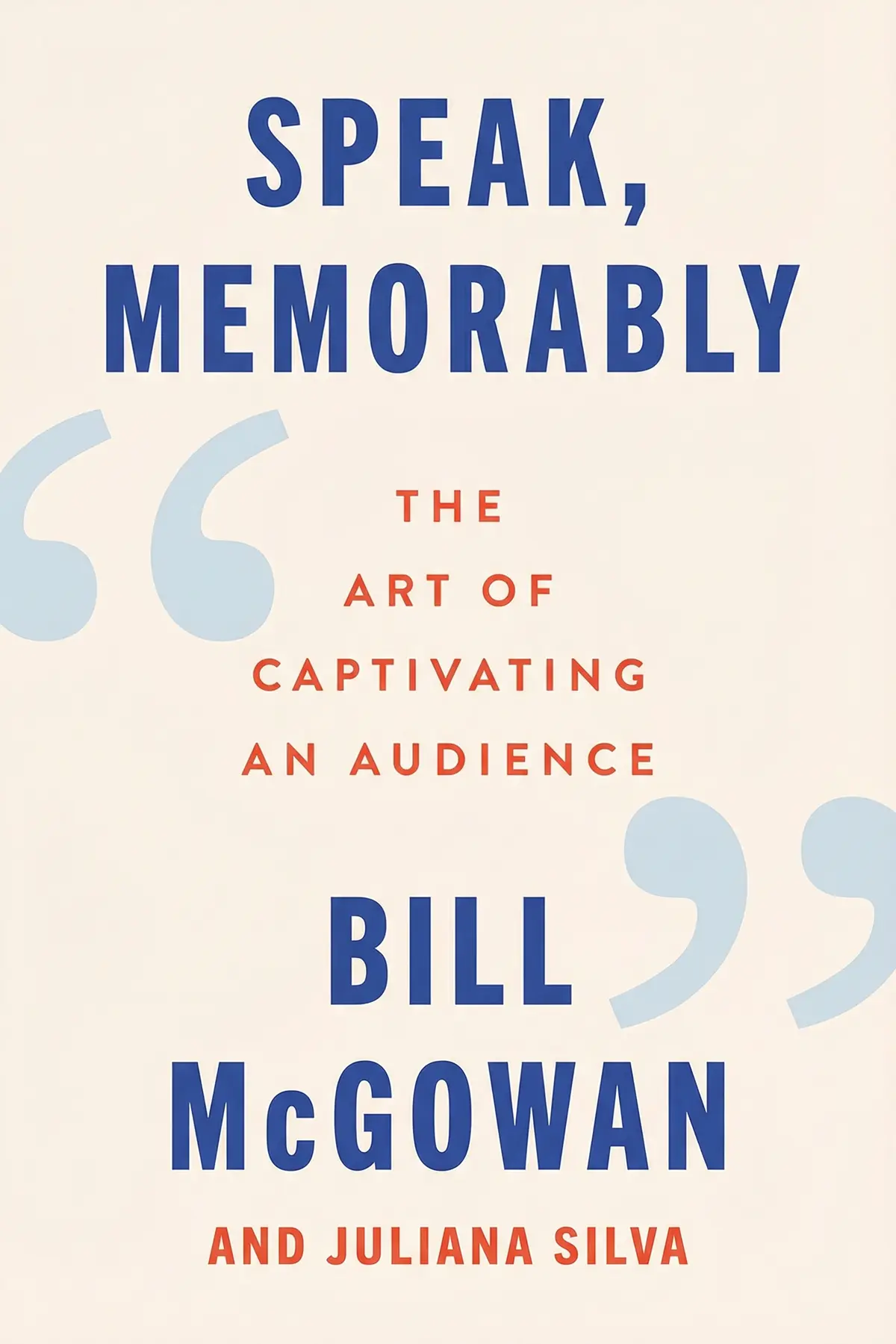
Table of Content
1. Introduction
1 min 03 sec
A strong idea delivered in a flat, rambling way is usually forgotten by the time the meeting ends, and the fault often lies with the delivery. In Speak, Memorably, media coach Bill McGowan and journalist Juliana Silva argue that tone, energy and pacing shape how seriously people take you, long before your facts land. They point out that unclear communication costs US businesses about $1.2 trillion a year.
Their case is that standing out in a loud, combative public world requires no stunts, only craft. Being memorable comes down to learnable choices: where you place your strongest lines, which words you cut and which you coin, how you use your voice and silence, and how much attention you pay to the people in front of you.
Along the way come a filmmaker’s rule for ordering ideas, a test named after your mother-in-law, and a good reason to stop fearing two seconds of quiet.
2. Treat every update as an audition
1 min 42 sec
A routine status report on a weekly call seems harmless enough. Yet employers, colleagues and even software are judging something in it that most people never think to check, and the first fix makes nearly everyone squirm.
3. Save your strongest line for the final minute
1 min 37 sec
Most speakers bury their best material exactly where audiences remember least. A famous film director and a celebrated chef both worked out the fix, and a psychologist’s research on memory explains why it works.
4. Cut the filler words and office jargon
1 min 48 sec
Rambling rarely comes from having too little to say. A sitcom boss lends his name to the problem, and a simple test involving a relative shows when your language has drifted too far from ordinary speech.
5. Coin phrases your audience will repeat tomorrow
1 min 53 sec
The lines people quote the next day rarely happen by accident. Seven devices, from a former president’s medical comparison to a single invented word, show how to build them, and one famous label shows how they can backfire.
6. Let pace, pitch and pauses hold attention
2 min 11 sec
A cartoon teacher’s droning voice is a joke on paper and a disaster in a meeting room. Small changes in speed, tone and silence decide whether listeners keep up, and most speakers fear the most useful one.
7. Win the room by making it about them
1 min 49 sec
Brains and polish persuade fewer people than most professionals expect. Warmth, a real smile and a little self-mockery matter more, and so does noticing the everyday behaviors that silence half the voices in a meeting.
8. Keep your voice ahead of slides and screens
1 min 49 sec
Every new tool promises to make communication easier, and each one has a habit of flattening the speaker. One tech founder banned slides outright, and generative AI raises the same problem at a much larger scale.
9. Conclusion
1 min 08 sec
The authors’ case adds up to a hopeful discovery: being memorable is a craft, built from small decisions anyone can make before and during a talk. In a public world full of shouting, the speaker who stands out is the one who has thought about where the strong lines go, which words earn their place, how the voice moves and who is sitting on the other side of the room. None of it calls for outrageous behavior.
Start with the camera. Record your next presentation, even a short one, and watch it once for energy and once for fillers. Then rebuild the talk around its edges, with your best idea at the close, your second best at the start, and a smooth bridge from the greetings into the substance. Put your main point through the Mother-in-Law Test and give it one device that sticks, perhaps a number with context or a definition of your own. When you deliver it, stop after the key sentence and let the silence work.
Charlie Brown’s teacher may have had lessons worth hearing. All anyone remembers is the drone.
About this book
What is this book about?
Public talk has become a constant shouting match, and plenty of capable people find that their good ideas vanish the moment they finish speaking. Bill McGowan and Juliana Silva, media coaches who prepare executives and experts for interviews and big speeches, argue that standing out does not require outrageous behavior. It requires craft, and craft can be learned. Their approach covers the whole act of speaking. They show how to order a talk so the opening and closing carry the weight, how to trim filler words and office jargon, and how to build phrases an audience will repeat, from sharp analogies to numbers given context. They then turn to delivery: pace, pitch, volume and the deliberate pause. Finally, they look at empathy, warmth and the behaviors that silence women at work, and at how slides, video calls and AI can drown out the human voice. Readers get practical tests and habits for meetings, presentations and virtual calls, all aimed at one result: being heard, and remembered, for the right reasons.
Book Information
Who it's for
Unheard in meetings
Professionals whose ideas get lost in meetings, status updates and video calls.
Managers and team leads
Managers and team leads preparing presentations, pitches or town halls who want people to remember the point.
Early in their careers
Early-career employees who sense that sounding confident and clear will shape how fast they get noticed.
About the Author
Bill McGowan
Bill McGowan founded Clarity Media Group, which coaches people for media interviews and public speaking. He spent more than twenty years in television news, won two Emmy Awards and reported over 700 national stories for programs such as ABC News 20/20, CBS News 48 Hours and MSNBC. Since 2001 he has prepared clients for high-stakes moments such as TED Talks and 60 Minutes interviews, and his clients have included Eli Manning and Jack Welch. Juliana Silva, a journalist with a background in global media brand strategy, is a Communications Specialist at the firm and has coached experts to become on-air network contributors.
Ratings & Reviews
Ratings at a glance
What people think
Listeners find that although perspectives differ regarding the book’s supposed political bias and extra material, many value the actionable techniques provided for enhancing public speaking and business communication. Furthermore, they appreciate the mix of educational guidance and wit that ensures the ideas are both accessible and captivating. They also highlight the work’s contemporary significance, with one listener pointing out its useful examination of how AI can be used as a tool for speakers to develop their message while still prioritizing powerful human narratives.
Top reviews
Lucas
Finally finished 'Speak, Memorably' and I have to say, it’s easily one of the most practical guides on communication I’ve encountered in years. The way the authors blend humor with actionable advice makes the concepts stick in a way that dry textbooks never could. I especially loved the focus on 'defining moments' in a speech—those specific beats that ensure your audience actually remembers what you said an hour after you leave the stage. Whether you are a seasoned executive or just starting your career, there is something here for you. It’s rare to find a book that is both this informative and this genuinely fun to read. Highly recommended for all speakers.
Show moreElias
One specific section on the 'humanity' of speaking really resonated with me, especially as we all start relying more on tech for our daily tasks. This book is a masterclass in how to stay relevant and engaging in a world where everyone’s attention span is shrinking. The authors provide a wealth of examples—some funny, some cautionary—that illustrate exactly why certain speakers fail to connect. I’ve already started implementing their 'memorable' strategies in my weekly team meetings, and the difference in engagement is noticeable. It’s an essential read for anyone who wants to ensure their ideas aren't just heard, but actually acted upon. Truly a game changer for my professional communication.
Show moreTak
How can you not love a book that teaches you how to stop being a boring speaker while being remarkably entertaining itself? I’ve read dozens of books on public speaking, and most of them are, ironically, quite forgettable. This one is different. The humor is integrated perfectly, and the advice is grounded in the reality of today’s fast-paced, AI-integrated business world. It’s informative without being academic and practical without being simplistic. I recommend it to both experienced presenters who need a tune-up and newcomers who are terrified of the podium. It’s a quick, high-impact read that delivers exactly what the title promises. You will definitely come away a better communicator.
Show morePairot
Personally, I found the blend of high-level strategy and granular tips to be the perfect balance for a modern business book. The authors clearly understand that the landscape of public speaking has changed, and their advice on leveraging AI to build better content while doubling down on human storytelling is spot on. I appreciated how they addressed the unique challenges of corporate communication in a way that felt fresh and applicable to real-world scenarios. Every chapter felt like it was designed to help you stand out in a crowded field of mediocre speakers. If you want your message to have a lasting impact, this is the blueprint you’ve been looking for.
Show morePatchara
Rarely do I find a business book that manages to address the elephant in the room—artificial intelligence—with such nuance and practicality. McGowan and Silva don't just dismiss AI as a threat; they frame it as a powerful tool for developing content while reminding us that humanity is the ultimate 'hook.' The chapters on crafting a narrative that sticks were incredibly useful for my recent keynote prep. I did find a few sections a bit long-winded, but the overall quality of the communication strategies made it worth the effort. It’s a solid choice for anyone in corporate America who needs to sharpen their message in an increasingly digital and automated professional landscape.
Show morePim
As a professional who frequently has to translate complex data into digestible presentations, I found the frameworks in this book to be exceptionally relevant. The authors do a great job of explaining how to build a powerful narrative that resonates on a human level, even in a stiff corporate environment. I was particularly impressed by the discussion on using AI to streamline the drafting process without losing your personal voice. While I noticed the political slant that other reviewers mentioned, I tried to look past it to get to the core advice, which is actually quite sound. It’s a very readable book that offers a lot of value if you’re willing to filter out the noise.
Show moreTan
To be fair, there are some genuinely helpful pointers scattered throughout this book regarding how to structure a speech for maximum impact. I particularly appreciated the advice on using humor to keep an audience engaged, which the authors actually practice in their own writing style. However, I found myself getting bored during the middle sections where the anecdotes seemed to drag on forever. It’s an informative read if you have the patience for it, but it doesn’t quite live up to the promise of being 'memorable' itself. I came away with about three or four solid takeaways, which is fine, but I expected more from a book with this much hype around its modern relevance.
Show moreOrawan
Frankly, the book is a bit of a mixed bag for me. On one hand, the authors raise some excellent points about the psychology of listening and how to avoid being a 'babbler.' On the other hand, the book itself feels like it could have used a much stricter editor to trim down the repetitive examples. I enjoyed the lighthearted tone and the occasional joke, but the pacing felt uneven, making it difficult to stay focused during the longer chapters. It’s a decent resource if you’re looking for specific pointers on public speaking, but don’t expect it to revolutionize your world. It's more of a helpful refresher with a few modern updates than a ground-breaking manual.
Show moreLily
This volume suffers from a common ailment in the business publishing world: it is a 20-page white paper stretched into a 200-page book. While the authors clearly have expertise, the amount of filler content I had to wade through to get to the 'nuggets' of actual wisdom was exhausting. Personally, I felt my time would have been better spent watching a twenty-minute YouTube summary than reading these repetitive chapters. There are a few practical strategies for corporate presentations, but they are surrounded by so much fluff that the message loses its impact. To be fair, the writing style is decent, but the signal-to-noise ratio is just too low for me to recommend it to anyone with a busy schedule.
Show moreRosa
It is quite disappointing when a guide on 'clear communication' is so heavily clouded by the authors' political leanings. Every single example of a 'successful' speaker seemed to come from one side of the aisle, while the 'failures' were exclusively from the other. This isn't just a matter of personal disagreement; it’s a failure of the book's core premise. How can you teach universal communication strategies while simultaneously alienating a massive portion of your potential audience? If you’re looking for objective advice on public speaking without a side of partisan lecturing, look elsewhere. Truth is, the bias was so distracting that I found it impossible to take the actual advice seriously, which is a shame because there might have been some decent tips buried under the agenda.
Show moreQuestions about this book
What is the main idea of Speak, Memorably?
Bill McGowan and Juliana Silva argue that being remembered when you speak is a learnable craft. How you sound shapes how seriously people take you, so they cover where to place your strongest material, how to cut filler and jargon, how to coin phrases that stick, how to use pace, pitch and silence, and how empathy and warmth build trust. They also show how slides, video calls and AI can drown out the speaker.
Who should read Speak, Memorably?
It suits anyone who speaks for a living or for a promotion: professionals giving updates, managers running meetings, and people preparing presentations or interviews. The authors frame every conversation as an audition and cite a 2024 LinkedIn report ranking communication skills first among what employers want. Readers who ramble, rely on jargon or feel flat on video calls will find specific fixes.
How do you structure a presentation according to Speak, Memorably?
The authors borrow a rule from Francis Ford Coppola: place your strongest idea last, your next strongest first, and your third strongest in the middle. This follows the primacy and recency effect identified by Hermann Ebbinghaus, since people recall openings and closings best. They also advise building one story instead of disconnected slides and planning the transition from greetings into the main talk.
How can I stop saying um when I speak?
The book recommends a verbal diet in three steps. Record yourself to notice how often fillers like um, so and like appear. Slow your pace so your brain has time to find the next thought. Then pause on purpose. The authors say fear of dead air, which they call sedatephobia, drives most fillers, and that deliberate pauses make talks more memorable.
Readers also enjoyed







AUDIO SUMMARY AVAILABLE
Listen to Speak, Memorably in 15 minutes
Get the key ideas from Speak, Memorably by Bill McGowan, plus 5,000+ more nonfiction titles.
- 5,000+ titles
- Listen as much as you want
- 7-day free trial
- Cancel anytime









