

11 min 14 sec
Available in: English
 ไทย
EnglishไทยSpark: The Revolutionary New Science of Exercise and the Brain
Shows how physical exercise changes the brain itself, helping you learn faster, handle stress, ease low moods, focus with ADHD and keep your mind sharp as you age.
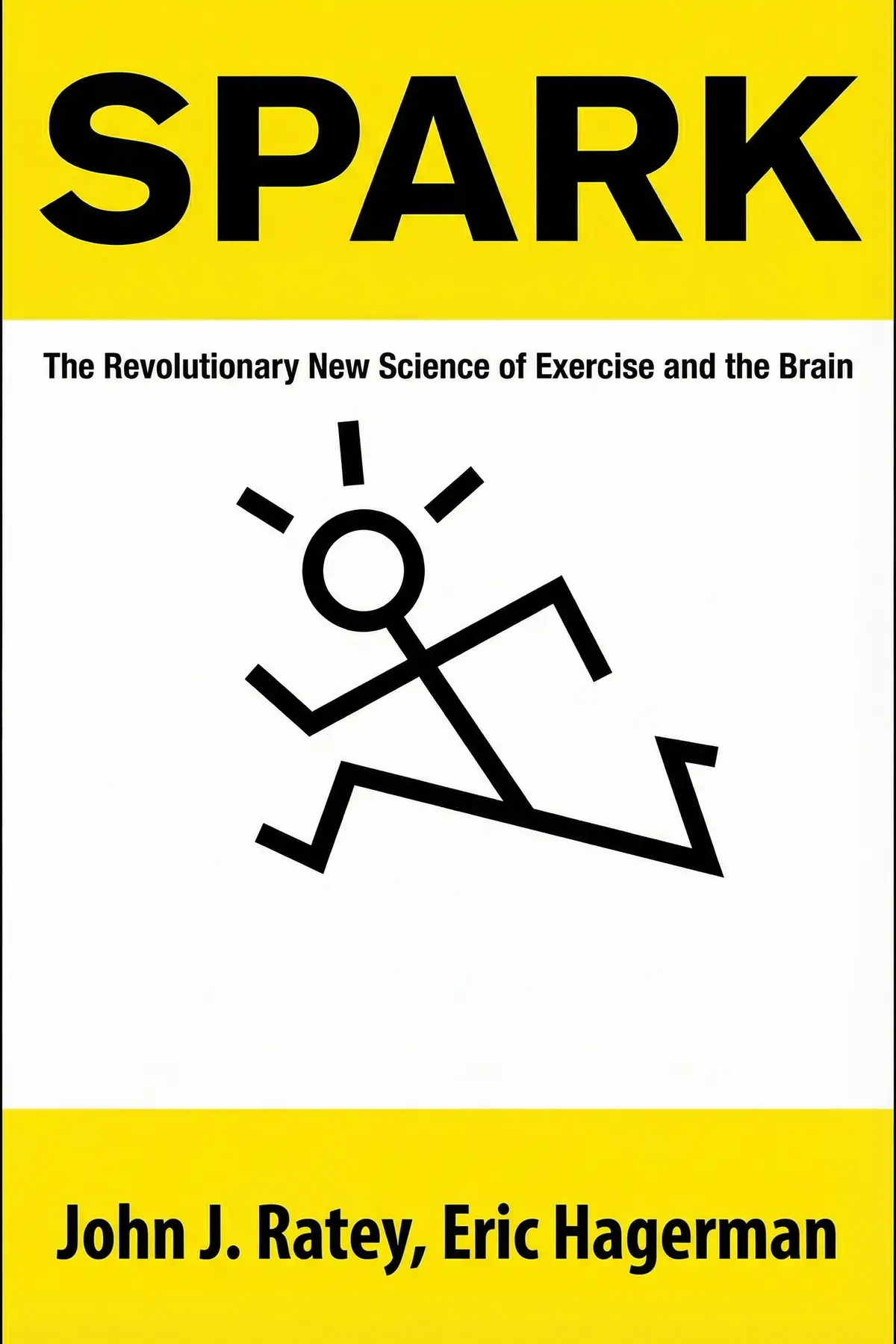
Table of Content
1. Introduction
1 min 02 sec
If your workday is a desk, a screen and a tired brain by four o’clock, the fix may be a walk instead of another coffee. That is the argument of Spark, by Harvard psychiatrist John J. Ratey and journalist Eric Hagerman: working muscles release proteins that travel to the brain and help its cells form new connections.
Our ancestors survived by moving, chasing game, escaping lions and walking from one waterhole to the next. The brain, the authors argue, still assumes we live that way, and it works poorly when the body sits still all day. That is the claim this whole listen follows. Movement is maintenance for the mind: it prepares the brain to learn, toughens it against stress, lifts low moods, steadies attention and slows decline with age.
Along the way you’ll meet a high school that put a workout before reading class, a mother of four who swapped wine for a skipping rope, and a teenager whose grades leapt from near failing to strong. Each one shows a way to put movement to work on your thinking, starting this week.
2. Learn faster by moving right before you study
1 min 44 sec
One group of struggling readers did nothing different in class, yet pulled clearly ahead of their classmates. The change happened before the lesson started, and it involved their legs more than their books.
3. Trade the stress drink for a skipping rope
1 min 48 sec
A kitchen renovation pushed one busy mother to pour wine before lunch. Her psychiatrist’s prescription sounds almost too simple, and the reason it worked says something odd about how strain can protect the brain.
4. Lift a low mood from the body up
1 min 47 sec
Doctors in the 1950s noticed patients cheering up on medicines meant for lungs and allergies. That accident changed how medicine thinks about sadness, and it points to a remedy available outside any pharmacy.
5. Give a restless mind the reward it needs
1 min 50 sec
A boy his family called a troublemaker once raised his grades dramatically when getting a driver’s license depended on it. What later helped steady his attention, from college into his working life, was a physical habit.
6. Stay sharp with age by refusing to sit still
1 min 52 sec
An active woman who gardened, golfed and swam broke her hip twice. What happened to her mind in the months that followed is a warning for anyone who thinks puzzles alone can protect an aging brain.
7. Conclusion
1 min 11 sec
Spark makes the line between physical fitness and mental health look mostly imaginary. The brain was built for a creature that walked, ran and fled, and it still runs best when the body does those things. A jog, in this picture, is a delivery of growth factors, dopamine, serotonin and endorphins to the organ that does your thinking, plus a small dose of strain that leaves brain cells tougher.
That makes movement something to use on purpose. Put a short, hard workout before the material you most need to learn. When tension builds, answer it with motion, the way Susan answered hers with a rope. The authors stretch the same idea to cravings: if you lean toward addictive habits, they suggest a run or a swim in place of the vice, because the effort brings a sense of accomplishment and dulls the urge. And as the years pass, protect your daily movement most carefully when injury or illness tempts you to stop.
The author’s mother did not lose her sharpness to age alone. Part of it came from the long months of inactivity she was forced into.
About this book
What is this book about?
Most people exercise for their heart, their weight or their looks. John J. Ratey and Eric Hagerman argue that the organ gaining most from a workout may be the brain. Our ancestors survived by moving all day, and the brain still behaves as if we live that way. When the body sits still, the mind suffers. Ratey, a Harvard psychiatrist, and Hagerman, a science and sports journalist, trace how exercise raises dopamine and serotonin, sends growth factors from the muscles to the brain and triggers a repair process that makes brain cells tougher. They follow that biology into everyday problems: a school where students who worked out before class improved their reading more, a mother of four who replaced daily wine with a skipping rope, a jogger whose irritability faded, a restless teenager who became a focused venture capitalist, and an active older woman whose mind declined after injury kept her still. Readers get a clear explanation of why movement matters for thinking and mood, and simple ways to use it: timing exercise before hard learning, answering stress with motion and protecting daily activity as the years pass.
Book Information
Who it's for
Students and office workers
Desk workers and students who want a sharper, calmer mind and are open to using exercise to get it.
Facing mental health struggles
People coping with stress, low moods, cravings or ADHD who want a physical tool beside their other help.
Protecting memory and thinking
Adults caring for aging parents, or watching their own age, who want to protect memory and thinking.
About the Author
John J. Ratey
John J. Ratey is an American physician and associate clinical professor of psychiatry at Harvard Medical School, with a private practice in Cambridge, Massachusetts. He has studied ADHD since the 1980s and co-wrote Driven to Distraction and ADHD 2.0 with Edward Hallowell. Eric Hagerman has been an editor at Popular Science and Outside, and his writing appeared in The Best American Sports Writing 2004.

Ratings & Reviews
Ratings at a glance
What people think
Listeners describe this work as accessible and captivating, commending the thorough research and data-driven perspective. This title acts as a strong incentive for intense physical activity, as listeners observe beneficial impacts on neurological health—especially during aging—alongside enhancements in emotional well-being and mental performance. Listeners value the informative and uplifting quality of the content, with one listener noting that it sparked a fascination with neuroscience principles. Reactions to the explanations are varied; though listeners enjoy the specialized data, some find these sections hard to understand.
Top reviews
Sam
Ever wonder why a simple morning jog seems to clear your head better than an extra shot of espresso? Ratey presents a compelling argument that movement isn’t just for muscles; it's the primary fuel for our gray matter. The Naperville school district case study alone is worth the price of admission, showing how physical activity can fundamentally transform academic performance. While it gets a bit technical with neuro-transmitters, the core message remains incredibly inspiring for anyone looking to optimize their life. It’s a paradigm shift in how we view the gym, turning it from a place for vanity into a pharmacy for the mind. I've already shared these findings with my coworkers because the data is just too good to keep to myself.
Show moreKek
After hearing about the connection between physical activity and cognitive decline, I knew I had to give this book a serious look. Ratey argues that we are essentially hunter-gatherers trapped in a sedentary world, and our brains are suffering for it. The section on how exercise mitigates the effects of aging was particularly eye-opening for me. It's not just about living longer; it's about staying sharp and maintaining our mood as the decades pass by. Since finishing this, I've been much more consistent with my cardio, and frankly, I feel more focused than ever. It's rare for a book to have such an immediate, tangible impact on my daily habits and overall outlook on aging.
Show moreManop
The chapter on ADHD was a total revelation for me as someone who has struggled with focus my entire adult life. Understanding that exercise can act as a natural stimulant, similar to Ritalin, has completely changed my daily routine. Ratey does a masterful job of connecting evolutionary biology with modern neuroscience to explain why our brains thrive when our bodies are moving. Yes, the science is complex, but it provides the necessary 'buy-in' to actually stick with a workout plan. I’ve recommended this to my entire family because the benefits for mood and memory are too significant to ignore. It is truly the best argument for physical education in schools that I have ever read.
Show moreUbolwan
Wow. This is easily one of the most important books I’ve read in the last five years. It completely reframes the purpose of exercise from a vanity project to a fundamental requirement for a healthy brain. The connection between physical movement and our ability to learn is something every teacher and parent should understand. Ratey’s passion is infectious, even if he occasionally gets carried away with the scientific data points. I feel empowered knowing that I have a tool at my disposal to fight off stress and potential dementia. An absolute must-read for anyone who cares about their long-term cognitive health. You will never look at your sneakers the same way again.
Show moreOn
Picked this up because I wanted more than just a typical 'how-to' guide on fitness. The science here is dense, focusing on things like BDNF and synaptic plasticity, which can be a bit overwhelming for a casual reader. Ratey clearly knows his stuff, but I occasionally found myself skimming the more academic paragraphs to get back to the real-world success stories. It’s a powerful read that has genuinely changed my perspective on why I should hit the gym, especially regarding mental health. I just wish it didn't feel like a medical textbook every few pages. To be fair, the evidence-based approach makes the author's claims much more believable than your average self-help guru.
Show morePaisley
This book is a deep dive into the neurological benefits of breaking a sweat, though it definitely leans into the technical side. I appreciated the evidence-based approach because it moves beyond the typical 'feel-good' tropes found in most health and wellness books. However, Ratey can come across as a bit of a zealot, suggesting a level of intensity that might be daunting for a beginner. Look, I’m all for fitness, but the 45-minute daily recommendation is a tall order for a busy parent or someone struggling with depression. Still, the insight into how movement regulates hormones and repairs synapses is genuinely fascinating. It provides a scientific backbone to what many athletes have felt intuitively for years.
Show moreSom
Finally got around to reading this classic, and I must say the 'exercise is medicine' philosophy is incredibly well-defended here. The authors walk you through various conditions like anxiety and addiction, showing how physical activity repairs the brain's internal circuitry. It is a bit long-winded, and I think a good editor could have trimmed the middle chapters without losing any of the impact. That said, the detailed explanation of how heart rate impacts brain chemistry is something you won't find in a standard gym magazine. It’s a dense read but undeniably rewarding for those willing to put in the time to understand the mechanisms behind the 'runner's high.'
Show moreElena
As someone who has always been sedentary, I found this book both terrifying and incredibly motivating. The description of how a lack of movement leads to cognitive decline and physical 'junk' in the brain really lit a fire under me. I did find the sections on synaptic plasticity and neurogenesis to be a bit thick with terminology, though. If you can push past the technical barriers, the core message is a total game-changer for anyone's health journey. I’ve started walking every morning and already notice a significant lift in my overall mood and mental clarity. It's not just about weight loss anymore; it's about keeping my mind intact as I get older.
Show moreSarawut
To be fair, the central thesis that exercise is essential for brain health is life-changing, but the delivery leaves something to be desired. The author tends to repeat himself, hammering home the same point about aerobic activity across every single chapter. Whether he’s talking about ADHD, menopause, or addiction, the solution is always the exact same prescription of intense exercise. While I appreciate the extensive research, the constant use of jargon like LTP and VEGF made my eyes glaze over. I stopped about three-quarters through because I felt I’d already gotten the gist of the argument. It's a solid resource for data, but the writing style is too dry for a leisure read.
Show moreDiego
Not what I expected from a book marketed toward a general audience. I was looking for motivation, but instead, I got buried under a mountain of medical jargon and acronyms. Between the constant mentions of BDNF and IGF-1, the narrative flow gets completely lost in the weeds. The tone also feels oddly pushy, almost like the author is a salesman for a lifestyle I can’t possibly sustain right now. It’s repetitive and dry, lacking the readability I’ve found in other popular science books about the human brain. Personally, I think the whole thing could have been a long-form article rather than a full-length book that recycles the same points.
Show moreQuestions about this book
What is the main idea of Spark by John Ratey?
Ratey and Hagerman argue that exercise matters as much for the brain as for the body. Humans evolved as movers, and the brain still expects physical activity. Exercise raises dopamine and serotonin, sends growth factors from muscles to the brain and toughens brain cells through a repair process. The result, they say, is better learning, lower stress, improved mood, steadier focus and slower mental decline with age.
How does exercise help you learn, according to Spark?
The authors explain that working muscles produce growth factors, proteins that travel to the brain and help cells form new connections, while exercise also raises dopamine and serotonin to sharpen focus. At Naperville Central High School, students who did vigorous exercise before a reading class improved comprehension by 17 percent, against 10.7 percent for classmates who did not exercise first.
Can exercise help with stress and depression?
In Spark, yes. Exercise is a controlled form of stress that triggers repair and makes brain cells sturdier against everyday pressure. A mother of four named Susan replaced her daily chardonnay with jumping rope on a psychiatrist’s advice. For mood, exercise releases endorphins, and Ratey’s patient Bill, who took up jogging at 50, became noticeably less grumpy and self-critical.
What does Spark say about exercise and ADHD?
The authors explain that in ADHD, fewer connections reach the brain’s reward center, the nucleus accumbens, so focusing feels less rewarding. Exercise helps switch that system on. Sam, once labeled a troublemaker, joined a serious college athletics program and now runs several miles a day, which the authors credit with helping him focus as a venture capitalist.
How can I apply the ideas in Spark?
Do a short, vigorous workout right before demanding learning or focused work. When stress or a craving hits, respond with movement such as jumping rope, running or swimming instead of a drink or other vice. As you age, choose active pastimes over sitting still, and return to movement quickly after injury or illness, since the authors link forced inactivity to mental decline.
Featured in

Readers also enjoyed

ADHD an A-Z: Figuring It Out Step by Step
Leanne Maskell






Alcoholics Anonymous
Alcoholics Anonymous World Services

Ali: A Life
Jonathan Eig

A Liberated Mind: How to Pivot Toward What Matters
Steven C. Hayes
AUDIO SUMMARY AVAILABLE
Listen to Spark in 15 minutes
Get the key ideas from Spark by John J. Ratey, plus 5,000+ more nonfiction titles.
- 5,000+ titles
- Listen as much as you want
- 7-day free trial
- Cancel anytime









