

59 Seconds: Change Your Life in Under a Minute
Richard Wiseman
 English
Shows how psychopaths with polished manners get hired, win loyal helpers and powerful sponsors, and climb inside companies. It also explains how managers and employees can spot the pattern and protect their work and reputation.
54 sec
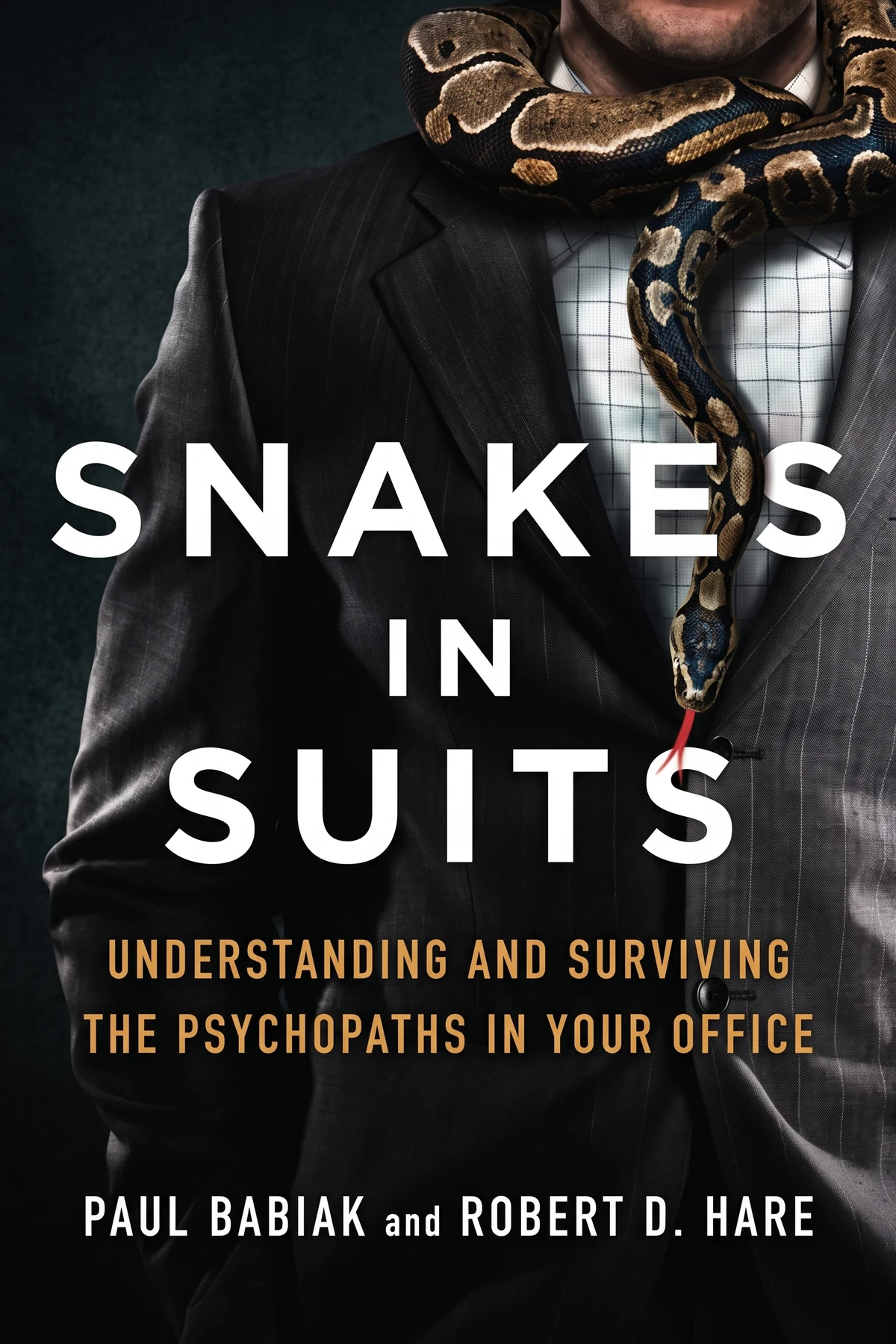
If a colleague charms everyone, takes credit for your projects and never answers for anything, you may be facing more than a difficult personality. In Snakes in Suits, industrial psychologist Paul Babiak and psychopathology specialist Robert D. Hare argue that some psychopaths never see a prison: they join large companies and climb by manipulating the people around them. About one percent of people fit the clinical picture, so most of us will work near one eventually.
The authors’ case is that these predators follow a pattern, and a pattern can be learned. They read people for usefulness and weakness, play a new character for each target, recruit loyal helpers and powerful sponsors, then drop them. Once you can see that sequence, you can protect a hiring process, your reputation and your peace of mind, and know what to put in writing before the rumors start.
1 min 44 sec
A tiny share of the population commits a startling share of serious crime. Yet the traits that define these people show up far more often in meeting rooms than in courtrooms, and they are easy to misread.
1 min 48 sec
The manipulators who stay out of prison share a routine, and its last step leaves victims stunned and doubting themselves. Brain scans help explain why the person who walks away feels nothing at all.
1 min 47 sec
A small-town radio host who played music for Jesus was running scams on his own listeners. Big companies offer the same kind of trust, plus money and status, and their hiring process is often wide open.
2 min 14 sec
The loyal friend, the senior sponsor and the overlooked bystander each play a part in a corporate psychopath’s rise. Only one of them usually sees what is happening, and that person rarely speaks up.
1 min 43 sec
A candidate who feels no nerves, reads you perfectly and has a story for everything can seem like the best hire of the year. A handful of plain interview habits makes that performance much harder to pull off.
1 min 48 sec
Even a trained prison psychologist was charmed into wrecking her own career. Protection starts with knowing what you want to hear and what you have that someone else might want.
1 min 40 sec
When the manipulator is your boss or the person at the next desk, proving what they are is rarely possible. Making yourself a hard target is, and sometimes that includes knowing when to walk away.
1 min 03 sec
Babiak and Hare leave a sobering thought: the most dangerous person in an office may also be the most charming one. Corporate psychopaths rarely break a company’s systems from outside. They ride them, using the trust that teamwork requires and the sponsorship that careers depend on. What protects people and companies is the same at every level: seeing the pattern early. Charm that arrives too fast, a story that shifts between meetings, a trail of colleagues who were close and then discarded.
So watch how people treat those who can do nothing for them, because the overlooked observer often sees first. Ask the people who know you best which compliments you cannot resist, before a stranger finds out. If you hire, hold to your interview plan and ask to see the work itself. And if a snake moves in nearby, keep your work strong, your feedback on paper and your temper level.
A psychopath’s best tool is the impression he makes. Your best answer is a record he cannot rewrite.
Most people picture a psychopath as a movie killer. Paul Babiak and Robert D. Hare argue that some of the most damaging ones wear business clothes, pass job interviews with ease and climb inside large companies, charming colleagues and executives while leaving wrecked careers behind them. The authors draw on the Psychopathy Checklist Revised to describe the traits involved. Then they trace the three-phase method these people use: they size up each person's usefulness and weak spots, play whatever character each target needs, and drop people once they have nothing left to give. Inside a company, that method becomes a system of pawns, patrons and patsies, backed by rumors that make victims look like the problem. Their examples range from a con man posing as a devout Christian to a prison psychologist who lost her career to an inmate's charm. Readers get practical defenses at every level. Hiring managers get interview habits that expose rehearsed charm. Employees learn how to find their own emotional hot buttons, keep feedback in writing, stay calm under provocation and, when the boss is the problem, leave on their own terms.
Employees who suspect a charming colleague or boss is playing everyone around them.
Hiring managers and HR staff who want interviews that expose rehearsed charm.
Team leads who have watched a rising star leave a trail of burned colleagues behind.
Paul Babiak is an industrial psychologist who studies how manipulative people gain power inside organizations. Robert D. Hare, born in 1934 in Calgary, Canada, is a professor emeritus at the University of British Columbia specializing in psychopathology and psychophysiology. He advises the FBI's Child Abduction and Serial Murder Investigative Resources Center, consults for prison services in Britain and North America, and also wrote Without Conscience. Snakes in Suits first appeared in 2006, and a revised and updated edition has followed.
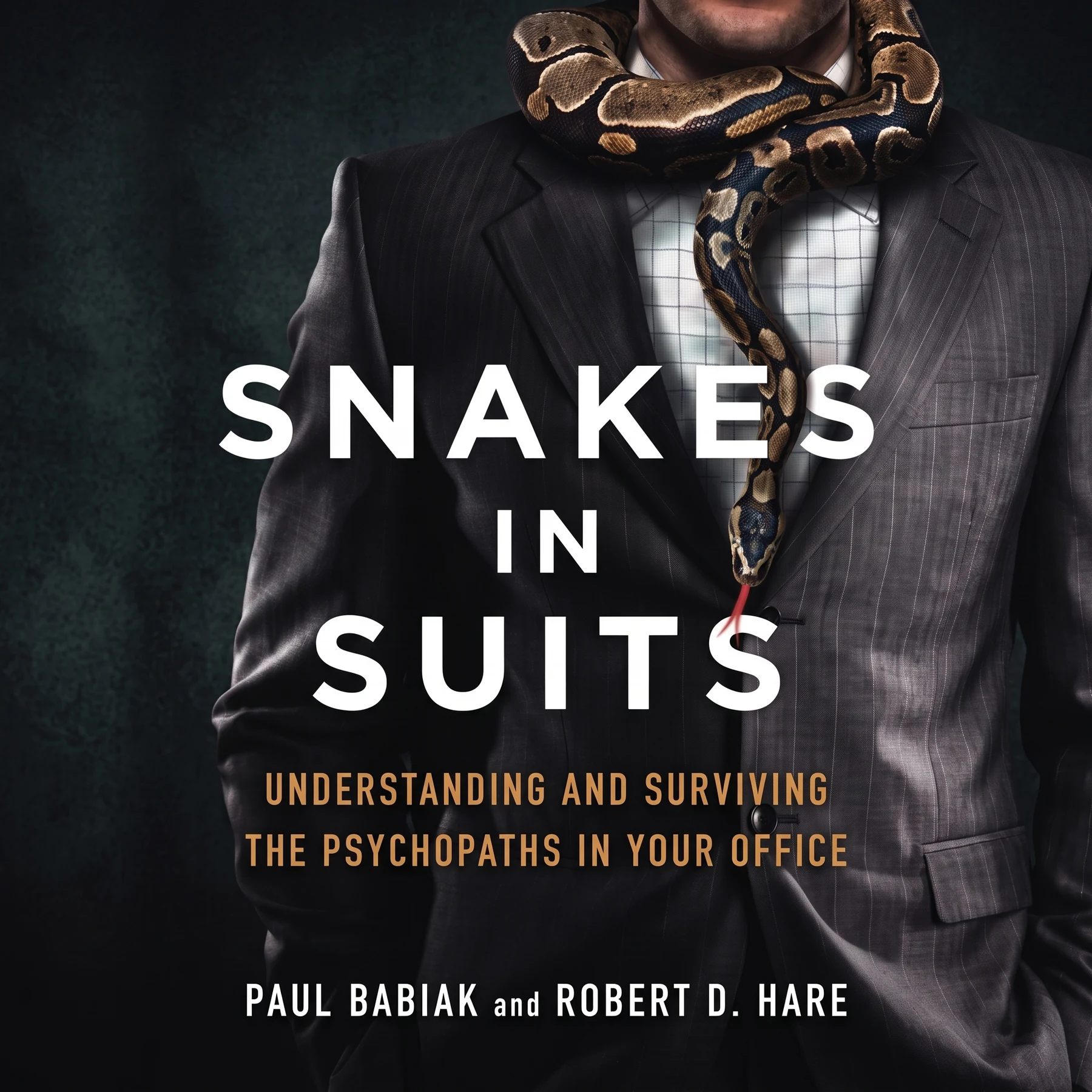
Listeners describe this work as captivating and skillfully composed, offering solid research and actionable insights for comprehending psychopathic traits. Furthermore, they value how effective it is as a manual and its capacity to provide psychological clarity. On the other hand, the narrative style gets varied feedback, including one listener who characterized it as a weak effort to blend dramatic elements with non-fiction. Plus, several listeners feel the content can be redundant.
Picked this up after a particularly brutal performance review with a manager who seemed to delight in my confusion. It was like reading a manual on my boss’s exact personality. The research presented by Babiak and Hare is deeply enthralling, and it actually helped restore my peace of mind by confirming I wasn’t the one losing it—the problem was structural and pathological. Frankly, the way they break down the manipulation tactics used in boardrooms is both terrifying and incredibly helpful for self-preservation. While some sections felt a little repetitive, hitting the same notes about the three-phase model of the corporate psychopath, the core message about how these "snakes" climb the ladder is essential for anyone in a high-stakes office environment. This isn’t just a book; it’s a survival guide for the modern cubicle dweller. I walked away feeling much more equipped to handle the psychological games being played around me.
Show moreThis book changed my entire perspective on workplace politics and saved my sanity. I had been struggling for years to understand why certain colleagues were so destructive, and "Snakes in Suits" gave me the vocabulary to describe what was happening. It’s remarkably well-written, even if the tone leans a little towards the dramatic side. Personally, I found the distinction between antisocial behavior and true psychopathy to be the most helpful part of the research. It isn’t just about people who break laws; it’s about those who break people for fun or profit. An absolutely essential read for the modern office worker who feels like they're being gaslit by a superior.
Show moreAfter hearing so much about the PCL-R test, I was eager to see how the concepts applied to the business world. This book doesn't disappoint in terms of insight. It provides a terrifyingly clear framework for understanding how empathy-free individuals can thrive in environments that prioritize profit over people. My only real gripe is that it feels a bit dated in its examples of corporate structure, but the personality profiles are timeless. It’s a wake-up call for anyone who thinks the business world is a meritocracy based on hard work and decency. Hard to read because of the subject matter, but even harder to ignore once you see the patterns.
Show moreAs someone who works in recruitment, I found the chapters on screening and HR practices to be the most valuable part of this entire read. The authors provide a very clear-eyed look at how charismatic predators can bypass standard interview questions by mirroring the interviewer’s own values. To be fair, the book does drag a bit in the middle, and I think they could have condensed the theoretical sections significantly. However, the practical information on identifying "red flags" in a professional setting is top-tier. It’s a solid handbook for anyone trying to protect their company culture from the damage a single toxic hire can cause. It avoids being too academic while still feeling grounded in Hare's famous clinical work.
Show moreWow, what an incredibly disturbing but necessary deep dive into the darker corners of the corporate world. The authors do a fantastic job of explaining why these individuals are often promoted instead of fired—their traits are frequently mistaken for "strong leadership" or "strategic vision." I’ve seen this play out in real-time, and reading this book was like finally seeing the man behind the curtain. Gotta say, the advice on how to handle yourself when you’re targeted by a "snake" is worth the price of the book alone. It provides a level of practical information that most academic texts lack, even if the storytelling elements are a bit hit-or-miss.
Show moreTruth is, most of us have worked with a "snake" at some point, and this book makes that realization hit like a ton of bricks. It’s enthralling to see how Babiak and Hare map out the stages of a psychopathic takeover within a company—from entry to manipulation and finally to the "clean up." While it definitely could have used a more aggressive editor to trim the repetitive fat, the core content is brilliant. Truly helpful for restoring some peace of mind after a bad experience. A solid guide.
Show moreNot what I expected given the heavy academic credentials of Robert Hare. The book attempts to merge deep psychological research with these fictionalized "Dave and Dave" stories, but it feels like a bit of a mismatch. These dramatic vignettes are meant to illustrate the points, but they often come across as slightly cheesy and distract from the actual science. I was looking for more hard data and fewer fictional accounts of corporate drama. Still, the underlying analysis of how organizations inadvertently reward psychopathic traits is spot on and quite eye-opening. It’s worth a look if you can tolerate the repetitive structure and the somewhat sensationalized tone of the case studies.
Show moreFinally got around to finishing this, and I have mixed feelings about the final product. On one hand, Robert Hare is the gold standard for psychopathy research, and his insights into the "mask of sanity" in a business context are fascinating. On the other hand, the book is incredibly repetitive, hitting the same three or four points for nearly three hundred pages. It’s a bit of a slog to get through the middle chapters where the fictional narratives take over. I think a shorter, more concise version would have been much more effective. It’s good info, but it requires some serious patience to dig it out of the fluff.
Show moreEver wonder if the field of psychology is occasionally prone to a bit of scaremongering for the sake of book sales? While there is some legitimate research here, the authors seem utterly convinced that almost every bad boss is a clinical psychopath rather than just a regular jerk. The reliance on anecdotal evidence and their own proprietary tests feels a bit self-serving at times. Look, the book raises some interesting points about the "dark triad," but it overreaches by trying to turn every corporate scandal into a case of pathology. If you want a more balanced view of the industry, Jon Ronson’s book is probably a better starting point for understanding how we label people.
Show moreThe chapter on recruitment and the supposed "signs" to look for in candidates feels a bit thin on actual evidence. It’s a lot of professional intuition dressed up as hard science. The truth is, the book leans too heavily on fictional storytelling to bridge the gaps in its research. It feels like a lame attempt to merge a drama novel with a non-fiction textbook, which really undermines the credibility of the more interesting statistics. For a book by such famous authors, I expected something a lot more rigorous and grounded in data rather than these hypothetical scenarios. It’s repetitive and ultimately more frustrating than it is informative.
Show morePaul Babiak and Robert D. Hare argue that not all psychopaths are violent criminals. Some join large companies, where charm and constant lying help them win loyal helpers and senior sponsors, climb quickly and push aside anyone who gets in their way. The book explains the traits involved, the three-phase method of assessing, manipulating and abandoning people, and how employees and organizations can protect themselves.
First, assessment: the psychopath judges what a person can supply, such as money, power or recognition, and spots their weak points. Second, manipulation: he becomes whatever character the target needs, using invented stories to build a bond. Third, abandonment: once the person has nothing left to give, he cuts contact abruptly and feels no remorse about it.
Pawns are colleagues a corporate psychopath befriends for what they can supply, such as information, expertise or influence. Patrons are senior executives impressed by a few dazzling meetings, who speed his career and protect him from critics. A patron becomes a patsy when the psychopath later pushes them aside after they have spent their influence defending him.
The authors suggest planning interview topics and holding to them, refusing vague answers until you hear concrete examples, asking for work samples such as written reports, taking notes and comparing them across interviews and interviewers, and calling references while checking backgrounds online. For internal promotions, a record of repeatedly failing to build a working team is a warning sign.
Build a reputation as a strong performer and keep good relationships across the company. Learn the formal rules and complaint channels, and get assignments and feedback in writing. Avoid confrontations and answer attacks calmly with facts. If the situation cannot be won, the authors suggest leaving on your own terms, with references from across the organization and no burned bridges.
Richard Wiseman




Steven C. Hayes


Deborah Gruenfeld


Anthony Pratkanis

AUDIO SUMMARY AVAILABLE
Get the key ideas from Snakes in Suits by Paul Babiak, plus 5,000+ more nonfiction titles.









